View Article

  • A Comprehensive Assessment Of Groundwater Quality For Drinking And Irrigation Purposes In Kilpennathur Block, Thiruvannamalai District, Tamil Nadu, India

  • Faculty, Department of Civil Engineering, Mailam Engineering College, Mailam

Abstract

There are 15 groundwater samples were collected and examined for various physical and chemical parameters of groundwater such as TDS, pH, EC, Ca, Mg, Na, K, Cl, NO3, SO4, F in Kilpennathur block of Thiruvannamalai District. The groundwater samples are compared with the WHO standards. The quality of ground water in the study area is fresh to Brackish, slightly basic in nature, Salinity nature. According to USSL classification identifies groundwater mainly within C3–S1 and C4–S1 classes, indicating a high salinity hazard paired with a low sodium hazard. signifying moderate salinity and low sodium hazard, which are acceptable for irrigation under proper management and drainage conditions

Keywords

TDS, WHO, Kilpennathur Block, EC, USSL etc.

Introduction

× Popup Image

Water is an pivotal natural resource, with the primary forms of surface runoff, including rivers, streams, ponds, and canals, and groundwater entering the earth. Globally, most residents depend on groundwater for drinking and domestic, agricultural, and industrial activities (Meghanad et al.,2025).Water is a most important natural resource, it is a essential human need and is a valuable national asset (Ramamoorthy et al 2018). In India, groundwater suites the drinking and domestic requirements of nearly 90% of the rural and 30% of the urban population  (Bhunia 2020). There has been a tremendous increase in the demand for groundwater due to increase in population, advanced irrigation practices and industrial usages (Ramamoorthy and Rammohan,2015). Due to shortage of surface water, demand for groundwater resource has increased in many folds in recent times for drinking, irrigation, and industrial purposes in the world. It is estimated that approximately one third of the world’s population use groundwater for drinking (Nickson et al., 2005).Due to overexploitation of groundwater for domestic, irrigation  and industrial purposes for the past few years the groundwater level has depleted forcefully it will adverse  affect of  groundwater quality and  quantity.  Groundwater quality mainly depends on numerous factors like lithology, rock water interaction, soil characteristics, sub-surface environment, manmade activity, climatical condition etc (Hem, 1989; Freeze and Cherry, 1979; Amadi et al. 1989; Appelo and Postma, 2005; Gholam and Azam, 2012; Ramamoorthy and Rammohan,2014). The significance of water quality in human health has recently attracted a great deal of interest (Ramamoorthy et al 2020). Once the groundwater is contaminated, it is not easy to restored by stopping the pollutants from the supply. This contamination is primarily caused by the discharge of untreated industrial effluents, agricultural septic tanks, domestic wastewater, and other sources (Siddiqui et al. 2015), causing waterborne diseases such as hepatitis, jaundice, typhoid, dysentery, and diarrhoea (Ayush Verma et al. 2023).

Study Area:

The study area Kilpennathur Block(Fig.1) falls in Thiruvanamalai district .The district is bounded on the North and West by Vellore district and on the South West by Dharmapuri district on the South Villupuram district and on the east by Kancheepuram district.
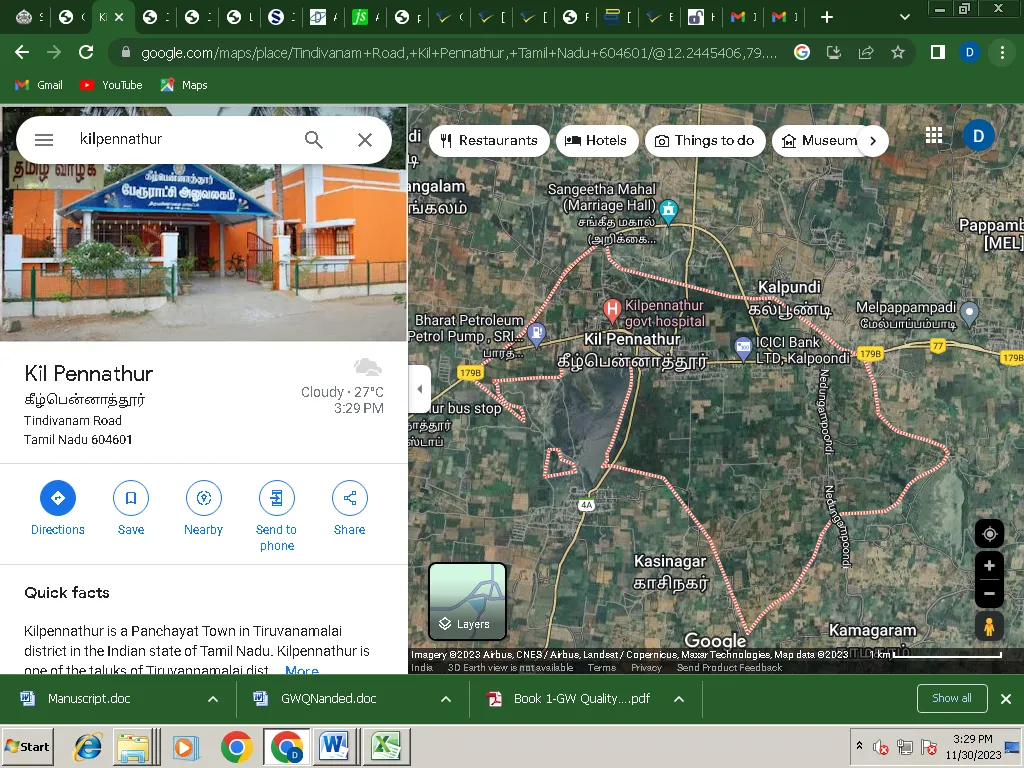
Fig:1 Study area Kilpennathur Block

MATERIALS AND METHODS:

Samples were collected from bore well and open wells and analysed for different parameters. All samples should be properly labelled with details of the locations, date and time of sampling. Water sample collected in the field were analyzed in the laboratory for the major cations and anions using the standard methods as suggested by the American Public Health Association(APHA, 1995)

RESULTS & DISCUSSION

pH

In the study area the pH ranges from 6.8 to 8, the groundwater samples in the study are permissible limit as per WHO standards. In the study area, the pH values for the water samples range from 6.8 to 8, Mostly neutral to slightly alkaline, suitable for drinking.

Electrical Conductivity(EC)

The electrical conductivity is the range of the concentration in the water which is being measured by using the Electrical conductivity meter (digitalized) is being used for the analyzed. The EC for the samples ranges from 910 μ mhos / cm to 2890μ mhos / cm. It attributes moderate to high salinity hazard.

Total dissolved solids (TDS)

The total dissolved solids in water are due to the presence of sodium, potassium, calcium, magnesium, manganese, carbonates, bicarbonates, chlorides, phosphate, organic matter, and other particles. The values of the total dissolved solids for all the groundwater samples vary between 394 and 1078 mg/l. Maximum was observed in location Sirunathur. All the samples are fall within the permissible limit.

Parameters

WHO international standard (1984)

No.of samples exceeding permissible limits

Highest desirable limits

Maximum permissible limits


pH

7- 8.5

9.2

Nil

TDS(mg/l)

500

1500

NIL

EC(μS/cm)

1000

1500

8

TH(mg/l)

100

500

-

Na(mg/l)

-

200

Nil

Ca(mg/l)

75

200

Nil

Mg(mg/l)

50

150

Nil

Cl(mg/l)

200

600

Nil

SO4(mg/l)

200

400

Nil

NO3(mg/l)

45

-

Nil

F(mg/l)

-

1.5

Nil

Table:1 Ground Water Sample Compared With WHO Standard

Calcium(Ca)

In the study area the Ca value ranges from 32 to 126 mg/l. Higher calcium value observed in Kilpennathur location. The concentrations of Ca in the groundwater was mostly derived from leaching of carbonate minerals such as Calcite and Dolomite (Magesh et al.2012). The higher Ca content can cause ailments in humans and it was also not useful for domestic uses as it causes scaling (Sarath Prasanth et al., 2012).

Magnesium (Mg)

The magnesium values are recorded between 23 and 134 mg/l for the groundwater samples. The highest value of magnesium is observed at station Kilpennathur and the lowest value  23  mg/l of magnesium is observed at station (Kalpoodi). On comparison with the WHO standard value of magnesium, in this study it is confirmed that the magnesium value for all the groundwater sample is within the maximum permissible limit (150 mg/l).

Sodium (Na+)

The sodium concentration in ground water is varied between 49 to 101 mg/l in study area. The high variation of Na+ and Ca+ in the groundwater is attributed to cation exchange among minerals as well as irrigation return-flow.

Potassium (K+)

The concentration of potassium ranges from 35 to98 mg/l higher concentration of pottasium it attributed to agricultural activities and minerals like biotite and orthoclase.

Chloride (Cl)

The Chloride (Cl) concentration of groundwater can be attributed naturally due to the presence of chlorides from rocks, evaporates and juvenile water or by the contamination of groundwater through industrial waste and domestic sewages (Saha et al., 2019). The concentration of Cl ranges from 75 to 258 mg/l.

Fluoride

The value of fluoride for the groundwater samples is recorded between 0.1 and 0.6 mg/l. The maximum allowed limit of fluoride according to WHO is 1.0 mg/l. The fluoride values for all the groundwater samples are within the  permissible limit.

Nitrate (NO3)

The nitrate concentration ranges from 7 to24 mg/l. The higher value of nitrate is the most common indication of agriculture impact on groundwater quality. Nitrate values for the village within the permissible limits according to the WHO standard (1984) for the irrigation water(50mg/l).

Sulphate(SO4)

The Sulphate concentration ranges from 9 to 360 mg/l.  The higher concentration observed in the location Nariyamangalam. The occurrence of SO4 in groundwater can be resulted from the oxidation of sulfur from the surrounding igneous rocks in the region (Saha et al.2019). The lower concentration of Sulphate in groundwater was less affected by anthropogenic sources especially industries (Mostafa et al. 2017).

Groundwater Classification for Irrigation

USSL Diagram

The values of EC and SAR are related and designed on USSL diagram. It directs the sign of salinity and alkali hazards. Suitability of water for irrigation purpose has been classified as four classes (C1-C4) has is shown in figure 2.
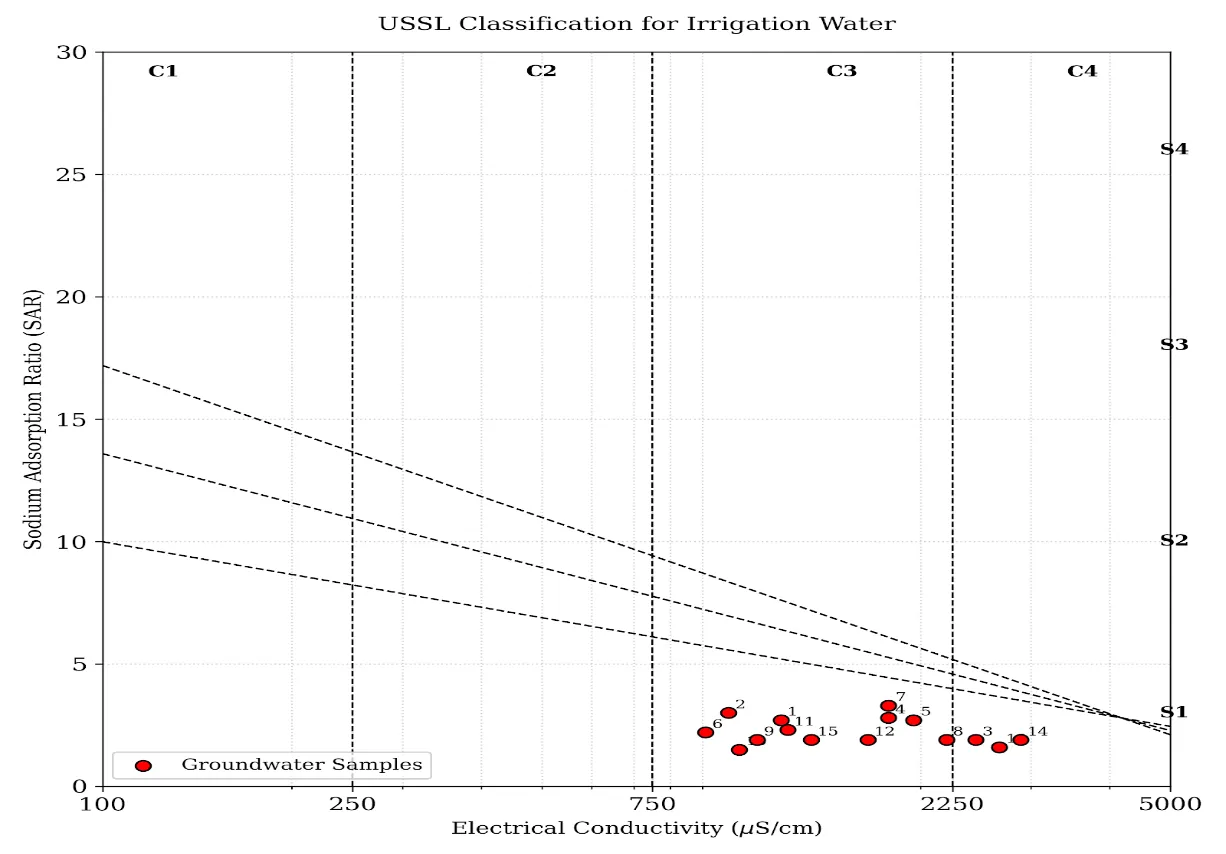
Fig 2 Shows USSL Plot of Study area

In the present study, the EC values of groundwater samples range from 910 to 2890 µS/cm, while SAR values vary between 1.5 and 3.3.

Sodium Hazard (SAR)

All the evaluated groundwater samples fall within the S1 category (low sodium hazard), as SAR values are less than 10. This indicates that sodium concentration in the water is not high enough to unfavorably affect soil permeability or structure. Hence, the groundwater is nontoxic with respect to sodium hazard and does not pose a risk of soil sodicity.

Salinity Hazard (EC)

Based on EC values, groundwater samples are distributed across different salinity classes:

  • C2 (Medium salinity hazard): A few samples fall in this category, indicating moderate salt content. These waters can be used for irrigation with minimal management practices.
  • C3 (High salinity hazard): The majority of samples fall under this category. Such water can be used for irrigation only in well-drained soils and requires salt-tolerant crops to avoid salinity buildup.
  • C4 (Very high salinity hazard): Some samples exhibit very high EC values, indicating excessive salinity. These waters are generally unsuitable for irrigation under normal conditions and can only be used with special management practices, such as leaching and proper drainage.

The USSL diagram reveals that most samples belong to C3–S1 (High salinity – Low sodium hazard) and C4–S1 (Very high salinity – Low sodium hazard)( Swati Pawar and Ravindra Bhagat,2026).This indicates that while sodium-related hazards are minimal, salinity is the major limiting factor affecting groundwater suitability.

CONCLUSION

A detailed study of groundwater quality of the study area (Kilpennathur block) revealed that, Overall evaluation of the samples shows that the groundwater in the area is of fresh to Brackish, slightly basic in nature, Salinity nature. According to USSL most groundwater samples fall in “C3–S1” classes, making them moderately suitable for irrigation purposes, but it is poor for drinking water purposes, do not drink directly, it requires Reverse Osmosis (RO) filtration or desalination treatment to lower the TDS and Magnesium levels before human consumption. For Irrigation purposes. It is concluded that the groundwater in Kilpennathur block is suitable for drinking and irrigation purposes, with the more care taken over it to avoid overexploitation of groundwater. Proper irrigation management, gypsum treatment, and periodic quality monitoring are recommended to maintain long-term soil fertility.

REFERENCES

  1. Amadi P.A., Ofoegbu C.O. and Morrison T.(1989) Hydrogeochemical Assessment of Groundwater Quality in Parts of the Niger Delta, Nigeria. Environ. Geol. Water Sci., v.14(3), pp.195-202.
  2. APHA,(1995). “Standard methods for the examination of water and wastewater,” 19th edition, American Public Health Association. Washington, D.C., pp. 1467.
  3. Appelo C.A.J. and Postma D. (2005) Geochemistry, groundwater and pollution, Second Edition. Balkema, Leiden, The Netherlands, pp.683.
  4. Ayush Verma ,JB Srivastava and Prabhat Kumar Patel (2023), Physico-chemical & biological study of groundwater at different locations of Lucknow City, World Journal of Advanced Research and Reviews, 19(03),pp. 1375–1384.
  5. Bhunia GS (2020) An approach to demarcate groundwater recharge potential zone using geospatial technology. Appl Water Sci. https ://doi.org/10.1007/s1320 1-020-0123 -1
  6. Freeze R.A. and Cherry J.A. (1979) Ground Water. Prentice-Hall, Englewood Cliffs, NJ, pp.553.
  7. Gholam A.K. and Azam M. (2012) Significance of Hydrogeochemical Analysis in the Management of Groundwater Resources: A Case Study in Northeastern Iran. InTech, Availablefrom:http://www.intechopen.com/ books/hydrogeology-a-global-perspective.
  8. Hem J.D.(1989) Study and interpretation of the chemical characteristics of natural water, Third Edition. U.S. Geological Survey Water-Supply Paper, v.2254, pp.263
  9. Magesh, N.S., Krishnakumar S., Chandrasekar N., Soundranayagam J.P. (2012). Groundwater quality assessment using WQI and GIS techniques, Dindigul district, Tamilnadu, India, Arabian journal of geosciences, 6, pp.4179-4189.
  10. Meghanad U.P, Vasanthamohan V, Selvakumar S, (2025). Groundwater quality assessment for drinking and irrigation: A case study in the Cauvery River Basin (CRB) of Tiruchirappalli District, Tamil Nadu, India. Water Quality Research Journal (2025) 60 (1): pp.73–88.
  11. Mostafa, M.G., Uddin, S.M.H., Haque, A.B.M.H. (2017). Assessment of hydro-geochemistry and groundwater quality of Rjshahi city in Bangladesh, Applied water science, 7, pp.4663-4671.
  12. Nickson R.T,M C Arthur J.M,Shrestha B.,Kyaw-Nyint ,T.O,Lowry D,(2005), Arsenic and other drinking water quality issues, Muzaffargaorh district, Pakistan, Appl Geochem.pp.55-66.
  13. Ramamoorthy P, Rammohan V, (2014). Assessment of ground water quality in Varahanadhi sub basin in Tamilnadu, India, India, International journal of water research, 2(1): pp.10-15.
  14. Ramamoorthy P, Senthil S and Kirubaharan M,(2020),Experimental Investigation Of Groundwater Quality In Thellar Village, Thiruvannamalai District, Tamilnadu, India. Solid State Technology,V.63, Issue.6,pp.10364-10373.
  15. Ramamoorthy.P and Rammohan.V(2015) Assessment of Groundwater potential zone using remote sensing and GIS in Varahanadhi watershed, Tamilnadu, India, International Journal for Research in Applied Science & Engineering Technology (IJRASET), Volume 3 Issue V,pp-695- 702.
  16. Saha, S., Selim Reza, A.H.M., Roy, M.K. (2019). Hydrochemical evaluation of groundwater quality of the Tista floodplain, Rangpur, Bangladesh, Applied Water Science, 9, 198.
  17. Sarath Prasanth S.V., Magesh N.S., Jitheshlal K.V., Chandrasekar N., Ganghadar. K., (2012). Evaluation of groundwater quality and its suitability for drinking and agricultural use in the coastal stretch of Alappuzha district, Kerala, India, Applied water science, 2, pp.165-175.
  18. Siddiqui Aisha, Ali Zulfikar and Malhotra S. (2015). Quality of ground water of Lucknow city: A review article, International journal of engineering and management research (IJEMR)5(2):pp.353-357.
  19. Swati Pawar and Ravindra Bhagat(2026), Assessment of Groundwater Hydrochemistry and Irrigation Suitability Using Piper, Wilcox, and USSL Diagrams in the Sina River Basin, International Journal of Scientific Research in Science, Engineering and Technology,Vol.13,Iss(3):pp-164-174.

Reference

  1. Amadi P.A., Ofoegbu C.O. and Morrison T.(1989) Hydrogeochemical Assessment of Groundwater Quality in Parts of the Niger Delta, Nigeria. Environ. Geol. Water Sci., v.14(3), pp.195-202.
  2. APHA,(1995). “Standard methods for the examination of water and wastewater,” 19th edition, American Public Health Association. Washington, D.C., pp. 1467.
  3. Appelo C.A.J. and Postma D. (2005) Geochemistry, groundwater and pollution, Second Edition. Balkema, Leiden, The Netherlands, pp.683.
  4. Ayush Verma ,JB Srivastava and Prabhat Kumar Patel (2023), Physico-chemical & biological study of groundwater at different locations of Lucknow City, World Journal of Advanced Research and Reviews, 19(03),pp. 1375–1384.
  5. Bhunia GS (2020) An approach to demarcate groundwater recharge potential zone using geospatial technology. Appl Water Sci. https ://doi.org/10.1007/s1320 1-020-0123 -1
  6. Freeze R.A. and Cherry J.A. (1979) Ground Water. Prentice-Hall, Englewood Cliffs, NJ, pp.553.
  7. Gholam A.K. and Azam M. (2012) Significance of Hydrogeochemical Analysis in the Management of Groundwater Resources: A Case Study in Northeastern Iran. InTech, Availablefrom:http://www.intechopen.com/ books/hydrogeology-a-global-perspective.
  8. Hem J.D.(1989) Study and interpretation of the chemical characteristics of natural water, Third Edition. U.S. Geological Survey Water-Supply Paper, v.2254, pp.263
  9. Magesh, N.S., Krishnakumar S., Chandrasekar N., Soundranayagam J.P. (2012). Groundwater quality assessment using WQI and GIS techniques, Dindigul district, Tamilnadu, India, Arabian journal of geosciences, 6, pp.4179-4189.
  10. Meghanad U.P, Vasanthamohan V, Selvakumar S, (2025). Groundwater quality assessment for drinking and irrigation: A case study in the Cauvery River Basin (CRB) of Tiruchirappalli District, Tamil Nadu, India. Water Quality Research Journal (2025) 60 (1): pp.73–88.
  11. Mostafa, M.G., Uddin, S.M.H., Haque, A.B.M.H. (2017). Assessment of hydro-geochemistry and groundwater quality of Rjshahi city in Bangladesh, Applied water science, 7, pp.4663-4671.
  12. Nickson R.T,M C Arthur J.M,Shrestha B.,Kyaw-Nyint ,T.O,Lowry D,(2005), Arsenic and other drinking water quality issues, Muzaffargaorh district, Pakistan, Appl Geochem.pp.55-66.
  13. Ramamoorthy P, Rammohan V, (2014). Assessment of ground water quality in Varahanadhi sub basin in Tamilnadu, India, India, International journal of water research, 2(1): pp.10-15.
  14. Ramamoorthy P, Senthil S and Kirubaharan M,(2020),Experimental Investigation Of Groundwater Quality In Thellar Village, Thiruvannamalai District, Tamilnadu, India. Solid State Technology,V.63, Issue.6,pp.10364-10373.
  15. Ramamoorthy.P and Rammohan.V(2015) Assessment of Groundwater potential zone using remote sensing and GIS in Varahanadhi watershed, Tamilnadu, India, International Journal for Research in Applied Science & Engineering Technology (IJRASET), Volume 3 Issue V,pp-695- 702.
  16. Saha, S., Selim Reza, A.H.M., Roy, M.K. (2019). Hydrochemical evaluation of groundwater quality of the Tista floodplain, Rangpur, Bangladesh, Applied Water Science, 9, 198.
  17. Sarath Prasanth S.V., Magesh N.S., Jitheshlal K.V., Chandrasekar N., Ganghadar. K., (2012). Evaluation of groundwater quality and its suitability for drinking and agricultural use in the coastal stretch of Alappuzha district, Kerala, India, Applied water science, 2, pp.165-175.
  18. Siddiqui Aisha, Ali Zulfikar and Malhotra S. (2015). Quality of ground water of Lucknow city: A review article, International journal of engineering and management research (IJEMR)5(2):pp.353-357.
  19. Swati Pawar and Ravindra Bhagat(2026), Assessment of Groundwater Hydrochemistry and Irrigation Suitability Using Piper, Wilcox, and USSL Diagrams in the Sina River Basin, International Journal of Scientific Research in Science, Engineering and Technology,Vol.13,Iss(3):pp-164-174.

Photo
P. Ramamoorthy
Corresponding author

Faculty, Department of Civil Engineering, Mailam Engineering College, Mailam

Photo
D. Saravanan
Co-author

Faculty, Department of Civil Engineering, Mailam Engineering College, Mailam

Photo
C. Mala
Co-author

Faculty, Department of Civil Engineering, Mailam Engineering College, Mailam

Photo
P. Easwary
Co-author

Faculty, Department of Civil Engineering, Mailam Engineering College, Mailam

P. Ramamoorthy*, D. Saravanan, C. Mala, P. Easwary, A Comprehensive Assessment Of Groundwater Quality For Drinking And Irrigation Purposes In Kilpennathur Block, Thiruvannamalai District, Tamil Nadu, India, Int. J. Sci. R. Tech., 2026, 3 (6), 941-946. https://doi.org/10.5281/zenodo.20702490

More related articles
The Future of Standardized Testing versus Alternat...
Sameeksha Srivastav, Neeraj Kumar Jaiswal...
Edible Drinking Straws: A Sustainable Zero-Waste S...
Asiya Shaik, Gorrekanti Sindhuja, Gogineni Sriram, Gubbala Naga V...
Edible Drinking Straws: A Sustainable Zero-Waste S...
Asiya Shaik, Gorrekanti Sindhuja, Gogineni Sriram, Gubbala Naga V...
Related Articles
Comparative AComparative Analysis of Underground Water Table Levels from the Sur...
John Adeyemi Eyinade, Joshua Ayodeji Oluwadare, Segun Isaac Olonade, Caleb Olutayo Oluwadare...
The Influence of Meteorological Parameters on Groundwater Radon Concentration in...
Aremu Abraham Adewale, Oni Emmanuel Abiodun, Oni Olatunde Michael, Amodu Fuhke Roseline...
Column Studies on Arsenic Removal from Ground Water for Filter Development in Ru...
Pranab Jyoti Barman, Bikash Das, Nistha Deori, Kuhi Borgohain, Bortika Baruah, Sudarshana Bharali...
More related articles
Edible Drinking Straws: A Sustainable Zero-Waste Solution for the Circular Bioec...
Asiya Shaik, Gorrekanti Sindhuja, Gogineni Sriram, Gubbala Naga Vinay, Gudisela Geyasri, Swechha Gou...
Edible Drinking Straws: A Sustainable Zero-Waste Solution for the Circular Bioec...
Asiya Shaik, Gorrekanti Sindhuja, Gogineni Sriram, Gubbala Naga Vinay, Gudisela Geyasri, Swechha Gou...
Edible Drinking Straws: A Sustainable Zero-Waste Solution for the Circular Bioec...
Asiya Shaik, Gorrekanti Sindhuja, Gogineni Sriram, Gubbala Naga Vinay, Gudisela Geyasri, Swechha Gou...
Edible Drinking Straws: A Sustainable Zero-Waste Solution for the Circular Bioec...
Asiya Shaik, Gorrekanti Sindhuja, Gogineni Sriram, Gubbala Naga Vinay, Gudisela Geyasri, Swechha Gou...