

We use cookies to ensure our website works properly and to personalise your experience. Cookies policy
Department of Pharmaceutical Quality Assurance, JES's SND College of Pharmacy, Babhulgaon (Yeola), India
Need poor aqueous solubility of drugs constitutes a tremendous challenge in pharmaceutical formulation due to its ability to cause low oral bioavailability, unpredictable drug absorption rate, and reduced drug efficacy. Nano-emulgel is a novel topical drug delivery system designed to overcome the limitation of regular emulsions and gels. Nano-emulgel is an integration of nanoemulsions and hydrogel capable of promoting enhanced drug penetration, improved spreadability, extended residence time, and controlled drug release. This study focuses on developing an ornidazole topical emulgel, a hydrophilic antimicrobial agent, to improve topical antimicrobial delivery and the physicochemical properties of hydrophobic drugs. The study entails three main processes: preparation of oil-in-water or water-in-oil, production of gel base using selected polymers, and incorporation of the formed emulsion into the gel base with continuous agitation. The produced formulation was subjected to various physicochemical and performance assessments to evaluate its quality control attributes, formulation capabilities, and antimicrobial potential. The analysis includes pH measurement, determining viscosity and spreadability, estimation of drug content, droplet size, zeta potential, in-vitro drug release assessment, skin irritation, permeation, and stability study.
Pharmacist developed modern dosing system since the beginning of Pharmaceutical culture in Mesopotamia (2600 BC)
At that time Plant and water were use to treat diseases, Scientist done research to introduce number of rout of administration to deliver modern dosage form, which are primarily dependent on the Physicochemical properties of the active compounds.[1] According to recent statistical reports on new chemical entities, poor aqueous solubility (70%) has surprised the earlier reports estimate of only about 40% new chemical entities with poor solubility[2] The lipophilic properties of the newly developed drug molecules lead to issues such as poor oral B.A. erratic absorption, inter- and intra-subject pK variations, and lack of dose proportionality. To minimize these problems and focus on the solubility enhancement approach, a continuous developing process[3-5] To increase the solubility of drug, a variety of techniques can be used such as physical modification, chemical modification, formulation development, which include particle size reduction, complexation, amorphization, and nanocarrier drug delivery system.[6-8]
Nano-emulsions:
Nano-emulsions are defined as colloidal mixture having two phases of oil and water i.e. dispersed and continuous phase , stability is achieved by adding emulsifying agent and reduses the surface tension of Dispersed and continuous phase. When we compare simple emulsion and other formulation, it is seen that Nano emulsion have High thermodynamic stability , which provides longer half-Life to the Formulation. The Problems like low viscosity can be resolved by modifying the nano- emulsion Into a nano- emulgel by using suitable gelling agents and proper care.[9-11]
Nano-emulgel :
Due to the lack of spreadability and retention time They have limitations for clinical application and have various advantages.
To solve the problem of nano-emulsion Nano-emulgel is the best option, A gelling agent should be add to the nano-Emulsion. Aqueous and hydroalcoholic bases should be added to colloidal particulate system to prepare Gels and the bases to be in huge quantity.
Nano-emulgel is formed By incorporating nano-emulsion into hydrogel Matrix, It causes reduction in the Thermodynamic instability of nano-emulsion . A controlled-Release dosage form for topical administration, nano Emulgel is beneficial with a short half-Life because of the improved retention time and Thermodynamic instability that allow the formation to Release drugs over time.[13-16]
Nano-emulgel and nano emulsion have specific gel properties and Characteristics such as particle size and Thermodynamic stability. Nano-emulgel increases skin Penetration, it provide high loading capacity of the active Moiety, less irritation, and more spreadability. Due to their Non irritant, nongreasy nature, Nano-Emulgel show better patient compliance and also increase Pharmacokinetic properties like bioavailability and reduce Side effects.[17]
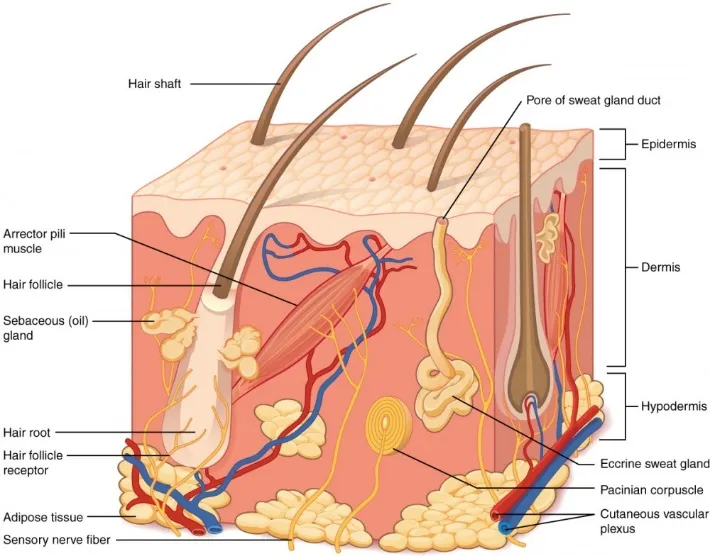
Figure 1: Layers of Skin
ADVANTAGES:
1.It resist First-pass metabolism.
2.Effectiveness for a managed and long-term drug delivery system has been proven.
3.Skin friendly.
4.Appropriate for self-medication.
5.Patient accept it quickly.
6.Nanoemulsion provides large surface area and free energy which make an efficient delivery system.
7.Emulsion defect like Creaming, phase separation, flocculation, and coalescence is not found in nanoemulsion.
8.Nanoemulsion prepared in variety of formulations, foams, creams, sprays and much other cosmetic
formulation.
9.It is safe on transdermal application due to its non-toxic nature.
10.By using biocompatible surfactant in nanoemulsion formulation, it can be administered orally.
11.It shows better penetration of drug because the nano-sized particles can easily enter by the rough skin surface.
12.By the process of precipitation and interfacial poly-condensation of nanoemulsion, nanocapsule and
nanosperes are prepared.[19-20]
DISADVANTAGES:
1.Bubbles formed during emulgel formulation.
2.For utilization in pharmaceutical application, surfactant used ought to be non-poisonous.
3.Possibility of allergenic reactions.
4.Skin irritation on contact dermatitis.
Characterization of Nanoemulgel:
∙ Viscosity.
∙ Ph.
∙ Spread ability.
∙ Skin irritation test.
∙ Drug Content.
∙ In vitro Permeation Study.
∙ Study of drug release kinetics.
∙ Comparison of nanoemulgel with marketed products.
∙ Stability Study
| Parameters | Nano-Emulgel | Nano-emulsion |
|---|---|---|
| Preperation | Low energy or high energy technique |
High energy technique |
| Particle size | Less than 100nm | Greater than 500nm |
| Thermodynamic property | More stable | Less stable due to sedimentation and creaming |
| Permeation | High permeation due to particle size | Lower permeation |
| Bioavailability | High | Less in comparison with nano emulgel |
| Systemic absorption | High | Low in comparison with nano emulgel |
| Ability to cross BBB | Cross BBB | Low in comparison with nano emulgel |
Method of preparation
It consist of 3 steps
Step-1:
Formulation of emulsion either o/w or w/o
E.g: span 20 in oil phase lie light liquid paraffin
Step-2.
Formulation of gel base: prepared by dispersing polymer in purified water with Constant stirring at a moderate speed using mechanical shaker, then the pH was adjusted to 6-6.5 using tri ethanolamine (TEA).
Step-3
Incorporation of emulsion into gel base: Add glutaraldehyde in during mixing of gel And emulsion in ratio of 1:1 to obtain emulgel.The main aim of the present study was to formulate the ornidazole emulgel so as to rerain the Formulation for prolong period of time and delivery of the drug to desired site of absorption.To overcome the limitations of hydro gels in the delivery of hydrophobic drugs. To evaluate And formulate the ornidazole topical emulgel. To develop an emulsion based gel formulation For a antimicrobial, antifungal infections of ornidazole To overcome the limitations of hydro Gels in the delivery of hydrophobic drugs.
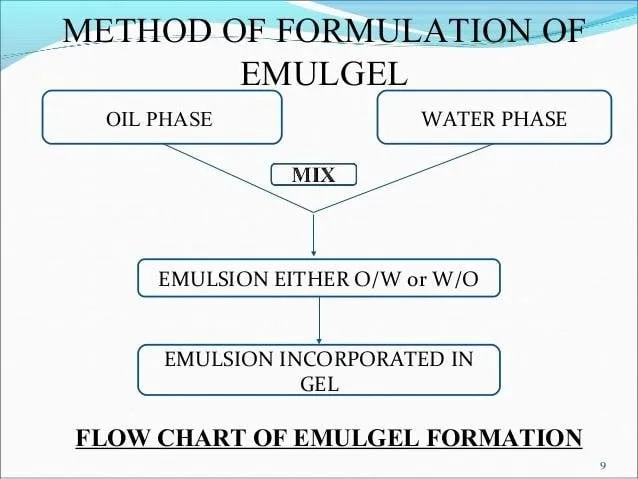
Figure 2: Formation of Emulgel.
https://www.researchgate.net/figure/Formation-of-Emulgel_fig4_334131932
Formulation
1. Preparation of Emulsion
A) Preparation of Aqueous Phase
The aqueous phse of the emulsion was prepared by dissolving tween 80 in purified water.
B) Preparation of oil Phase: Methyl parabeen and propyl paraben were dissolved in
propylene glycol where as drug was dissolved in ethanol and both solution were mixed with
aqueous phase. Both the oily and aqueous phase were separately heated to 75â—¦c. then the oil phase was added to the aqueous phase with continous stirring until cooled to room temperature.
2. Preparation of gel:
The gel bases were prepared by dispersing different concentrations of
polymers in distilled water separately with constant stirring at a moderate speed using mechanical shaker. The pH of all formulations was adjusted to 6 - 6.5 using triethanolamine
(TEA).
3. Preparation of Emulgel:
The obtained emulsion was mixed with the gel with gentle stirring to obtain the emulgel.[23-29]
Characteristics of Emulgel
• Zeta potential
Zeta potential is used to compare consistency between batches based on an indirect measurement of the net charge. If zeta potential is high, the products repulsion and stability of formulation is increase. Surfactants are used to maintain zetapotential in nano-emulgel. Instruments used for measuring zeta potential are Malvern nano-sizer/ zeta-sizer.[30-31]
• Droplet size measurement and polydispersibility Index (PDI)
The hydrodynamic diameter of a globule in a nano-emulgel is the diameter of an analogue of a hard sphere that diffuses at the same rate as the active moiety.70 The standard deviation of droplet size divided by the mean droplet size is known as the PDI, which determines the distribution of droplet size. Droplet size and PDI are closely connected to the drug release and stability (in-vivo and ex-vivo performance) and also provide consistency between the batches. It is measured by zeta size, which is work on the principal of dynamic light scattering.[32-33]
• Rheological characteristics
Flow properties of the material are determined by rheology. The viscoelastic flow behaviors of the formulation are show by the rheological characteristics of materials. This effect is caused by the concentration of oil, surfactants, gelling agents. Formulation stability, drug release, and other in-vivo properties may be affected by variations in its viscosity and flow characteristics. Rheological behavior is an important factor for nano-emulgel due to their thinning tendency, which generates a thin layer on the skin surface, and improved permeability. Various types of viscometers are used to determine rheological behavior.[34]
• Spreadability testing
The spreadability of the nano-emulgel significantly affected by the viscosity of the formulation. The parallel-plate method is commonly used for the determination of spreadability. In this method, two glass slides of the same length are used. In which one is stationarily attached to the wooden block and another slide is attached to a pulley at one end to measure spreadability. The nano-emulgel dosage form will be placed on a stationary glass slide, which is then squeezed in between the both slides. The known weight is added to the pully until the upper slide slips off from the lower slide. The time required for slipping off is recoded, which is used to calculate spreadability by formula.[17]
S= M*L/T
Where-
s is Spreadability.
M- is weight bounded to the upper slide.
L- is the length of the slide.
T- is the time taken to detach the slide
• In-Vitro Release Test (IVRT)
In-vitro release of semi-solid dosage form is determined by using the vertical diffusion cell or immersion cell method. The vertical diffusion has a receptor and donor chamber separated by a receptor membrane. The donor chamber contains a sample of nano-emulsion and the receptor chamber holds the receptor media (which may be buffer or hydroalcoholic solution). A membrane is selected that act as a skin cell membrane, and the temperature of the mediais maintained at 37 ± 1o C for topical product 37±10C for mucosal product.
CONCLUSION
Nano-emulgel is a promising topical drug-delivery system that combines the advantages of nano-emulsion and gel. Its nano-sized droplets provide improved drug penetration, enhanced permeation and better bioavailability, while the gel base improves spreadability, retention time and patient acceptability. It can also provide controlled and prolonged drug release, making it useful for the topical delivery of poorly water-soluble drugs. Therefore, nano-emulgel offers a potential approach for improving the effectiveness and performance of topical drug formulations.
Bottom of Form
REFERENCES


Savita Somase, Shivprasad Wagh, Sojwal Purva, Vikas Shinde, A Nano Emulgel: A Novel Carrier for Topical Drug Delivery System, Int. J. Sci. R. Tech., 2026, 3 (11), 626-631. https://doi.org/10.5281/zenodo.24215460
 10.5281/zenodo.24215460