

We use cookies to ensure our website works properly and to personalise your experience. Cookies policy
1Department of Business Administration, KMM College of Arts and Science, Thrikkakara & Research Scholar, SCMS School of Technology and Management, Aluva
2Santhigiri College of Computer Sciences,Vazhithala & Research Scholar, SCMS School of Technology and Management, Aluva
The rapid spread of artificial intelligence (AI) into everyday life has left a visible mark on how college students - arguably the archetypal digital natives - live, shop, and think about consumption. This conceptual paper looks closely at that shift, asking how AI technologies are reshaping both the lifestyle choices and the sustainability habits of this group. Drawing on the Theory of Planned Behaviour, the Technology Acceptance Model, and the broader sustainable consumption literature, it builds a framework for understanding how AI-driven tools - smart assistants, recommendation engines, sustainability apps - feed into students' awareness, attitudes, and eventual behaviour around environmentally responsible choices. More specifically, the paper works through how AI exposure (how often students use these tools, how much they trust them, and how digitally literate they are) interacts with everyday lifestyle factors - time management, health consciousness, social connectivity - to shape three concrete sustainability domains: waste reduction, energy use, and ethical purchasing. Institutional support, environmental concern, and socioeconomic background are treated as conditions that can strengthen or weaken these relationships. Rather than testing a hypothesis, the paper's contribution is to pull together scattered strands of existing research into one workable model, one that later empirical work can pick up and test. In the process, it makes the case that AI is neither a straightforward force for good nor a straightforward threat to sustainable living among young people - it can go either way - and argues that technology developers and educators have a real role to play in tipping that balance toward responsible use.
It wasn't long ago that artificial intelligence belonged mostly to computer science labs and corporate research divisions. That's no longer true. AI now shows up quietly in the background of ordinary student life - in the voice assistant that sets a reminder, the algorithm that decides which video plays next, the app that suggests what to buy or where to eat. College students, often labelled digital natives, run into these systems dozens of times a day without necessarily thinking of them as "AI" at all. That every day, almost invisible presence is exactly what makes the question worth asking: as AI becomes woven into how students spend their time and money, what is it doing to how sustainably they consume?
The stakes are not small. Sustainable consumption - broadly, using goods and services in ways that don't compromise the environment for future needs - has become an urgent concern for a generation that will live longest with the consequences of climate change and resource strain. College is also, not coincidentally, when many lifelong consumption habits take shape: students are gaining financial independence for the first time, forming routines, and doing almost all of it through digital platforms that quietly shape their options. If AI is influencing that formative window, it deserves closer scrutiny than it has so far received.
Its aim is more modest and, hopefully, more useful as a starting point: to pull together behavioural theory, technology-adoption research, and the sustainability literature into one coherent framework, and to be explicit about how AI exposure and everyday lifestyle habits might feed into sustainable - or unsustainable - consumption. Three things follow from that goal. First, the paper tries to lay out the specific mechanisms by which AI could either encourage or quietly erode sustainable behaviour among students. Second, it turns those mechanisms into a set of propositions that future empirical studies can test. Third, it offers some early, necessarily tentative guidance for the people in a position to act on this - educators, platform designers, and policymakers.
2. LITERATURE REVIEW
2.1 AI and Changing Consumer Behaviour
A useful place to start is with what AI does inside a consumer's daily routine. Personalized recommendations, predictive search, dynamic pricing, conversational assistants - these are the mechanisms through which AI increasingly mediates everyday decisions (Davenport, Guha, Grewal, & Bressgott, 2020). For students, the effect isn't confined to what they buy. It bleeds into how they spend time, what information they see, and how they interact socially, which fits with a broader argument that digital technology has become part of an "extended self" for young, always-connected consumers (Belk, 2013). Recommendation algorithms sit at the centre of this: depending on how a platform is built and what it's optimized for, the same algorithm can nudge someone toward more of the same convenient, high-turnover consumption, or toward something genuinely more sustainable (Davenport et al., 2020).
None of this happens by accident. Default settings, gamified engagement loops, the sheer logic of what gets recommended first - these design choices are rarely neutral, and a fair amount of earlier work on consumer habits already shows that small contextual cues can be surprisingly powerful levers for breaking or reinforcing routine behaviour (Verplanken & Wood, 2006).
2.2 Sustainable Consumption Among Youth
Sustainability researchers have long wrestled with a stubborn puzzle, people tend to say they care about the environment far more than their actual purchasing behaviour would suggest. This attitude-behaviour gap (Kollmuss & Agyeman, 2002) is well documented, and among college students it seems to widen under the weight of tight budgets, peer pressure, and the simple pull of convenience - even when environmental concern and a sense of personal capability are genuinely present (Jackson, 2005). Steg and Vlek (2009) make a related point worth borrowing here: pro-environmental behaviour rarely comes down to motivation alone; it also depends on whether the surrounding context makes acting on that motivation easy or hard. That distinction maps neatly onto what AI-mediated platforms do - they can narrow the attitude-behaviour gap by surfacing eco-labelled products or automatically optimizing energy use, or they can widen it by pushing convenience and low-cost options to the front of every screen.
For the purposes of this framework, three domains capture most of what "sustainable consumption" means in a student's day-to-day life: how much waste they generate, how they use energy, and how ethically they shop (Jackson, 2005). Each is plausibly touched by AI in a concrete way - waste through tracking and feedback apps, energy through smart devices and campus systems, ethical purchasing through whatever transparency (or opacity) a platform offers about where a product comes from (Davenport et al., 2020).
2.3 Theoretical Foundations
Three theoretical traditions do most of the work in this framework. The first, the Theory of Planned Behaviour (TPB), treats behaviour as the outcome of attitudes, subjective norms, and perceived control over one's own actions - all of which roll up into behavioural intention (Ajzen, 1991). Applied to this context, AI exposure could plausibly move the needle on any of these: it might sharpen students' attitudes toward sustainability by raising awareness of environmental impact, and it might increase perceived control simply by making the sustainable option easier to spot and act on.
The second, the Technology Acceptance Model (TAM), explains why people adopt a given technology in the first place - largely through perceived usefulness and perceived ease of use (Davis, 1989), later extended to account for social influence and cognitive factors as well (Venkatesh & Davis, 2000). TAM is useful here because it helps explain a pattern that seems intuitively true: students who find an AI sustainability tool genuinely useful and easy to use are the ones most likely to rely on it, which is presumably a precondition for that tool having any real behavioural effect at all.
The third strand, sustainable consumption theory, supplies the outcome side of the model - treating consumption as something that spans acquisition, use, and disposal rather than a single purchasing moment (Jackson, 2005). It's also worth noting that today's college-age cohort has grown up during a period of continuous, technology-mediated information exposure, a defining feature of the "digital native" identity that Prensky (2001) first popularized - which is one reason this population, more than most, seems worth studying through an AI-specific lens. Together, these three traditions let the framework speak to three different questions at once: what psychologically drives behaviour change (TPB), what makes an AI tool trusted enough to be used in the first place (TAM), and what, concretely, that behaviour change looks like in practice (sustainable consumption theory).
3. CONCEPTUAL FRAMEWORK AND PROPOSITIONS
Pulling the literature above into a single picture, the framework proposed here links AI exposure and everyday lifestyle factors to sustainable consumption outcomes, with institutional, attitudinal, and socioeconomic conditions acting as moderators along the way. It's organized around four blocks: AI exposure, lifestyle factors, sustainable consumption domains, and the moderating variables that determine how strongly the first three connect to each other.
3.1 AI Exposure Dimensions
AI exposure isn't a single thing - it's better understood along three dimensions. How often a student uses AI-driven platforms in daily life is the most obvious one (usage frequency). Less obvious, but arguably more important, is how much a student trusts what these systems tell them, since trust is really what determines whether a recommendation gets acted on or ignored. And finally, digital literacy - a student's ability to understand, question, and critically engage with AI-generated content - shapes whether that exposure translates into informed choices or something closer to passive acceptance.
3.2 Lifestyle Factors
Sitting between AI exposure and sustainable outcomes are three lifestyle factors that work both ways - shaped by AI, and in turn shaping consumption. Time management is one: scheduling assistants and automated services free up (or, sometimes, quietly consume) the time a student would otherwise spend thinking through a purchase. Health consciousness is another - fitness apps and nutrition trackers, most of them AI-curated in some way, tend to surface the link between personal wellbeing and environmental impact, whether that's their explicit purpose. And social connectivity matters too: AI-driven social platforms are constantly shaping the peer norms and social comparisons that quietly steer what students buy and how they justify it to themselves.
3.3 Sustainable Consumption Domains
On the outcome side, the framework focuses on three domains that are both meaningful and reasonably easy to observe. Waste reduction covers things like cutting down on single-use packaging, food waste, and e-waste. Energy use spans both personal habits (how a student manages their own devices) and shared settings like a hostel or campus building. Ethical purchasing is about preference - choosing brands and products seen as environmentally or socially responsible, sometimes even at a price premium.
3.4 Moderating Variables
None of these relationships plays out the same way for every student, and three moderators seem particularly important in explaining why. Institutional support captures how much infrastructure, curriculum, and incentive a college puts behind sustainable behaviour - it's one thing to want to recycle, another to have a working recycling system. Environmental concern is simply the pre-existing values a student brings to the table, independent of anything AI does. And socioeconomic background matters because sustainable alternatives are, more often than not, the pricier or less convenient option - so the financial and social resources a student has access to will shape how much of their environmental concern turns into action.
3.5 Proposed Propositions
Putting the framework into testable form, the following eight propositions are offered as a starting point for empirical work:
P1: Higher frequency of AI usage is positively associated with awareness of sustainable consumption options among college students.
P2: Trust in AI systems positively moderates the relationship between AI-generated sustainability recommendations and actual sustainable consumption behaviour.
P3: Digital literacy strengthens the positive relationship between AI exposure and informed (as opposed to uncritical) sustainable consumption decisions.
P4: AI-enabled time-management tools are positively associated with the likelihood of engaging in deliberate, values-driven purchasing decisions.
P5: Health-conscious lifestyle orientation, when reinforced by AI-curated content, is positively associated with ethical purchasing behaviour.
P6: Social connectivity mediated by AI-driven platforms influences sustainable consumption behaviour through peer-norm effects, which may be positive or negative depending on the dominant norms within a student's network.
P7: Institutional support moderates the strength of the relationship between AI exposure and sustainable consumption, such that the relationship is stronger in institutions with active sustainability infrastructure and programming.
P8: The positive effects of AI exposure on sustainable consumption are attenuated among students from lower socioeconomic backgrounds due to cost and access constraints.
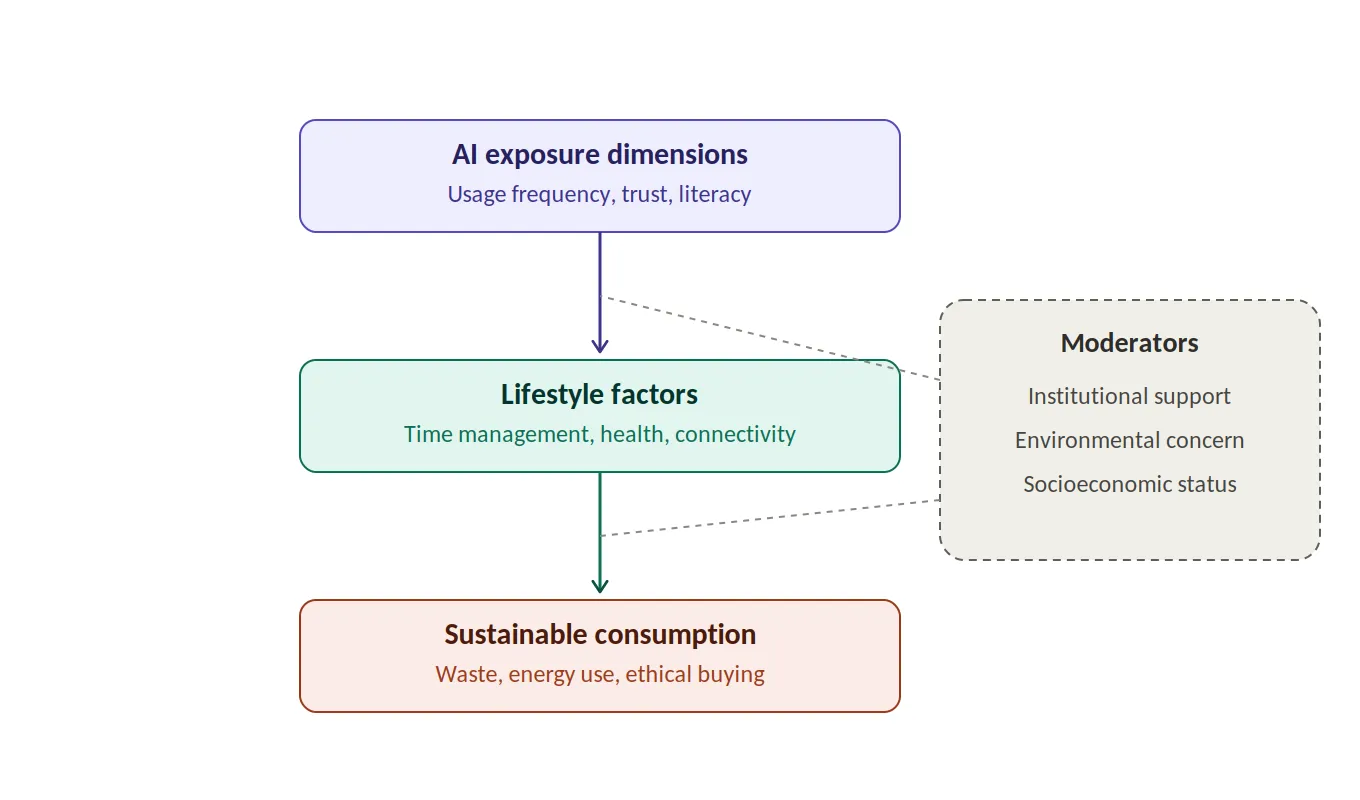
Figure 1. Proposed conceptual framework linking AI exposure dimensions, lifestyle factors, and sustainable consumption domains, moderated by institutional, attitudinal, and socioeconomic variables.
4. DISCUSSIONS
Step back from the individual propositions and a broader tension comes into view - one that runs through the entire framework. AI can act as a facilitator of sustainable behaviour: it can lower the barriers, both informational and practical, that keep students from acting on values they already hold. A recommendation engine can surface a genuinely eco-friendlier product; a smart device can automate energy savings without anyone having to think about it; a waste-tracking app can turn an abstract concern into a visible, gamified number. In each case, AI is doing exactly what the attitude-behaviour gap literature says is hardest to do - closing the distance between what people believe and what they do.
But the same technology can just as easily work in the opposite direction. Most AI platforms are not built with sustainability in mind; they're built to maximize engagement, convenience, or sales. A recommendation algorithm optimized purely for clicks has no reason to favour a durable product over a cheap, disposable one, and may in fact push students toward exactly the kind of fast, high-turnover consumption that sustainability researchers worry about. There's also a subtler cost: when AI automates a decision that used to require some thought, it can quietly remove the moment of reflection where values-driven purchasing happens. In effect, ethical judgment gets outsourced to a system that was never asked to exercise any.
So which effect wins out - facilitation or disruption - probably isn't a fixed property of the technology itself. It seems to depend on how a platform is designed, what kind of institutional support surrounds a student, and how much trust and digital literacy that student brings to the interaction. That's precisely why the framework treats institutional support and digital literacy as more than background variables: they look like the two most realistic levers for tilting AI's influence toward the facilitative side and away from the disruptive one.
5. IMPLICATIONS
5.1 Theoretical Implications
At a theoretical level, this paper's main contribution is narrow but, hopefully, useful: it brings technology-acceptance and behavioural theory into a context - AI-mediated consumption among young people - that hasn't received much sustained attention yet. By adding AI-specific constructs like trust and digital literacy directly into the TPB/TAM scaffolding, the framework gives future researchers a more concrete set of variables to test rather than treating "technology" as an undifferentiated backdrop.
5.2 Practical Implications
For the people building these platforms, the implication is direct, defaults matter. Embedding sustainability-oriented defaults and making recommendation logic at least somewhat transparent could shift youth consumption patterns more than any amount of awareness campaigning. For colleges and universities, the framework points to something they already have some control over - institutional support. Sustainability curricula, better campus infrastructure, and digital literacy programming all look like realistic ways to tip the balance toward AI's facilitative side.
5.3 Policy Implications
For policymakers working at the intersection of digital governance and environmental policy, two things stand out. First, there's a reasonable case for algorithmic transparency requirements and sustainability-by-design standards, particularly for platforms with large youth user bases. Second, because the framework predicts that AI's sustainability benefits will be uneven across socioeconomic groups, policy attention probably needs to go beyond simply promoting AI adoption and toward making sure sustainable alternatives are affordable and accessible - otherwise the gains risk concentrating among students who are already comparatively advantaged.
6. LIMITATIONS AND FUTURE RESEARCH DIRECTIONS
It's worth being upfront about what this paper is not. As a conceptual piece, it doesn't test any of the relationships it proposes - that empirical work still needs to happen, likely through a mix of surveys, longitudinal tracking, and qualitative approaches across different institutional and cultural settings. A few directions seem especially worth pursuing:
CONCLUSION
AI is no longer a background detail in college students' lives - it's become part of how they decide what to buy, how to spend their time, and even how they think about their own habits. This paper has tried to make sense of what that means for sustainability specifically, proposing a framework that connects AI exposure and everyday lifestyle factors to concrete sustainable consumption outcomes, filtered through institutional, attitudinal, and socioeconomic conditions. If there's one central takeaway, it's that AI's effect on sustainability isn't fixed in either direction - it depends on design choices, the institutional environment around a student, and that student's own capacity to engage critically with what AI tells them.
As AI becomes a bigger part of campus life, and as students lean on these tools for more of their everyday decisions, getting a handle on this relationship - and actively shaping it - matters more than it might have five years ago. The hope is that technology developers, educators, and policymakers come to see AI not as neutral scaffolding sitting underneath youth consumption, but as an active, design-dependent force that can, with the right push, be steered toward a more sustainable future.
REFERENCES

Akhila Gopalakrishnan1*, Treesa Thomas2, AI Impact On Lifestyle And Sustainable Consumption Among College Students, Int. J. Sci. R. Tech., 2026, 3 (7), 846-851. https://doi.org/10.5281/zenodo.21531352
 10.5281/zenodo.21531352