

We use cookies to ensure our website works properly and to personalise your experience. Cookies policy
Assistant Professor, Dr. C. V. Raman University, Khandwa (M.P.)
Increasing water scarcity, rapid industrialization and the growing demand for commercial water consumption have emerged as major global sustainability challenges in the twenty-first century. Traditional water governance mechanisms often face limitations in ensuring efficient resource allocation, real-time monitoring and sustainable utilization of water resources. In this context, Artificial Intelligence (AI) - driven Decision Support Systems (DSS) are increasingly being recognized as transformative tools for advancing sustainable water resource governance. This review paper critically examines the role of AI technologies, including Machine Learning, Predictive Analytics, Internet of Things (IoT), Big Data Analytics and smart monitoring systems, in improving commercial and industrial water management practices. The study explores how AI-enabled systems contribute to leak detection, demand forecasting, wastewater treatment optimization, quality assessment and efficient water allocation through data-driven decision-making processes. Furthermore, the paper evaluates existing governance frameworks within the broader perspectives of the digital economy, environmental sustainability and smart governance to assess their effectiveness in balancing industrial productivity with ecological conservation. By synthesizing recent scholarly literature, policy reports and emerging technological developments, the review identifies the opportunities, challenges and ethical concerns associated with AI-based water governance systems. The findings indicate that AI-integrated governance frameworks can significantly enhance operational efficiency, regulatory compliance, climate resilience and sustainable business practices. Additionally, the paper highlights the relevance of AI-driven water governance in achieving the United Nations Sustainable Development Goals (SDGs), particularly SDG 6 (Clean Water and Sanitation) and SDG 9 (Industry, Innovation, and Infrastructure). The study concludes by proposing future research directions and policy recommendations for developing inclusive, transparent, and sustainable AI-enabled water governance models for commercial sectors.
Water is the lifeblood of both the natural ecosystem and the global industrial economy. However, the 21st century faces an unprecedented crisis of water scarcity, driven by rapid urbanization, climate change and inefficient governance. In the context of the Digital Economy, the management of water resources is no longer just a matter of civil engineering infrastructure but has become a critical data-driven challenge. For commercial sectors - ranging from manufacturing to large scale agriculture - water is a primary input and its mismanagement poses significant financial and operational risks.
Traditional water governance models often rely on manual monitoring and historical data, which are insufficient for addressing real-time fluctuations in demand and supply. This is where Artificial Intelligence (AI) emerges as a transformative force. From a Water Resources Engineering perspective, AI offers the ability to process vast datasets from sensors, satellites and smart meters to provide actionable insights.
The integration of Decision-Support Systems (DSS) powered by AI algorithms - such as Machine Learning (ML), Neural Networks and Predictive Modeling - enables businesses to transition from "reactive" water management to "proactive" governance. These systems can predict peak demand, detect underground leakages with high precision and optimize the recycling of industrial wastewater.
This paper explores the intersection of AI and sustainable water governance. It reviews how innovative digital tools can enhance the "Sustainable Business" model by reducing resource footprints and ensuring compliance with environmental regulations. By aligning technological innovation with the United Nations’ Sustainable Development Goal 6 (Clean Water and Sanitation) and Goal 9 (Industry, Innovation, and Infrastructure), this review establishes a framework for a smarter, more resilient water future in the commercial landscape.
2. OBJECTIVES
The present review paper aims to examine the role of Artificial Intelligence (AI)-driven Decision Support Systems (DSS) in promoting sustainable water resource governance within commercial and industrial sectors. The specific objectives of the study are as follows:
3. RESEARCH METHODOLOGY
The present study is based on a systematic review and qualitative research methodology to examine the role of Artificial Intelligence (AI)-driven Decision Support Systems (DSS) in sustainable water resource governance for commercial and industrial sectors. The research primarily relies on secondary data collected from various scholarly and institutional sources.
The study adopts a descriptive and analytical research design to evaluate existing literature, technological frameworks, policy models, and governance practices related to AI-based water management systems. Relevant research articles, conference papers, government reports, policy documents, books, and international publications were reviewed to understand recent developments in the field of AI-enabled water governance.
Data for the study were collected from authentic academic databases and digital sources such as Google Scholar, Scopus, Web of Science, ScienceDirect, Springer, Taylor & Francis, and reports published by international organizations including the United Nations (UN), UNESCO, and the World Bank. The review mainly focuses on literature published between 2020 and 2026 to ensure contemporary relevance and technological accuracy.
The methodology emphasizes the analysis of AI technologies such as Machine Learning, Predictive Analytics, Internet of Things (IoT), Big Data Analytics, and smart monitoring systems in improving water allocation, leak detection, wastewater treatment, demand forecasting, and real-time water management. Furthermore, the study evaluates the relationship between AI-driven governance frameworks, sustainable business practices, and Sustainable Development Goals (SDGs).
To maintain research reliability and academic validity, only peer-reviewed and credible sources were included in the review process. The collected data were systematically classified, interpreted, and synthesized to identify major trends, opportunities, challenges, and future research directions in sustainable AI-based water governance.
The study finally proposes policy-oriented insights and conceptual understanding regarding the adoption of AI-enabled Decision Support Systems for achieving efficient, transparent, and sustainable commercial water management practices.
4. RESULTS AND DISCUSSION
The findings of the present review indicate that Artificial Intelligence (AI)-driven Decision Support Systems (DSS) have emerged as effective tools for improving sustainable water resource governance in commercial and industrial sectors. The analysis of recent literature and technological developments highlights the growing importance of AI technologies in addressing global water scarcity, operational inefficiencies and environmental sustainability challenges.
4.1. Improvement in Water Management Efficiency
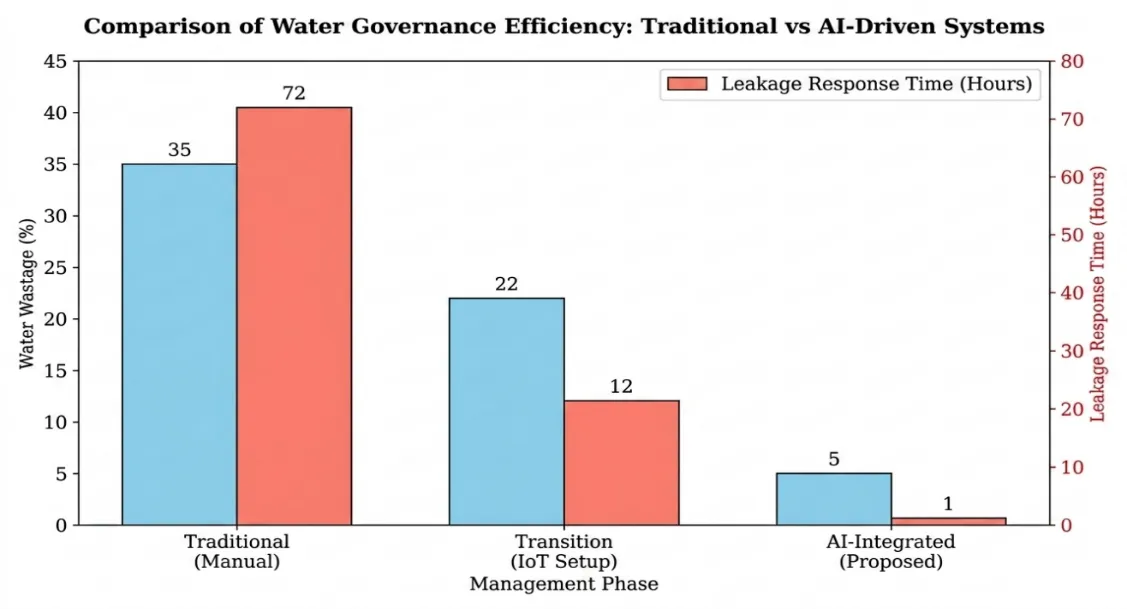
The study reveals that AI technologies such as Machine Learning, Predictive Analytics and Internet of Things (IoT) significantly improve water management efficiency through real-time monitoring and intelligent decision-making. AI-enabled systems help industries optimize water allocation, reduce unnecessary consumption and improve resource utilization. Smart monitoring systems also assist in identifying irregular water usage patterns and minimizing wastage.
4.2. Role of AI in Leak Detection and Demand Forecasting
One of the major findings of the study is the effectiveness of AI-based systems in leak detection and water demand forecasting. Predictive analytics and sensor-based monitoring systems can identify leakages at an early stage, thereby reducing water losses and operational costs. Similarly, AI models can forecast future water demand based on historical data, weather conditions, and industrial consumption patterns, allowing organizations to adopt proactive water management strategies.
4.3. AI-Driven Wastewater Treatment and Quality Monitoring
The review highlights that AI applications in wastewater treatment and water quality assessment have improved industrial sustainability practices. AI-enabled systems can monitor water quality parameters in real time and automate treatment processes for better efficiency and regulatory compliance. This not only reduces environmental pollution but also promotes water recycling and reuse in commercial sectors.
4.4. Contribution towards Sustainable Development Goals (SDGs)
The findings indicate that AI-driven water governance frameworks strongly support the achievement of Sustainable Development Goals (SDGs), especially:
AI-based governance systems contribute to sustainable business operations by balancing industrial productivity with environmental conservation.
4.5. Challenges in Implementing AI-Based Water Governance
Despite the growing benefits of AI technologies, the study identifies several challenges associated with their implementation. Major issues include:
These challenges are particularly significant in developing economies where digital infrastructure and policy support remain limited.
4.6. Policy and Governance Implications
The discussion suggests that governments, industries, and policymakers must collaborate to develop transparent and sustainable AI governance frameworks for water management. Public-private partnerships, digital infrastructure investments, and AI policy regulations are essential for ensuring responsible and inclusive adoption of smart water technologies.
4.7. Future Scope and Emerging Trends
The study further indicates that future advancements in technologies such as Big Data Analytics, Digital Twins, Blockchain, and Explainable AI (XAI) may further strengthen sustainable water governance systems. The integration of AI with smart city initiatives and climate-resilient infrastructure can play a transformative role in future commercial water management practices.
DISCUSSION
Overall, the review demonstrates that AI-driven Decision Support Systems have substantial potential to transform commercial water governance by improving efficiency, sustainability, and data-driven decision-making. The integration of AI technologies into water management practices can help industries achieve long-term environmental and economic sustainability. However, effective implementation requires strong governance mechanisms, ethical regulations, technological accessibility, and continuous innovation. Therefore, a balanced approach combining technological advancement with sustainable policy frameworks is essential for ensuring responsible AI-enabled water governance in the future.
CONCLUSION
The present review study concludes that Artificial Intelligence (AI)-driven Decision Support Systems (DSS) have emerged as transformative tools for achieving sustainable water resource governance in commercial and industrial sectors. The growing challenges of water scarcity, increasing industrial demand, climate change and environmental degradation have highlighted the urgent need for intelligent and technology-driven water management practices. In this context, AI technologies such as Machine Learning, Predictive Analytics, Internet of Things (IoT) and smart monitoring systems offer innovative solutions for improving efficiency, transparency, and sustainability in water governance.
The study reveals that AI-enabled systems play a significant role in water allocation, leak detection, wastewater treatment, demand forecasting and real-time monitoring, thereby reducing water wastage and enhancing operational efficiency. Furthermore, AI-based governance frameworks support data-driven policymaking and sustainable business practices by balancing industrial productivity with environmental conservation. The findings also indicate that AI-integrated water management systems can contribute substantially toward achieving Sustainable Development Goals (SDGs), particularly SDG 6, SDG 9, and SDG 12.
However, despite the growing benefits of AI technologies, several challenges continue to hinder their effective implementation. Issues such as high implementation costs, technological limitations, data privacy concerns, lack of digital infrastructure, and inadequate policy frameworks remain significant barriers, especially in developing economies. Therefore, effective collaboration between governments, industries, policymakers, and technology providers is essential for ensuring responsible and inclusive adoption of AI-based water governance systems.
Overall, the study emphasizes that the future of sustainable commercial water management largely depends on the integration of advanced digital technologies with strong governance and environmental policies. AI-driven Decision Support Systems have the potential to create smarter, more resilient, and sustainable water governance frameworks capable of addressing future global water challenges. Future research should focus on developing transparent, ethical, and scalable AI models that can support long-term sustainability and equitable water resource management across commercial sectors.
REFERENCES



Aditya Girothia*, Pradumanrao Kadam, Brajesh Mandrai, Artificial Intelligence in Sustainable Water Resource Governance: A Review of AI-Driven Decision Support Systems for Commercial Water Management, Int. J. Sci. R. Tech., 2026, 3 (6), 529-534. https://doi.org/10.5281/zenodo.20576260
 10.5281/zenodo.20576260