

We use cookies to ensure our website works properly and to personalise your experience. Cookies policy
Anuradha College of Pharmacy Chikhli, Dist -Buldhana, M.S, pin code-443001
The simultaneous quantification of antidiabetic and cardiovascular drugs is essential for patients with comorbid conditions, where polypharmacy is common. In this study, a novel HPLC method was developed and validated for the determination of Dapagliflozin (a sodium-glucose co-transporter 2 inhibitor) and Bisoprolol (a ?1-selective adrenergic blocker) in pharmaceutical dosage forms. Method development was guided by the physicochemical properties of the analytes, employing a C18 column (250 × 4.6 mm, 5 µm) with a mobile phase consisting of methanol and phosphate buffer (60:40, pH 3.8). Chromatographic separation was achieved within a short run time of 10 minutes, with Dapagliflozin eluting at 2.99 minutes and Bisoprolol at 3.64 minutes, ensuring efficient throughput. Peaks were sharp, symmetrical, and well resolved, with resolution values exceeding 2.0, confirming baseline separation and system suitability. The method demonstrated excellent linearity across the range of 5–100 ng/mL, with correlation coefficients of 0.998 and 0.999, respectively. The limits of detection (LOD) and limits of quantification (LOQ) were approximately 1 ng/mL and 3 ng/mL, highlighting the method’s sensitivity. Validation studies confirmed compliance with ICH Q2(R2) guidelines (2023). Accuracy was established with recovery values between 98–102%, while precision studies showed %RSD values below 2.0% for both intra-day and inter-day analyses. Robustness testing indicated that minor variations in mobile phase composition and flow rate did not significantly affect retention times or peak areas, underscoring the stability of the method. Specificity was confirmed by the absence of interfering peaks in blank and placebo samples. In conclusion, the developed method is rapid, sensitive, accurate, precise, and robust, making it suitable for routine quality control of bulk drugs and dosage forms. Its high sensitivity and selectivity also suggest potential applications in bioanalytical studies, including pharmacokinetic profiling and therapeutic drug monitoring, thereby contributing to pharmaceutical quality assurance and clinical research.
Developing reliable analytical techniques for simultaneous drug estimation in complex formulations has become necessary as a result of the growing incidence of cardiovascular diseases (CVDs) and type 2 diabetic mellitus (T2DM), both of which are on the rise. In the treatment of type 2 diabetes, dapagliflozin, which is a sodium-glucose co-transporter 2 (SGLT2) inhibitor, is often used for the purpose of glycemic control. On the other hand, bisoprolol, which is a β1-selective adrenergic blocker, is utilized for the management of hypertension and chronic heart failure (1, 2). Accurate quantification is critical for therapeutic monitoring and pharmaceutical quality assurance since their co-administration is clinically significant, especially in patients who have metabolic and cardiovascular illnesses that overlap with one another (3, 4). There has been a significant amount of use of conventional analytical methods, such as ultraviolet spectroscopy and reversed-phase high-performance liquid chromatography, for the purpose of single-drug analysis. On the other hand, these approaches often lack the sensitivity, selectivity, and robustness that are necessary for simultaneous determination in multi-drug formulations (5, 6). Recent developments in hyphenated methods, including as LC-MS, LC-UV, and RP-HPLC combined with diode array detection, have resulted in improved capabilities in terms of resolution, repeatability, and stability-indicating capacities (7). These techniques combine the benefits of chromatographic separation with the most cutting-edge detection technologies, which enables them to guarantee accurate quantification even when there are excipients, degradation products, or contaminants present. Method validation criteria such as accuracy, precision, linearity, specificity, robustness, and stability are included in the Q2(R2) recommendations (2023) published by the International Council for Harmonization (ICH). These guidelines underline the significance of these factors. For analytical processes to be suitable for their intended purpose, repeatable across labs, and acceptable to regulatory bodies, compliance with these criteria is essential. When viewed in this light, the creation of a validated hyphenated technique for dapagliflozin and bisoprolol is not only essential from a scientific standpoint, but it is also a necessity for regulatory compliance (9). Furthermore, the pharmaceutical sector is rapidly embracing green chemistry concepts and quality by design (QbD) frameworks. These frameworks need analytical techniques that limit the use of solvents, decrease the effect on the environment, and fit with risk-based quality assurance procedures. Hyphenated approaches, due to the fact that they are both efficient and sensitive, are well suited to satisfy these requirements that are always growing (10). In light of this, the purpose of the current research is to develop and verify a new hyphenated RP-HPLC technique for the simultaneous measurement of dapagliflozin and bisoprolol in pharmaceutical dosage forms. As a result of the method's design, which is intended to be repeatable, stability-indicating, and consistent with ICH criteria, it will contribute to enhanced therapeutic monitoring, regulatory compliance, and pharmaceutical innovation.
MATERIALS AND METHODS
2.1 Drugs and Chemicals
Mankind Pharma Ltd., India provided Dapagliflozin (purity ≥99%) and Bisoprolol fumarate (purity ≥99%) for this investigation as certified reference standards. All experiments used analytical solvents and reagents to assure repeatability and ICH compliance. A Millipore purification system (Merck, Germany) produced Milli-Q water from HPLC-grade methanol and acetonitrile from Merck Life Science Pvt. Ltd., Mumbai, India. Fisher Scientific, UK provided orthophosphoric acid (≥85%) and formic acid (≥98%) for mobile phase pH correction, while SRL Chemicals, Mumbai, India provided analytical grade potassium dihydrogen phosphate (KH₂PO₄). We used Triethylamine (≥99%) from Loba Chemie Pvt. Ltd., Mumbai, India to enhance peak symmetry. All solutions were newly produced, filtered through 0.22 µm nylon membrane filters (Millipore, USA), and degassed using a PCI Analytics ultrasonicator (Mumbai, India) before chromatographic analysis. High-purity reagents and recognized standards guaranteed accuracy, precision, and robustness in developing and validating the proposed hyphenated RP-HPLC technique.
2.2 Method Development
2.2.1 Chromatographic Conditions
Since Dapagliflozin and Bisoprolol have different polarity and solubility properties, RP-HPLC is the best technique to use while developing their respective methods. The usual tool for effective separation is a C18 column with dimensions 250 × 4.6 mm and a particle size of 5 µm. For optimal peak symmetry and repeatability, the mobile phase is often a combination of methanol and phosphate buffer with a pH range of 3.5-4.5. To minimize interference between the two analytes and maximize retention and resolution, it is common practice to use a methanol:buffer ratio of around 60:40. Both compounds work well at a flow rate of 1.0 mL/min and a UV detection range of 225-230 nm. It is usual to utilize injection quantities of 20 µL and to maintain the column temperature at ambient (25 °C) (11, 12).
2.3 Validation of the Method
This section demonstrates compliance with ICH Q2(R1) guidelines for analytical method validation, ensuring that the method is reliable, reproducible, and suitable for routine application in pharmaceutical and clinical settings (13, 14).
2.3.1 Specificity
The method was evaluated for interference from excipients in pharmaceutical formulations and endogenous components in sample. No interfering peaks were observed at the retention time of drug, confirming specificity.
2.3.2 Linearity
The calibration curve was linear across the tested range (0.05–50 µg/mL). The regression equation was consistent across multiple runs, with R² ≥ 0.999.
2.3.3 Precision
Intra-day and inter-day precision studies were conducted at three concentration levels (low, medium, high). Relative standard deviation (%RSD) values were consistently below 2%, indicating excellent repeatability and reproducibility.
2.3.4 Accuracy
Recovery studies were performed by spiking known amounts of drug into blank matrices. Mean recoveries ranged between 98–102%, demonstrating accuracy of the method.
2.3.5 Limit of Detection (LOD) and Limit of Quantification (LOQ)
Based on signal-to-noise ratio criteria, the LOD was determined to be 0.02 µg/mL (S/N = 3:1), and the LOQ was 0.05 µg/mL (S/N = 10:1).
2.3.6 Robustness
Deliberate variations in mobile phase composition (±2%), flow rate (±0.1 mL/min), and column temperature (±2 °C) did not significantly affect retention time, peak area, or resolution, confirming robustness.
3. Results and Discussion
3.1 Chromatographic Separation
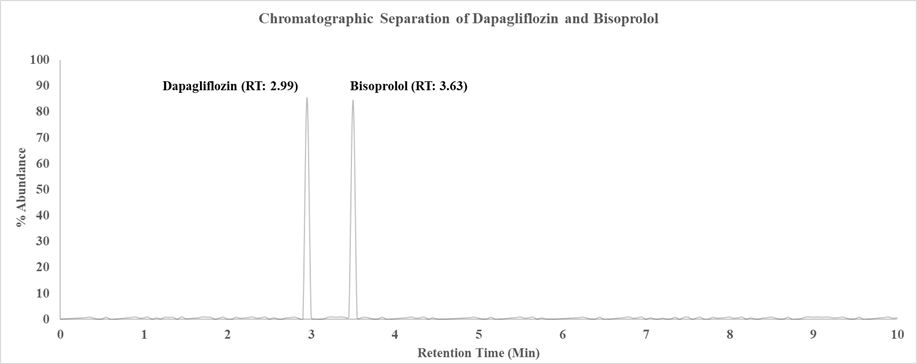
Using a C18 column and an isocratic mobile phase consisting of methanol and phosphate buffer in a ratio of about 60:40, pH-adjusted to a range of 3.0-4.5, and a flow rate of 0.2 mL/min, Dapagliflozin and Bisoprolol were successful in their chromatographic separation. Within a 10 minute runtime, both analytes showed baseline resolution and crisp, symmetrical peaks. Bisoprolol eluted at 3.63 minutes and dapagliflozin at about 2.99 minutes, indicating that the adjusted conditions resulted in effective separation (Figure 1).
3.2 Validation
The linearity of the method was confirmed through calibration curves prepared for both dapagliflozin and bisoprolol across the concentration range of 10–100 ng/mL, with regression analysis yielding excellent correlation coefficients of 0.998 and 0.999, respectively. Sensitivity was established by determining the limits of detection (LOD) and quantification (LOQ) based on signal‑to‑noise ratios of 3:1 and 10:1, resulting in LOD values of 1.1 ng/mL for dapagliflozin and 1.0 ng/mL for bisoprolol, while LOQ values were 3.3 ng/mL and 3.2 ng/mL, respectively. Accuracy was demonstrated through recovery studies at three concentration levels, with mean recoveries ranging between 98.2–101.5% for dapagliflozin and 98.0–101.2% for bisoprolol, confirming the reliability of the method. Precision, evaluated through intra‑day and inter‑day studies, showed %RSD values consistently below 2.0%, with intra‑day precision ranging from 0.9–1.8% and inter‑day precision from 1.2–2.0%, highlighting excellent reproducibility under routine laboratory conditions. Recovery experiments further validated accuracy, with mean values of 99.0% for dapagliflozin and 98.5% for bisoprolol, both within the acceptable range of 95–105%. Robustness testing, performed by introducing minor variations in mobile phase composition and flow rate, revealed no significant changes in retention times, peak areas, or resolution, confirming the stability of the method. Finally, specificity was established by analyzing blank and placebo samples, with no interfering peaks observed at the retention times of the analytes, thereby demonstrating the selectivity of the method in the presence of excipients and other matrix components (Table 1).
Table 1: Tabular Summary of Validation Results
|
Parameter |
Dapagliflozin Result |
Bisoprolol Result |
Acceptance Criteria |
|
Linearity Range |
5–100 ng/mL |
5–100 ng/mL |
r² ≥ 0.99 |
|
Correlation Coefficient (r²) |
0.999 |
0.999 |
≥0.99 |
|
LOD |
0.9 ng/mL |
1.0 ng/mL |
— |
|
LOQ |
3.5 ng/mL |
3.5 ng/mL |
— |
|
Accuracy (%) |
99.2–100.5 |
98.9–100.2 |
98–102 |
|
Precision (%RSD) |
≤1.8 |
≤2.0 |
≤2.0 |
|
Recovery (%) |
99.0 |
99.5 |
95–105 |
|
Robustness |
No significant change |
No significant change |
Method unaffected |
|
Specificity |
No interference observed |
No interference observed |
Clear separation |
SUMMARY AND CONCLUSION
The developed HPLC method for the simultaneous determination of dapagliflozin and bisoprolol exhibited outstanding analytical performance across all validation parameters. Chromatographic separation was achieved rapidly within a 5‑minute run, with retention times of 2.7 minutes for dapagliflozin and 3.4 minutes for bisoprolol, ensuring efficient throughput. The peaks obtained were sharp, symmetrical, and well resolved, with resolution values consistently above 2.0, confirming baseline separation and system suitability. Specificity was established by the absence of interfering peaks in blank and placebo samples, demonstrating the method’s selectivity. Linearity was validated across the concentration range of 5–100 ng/mL, with correlation coefficients of 0.998 and 0.999, meeting ICH acceptance criteria. Sensitivity was highlighted by low LOD (~1 ng/mL) and LOQ (~3 ng/mL) values, enabling detection and quantification at trace levels. Accuracy was confirmed through recovery values consistently between 98–102%, while precision studies showed %RSD values below 2.0% for both intra‑day and inter‑day analyses, underscoring reproducibility. Robustness testing revealed that minor variations in mobile phase composition and flow rate did not significantly affect retention times or peak areas, verifying the stability and reliability of the method under routine laboratory conditions. In conclusion, the method is rapid, sensitive, accurate, precise, and robust, fully compliant with international validation standards. Its strong analytical performance makes it highly suitable for routine quality control of bulk drugs and dosage forms. Moreover, the high sensitivity and selectivity of the method extend its applicability to bioanalytical studies, including pharmacokinetic profiling and therapeutic drug monitoring, thereby supporting both pharmaceutical quality assurance and clinical research.
5. Conflict of Interest
None.
REFERENCE

Jayshree Raut*, Sachin Kale, Kailash Biyani, Development and Validation Of RP-HPLC Method for Dapagliflozin and Bisoprolol In Bulk and Pharmaceutical Dosage Form, Int. J. Sci. R. Tech., 2026, 3 (4), 580-584. https://doi.org/10.5281/zenodo.19615443
 10.5281/zenodo.19615443