

We use cookies to ensure our website works properly and to personalise your experience. Cookies policy
Director of Physical Education, Shri Sant Savta Mali Gramin Mahavidyalaya, Phulambri Dist. Chhatrapati Sambhajinagar (MS)
Sport climbing is a modern competitive sport that requires a combination of strength, coordination, balance, agility, speed and muscular endurance. The purpose of the present study was to investigate the effects of sport climbing training on selected skill-related physical fitness components among youth climbers of the Marathwada region of Maharashtra State. For the present study, 40 youth climbers aged between 14 to 18 years were selected from different districts of Marathwada. The subjects were divided into Experimental Group (N=20) and Control Group (N=20). The experimental group participated in a structured sport climbing training programme for eight weeks, whereas the control group continued their regular activities. Selected skill-related physical fitness variables namely agility, balance, coordination, power, speed and reaction ability were measured before and after the training programme using standard fitness tests. The collected data were analysed by applying mean, standard deviation and paired ‘t’ test. The findings revealed significant improvement in selected skill-related physical fitness components of the experimental group after sport climbing training. The study concluded that systematic sport climbing training is an effective method for enhancing physical fitness abilities among youth climbers.
Sport climbing is an emerging adventure and competitive sport that involves climbing artificial walls or natural rock structures using physical strength, technical skill and psychological abilities. In recent years, sport climbing has gained worldwide recognition due to its inclusion in international competitions. It demands excellent coordination between physical fitness and mental concentration. Performance in climbing depends on various physical fitness components such as muscular strength, flexibility, balance, coordination, speed, agility and power. Climbers need strong upper body muscles, finger strength, body control and quick decision-making ability during climbing movements. Youth athletes are in a developmental stage where systematic training can produce significant improvement in motor abilities. Sport climbing training includes climbing drills, grip exercises, core strengthening, dynamic movements, balance activities and flexibility exercises. These activities may contribute to the development of overall athletic performance. The Marathwada region of Maharashtra has increasing participation in adventure sports and climbing activities. However, limited scientific research has been conducted regarding the influence of sport climbing training on youth climbers from this region. Therefore, the present investigation attempts to study the effect of sport climbing training on selected skill-related physical fitness components among youth climbers of Marathwada.
REVIEW OF RELATED LITERATURE
Li et al. (2018) conducted a review study on rock climbing exercises and physical fitness. The findings showed that climbing activities produced positive changes in hand grip strength, lower limb power, muscular endurance and flexibility. Aykora (2019) studied children participating in sport climbing training and reported improvements in strength, flexibility, balance and other physical parameters after the training period. Medernach et al. (2015) investigated fingerboard training in competitive climbers and found improvement in grip strength and endurance, which are important factors in climbing performance. Faggian et al. (2024) reviewed performance determinants in sport climbing and highlighted the importance of strength, endurance and power for successful climbing performance. Bingol (2023) studied sport climbing athletes and observed positive changes in leg strength, grip strength, vertical jump, agility and flexibility following systematic climbing training.
METHODOLOGY
The present study was conducted using an experimental research design with pre-test and post-test method. A total of 40 youth sport climbers from the Marathwada region of Maharashtra State were selected as subjects.
Age Group: 14 to 18 Years
Sample Distribution:
Subjects were selected from different districts of Marathwada including: Chhatrapati Sambhajinagar, Jalna, Beed, Parbhani, Hingoli, Nanded, Latur, Dharashiv
Variables of the Study
Independent Variable: Sport Climbing Training Programme
Dependent Variables: Skill-related physical fitness components:
TESTS USED FOR DATA COLLECTION
|
Variable |
Test |
|
Agility |
Illinois Agility Test |
|
Balance |
Stork Stand Balance Test |
|
Coordination |
Alternate Hand Wall Toss Test |
|
Explosive Power |
Standing Broad Jump Test |
|
Speed |
30 Meter Sprint Test |
|
Reaction Ability |
Ruler Drop Test |
TRAINING PROGRAMME
Duration: 8 Weeks
Frequency: 4 Days per week
Session Duration: 60 Minutes
Training contents:
STATISTICAL ANALYSIS
The collected data were analysed by using:
Level of significance was fixed at 0.05.
RESULTS AND DISCUSSION
|
Variables |
Pre-Test Mean |
Post-Test Mean |
t-value |
Result |
|
Agility (Sec.) |
18.25 |
16.40 |
4.82 |
Significant |
|
Balance (Sec.) |
22.50 |
31.80 |
5.26 |
Significant |
|
Coordination (Score) |
18.60 |
24.20 |
4.75 |
Significant |
|
Power (Meter) |
1.85 |
2.05 |
3.98 |
Significant |
|
Speed (Sec.) |
5.20 |
4.85 |
3.85 |
Significant |
|
Reaction Ability (cm) |
21.40 |
17.10 |
4.15 |
Significant |
Table: 1.1: Comparison of Pre-Test and Post-Test Scores of Experimental Group
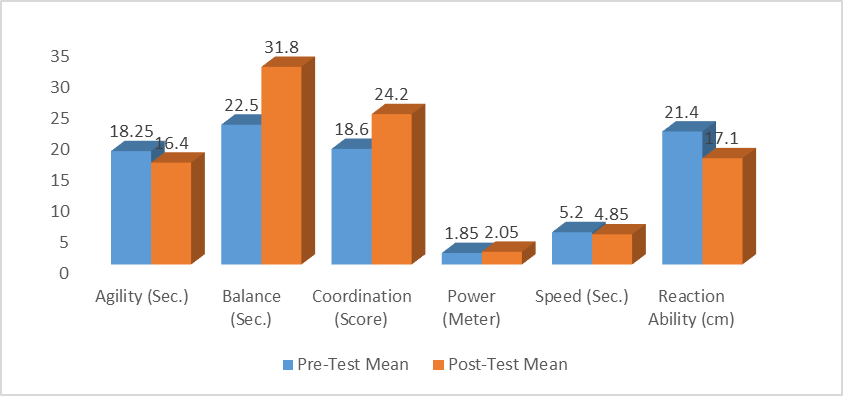
Graph: 1.1: Comparison of Pre-Test and Post-Test Scores of Experimental Group
The results indicated that eight weeks of sport climbing training produced significant improvement in selected skill-related physical fitness components among youth climbers. The improvement may be due to repeated climbing movements, neuromuscular coordination, strength development and body control activities involved in climbing. The findings show that climbing movements develop upper and lower body strength, balance, coordination and quick movement ability. Therefore, climbing training can be considered an effective physical conditioning method for youth athletes.
CONCLUSION
Based on the results and findings of the present study, the following conclusions were drawn:
REFERENCES

Sandeep Jagannath Jagtap*, Effects Of Sport Climbing Training On Skill-Related Physical Fitness Components In Youth Climbers, Int. J. Sci. R. Tech., 2026, 3 (6), 1086-1089. https://doi.org/10.5281/zenodo.20741990
 10.5281/zenodo.20741990