

We use cookies to ensure our website works properly and to personalise your experience. Cookies policy
Department of Botany, M. B. P. Govt. P. G. College, Ashiyana, Lucknow, U.P., India- 226012
Fever is a common ailment among rural and tribal communities and is frequently managed using traditional plant-based remedies. The present studies aimed to document and identify plant species used by local inhabitants in Bhinga Block of Shravasti district of Uttar Pradesh for the treatment of febrile conditions. Data were collected from 50 local healers and elderly informants through interviews and guided field walks. An ethnobotanical questionnaire was also administered. Plant specimens were collected, processed, and identified using standard floras and taxonomic literature. A total of 18 plant species belonging to 13 families were recorded for their antipyretic uses, with Fabaceae and Solanaceae being the most represented families. Leaves and roots were the most commonly utilized plant parts for the preparation of remedies. Indigenous communities employ a variety of medicinal plants for the treatment of several ailments, particularly malaria, dengue, typhoid, and fever. These medicinal plants represent a valuable source of traditional healthcare knowledge and may possess potential bioactive compounds for the treatment of various diseases. Preparation methods and modes of administration of herbal remedies vary among different localities within the study area.
Bhinga Block is located in Shravasti district of Uttar Pradesh. The district is a relatively newly established administrative unit formed from parts of Gonda and Bahraich districts. It is situated on the banks of the Rapti River and shares its northern boundary with Nepal and its eastern boundary with Balrampur district. Shravasti falls under the Devipatan Division, with Bhinga serving as its district headquarters. The total geographical area of the district is 1,126.0 km².
Shravasti experiences a subtropical climate with marked seasonal variation. Summer temperatures range from 30°C to 43°C, while winter temperatures range from 6°C to 18°C. The monsoon season (July to October) is generally pleasant. The district has a total forest cover of approximately 34,238 hectares, managed under four forest ranges. The vegetation is mainly composed of dry Sal (Shorea robusta) forests. Important associated tree species include Sheesham (Dalbergia sissoo), Jamun (Syzygium cuminii), Rohini (Mallotus philippensis), Asan (Pterocarpus marsupium), Gular (Ficus racemosa), Haldu (Haldina cordifolia), Teak (Tectona grandis), Semal (Bombax ceiba), Mahua (Madhuca indica), Khair (Acacia catechu), and Bel (Aegle marmelos). Extensive teak plantations have been established in recent years. The area also supports a rich diversity of shrubs, climbers, and grasses.
The Tharu tribe is indigenous to the Tarai region spanning India and Nepal. In Uttar Pradesh, they are mainly distributed in the Tarai belt including Shravasti district. The Tharus are primarily forest-dependent communities and traditionally rely on forest resources for their livelihood and daily needs. They speak various dialects and are engaged mainly in agriculture and animal husbandry (Verma, 2011). The community possesses rich ethnobotanical knowledge regarding medicinal plant use (Kumar et al., 2006). The Government of India recognized the Tharu as a Scheduled Tribe in 1967. They constitute one of the major tribal groups in Uttar Pradesh.
The economy of the Tharu community is predominantly agrarian, with rice, maize, wheat, barley, lentils, potatoes, peas, sugarcane, and mustard as major crops. In addition, forest resources contribute significantly to their subsistence. Various socio-economic and demographic factors influence the well-being of the region (Kumari, et al., 2020). Although primarily agriculturists, the Tharus maintain a mixed livelihood system and collect non-timber forest products such as wild fruits, bulbs, tubers, and medicinal plants.
They also utilize grasses and wood for basket weaving, mat making, house construction, preparation of herbal beverages, and religious ceremonies. The present study was conducted in Bhinga Block of Shravasti district, Uttar Pradesh, where Tharu tribal communities inhabit villages such as Motipur, Bhachkahi, Masaha Kalan, and Katkuinya. Access to modern healthcare facilities remains limited in these economically marginalized areas, and the communities continue to rely heavily on traditional knowledge systems (TKS) and medicinal plants for primary healthcare.
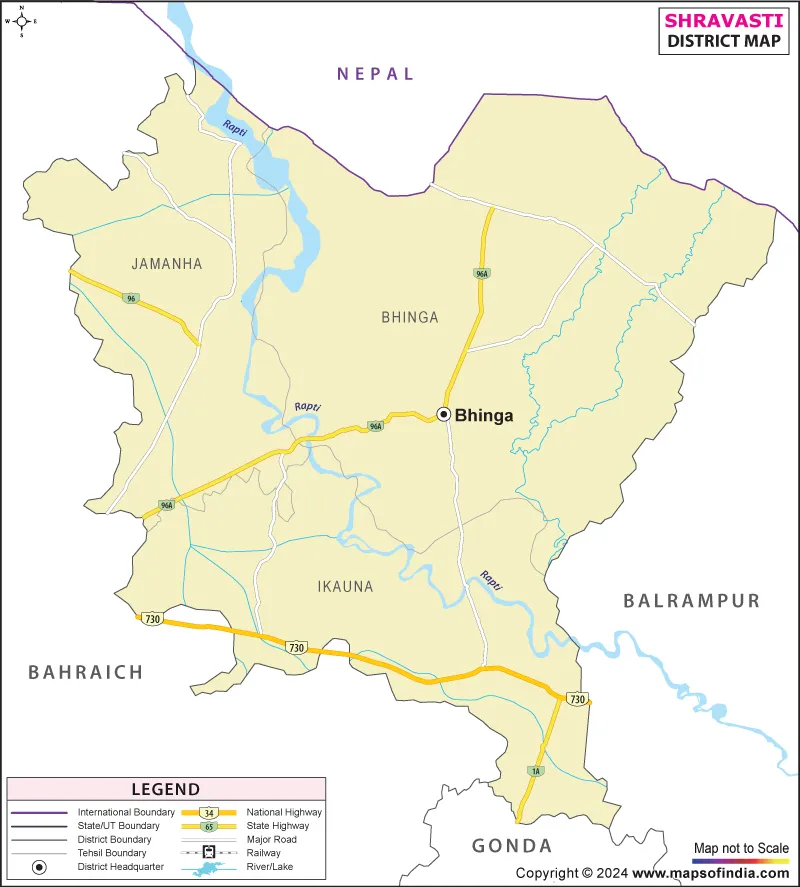
Map-1: Showing Study area (Shravasti district) of the Tarai region of Uttar Pradesh
REVIEW OF LITERATURE:
Ethnobotany is generally defined as the study of human–plant relationships among forest dwellers and rural communities (Mishra, et al., 2021). In India, numerous ethnobotanical studies have been conducted by several researchers, including Chopra, et al. (1956), Jain (1991), Dastur (1996), Kirtikar and Basu (1999), Dubey, et al. (2004), and Bajpai, et al. (2016).
In Uttar Pradesh, ethnobotanical research has been extensively carried out in different districts and ecological regions by various workers, including Dixit and Pandey (1984), Singh and Maheshwari (1989), Narain and Narain (1999), Pandey and Verma (2002), Singh, et al. (2002), Singh, et al. (2003), Singh, et al. (2007), Singh, et al. (2010), Khanna (2002), Mishra, et al. (2012), Dubey (2012), Narayan and Singh (2017), Srivastava and Shukla (2018), Prajapati, et al. (2025a, 2025b, 2026a, 2026b), Rahul, et al. (2026) and Patel, et al. (2026). These studies have been reported from various districts of Uttar Pradesh and surrounding Tarai and Gangetic plains, covering diverse habitats and tribal-dominated regions.
The present study attempts to document the traditional medicinal plants used by ethnic communities of the study area, with the aim of preserving indigenous knowledge that has evolved over generations. The traditional practices of the Tharu tribe remain largely undocumented and are transmitted orally from one generation to another. Furthermore, the Tharu-dominated Tarai region of Uttar Pradesh remains relatively underexplored from an ethnobotanical perspective.
MATERIALS AND METHODS:
Field surveys were conducted regularly in Motipur, Bhachkahi, Masaha Kalan, and Katkuinya villages of Bhinga Block, Shravasti district, Uttar Pradesh, during 2024–2025. Plant specimens were collected from different localities across various seasons with the assistance of local inhabitants and documented based on their ethnomedicinal uses in tribal communities. Detailed field notes were recorded in a field notebook, including collection number, accepted botanical name, family, vegetation type, and photographic documentation of each specimen.
Standard herbarium labels were prepared and attached to mounting sheets, documenting essential information such as botanical name, habitat, locality, plant colour, collector name, collection number, and other relevant field observations necessary for accurate identification (Jain and Rao, 1977). Specimen identification was carried out using standard floras and taxonomic references, including Hooker (1872–1897) and Duthie (1960).
The collected plant specimens were properly processed, treated with preservatives, and mounted on herbarium sheets. These were subsequently deposited in the Herbarium of the Department of Botany, Prof. B. K. Verma Herbarium, Maharaja Bijli Pasi Government P.G. College, Lucknow, Uttar Pradesh, for future reference and documentation.
DATA COLLECTION:
The collection and documentation of ethnomedicinal plants used for the treatment of different types of fever in Bhinga Block, Shravasti district, Uttar Pradesh, were carried out through extensive field surveys conducted from December 2024 to June 2026. A systematic fieldwork plan was adopted to gather primary ethnobotanical information.
Data were collected from traditional healers, particularly elderly informants with extensive knowledge of plant use and therapeutic practices. Information was obtained through a pretested structured questionnaire (as provided in the supplementary material), direct field observations, and detailed interviews. Additional data on modes of preparation, methods of administration, dosage, and storage (shelf life) of herbal formulations were also recorded.
Discussions were further conducted with traditional healers, knowledgeable community members, and local Vaidyas belonging to the tribal population to validate and cross-check the information. This participatory approach ensured the reliability and authenticity of the ethnomedicinal data collected during the study.
RESULT:
An extensive field survey was conducted, including interviews with 50 participants from Bhinga Block, Shravasti district, Uttar Pradesh (Table 1). Among the respondents, 45 (90%) were male and 5 (10%) were female. The higher participation of male respondents may be attributed to their greater willingness to engage in discussions with the investigators, whereas female participation was comparatively limited due to sociocultural constraints and lower interaction levels with outsiders.
The respondents included traditional herbal practitioners, medicinal plant collectors, farmers, and herdsmen. These informants possessed considerable knowledge of the utilization of local medicinal plants for the treatment of various ailments. The participants represented different age groups and educational backgrounds and were categorized into three age classes (Table 1). A majority of respondents belonged to the 60–70 years age group (54%), while the least representation was recorded in the above 70 years age group (6%).
Regarding educational status, the majority of informants were illiterate (86%), while 14% had received primary education. Illiterate informants contributed a greater amount of ethnomedicinal knowledge compared to literate individuals. This difference may be attributed to changing lifestyles, increased dependence on allopathic medicine, and the ongoing process of urbanization, which has contributed to a gradual decline in traditional knowledge transmission among younger and more educated populations.
Table 1: Demographic Characteristics of Informants in Bhinga Block, Shravasti District, Tarai Region of Uttar Pradesh.
| Demographic feature | Categories | No. of person | Percentage (%) |
|---|---|---|---|
| Informants | Local inhabitant’s (Male) | 45 | 90 |
| Local inhabitant’s (Female) | 5 | 10 | |
| Age | 50-59 | 15 | 30 |
| 60-70 | 27 | 54 | |
| More than 70 | 3 | 6 | |
| Education | Illiterate | 43 | 86 |
| Primary | 7 | 14 | |
| Total | 50 |
The present study documented a total of 18 medicinal plant species, representing 18 genera and 13 families, traditionally used for the treatment of various types of fever. In terms of family representation, Fabaceae was the most dominant family with seven species, followed by Solanaceae with two species. The remaining families, including Meliaceae, Asclepiadaceae, Caricaceae, Asteraceae, Malvaceae, Verbenaceae, Anacardiaceae, Moringaceae, Oleaceae, Apocynaceae, and Menispermaceae, were each represented by a single species (Table 2).
Regarding life forms, trees were the most dominant growth form with seven species, followed by shrubs (five species), herbs (five species), and climbers (one species). A variety of plant parts were utilized for medicinal purposes. Leaves and roots were the most frequently used plant parts (five species each), followed by bark (two species), fruits (two species), and whole plants (two species). Inflorescence and flowers were the least used plant parts, each represented by a single species.
The recorded species were distributed across different habitats, including natural forest, degraded forest, roadside vegetation, and mixed habitats, reflecting the ecological adaptability of these medicinal plants. These plant resources are primarily used for the treatment of different types of fever, including malaria, dengue, and other febrile conditions in Bhinga Block of Shravasti district, Tarai region of Uttar Pradesh.
[Figure - see the formatted PDF]
Figure: 1: Life Form of the Plants in Bhinga Block of Shravasti District of the Tarai Region.
[Figure - see the formatted PDF]
Figure: 2: Ethnomedicinal Plants Used for Different Types of Fever in Bhinga Block of Shravasti District.
[Figure - see the formatted PDF]
Figure: 3: Most Used Plant Parts in Bhinga Block of Shravasti District of the Tarai Region.
Table: 2: Quantitative Documentation of Medicinal Plants Species in Bhinga Block of Sharavsti Distrcit of the Tarai Region of Uttar Pradesh.
| S. No. | Taxon (Genera/Species) |
Family | Local Name | Habit | Uses | Part used |
|---|---|---|---|---|---|---|
| Azardirachta indica Juss. | Meliaceae | Neem | Tree | Malaria fever | Leaves and Inflorescence | |
| Bauhinia variegata L. | Fabaceae | Kachnar | Tree | Malaria fever | Bark | |
| Calotropis procera Br. | Asclepiadaceae | Madar | Shrub | Fever | Root | |
| Carica papaya L. | Caricaceae | Papista | Shrub | Dengue | Leaves | |
| Cassia fistula L. | Fabaceae | Amaltas | Tree | Fever | Root | |
| Datura metel L. | Solanaceae | Dhatura | Herb | Fever | Fruit | |
| Eclipta prostata (L.) L. | Asteraceae | Bhringraj | Herb | Fever | Whole plant | |
| Hibiscus rosa-sinensis L. | Malvaceae | Betjongnaro | Shrub | Fever | Flower | |
| Lantana camara L. | Verbenaceae | Galphusia | Shrub | Malaria fever | Root | |
| Mangifera indica L. | Anacardiaceae | Aam, Amba | Tree | Fever | Leaves | |
| Moringa oleifera Lam. | Moringaceae | Saijana | Tree | Fever | Bark | |
| Nyctanthes arbor-tristis L. | Oleaceae | Gargad, Harsingar | Tree | Malaria fever | Leaves | |
| Senna tora L. | Fabaceae | Chakonda | Herb | Fever | Root | |
| Solanum melongena var. incanum (L.) Ktze. | Solanaceae | Banbhantawa, Bhata | Herb | Fever | Fruits | |
| Tabernaemontana divaricate (L.) Br. ex Roem. & Schult. | Apocynaceae | Chandni | Shrub | Fever | Leaves | |
| Tamarindus indica L. | Fabaceae | Amli, Imli | Tree | Fever | Leaves | |
| Tinospora codifolia (L.) Merr. | Menispermiaceae | Baur, Athervel, Giloe | Climber | Fever | Whole plant | |
| Uraria picta (Jacq.) Desv. | Fabaceae | Kavario | Herb | Fever | Roots |
DISCUSSION:
The present ethnobotanical study conducted in Bhinga Block, Shravasti district, Uttar Pradesh highlights the significant dependence of local communities, particularly the Tharu tribe, on medicinal plants for the treatment of various fever-related ailments. The documentation of 18 medicinal plant species belonging to 13 families reflects a rich traditional knowledge system still prevalent in the study area.
The dominance of the Fabaceae family in the present study is consistent with several earlier ethnobotanical reports, which indicate that this family is widely represented in traditional medicinal systems due to its high species diversity and pharmacological potential. The predominance of trees, followed by shrubs and herbs, suggests that woody perennials play a major role in primary healthcare among local communities, possibly due to their long-term availability and ease of access in forested and semi-forest landscapes.
Leaves and roots were identified as the most frequently used plant parts, which aligns with general ethnomedicinal trends where leaves are preferred due to their easy availability and non-destructive harvesting, while roots are often used for their perceived higher therapeutic potency. However, the use of roots may pose a conservation concern due to the destructive nature of harvesting, potentially affecting plant regeneration.
The high dependence of elderly and illiterate informants on ethnomedicinal knowledge indicates that traditional knowledge is largely preserved among older generations. The declining participation of younger and more educated individuals suggests a gradual erosion of indigenous knowledge systems due to modernization, increased reliance on allopathic medicine, and socio-economic changes.
Furthermore, the use of these medicinal plants for treating diseases such as malaria, dengue, and general fever demonstrates their continued relevance in primary healthcare, especially in areas with limited access to modern medical facilities. However, the lack of standardization in dosage, preparation methods, and administration highlights the need for scientific validation and pharmacological studies.
CONCLUSION:
The present study documents important ethnomedicinal knowledge of Bhinga Block in Shravasti district, emphasizing the continued reliance of local communities on traditional plant-based remedies for the treatment of fever and related diseases. A total of 18 plant species were recorded, reflecting both biodiversity richness and strong cultural-ecological relationships.
The findings clearly indicate that ethnomedicinal knowledge is predominantly preserved among older and less-educated members of the community and is at risk of erosion in younger generations. Therefore, there is an urgent need for systematic documentation and preservation of this traditional knowledge.
Conservation of these medicinal plant resources is essential, not only for maintaining biodiversity but also for sustaining the healthcare practices of indigenous communities. Integration of traditional knowledge with modern scientific research can contribute to the development of novel therapeutic agents and promote sustainable utilization of plant resources.
In conclusion, this study underscores the importance of ethnobotanical research in bridging traditional knowledge systems with contemporary conservation and healthcare strategies, ensuring both cultural preservation and ecological sustainability.
ACKNOWLEDGEMENT:
The authors are thankful to the Director, Council of Science and Technology (CST), Uttar Pradesh, for funding this project. We are also thankful to the Department of forest, Government of India, for the necessary permits to carry out fieldwork in protected areas. Sincere gratitude is extended to the forest staff for their kind support during fieldwork and studies.
REFERENCES

Vinay Kumar Prajapati, Rahul, Santosh Kumar, Folk Medicinal Plants, Their Utilization, and Conservation by Local Communities in Bhinga Block, Uttar Pradesh, Int. J. Sci. R. Tech., 2026, 3 (11), 209-216. https://doi.org/10.5281/zenodo.23942437
 10.5281/zenodo.23942437