

We use cookies to ensure our website works properly and to personalise your experience. Cookies policy
Womens College Of Pharmacy Peth Vadgaon, Kolhapur, Maharashtra
The present study was focused on the preparation and evaluation of a herbal face wash containing radish pod extract (Raphanus sativus) as the main active ingredient. Herbal cosmetics are widely accepted due to their safety, effectiveness, eco-friendly nature, and reduced side effects compared to synthetic cosmetic products. Radish pods are rich in phytoconstituents such as flavonoids, phenolic compounds, tannins, glucosinolates, vitamins, and antioxidants which possess antimicrobial, antioxidant, and anti-inflammatory activities beneficial for skin care. In this work, radish pods were collected, shade dried, powdered, and extracted using the Soxhlet extraction method with ethanol as solvent. The obtained extract was subjected to phytochemical screening, which confirmed the presence of alkaloids, flavonoids, phenolic compounds, tannins, saponins, coumarins, glucosinolates, vitamins, and other active constituents. The total ash value of radish pod powder was found to be 3.25% w/w, indicating acceptable purity and quality of the crude drug. The herbal face wash was formulated using Carbopol 934, Glycerine, sodium lauryl sulphate, triethanolamine, parabens, rose oil, and distilled water. The prepared formulation was evaluated for various parameters such as organoleptic properties, pH, viscosity, spreadability, washability, foamability, grittiness, extrudability, skin irritation, stability, and antimicrobial activity. The formulation showed greenish color, pleasant odor, smooth texture, homogeneous appearance, good spreadability, easy washability, and satisfactory foamability. The pH was found between 5–6, indicating compatibility with skin. The viscosity was observed between 7000–10000 mPa·s, providing suitable consistency for topical application. No irritation, redness, or itching was observed during the skin irritation test. Stability studies showed no significant changes in physical properties during storage. The antimicrobial study also indicated effective antibacterial activity of the formulation against skin microorganisms.
Cosmetic science is the branch of science that deals with the formulation, preparation, evaluation, and application of cosmetic products used for skin, hair, nails, and personal care. It combines the knowledge of chemistry, biology, pharmacology, and dermatology to develop safe and effective cosmetic products. Cosmetic science aims to improve appearance, maintain hygiene, and protect the body from environmental damage. It includes products such as creams, lotions, shampoos, facewash, perfumes, and makeup preparations. Herbal and synthetic ingredients are commonly used in cosmetic formulations to enhance beauty and maintain healthy skin and hair.[1]
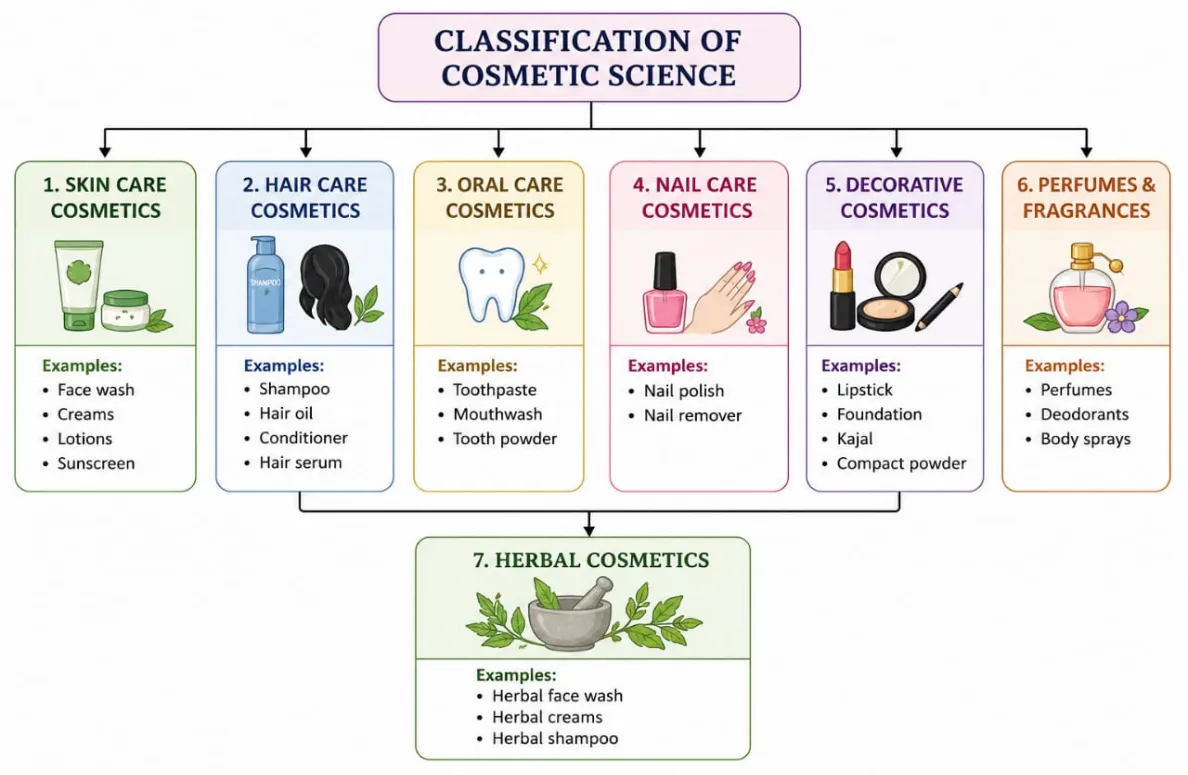
Fig.No.1 Classification of Cosmetic science
2. MATERIALS AND METHODS
2.1 Materials
Fresh radish pods (Raphanus sativus) were used as the herbal active material. The plant material was obtained from a local market in Kolhapur, Maharashtra. The excipients used for formulation development included Carbopol 934, sodium lauryl sulphate (SLS), glycerine, triethanolamine, methyl paraben, propyl paraben, rose oil, and distilled water. Ethanol was used as the extraction solvent. The required laboratory glassware, Soxhlet apparatus, heating mantle, water bath, weighing balance, pH meter, autoclave, incubator, and Brookfield viscometer were available in the laboratory.
2.2 Collection and Preparation of Plant Material
Fresh radish pods were collected from a local market in Kolhapur, Maharashtra. The collected material was thoroughly washed with tap water followed by distilled water to remove adhering dirt and other impurities. The cleaned pods were shade dried for several days and subsequently powdered using a grinder. The dried powdered material was stored in an airtight container until further use.
2.3 Preparation of Radish Pod Extract
The radish pod extract was prepared by Soxhlet extraction using ethanol as the extraction solvent. The dried and powdered plant material was placed in a Soxhlet extraction chamber using filter paper/Whatman filter paper. Approximately 50–100 g of powdered radish pods was used for extraction, while approximately 300–500 mL ethanol was employed as the solvent.
The Soxhlet apparatus consisted of a round-bottom flask containing ethanol, an extraction chamber containing the plant material, and a condenser. The system was maintained under continuous cold-water circulation through the condenser. The extraction was performed using a heating mantle, with the temperature maintained at approximately 40–45°C. Repeated cycles of evaporation, condensation, extraction, and siphoning were continued for approximately 10–12 h.
After completion of extraction, the obtained extract was filtered and concentrated using a water bath. The concentrated extract was collected in a clean airtight container and stored under refrigerated conditions until formulation.
2.4 Determination of Total Ash Value
The total ash value of the powdered radish pods was determined to assess the inorganic residue and general quality of the plant material. A clean, dry silica crucible was accurately weighed, followed by the addition of approximately 4 g of radish pod powder. The sample was gradually incinerated until the organic matter was completely removed and a carbon-free residue was obtained. The crucible was cooled in a desiccator and weighed.
The recorded weight of the empty crucible was 66.65 g, whereas the weight of the crucible containing ash was 66.78 g. The weight of ash was therefore 0.13 g, corresponding to a total ash value of 3.25% w/w.
2.5 Preliminary Phytochemical Screening
The ethanolic radish pod extract was subjected to preliminary phytochemical screening for the detection of different classes of phytoconstituents. The tests included qualitative identification of alkaloids, carbohydrates, cardiac glycosides, proteins and amino acids, flavonoids, phenolic compounds, tannins, saponins, glucosinolates, sulphur-containing compounds, coumarins, fixed oils and fats, vitamin C, and vitamin E.
The phytochemical tests were performed using standard qualitative chemical reactions. Positive reactions were identified from characteristic colour changes, precipitate formation, foam formation, or other observable reactions. The screening indicated the presence of several phytochemical groups in the radish pod extract.
2.6 Formulation Development of Herbal Face Wash
Three formulations, designated F1, F2, and F3, were developed to investigate the effect of varying SLS concentration on the performance of the herbal face wash. The concentration of radish pod extract and the other formulation components was maintained constant, whereas SLS was varied from 2.5 mL to 3.0 mL.
|
Sr. No. |
Ingredient |
Function |
F1 |
F2 |
F3 |
|
1 |
Radish pod extract |
Herbal active ingredient |
5 mL |
5 mL |
5 mL |
|
2 |
Carbopol 934 |
Thickening agent |
1 g |
1 g |
1 g |
|
3 |
Sodium lauryl sulphate |
Cleansing agent |
2.5 mL |
2.8 mL |
3.0 mL |
|
4 |
Glycerine |
Moisturizer/humectant |
5 mL |
5 mL |
5 mL |
|
5 |
Triethanolamine |
pH adjuster/neutralizing agent |
1.2 mL |
1.2 mL |
1.2 mL |
|
6 |
Propyl paraben |
Preservative |
0.02 g |
0.02 g |
0.02 g |
|
7 |
Methyl paraben |
Preservative |
0.1 g |
0.1 g |
0.1 g |
|
8 |
Rose oil |
Perfuming agent |
q.s. |
q.s. |
q.s. |
|
9 |
Distilled water |
Vehicle/solvent |
q.s. to 100 mL |
q.s. to 100 mL |
q.s. to 100 mL |
Table 1. Composition of the Developed Herbal Face Wash Formulations
The formulation composition was taken directly from the thesis formulation table.
2.7 Preparation of Optimized Face Wash Formulation
The optimized formulation F3 contained 5 mL radish pod extract, 1 g Carbopol 934, 3 mL SLS, 5 mL glycerine, 1.2 mL triethanolamine, 0.02 g propyl paraben, 0.1 g methyl paraben, rose oil q.s., and distilled water q.s. to 100 mL.
For preparation, approximately 60–70 mL purified water was taken in a beaker and the Carbopol was slowly dispersed into the water. The dispersion was allowed to hydrate for approximately 30–60 min. Glycerine was then incorporated and mixed uniformly. Triethanolamine was added gradually with continuous stirring to facilitate gel formation and thickening.
Methyl paraben and propyl paraben were dissolved in a small quantity of warm water and incorporated into the gel base. SLS was subsequently added slowly with gentle stirring to minimize excessive foaming. The measured quantity of radish pod extract was then incorporated and mixed uniformly. Rose oil was added at the final stage, followed by addition of purified water to make the final volume to 100 mL. The formulation was mixed thoroughly to obtain a smooth and homogeneous face wash.
2.8 Evaluation of the Prepared Face Wash
The developed formulations were evaluated for their physicochemical and performance characteristics. The evaluation parameters included organoleptic properties, washability, spreadability, grittiness, pH, viscosity, skin irritation, foamability, extrudability, stability, and antibacterial activity.
2.8.1 Organoleptic Evaluation
The formulations were examined for colour, odour, appearance, texture, and consistency. The observations were made visually and by sensory examination to assess uniformity, homogeneity, smoothness, and general acceptability of the formulation.
2.8.2 Washability
A small quantity of the face wash was applied to the skin and washed with water. The formulation was assessed for ease of removal and for the presence or absence of oily, sticky, or other undesirable residue after washing.
2.8.3 Spreadability
Spreadability was evaluated by placing a small quantity of formulation on a glass slide and covering it with another slide. A weight of up to 100 g was applied, and the spreading behaviour of the formulation was observed. Good spreadability was considered indicative of ease of application and uniform distribution over the skin surface.
2.8.4 Grittiness
The formulation was examined for the presence of coarse or hard particles. A small amount was rubbed between the fingers and applied to the skin to determine whether any gritty or grainy particles were present. A smooth formulation without detectable grittiness was considered desirable for topical application.
2.8.5 Determination of pH
The pH of the formulation was determined using a digital pH meter. Approximately 1 g of the formulation was dispersed in 100 mL distilled water and stirred until a uniform dispersion was obtained. The pH meter was calibrated using standard buffer solutions before measurement, after which the electrode was immersed into the prepared sample and the pH was recorded.
2.8.6 Determination of Viscosity
The viscosity of the face wash was determined using a Brookfield viscometer. The formulation was transferred into a suitable beaker, and the spindle was immersed in the sample. The instrument was operated at the selected rotational speed and the viscosity reading was recorded.
2.8.7 Skin Irritation Test
A small quantity of the formulation was applied to a small area of skin and observed for any visible signs of irritation. The test area was examined for redness, itching, swelling, or other undesirable reactions.
2.8.8 Foamability
One millilitre of the face wash was diluted with 10 mL distilled water in a measuring cylinder. The mixture was shaken vigorously and the foam formation and stability were observed. Foamability was considered as an indicator of cleansing performance and user acceptability.
2.8.9 Extrudability
The face wash was filled into a collapsible tube and manual pressure was applied to evaluate the ease of dispensing. The ability of the formulation to be extruded without excessive force was used as an indication of suitable consistency and convenience of application.
2.8.10 Stability Study
The prepared formulation was stored at room temperature and periodically observed for changes in colour, odour, pH, consistency, and phase separation. Retention of the original physical characteristics during storage was considered indicative of satisfactory stability.
2.8.11 Antibacterial Activity
The antibacterial activity of the formulated face wash was evaluated using the agar well diffusion method against Bacillus subtilis, Escherichia coli, and Staphylococcus aureus. The test organisms were evaluated for their response to the formulation by observing the clear zones of inhibition surrounding the sample-containing wells. The antibacterial activity was interpreted from the observed inhibition zones.
2.9 Selection of Optimized Formulation
The three formulations were comparatively assessed based on their physical characteristics and overall performance. F3 was selected as the optimized formulation because it demonstrated superior overall performance, including satisfactory cleansing ability, foamability, consistency, and spreadability. The optimized formulation was subsequently subjected to detailed evaluation and antibacterial assessment.
3. RESULTS AND DISCUSSION
3.1 Evaluation of Radish Pod Powder
The prepared radish pod powder was evaluated for its total ash value as a preliminary quality-control parameter. The total ash value was found to be 3.25% w/w. The observed value indicated the presence of a relatively low proportion of inorganic residue in the powdered plant material and supported its suitability for further extraction and formulation studies.
3.2 Phytochemical Screening of Radish Pod Extract
Preliminary phytochemical investigation of the ethanolic radish pod extract demonstrated the presence of several classes of phytoconstituents. The screening reported positive reactions for alkaloids, flavonoids, phenolic compounds, tannins, saponins, coumarins, glucosinolates, sulphur-containing compounds, and vitamins, among other constituents. The presence of these phytochemical groups provided a preliminary basis for investigating the extract as a herbal active ingredient in a topical cosmetic formulation.
|
Sr. No. |
Phytoconstituent |
Observation in thesis |
|
1 |
Alkaloids |
Positive |
|
2 |
Flavonoids |
Positive |
|
3 |
Phenolic compounds |
Positive |
|
4 |
Tannins |
Positive |
|
5 |
Saponins |
Positive |
|
6 |
Glucosinolates |
Positive |
|
7 |
Coumarins |
Positive |
|
8 |
Sulphur-containing compounds |
Positive |
|
9 |
Vitamin C |
Positive |
|
10 |
Vitamin E |
Positive |
Table 2. Preliminary phytochemical screening of ethanolic radish pod extract
The thesis reported positive qualitative reactions for these phytochemical groups; individual quantitative concentrations of the constituents were not determined.
3.3 Formulation Development
Three herbal face wash formulations, F1, F2, and F3, were developed by maintaining the amount of radish pod extract and other major excipients constant while varying the quantity of sodium lauryl sulphate. The SLS concentration was increased from 2.5 mL in F1 to 2.8 mL in F2 and 3.0 mL in F3. This formulation strategy was used to identify a batch with satisfactory cleansing, foamability, consistency, and application characteristics.
F3 contained 5 mL radish pod extract, 1 g Carbopol 934, 3 mL SLS, 5 mL glycerine, 1.2 mL triethanolamine, 0.02 g propyl paraben, 0.1 g methyl paraben, rose oil q.s., and distilled water q.s. to 100 mL.
The formulation development results indicated that increasing SLS to 3 mL in F3 produced the most satisfactory overall formulation characteristics among the tested batches. F3 was therefore selected as the optimized formulation for detailed evaluation.
3.4 Organoleptic Evaluation
The optimized formulation F3 exhibited satisfactory organoleptic characteristics. It showed a greenish colour, pleasant odour, semisolid consistency, homogeneous appearance, and smooth texture. The homogeneous nature indicated uniform distribution of formulation components, while the smooth texture was considered desirable for topical application.
|
Parameter |
Observation |
|
Colour |
Greenish |
|
Odour |
Pleasant |
|
Appearance |
Homogeneous |
|
Texture |
Smooth |
|
Consistency |
Semisolid |
Table 3. Organoleptic characteristics of optimized F3 formulation
The observed characteristics were considered satisfactory for a topical face wash preparation. The greenish colour was consistent with the incorporation of the herbal radish pod extract.
3.5 Washability
The optimized face wash showed good washability. On application and subsequent washing with water, the formulation was readily removed without leaving an oily, sticky, or excessively dry residue on the skin. Good washability is an important characteristic of a cleansing formulation because the product should effectively remove surface impurities while allowing convenient rinsing.
3.6 Spreadability
The formulation demonstrated good spreadability. When evaluated using the glass-slide method with a load of up to 100 g, the formulation spread rapidly and uniformly. The observed spreadability indicated that the optimized formulation could be distributed over the skin surface with comparatively little effort, which is desirable for a facial cleansing preparation.
3.7 Grittiness
The optimized face wash was found to be free from coarse or hard particles. No appreciable gritty sensation was observed when the formulation was rubbed between the fingers. The absence of grittiness indicated a smooth formulation and supported its suitability for comfortable topical application.
3.8 Determination of pH
The pH of the optimized formulation was found to be 5.75. The formulation was therefore mildly acidic and was considered suitable for topical application in the thesis evaluation. A controlled pH is important in facial cosmetic formulations because substantial deviation from skin-compatible conditions may adversely affect skin comfort and barrier properties.
3.9 Determination of Viscosity
The viscosity of F3 was determined using a Brookfield viscometer and was reported to be approximately 79,353 mPa·s at 15 rpm. The observed viscosity indicated a relatively thick consistency while maintaining suitability for application. The formulation was considered to possess acceptable consistency and flow characteristics for topical use.
|
Evaluation parameter |
Result/observation |
|
Colour |
Greenish |
|
Odour |
Pleasant |
|
Appearance |
Homogeneous |
|
Texture |
Smooth |
|
Consistency |
Semisolid |
|
Washability |
Good; easily rinsed |
|
Spreadability |
Good; rapid and uniform |
|
Grittiness |
Absent |
|
pH |
5.75 |
|
Viscosity |
Approximately 79,353 mPa·s at 15 rpm |
Table 4. Physicochemical evaluation of optimized F3
The above results demonstrate that the optimized formulation possessed acceptable physical characteristics for a herbal face wash.
3.10 Skin Irritation Study
The skin irritation evaluation showed that the prepared herbal face wash was non-irritant under the conditions described in the thesis. No redness, itching, swelling, or other visible irritation was observed after application. These findings supported the preliminary topical acceptability of the formulation.
It should be noted that the thesis does not provide a detailed numerical scoring system or statistical analysis for the irritation assessment; therefore, the result is reported qualitatively rather than as a quantitative safety endpoint.
3.11 Foamability
The optimized formulation demonstrated satisfactory foam formation and foam stability. In the evaluation, 1 mL of face wash was diluted with 10 mL distilled water and shaken vigorously. The formulation maintained foam stability for a suitable period. The observed foamability was considered supportive of its cleansing performance and user acceptability.
3.12 Extrudability
The formulation showed satisfactory extrudability. When placed in a collapsible tube and pressure was applied manually, the face wash could be dispensed without excessive force. This result indicated suitable consistency and convenient handling of the developed formulation.
3.13 Stability Study
The optimized formulation was stored at room temperature and monitored for changes in its physical characteristics. No significant changes in colour, odour, pH, consistency, or phase separation were observed during the reported storage period. The formulation therefore retained its original physical properties during the stability assessment.
|
Parameter monitored |
Observation |
|
Colour |
No significant change reported |
|
Odour |
No significant change reported |
|
pH |
No significant change reported |
|
Consistency |
No significant change reported |
|
Phase separation |
Not observed |
|
Overall physical stability |
Satisfactory |
Table 5. Stability observations of optimized F3 formulation
The stability findings support the physical robustness of the formulation under the storage conditions evaluated in the thesis. However, the exact duration and specific storage conditions should be stated in the final manuscript according to the original laboratory record if required by the target journal.
3.14 Antibacterial Activity
The antibacterial activity of the optimized radish pod face wash was evaluated by the agar well diffusion method against Bacillus subtilis, Escherichia coli, and Staphylococcus aureus. Clear zones of inhibition were observed around the wells containing the formulation, demonstrating antibacterial activity against all three tested organisms. The formulation showed noticeable inhibition against E. coli and B. subtilis, whereas comparatively moderate activity was reported against S. aureus.
|
Test organism |
Agar well diffusion result reported in thesis |
|
Bacillus subtilis |
Noticeable inhibition |
|
Escherichia coli |
Noticeable inhibition |
|
Staphylococcus aureus |
Moderate inhibition |
Table 6. Antibacterial activity of optimized F3 formulation
The observed antibacterial activity may be relevant to the intended cleansing application of the formulation. However, the thesis does not provide the numerical diameter of each zone of inhibition in the reported results. Therefore, numerical values should not be added to the journal manuscript unless they are available from the original experimental records.
3.15 Overall Discussion
The present formulation-development study demonstrated that radish pod extract could be incorporated into a semisolid herbal face wash containing Carbopol, SLS, glycerine, triethanolamine, preservatives, rose oil, and water. The development of F1, F2, and F3 with progressively increasing SLS concentrations provided a simple formulation optimization approach. Among the tested batches, F3 containing 3 mL SLS was selected as the optimized formulation based on its overall cleansing, foamability, consistency, and spreadability characteristics.
The optimized F3 formulation showed a homogeneous, smooth, semisolid product with pleasant odour and greenish colour. Its pH was 5.75, and the reported viscosity was approximately 79,353 mPa·s at 15 rpm. The formulation was easily washable, showed good spreadability, was free from detectable grittiness, and demonstrated satisfactory extrudability and foamability. No visible signs of irritation were observed during the reported skin irritation assessment.
The stability assessment further showed retention of the principal physical characteristics without significant colour, odour, pH, consistency, or phase-separation changes under the reported storage conditions. In addition, antibacterial testing demonstrated inhibition against the three organisms investigated. These findings collectively support the potential of the developed radish pod extract face wash as a herbal topical cleansing formulation.
Nevertheless, the present study is primarily a formulation-development and preliminary evaluation study. Further investigations involving quantitative phytochemical characterization, validated antimicrobial testing with numerical zone-of-inhibition data, microbial-limit testing, extended stability studies, and appropriately designed skin-safety studies would strengthen the evidence for further product development.
One important correction before we proceed: your thesis gives 79,353 mPa·s at 15 rpm in the detailed results, while the abstract states a broader 7,000–10,000 mPa·s range. For the research paper, I have used the detailed result (79,353 mPa·s) rather than the abstract range.
CONCLUSION
The present study successfully demonstrated the development and preliminary evaluation of a herbal face wash containing ethanolic extract of radish pods (Raphanus sativus). The radish pod material was subjected to drying, powdering, Soxhlet extraction, and preliminary phytochemical investigation. The extract showed the presence of several phytochemical groups, including flavonoids, phenolic compounds, tannins, saponins, glucosinolates, coumarins, and vitamins, while the total ash value of the powdered material was found to be 3.25% w/w.
Three formulations, F1, F2, and F3, were developed with different concentrations of sodium lauryl sulphate to optimize the formulation characteristics. Among the developed batches, F3 containing 3 mL SLS was selected as the optimized formulation based on its overall formulation performance.
The optimized F3 formulation exhibited a greenish colour, pleasant odour, homogeneous appearance, smooth texture, and semisolid consistency. It demonstrated good washability and spreadability, absence of grittiness, satisfactory foamability and extrudability, and no visible signs of skin irritation during the reported evaluation. The pH was found to be 5.75, while the viscosity was approximately 79,353 mPa·s at 15 rpm.
The formulation also retained its principal physical characteristics during the reported stability assessment. Antibacterial evaluation using the agar well diffusion method demonstrated inhibition against Bacillus subtilis, Escherichia coli, and Staphylococcus aureus.
Overall, the findings indicate that radish pod extract can be successfully incorporated into a herbal face wash and that the developed F3 formulation possesses satisfactory physicochemical and preliminary antibacterial characteristics. The study provides a basis for further investigation of radish pods as a potential herbal ingredient for topical cosmetic formulation development.
LIMITATIONS AND FUTURE SCOPE
Limitations
The present investigation was primarily focused on formulation development and preliminary evaluation of a radish pod extract-based face wash. The phytochemical investigation was qualitative and did not establish the individual concentrations of the identified phytoconstituents. Similarly, the antibacterial evaluation demonstrated inhibition against the selected microorganisms, but numerical zone-of-inhibition values and comparative statistical analysis were not reported in the thesis results.
The stability assessment was based mainly on physical observations. More extensive stability testing under standardized accelerated and long-term conditions would be required for comprehensive product characterization. The skin irritation assessment was also preliminary and did not include a detailed quantitative scoring system.
5.2 Future Scope
Further research may be directed toward quantitative characterization of the phytoconstituents present in radish pod extract and identification of the constituents potentially responsible for its biological activity. The antibacterial activity may be investigated using standardized antimicrobial protocols with quantitative measurements and appropriate controls.
Additional formulation studies could optimize the concentration of the herbal extract, surfactant, thickener, humectant, and other excipients to further improve formulation performance. Extended stability studies under controlled temperature and humidity conditions would provide additional information regarding product shelf life.
Future investigations may also include microbial-limit testing, preservative-efficacy testing, dermatological safety assessment, antioxidant evaluation, and comparative studies with marketed herbal face-wash products. These investigations could help establish the reproducibility, safety, efficacy, and potential commercial applicability of the developed radish pod face wash.
REFERENCES



Rutuja More*, Sanika Patil, Mahesh Thorat, Dhanraj Jadge, Formulation Development and Evaluation of a Herbal Face Wash Containing Radish Pod (Raphanus sativus) Extract, Int. J. Sci. R. Tech., 2026, 3 (8), 825-836. https://doi.org/10.5281/zenodo.22054491
 10.5281/zenodo.22054491