

We use cookies to ensure our website works properly and to personalise your experience. Cookies policy
Department of Pediatric Nursing, Little Flower College of Nursing
Early menarche, defined as the onset of menstruation before 8 years of age, poses significant physical and psychological challenges for children and their families.Maternal knowledge and preparedness play crucial roles in managing early puberty effectively.Objective: To assess mothers' knowledge regarding early menarche and evaluate their anxiety levels and preparedness in managing menstrual health for their daughters. Methods: A cross-sectional survey was conducted among 29 mothers of female children using a structured questionnaire comprising demographic data, 15 knowledge-based items, and 10 anxiety/attitude items on a 5-point Likert scale.Results: The mean knowledge score was 14.45±0.74 out of 15 (96.3%). Despite high knowledge levels, mothers reported moderate anxiety, particularly regarding their child's emotional changes (mean: 3.21), safety during puberty (mean: 3.10), and lack of knowledge about puberty (mean: 2.79). Confidence in managing puberty was moderate (mean: 3.38). Conclusion: While mothers demonstrate excellent knowledge about early menarche, significant anxiety persists, highlighting the need for targeted psychosocial support alongside educational interventions.
Early menarche, the onset of menstruation before 8 years of age, represents a significant deviation from normal pubertal development. The normal age of menarche ranges between 10–14 years, with variations influenced by genetic, nutritional, and environmental factors1. Early puberty has been associated with various psychosocial challenges including emotional stress, social stigma, and difficulties in adapting to rapid physical changes2.Mothers serve as primary caregivers and educators for children experiencing early menarche. Their knowledge levels, attitudes, and anxiety regarding this condition significantly influence the child's adaptation and psychological well-being. Despite the critical role of maternal preparedness, limited research has examined the dual dimensions of knowledge and anxiety among mothers of children with or at risk of early menarche.
OBJECTIVES
METHODOLOGY
Study Design and Setting
Cross-sectional descriptive study conducted through structured questionnaire administration.
Participants
A total of 29 mothers of female children participated in the study. Inclusion criteria: mothers with female children aged 6–14 years. Convenience sampling was employed.
Instruments: A structured questionnaire comprising three sections:
Scoring
STATISTICAL ANALYSIS
Descriptive statistics including frequencies, percentages, means, standard deviations, and medians were calculated.
RESULTS
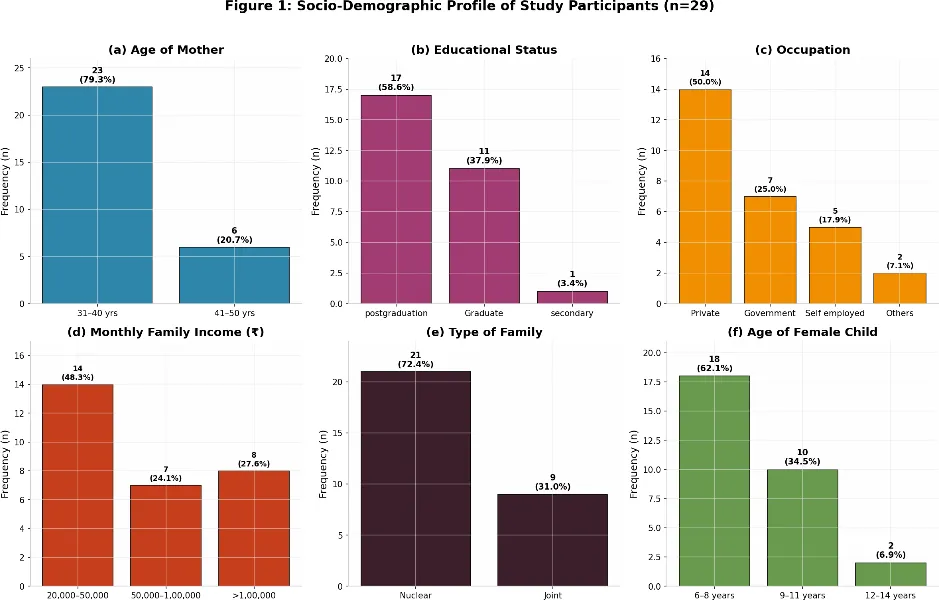
Socio-Demographic Characteristics
TABLE
|
Variable |
Category |
n (%) |
|
Age of mother |
31–40 years |
23 (79.3) |
|
|
41–50 years |
6 (20.7) |
|
Educational status |
Postgraduate |
17 (58.6) |
|
|
Graduate |
11 (37.9) |
|
|
Secondary |
1 (3.4) |
|
Occupation |
Private sector |
14 (50.0) |
|
|
Government |
7 (25.0) |
|
|
Self-employed |
5 (17.9) |
|
|
Others |
2 (7.1) |
|
Monthly family income |
₹20,000–50,000 |
14 (50.0) |
|
|
₹50,000–1,00,000 |
7 (25.0) |
|
|
>₹1,00,000 |
7 (25.0) |
|
Type of family |
Nuclear |
20 (69.0) |
|
|
Joint |
8 (27.6) |
|
|
Both |
1 (3.4) |
|
Number of children |
One |
11 (37.9) |
|
|
Two |
18 (62.1) |
|
Age of female child |
6–8 years |
17 (60.7) |
|
|
9–11 years |
9 (32.1) |
|
|
12–14 years |
2 (7.1) |
|
Variable |
Category |
n (%) |
|
Previous information about menarche |
Yes |
23 (82.1) |
|
|
No |
5 (17.9) |
|
|
Yes/No |
1 (3.6) |
1.1 Sources of Information
Table
|
Source |
n |
% |
|
Health personnel |
10 |
34.5 |
|
Family |
8 |
27.6 |
|
School |
7 |
24.1 |
|
Media |
6 |
20.7 |
|
Others |
3 |
10.3 |
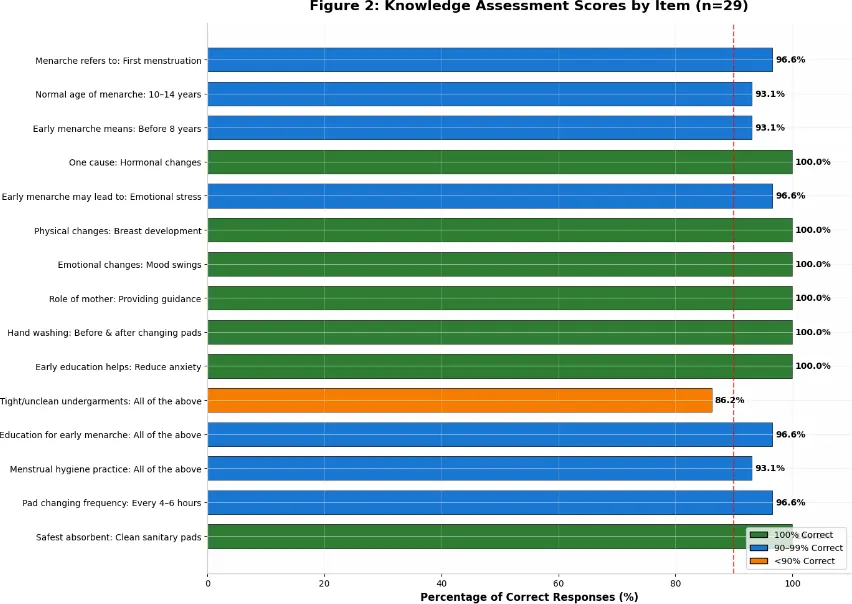
1.2 Knowledge Assessment
|
Knowledge Item |
Correct n |
Total n |
Correct % |
|
Menarche refers to: First menstruation |
28 |
29 |
96.6 |
|
The normal age of menarche is: 10–14 years |
27 |
29 |
93.1 |
|
Early menarche means: Before 8 years |
27 |
29 |
93.1 |
|
One cause of early menarche is: Hormonal changes |
29 |
29 |
100.0 |
|
Early menarche may lead to: Emotional stress |
28 |
29 |
96.6 |
|
Physical changes before menarche include: Breast development |
28 |
28 |
100.0 |
|
Emotional changes may include: Mood swings |
29 |
29 |
100.0 |
|
Role of mother includes: Providing guidance |
29 |
29 |
100.0 |
|
Hand washing during menstruation: Before and after changing pads |
29 |
29 |
100.0 |
|
Early education helps: Reduce anxiety |
29 |
29 |
100.0 |
|
Tight/unclean undergarments may cause: All of the above |
25 |
29 |
86.2 |
|
Early menarche requires education regarding: All of the above |
28 |
29 |
96.6 |
|
Practice for menstrual hygiene: All of the above |
27 |
29 |
93.1 |
|
Pad changing frequency: Every 4–6 hours |
28 |
29 |
96.6 |
|
Safest menstrual absorbent: Clean sanitary pads |
28 |
28 |
100.0 |
Overall Knowledge Score: Mean 14.45 ± 0.74 (Range: 13–15; Median: 15; Mean percentage: 96.3%)
Knowledge Score Distribution:
TABLE
|
Score |
n |
% |
|
13/15 |
4 |
13.8 |
|
14/15 |
8 |
27.6 |
|
15/15 |
17 |
58.6 |
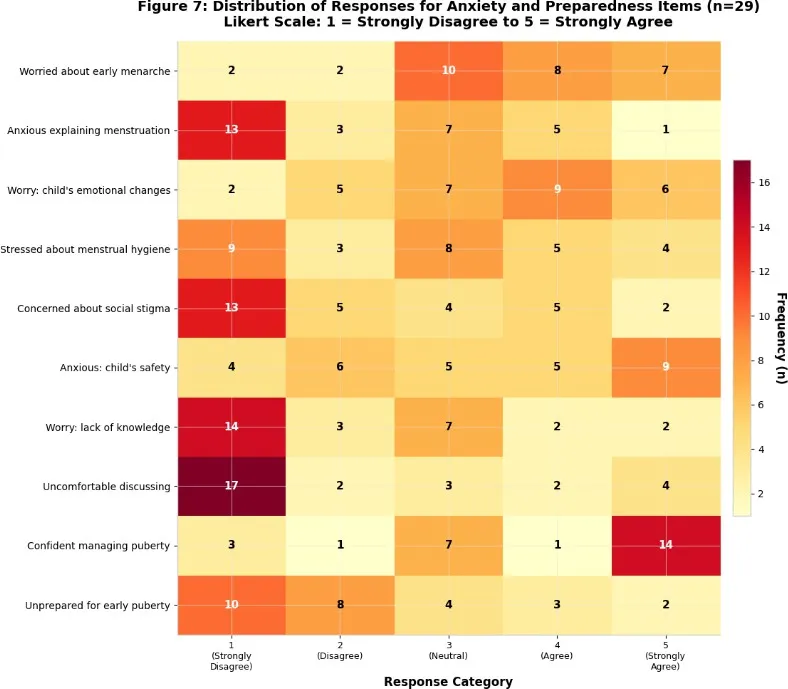
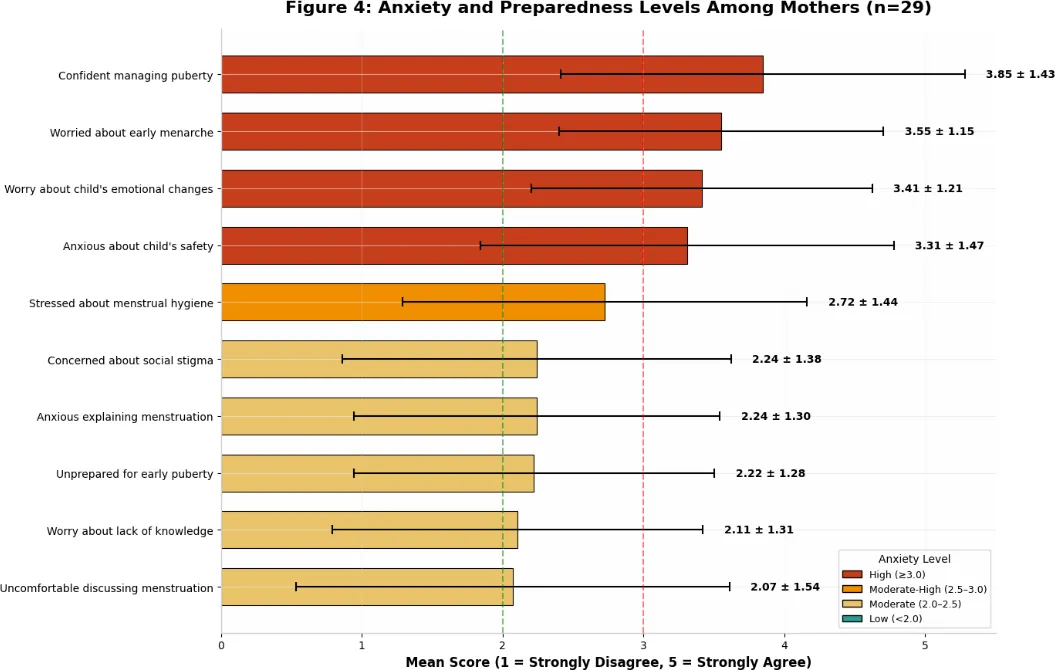
1.3 Anxiety and Preparedness Assessment
TABLE
|
Statement |
Mean |
Median |
SD |
Interpretation |
|
I feel worried about my child attaining early menarche |
3.55 |
3.0 |
1.14 |
Moderate worry |
|
I am anxious about explaining menstruation to my child |
2.14 |
1.0 |
1.24 |
Low anxiety |
|
I worry about my child's emotional changes |
3.21 |
3.0 |
1.28 |
Moderate worry |
|
I feel stressed about maintaining menstrual hygiene for my child |
2.79 |
3.0 |
1.38 |
Moderate stress |
|
I am concerned about social stigma related to early menarche |
2.38 |
2.0 |
1.24 |
Low-moderate concern |
|
I feel anxious about my child's safety during puberty |
3.10 |
3.0 |
1.35 |
Moderate anxiety |
|
I worry about lack of knowledge regarding puberty |
2.79 |
3.0 |
1.28 |
Moderate worry |
|
I feel uncomfortable discussing menstruation |
2.07 |
1.0 |
1.33 |
Low discomfort |
|
I feel confident in managing my child's puberty |
3.38 |
5.0 |
1.54 |
Moderate confidence |
|
I feel unprepared to handle early puberty issues |
2.24 |
2.0 |
1.30 |
Low-moderate unpreparedness |
Key Findings from Anxiety Assessment:
The study predominantly included educated mothers (96.5% with graduate or higher education), reflecting an urban, educated demographic. The majority (79.3%) were in the 31–40 years age group, representing active reproductive and parenting years. Nuclear families predominated (69.0%), consistent with contemporary urban Indian family structures.
Notably, 60.7% of mothers had children in the 6–8 years age group, the critical window for early menarche detection.
Mothers demonstrated exceptionally high knowledge (96.3% mean score), with 58.6% achieving perfect scores. This finding contrasts with several studies from developing countries reporting lower maternal knowledge about puberty [3,4]. The high educational status of participants (58.6% postgraduates) likely contributed to this outcome.
Strengths in knowledge:
Areas of relative deficiency:
The minor knowledge gaps suggest that while mothers understand basic concepts, nuanced aspects of comprehensive care require reinforcement.
Despite near-universal knowledge, mothers reported substantial anxiety across multiple domains. This "knowledge-anxiety paradox" represents the study's most significant finding:
Table
|
Domain |
Knowledge |
Anxiety |
Gap |
|
Definition of early menarche |
93.1% correct |
Worry about early menarche: 3.55 |
High |
|
Emotional consequences known |
96.6% correct |
Worry about emotional changes: 3.21 |
High |
|
Hygiene practices known |
96.6% correct |
Stress about hygiene maintenance: 2.79 |
Moderate |
This paradox suggests that knowledge alone does not translate to emotional preparedness. Mothers may intellectually understand early menarche but remain emotionally unprepared for its manifestation in their own children.
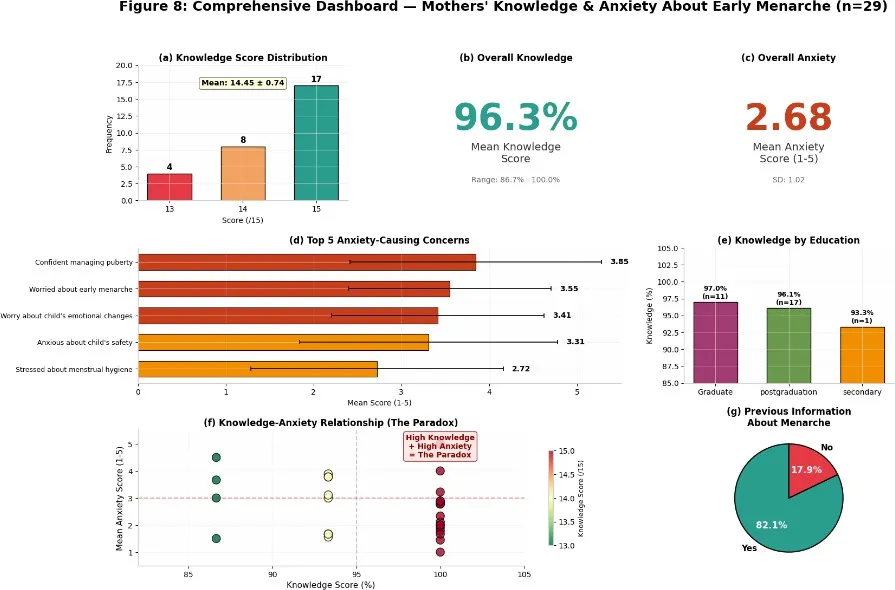
Health personnel (34.5%), family (27.6%), and schools (24.1%) emerged as primary information sources. The diversity of sources indicates good information accessibility for this educated cohort. However, the persistence of anxiety despite multiple information channels suggests that information quality and emotional support components may be inadequate.
CONCLUSION
This study reveals a critical disconnect between cognitive knowledge and emotional preparedness among mothers regarding early menarche. While the study population—predominantly educated, urban mothers—demonstrates excellent knowledge about early menarche definition, causes, consequences, and management, significant anxiety persists across multiple domains. The highest anxiety levels concern the child's emotional well-being and safety during puberty, areas where maternal emotional investment is greatest.
KEY RECOMMENDATIONS:
LIMITATIONS
FUTURE DIRECTIONS
REFERENCES

Karthika R.*, Susan Jacob, Meera R. Nair, Mother’s Knowledge And Anxiety Regarding Early Menarche In Children, Int. J. Sci. R. Tech., 2026, 3 (7), 489-498. https://doi.org/10.5281/zenodo.21410791
 10.5281/zenodo.21410791