View Article

Abstract

Unlike fossil Fuels Ethanol is one of the renewable energy sources produced by decomposing of sugars. Traditionally Distilleries are producing it by decomposing Molasses which is by product of sugar manufacturing process. The challenge is to increase the production of ethanol and getting high yield by changing the raw material i.e. using Sugarcane juice instead of Molasses. Further process changes, Design changes and Biological changes are studied.

Keywords

Ethanol, Yeast, Distillation, Sugarcane, Fuel

Introduction

× Popup Image

Ethanol is an essential part of the fuel industry in chemical engineering. Since humans are using organic and inorganic compounds those may be naturally found or prepared by some chemical and physical processes. Coming to the automobile industry ethanol usage in petrol was initially 5% and now it has been increased to 10%. It is having a huge impact on rising petrol prices. Now there are chances that the percentage of ethanol in petrol can be again increased and raised to 30%. In the future, we might be running all vehicles 100% on ethanol only as we can see a lack of sources of crude oil and they are going to get vanished soon. For many years we are producing ethanol from molasses with good efficiency.

In recent days if we see the demand for ethanol has increased as its part of fuel and energy. To fulfil that demand we need to produce ethanol and other resources also. Ethanol production from the raw material is dependent on the content of Reducing Sugar in that particular material. As we know sugarcane juice is having an abundant amount of sugar content that can be reduced and ethanol can be obtained more efficiently. The thesis is related to the optimization of the process for production of ethanol from sugarcane juice. Some design, process, and biological changes are to be observed and some suggestive measures to be given.

India is leading sugarcane producer in the world but a huge amount of sugarcane remains unprocessed due to unavailability of the facilities. Main agenda of this study is to utilize the unprocessed sugarcane for production of ethanol.
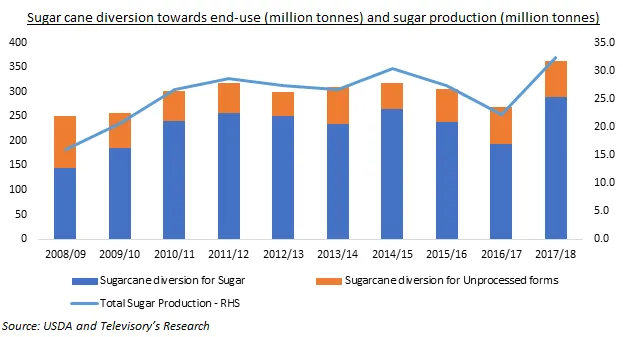
Fig -1: Sugarcane production and processing

2. PAPER BODY

Preliminary Analysis

Preliminary analysis is carried out to check properties of sugarcane syrup
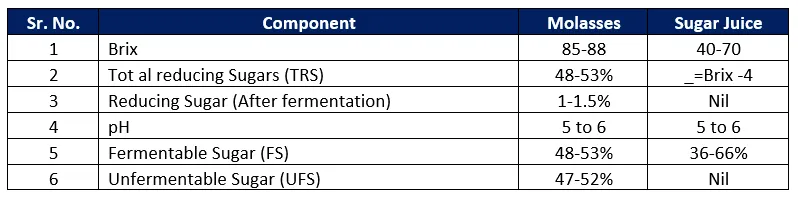
Table -1: Preliminary Analysis

Scope of Work 

In order to achieve the objective, the following scopes have been identified and to be applied:

  • To study the amount of ethanol yield from Sugarcane Juice fermentation process.
  • To investigate the effect of yeast quantity, temperature, and fermentation period on the ethanol yield using batch fermentation.
  • To suggest necessary design and process changes to the industry.

Cumulative Observation, I

Sample ratio components is 1:5

It is combination of juice in the ratio of 1:4 that means 85 ml of concentrated juice is added to 415ml of water.

2.5 gm of urea is added to the solution while adding 2.5gm of yeast.

The above sample is prepared to treat with Fali Fueling activated fermentation yeast for fermentation and below mentioned readings are taken on 25th January 2022 on the time mentioned in the table
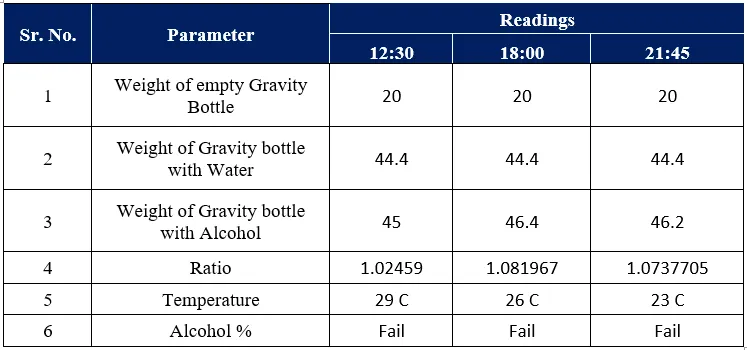
Table -2: Cumulative observation table I

Cumulative Reading II

Sample ratio components is 1:4

It is combination of juice in the ratio of 1:4 that means 100 ml of concentrated juice is added to 400ml of water.

2.5 gm of urea is added to the solution while adding 2.5gm of yeast.

The above sample is prepared to treat with Thermosacc XL fermentation yeast for fermentation and below mentioned readings are taken on 25th January 2022 on the time mentioned in the table.
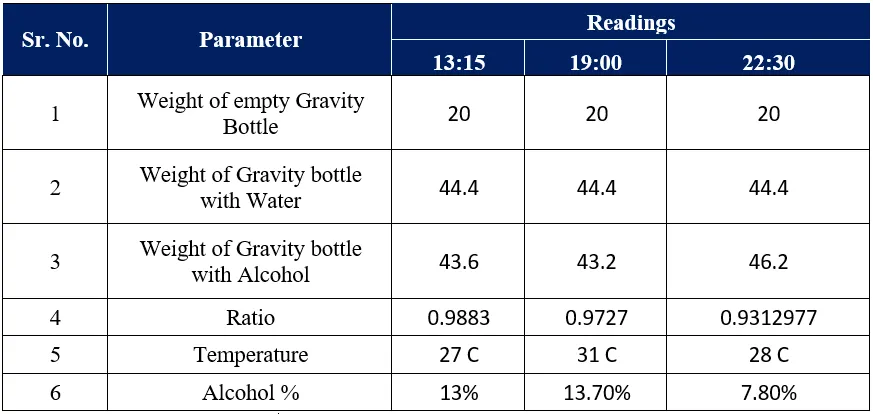
Table -3: Cumulative observation table II

Cumulative Reading III

Sample ratio components is 1:4

It is combination of juice in the ratio of 1:4 that means 100 ml of concentrated juice is added to 400ml of water.

2.5 gm of urea is added to the solution while adding 2.5gm of yeast.

The above sample is prepared to treat with Fali Fueling activated fermentation yeast for fermentation and below mentioned readings are taken on 25th January 2022 on the time mentioned in the table
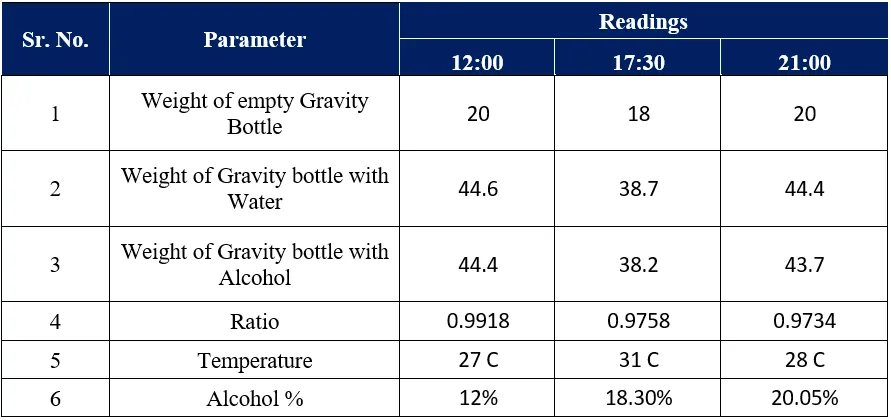
Table -4: Cumulative observation table III

Material Balance
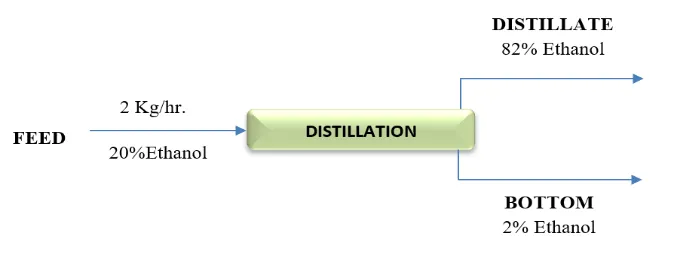
Fig -2: Overall Material Balance

                         X + Y=2                       ……………[i]

  • Material Balance of Ethanol:

Ethanol in Feed = Ethanol in Distillate + Ethanol in Bottom

     0.2 * 2   = 0.82X   +0.02Y        ……………[ii]
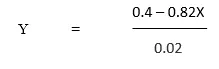
Y    =   20   -   41X           ……………[iii]

Put equation [i] in [iii],

X + (20 – 40X) = 2

X + 20 – 41X = 2

10 – 20X = 1

-20X = 1 – 10
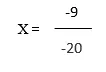
X = 0.45 kg/hr.

Now equation [i] becomes,

Y = 2 – 0.45

Y = 1.55 kg/hr.

Distillate Flow rate = 0.45 kg/hr.

Bottom Product      = 1.55 kg/hr.

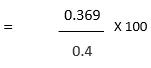
Ethanol in Distillate = 0.82 * 0.45

                                 = 0.369 kg/hr.

Ethanol in Feed = 0.2 * 2

                          = 0.4 kg/hr.
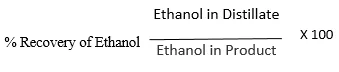
                                    = 92.25 %

CONCLUSION

To fulfill the demand of fuel market and to utilize the unprocessed sugarcane we can produce ethanol directly from sugarcane syrup instead of molasses. The yeast used for molasses for fermentation is not that much usefull because of excess sugar present, hence changing the yeast can give us better outcomes. As shown in material balance part we have derived 92% alcohol recovery by this process.

REFERENCES

  1. Marina O.S. Dias , Tassia L. Junqueira , Otávio Cavalett , Marcelo P. Cunha , Charles D.F. Jesus , Carlos E.V. Rossell , Rubens Maciel Filho , Antonio Bonomi   Integrated versus stand-alone second generation ethanol production from sugarcane bagasse and trash Bioresource Technology Volume 103, Issue 1, Published: January 2012    (1)
  2. Faculty of Chemical and Natural Resources Engineering Universiti Malaysia Pahang A thesis submitted in fulfillment of the requirements for the award of the degree of Bachelor of Chemical Engineering (Gas Technology) BIOETHANOL PRODUCTION FROM SUGAR CANE MOLASSE Published: 18th June 2012   (2)
  3. Kaur Harpreet .Keshri Rajan | Poduction of Ethanol from Sugarcane Molasses Published:09/05/2020    (3)
  4. Lei Liang, Yuan-ping Zhang, Li Zhang, Ming-jun Zhu, Shi-zhong Liang , Yu-nan Huang Study of sugarcane pieces as yeast supports for ethanol production from sugarcane juice and molasses Journal of Industrial Microbiology and Biotechnology, Volume 35, Issue 12, Published: 01 December 2008    (4)
  5. Audiananti Meganandi Kartini1 , Yeny Dhokhikah2 Environmental Engineering Study Program, Engineering Faculty, University of Jember1,2 Tegalboto Campus, Jl. Kalimantan No. 37, Sumbersari, Krajan Timur, Sumbersari, Jember Regency, East Java 68121, Indonesia1,2 | Bioethanol Production from Sugarcane Molasses with Simultaneous Saccharification and Fermentation (SSF) Method using Saccaromyces cerevisiae-Pichia stipitis Consortium | 1st International Conference on Food and Agriculture 2018 | IOP Conf. Series: Earth and Environmental Science 207 (2018) 012061   (5)
  6. Ashwini P., Dr. Preeti Rawat (2015) | Production of Ethanol | Microbiology | Industrial and Environmental Microbiology | Unit 3: Microbial production of industrial products | Topics: Ethanol production (2015)    (6)
  7. Hamid Zentou1 *, Zurina Zainal Abidin2 , Mustapha Zouanti3 , Darren Greetham4 | Effect of Operating Conditions on Molasses fermentation for Bioethanol production | International Journal of Applied Engineering Research ISSN 0973-4562 Volume 12, Number 15 (2017) pp. 5202-5506   (7)

Reference

  1. Marina O.S. Dias , Tassia L. Junqueira , Otávio Cavalett , Marcelo P. Cunha , Charles D.F. Jesus , Carlos E.V. Rossell , Rubens Maciel Filho , Antonio Bonomi   Integrated versus stand-alone second generation ethanol production from sugarcane bagasse and trash Bioresource Technology Volume 103, Issue 1, Published: January 2012    (1)
  2. Faculty of Chemical and Natural Resources Engineering Universiti Malaysia Pahang A thesis submitted in fulfillment of the requirements for the award of the degree of Bachelor of Chemical Engineering (Gas Technology) BIOETHANOL PRODUCTION FROM SUGAR CANE MOLASSE Published: 18th June 2012   (2)
  3. Kaur Harpreet .Keshri Rajan | Poduction of Ethanol from Sugarcane Molasses Published:09/05/2020    (3)
  4. Lei Liang, Yuan-ping Zhang, Li Zhang, Ming-jun Zhu, Shi-zhong Liang , Yu-nan Huang Study of sugarcane pieces as yeast supports for ethanol production from sugarcane juice and molasses Journal of Industrial Microbiology and Biotechnology, Volume 35, Issue 12, Published: 01 December 2008    (4)
  5. Audiananti Meganandi Kartini1 , Yeny Dhokhikah2 Environmental Engineering Study Program, Engineering Faculty, University of Jember1,2 Tegalboto Campus, Jl. Kalimantan No. 37, Sumbersari, Krajan Timur, Sumbersari, Jember Regency, East Java 68121, Indonesia1,2 | Bioethanol Production from Sugarcane Molasses with Simultaneous Saccharification and Fermentation (SSF) Method using Saccaromyces cerevisiae-Pichia stipitis Consortium | 1st International Conference on Food and Agriculture 2018 | IOP Conf. Series: Earth and Environmental Science 207 (2018) 012061   (5)
  6. Ashwini P., Dr. Preeti Rawat (2015) | Production of Ethanol | Microbiology | Industrial and Environmental Microbiology | Unit 3: Microbial production of industrial products | Topics: Ethanol production (2015)    (6)
  7. Hamid Zentou1 *, Zurina Zainal Abidin2 , Mustapha Zouanti3 , Darren Greetham4 | Effect of Operating Conditions on Molasses fermentation for Bioethanol production | International Journal of Applied Engineering Research ISSN 0973-4562 Volume 12, Number 15 (2017) pp. 5202-5506   (7)

Photo
Rushikesh Khade
Corresponding author

Tatyasaheb Kore Institue Of Engineering and Technology. Warananagar

Photo
Prashant Dehankar
Co-author

Tatyasaheb Kore Institue Of Engineering and Technology. Warananagar

Photo
Kalyan Patil
Co-author

Tatyasaheb Kore Institue Of Engineering and Technology. Warananagar

Photo
Shilpa Patil
Co-author

Tatyasaheb Kore Institue Of Engineering and Technology. Warananagar

Rushikesh Khade*, Prashant Dehankar, Shilpa Patil, Kalyan Patil, Optimization Of Production Of Ethanol By Using Sugarcane Juice As A Raw Material Instead Of Molasses, Int. J. Sci. R. Tech., 2026, 3 (6), 768-771. https://doi.org/10.5281/zenodo.20642837

More related articles
Comprehensive Study of Partial Replacement of Ceme...
Dr. Pranab Jyoti Barman, Manjit Pathak, Ritushna Sarmah, Gyandeep...
A Review on Role of Colophony in Different Formula...
Rushikesh Sanap, Araj Ishwar, Bhad Manoj, Pund Sonali, Sarukh Vik...
A Review on Role of Colophony in Different Formula...
Rushikesh Sanap, Araj Ishwar, Bhad Manoj, Pund Sonali, Sarukh Vik...
The Effect of Preheating Mold Changeover on Production Efficiency and Product Qu...
Kurniawan Adi Prasetyo, Yudi Prastyo, Mohammad Ibnu Fakih Husen, Ibnu Williyansyah, Bambang Tri Asha...
Nature’s Sugar Destroyer: Phytochemical Diversity And Free Radical Scavenging ...
Patel Aesha, Solanki Hitesh, Pandya Himanshu, Maitreya Anusha...
Formulation and Development of Herbal Gel Utilizing Natural Fruit Extracts....
SAIYED SELIM ALI, PINTU KUMAR DE, HIMANGSHU SEKHAR MAJI, ABDUS SAMAD ...
Related Articles
Microbial Production of Xanthan Gum Using Various Agro Wastes and Molecular Char...
Ajayi Oluwatosin Itunu , J. A. Tutuwa, A. K. Lawal, O. A. Thonda, A. D. Aina, J. Ehiwuogu-Onyibe, C....
Chemical Evaluation of Vitamin C and Reducing Properties of Selected Fruit Juice...
Naveen Awasthi, Rajesh Kishor Tripathi, Divya Jyoti Mishra...
A Study on the Different Types of Biochar on the Geotechnical Behaviour of Local...
Dr. Pranab Jyoti Barman, Rahul Bey, Rajashree Bora, Nandini Batsah, Kangkana Gogoi, Jubli Jaman, Dee...
Comprehensive Study of Partial Replacement of Cement with Biochar in Concrete...
Dr. Pranab Jyoti Barman, Manjit Pathak, Ritushna Sarmah, Gyandeep Das, Ankita Gogoi, Manash Pratim D...
More related articles
Comprehensive Study of Partial Replacement of Cement with Biochar in Concrete...
Dr. Pranab Jyoti Barman, Manjit Pathak, Ritushna Sarmah, Gyandeep Das, Ankita Gogoi, Manash Pratim D...
A Review on Role of Colophony in Different Formulation...
Rushikesh Sanap, Araj Ishwar, Bhad Manoj, Pund Sonali, Sarukh Vikram...
A Review on Role of Colophony in Different Formulation...
Rushikesh Sanap, Araj Ishwar, Bhad Manoj, Pund Sonali, Sarukh Vikram...
Comprehensive Study of Partial Replacement of Cement with Biochar in Concrete...
Dr. Pranab Jyoti Barman, Manjit Pathak, Ritushna Sarmah, Gyandeep Das, Ankita Gogoi, Manash Pratim D...
A Review on Role of Colophony in Different Formulation...
Rushikesh Sanap, Araj Ishwar, Bhad Manoj, Pund Sonali, Sarukh Vikram...
A Review on Role of Colophony in Different Formulation...
Rushikesh Sanap, Araj Ishwar, Bhad Manoj, Pund Sonali, Sarukh Vikram...