

We use cookies to ensure our website works properly and to personalise your experience. Cookies policy
Department of Pharmacology, Anuradha College of Pharmacy, Chikhli, Dist. Buldhana, Maharashtra, India
Liver disorders are among the major health challenges worldwide, often resulting from exposure to toxins, drugs, alcohol, and oxidative stress. The present study aimed to develop and evaluate a polyherbal hepatoprotective formulation containing extracts of Michelia champaca, Curcuma longa, and Emblica officinalis. The selected plants were subjected to pharmacognostic, physicochemical, and phytochemical evaluations to ensure their authenticity and quality. A polyherbal capsule formulation was prepared and evaluated for various quality control parameters, including appearance, weight variation, disintegration time, and microbial load. Hepatoprotective activity was assessed using a carbon tetrachloride (CCl?)-induced hepatotoxicity model in rats. Biochemical parameters such as AST, ALT, ALP, GGT, bilirubin, urea, and creatinine were estimated along with antioxidant markers including TBARS, GSH, SOD, and catalase. Histopathological examination of liver tissues was also performed. The results demonstrated that the polyherbal formulation significantly restored altered biochemical parameters, enhanced antioxidant enzyme levels, reduced lipid peroxidation, and improved liver histoarchitecture compared with the toxic control group. The hepatoprotective effect was comparable to that of the standard drug silymarin. These findings suggest that the polyherbal formulation possesses significant hepatoprotective, antioxidant, and membrane-stabilizing properties and may serve as a promising natural therapeutic agent for the management of liver disorders.
The liver is one of the most vital organs in the human body and plays a central role in metabolism, detoxification, protein synthesis, bile production, and regulation of various biochemical processes. Due to its continuous exposure to xenobiotics, environmental toxins, drugs, alcohol, and infectious agents, the liver is highly susceptible to injury. Liver diseases such as hepatitis, cirrhosis, fatty liver disease, and drug-induced hepatotoxicity are major global health concerns and contribute significantly to morbidity and mortality worldwide.[1] Medicinal plants have been extensively used in traditional systems of medicine for the treatment of liver disorders.[2] Among these, Michelia champaca, Emblica officinalis (Amla), and Curcuma longa (Turmeric) possess significant antioxidant, anti-inflammatory, and hepatoprotective properties. Michelia champaca contains essential oils, flavonoids, and alkaloids that exhibit antioxidant and anti-inflammatory activities. Emblica officinalis is rich in vitamin C, tannins, emblicanins, and polyphenols, which help protect hepatocytes from oxidative stress and cellular damage. Curcuma longacontains curcumin and related curcuminoids known for their potent antioxidant, anti-inflammatory, and liver-protective effects.[3]
Hepatotoxicity is commonly induced by chemicals, pharmaceuticals, and oxidative stress, leading to cellular damage, inflammation, and impaired liver function. Although several synthetic drugs are available for the management of liver disorders, their effectiveness is often limited and may be associated with adverse effects.[4] Therefore, there is an increasing interest in the development of safer and more effective hepatoprotective agents derived from natural sources.Medicinal plants have been utilized for centuries in traditional systems of medicine due to their therapeutic properties. Numerous herbal extracts possess hepatoprotective activity owing to the presence of bioactive phytoconstituents such as flavonoids, phenolic compounds, alkaloids, tannins, terpenoids, and saponins.[5] These compounds exert antioxidant, anti-inflammatory, membrane-stabilizing, and free radical scavenging effects, thereby protecting hepatic tissues against toxic insults.[6]
Herbal combinations have gained considerable attention because they may provide synergistic therapeutic effects compared to individual plant extracts. The combination of multiple medicinal plants can enhance efficacy by targeting different pathological pathways involved in liver injury, including oxidative stress, inflammation, lipid peroxidation, and apoptosis. Such polyherbal formulations are increasingly being explored as potential alternatives for the prevention and treatment of liver diseases.Experimental animal models are widely employed to evaluate the hepatoprotective potential of novel therapeutic agents. Chemical-induced liver injury models, such as those using carbon tetrachloride (CClâ‚„), paracetamol, or thioacetamide, closely mimic human liver damage and are useful for assessing the efficacy of hepatoprotective compounds. Evaluation of biochemical markers including serum glutamate oxaloacetate transaminase (SGOT/AST), serum glutamate pyruvate transaminase (SGPT/ALT), alkaline phosphatase (ALP), bilirubin levels, and histopathological examination provides reliable evidence of liver protection.[7]
The present study aims to investigate the hepatoprotective activity of a novel herbal combination in an experimental model of liver injury. The study evaluates the ability of the herbal formulation to restore altered biochemical parameters, reduce oxidative stress, and improve histopathological changes in hepatic tissue. The findings of this research may contribute to the development of an effective and safe herbal therapeutic approach for the management of liver disorders and support the scientific validation of traditional medicinal plants as hepatoprotective agents.[8]
MATERIALS AND METHODS
Plant Material Collection and Authentication
Fresh plant materials of Michelia champaca flowers, Emblica officinalis fruits, and Curcuma longa rhizomes were collected from the Chikhli region, Buldana district, Maharashtra, India. The collected plant materials were authenticated by Dr. Pramod R. Padole, Department of Botany, Shivaji Science and Arts College, Chikhli (Buldana). Voucher specimens (ACP/HF-486, ACP/HF-487, and ACP/HF-488) were deposited in the institutional herbarium for future reference.The collected plant materials were washed, shade-dried at room temperature under controlled humidity conditions, and pulverized into coarse powder. The powdered materials were passed through sieve No. 40 and stored in airtight containers until further use.
Preparation of Extracts
The dried powdered plant materials (1 kg each) were subjected to continuous hot extraction using ethanol as solvent in a Soxhlet apparatus for 72 hours. The extracts obtained were concentrated under reduced pressure using a rotary vacuum evaporator and dried to obtain semisolid masses. The percentage yield of each extract was calculated with reference to the air-dried plant material. The dried extracts were stored at 4°C until further use.[9]
|
Sr. No. |
Parameter Evaluated |
Method/Procedure |
Purpose |
|
1 |
Alcohol-Soluble Extractive Value |
Maceration of powdered drug with alcohol followed by evaporation and weighing of residue |
Determines the amount of active constituents soluble in alcohol |
|
2 |
Water-Soluble Extractive Value |
Maceration with water followed by evaporation and weighing of residue |
Estimates water-soluble phytoconstituents |
|
3 |
Chloroform-Soluble Extractive Value |
Maceration with chloroform followed by evaporation and weighing |
Indicates presence of non-polar constituents |
|
4 |
Petroleum Ether-Soluble Extractive Value |
Maceration with petroleum ether followed by evaporation and weighing |
Evaluates lipid-soluble constituents |
|
5 |
Loss on Drying (%) |
Drying at 105°C until constant weight is obtained |
Determines moisture and volatile matter content |
|
6 |
Total Ash Value |
Incineration of powdered drug in silica crucible |
Measures total inorganic content present in the drug |
|
7 |
Acid-Insoluble Ash Value |
Treatment of total ash with dilute HCl followed by filtration and ignition |
Estimates silica and earthy matter contamination |
|
8 |
Heavy Metal Analysis |
WHO recommended procedures for arsenic, cadmium, mercury, and lead |
Ensures safety and quality of herbal material |
|
9 |
Organoleptic Evaluation |
Assessment of color, odor, taste, texture, and appearance |
Preliminary identification and quality assessment |
|
10 |
Powder Characteristics |
Examination of color, texture, and particle size of powdered drug |
Authentication and standardization of crude drug |
Table: Pharmacognostic Evaluation of Selected Medicinal Plants [10-15]
Formula for Loss on Drying
Loss on Drying (%) = ((Initial Weight − Final Weight) / Initial Weight) × 100
Formulation of Polyherbal Capsules
The dried ethanolic extracts of Michelia champaca, Emblica officinalis, and Curcuma longa were selected for the preparation of a polyherbal capsule formulation. All raw materials were standardized according to WHO guidelines. Excipients were dried separately in a tray dryer at 100°C for 30 minutes before use. The extracts and excipients were accurately weighed, blended uniformly, lubricated with magnesium stearate, and mixed thoroughly for 30 minutes. The final blend was packed in polyethylene bags, labeled, and used for capsule filling and evaluation.[16]
|
Sr. No. |
Ingredient |
Quantity (mg/capsule) |
Function |
|
1 |
Michelia champaca extract |
100 |
Hepatoprotective agent |
|
2 |
Emblica officinalis extract |
100 |
Hepatoprotective agent |
|
3 |
Curcuma longa extract |
100 |
Hepatoprotective agent |
|
4 |
Lactose |
25 |
Diluent |
|
5 |
Sodium Starch Glycolate |
5 |
Disintegrant |
|
6 |
Magnesium Stearate |
4 |
Lubricant |
|
7 |
Talc |
16 |
Glidant |
Table : Composition of Polyherbal Capsule Formulation
Total Weight per Capsule = 350 mg
Bulk characterization of blend
Various trial batches were formulated by varying the composition of excipient proportions and the powder were evaluated for its flow characteristics. The blended powder of all five trial batches was analyzed for its flow characteristics like bulk density, tap density, compressibility index, Hausner’s ratio and angle of repose. From the five trial batches one optimized batch is selected for formulation based on above test results.[17]
Preparation of capsules
The optimized batch were filled in “00” size capsules to an average net content weight of 500 mg.Capsules were then dedusted transferred into self-sealed polybags, labelled and the samples were evaluated as per testing requirements.[18]
Evaluation of polyherbal capsules
The developed capsules were evaluated for the following parameters for the purpose of standardization: Description of capsules, physical and physicochemical parameters, qualitative and quantitative phytochemical studies, heavy metal analysis and microbial load analysis. Capsule evaluation. The polyherbal capsules were evaluated for its description; average weight & uniformity of weight, disintegration test, pH and moisture content, the observations were compared with Indian Pharmacopoeial standards.[19,2]
RESULT:
Morphological Studies
The morphological characteristics of Michelia champaca (leaves), Curcuma longa (rhizomes), and Emblica officinalis (fruits) were evaluated based on color, odor, taste, size, and shape. The observed characteristics were consistent with standard pharmacognostic descriptions and Ayurvedic references, confirming the authenticity of the plant materials.
|
Plant |
Part Used |
Color |
Odor |
Taste |
|
M. champaca |
Leaves |
Dark green |
Characteristic |
Bitter and astringent |
|
C. longa |
Rhizomes |
Yellowish-brown |
Characteristic |
Spicy |
|
E. officinalis |
Fruits |
Light green |
Fruity |
Sour and astringent |
Powder Microscopy
Powder microscopy confirmed the identity of the selected crude drugs through characteristic diagnostic features:
These microscopic features verified the purity and authenticity of the plant materials.
Extraction Yield
Alcoholic extracts were prepared using the Soxhlet extraction method.
|
Plant |
Extract Yield (%) |
|
M. champaca |
12.52 ± 2.67 |
|
C. longa |
14.18 ± 1.08 |
|
E. officinalis |
20.83 ± 3.33 |
Among the selected plants, E. officinalis showed the highest extraction yield, indicating a higher amount of alcohol-soluble constituents.
Pharmacognostic Parameters
The physicochemical evaluation revealed acceptable values for loss on drying, ash values, and extractive values, indicating good quality crude drugs. E. officinalis exhibited the highest water-soluble extractive value (46.23%), while C. longa showed the highest total ash value (9.35%).The morphological, microscopic, extraction yield, and physicochemical studies confirmed the identity, purity, and quality of M. champaca, C. longa, and E. officinalis. The obtained results support their suitability for the preparation of the polyherbal hepatoprotective formulation.
Formulation and Evaluation of Polyherbal Capsules
The polyherbal capsule formulation containing extracts of Michelia champaca, Curcuma longa, and Emblica officinalis was prepared using lactose, sodium starch glycolate, magnesium stearate, and talc. The formulation was evaluated for physical and microbiological parameters and found to comply with official standards, indicating its safety and quality.
Table Evaluation of Capsules
|
Sr. No. |
Test |
Observation |
|
1 |
Appearance |
Light green |
|
2 |
Size |
00 |
|
3 |
Shape |
Capsule |
|
4 |
Weight |
400 ± 20 mg |
|
5 |
Disintegration Time |
5 min 7 sec |
|
6 |
Aerobic CFU (NMT 1000) |
320 |
|
7 |
Anaerobic CFU (NMT 100) |
60 |
The prepared capsules showed acceptable physical characteristics, rapid disintegration, and microbial counts within permissible limits.
Hepatoprotective Activity
The hepatoprotective activity of the polyherbal formulation was evaluated against CClâ‚„-induced liver toxicity in rats. CClâ‚„ treatment significantly elevated serum liver enzymes (AST, ALT, ALP, and GGT), indicating hepatic damage. Treatment with the polyherbal extract significantly reduced these elevated enzyme levels, demonstrating hepatoprotective activity comparable to the standard drug silymarin.
Table Effect on Serum Liver Marker Enzymes
|
Group |
AST (IU/L) |
ALT (IU/L) |
ALP (IU/L) |
GGT (IU/L) |
|
I (Control) |
12.73 ± 2.97 |
29.20 ± 6.89 |
66.59 ± 8.99 |
43.09 ± 3.11 |
|
II (CClâ‚„) |
115.47 ± 12.21 |
141.37 ± 16.59 |
200.63 ± 9.70 |
142.66 ± 5.58 |
|
III (Silymarin + CClâ‚„) |
24.41 ± 2.26 |
37.36 ± 5.26 |
74.74 ± 4.74 |
37.19 ± 3.34 |
|
IV (Polyherbal Extract + CClâ‚„) |
14.15 ± 3.51 |
25.16 ± 2.34 |
68.23 ± 8.00 |
42.16 ± 3.86 |
The polyherbal formulation effectively restored liver enzyme levels toward normal, confirming its significant hepatoprotective potential against CClâ‚„-induced liver damage.
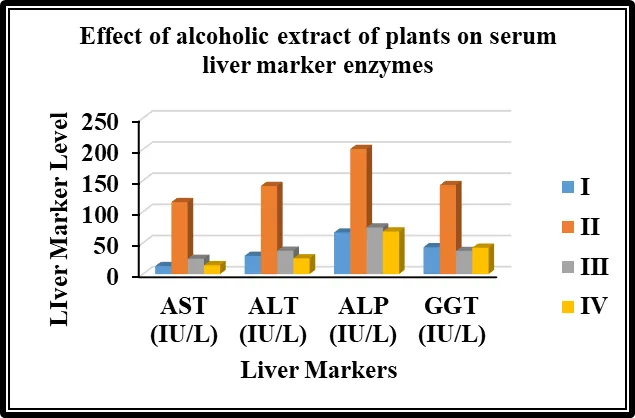
Figure. Effect of alcoholic extract of plants on serum liver marker enzymes
Effect on Renal Markers
Assessment of liver and kidney function was carried out by estimating serum levels of urea, creatinine, and total bilirubin. Administration of CClâ‚„ significantly increased these parameters, indicating hepatic and renal damage. Treatment with the polyherbal extract and standard drug silymarin significantly reduced the elevated levels and restored them towards normal values. No significant changes were observed in the extract-alone treated group compared with the normal control, indicating the safety of the formulation.
Table Effect of Polyherbal Extract on Renal Markers in CClâ‚„-Induced Toxicity
|
Group |
Urea (mg/dL) |
Creatinine (mg/dL) |
Total Bilirubin (mg/dL) |
|
I (Control) |
33.05 ± 3.92 |
0.79 ± 0.02 |
0.83 ± 0.14 |
|
II (CClâ‚„) |
55.12 ± 7.52 |
1.87 ± 0.02 |
1.12 ± 0.19 |
|
III (Silymarin + CClâ‚„) |
40.50 ± 3.54 |
1.25 ± 0.02 |
0.90 ± 0.33 |
|
IV (Polyherbal Extract + CClâ‚„) |
38.21 ± 3.14 |
0.80 ± 0.02 |
0.75 ± 0.04 |
Values are expressed as Mean ± SD (n = 6); p < 0.05.The polyherbal formulation significantly reduced elevated urea, creatinine, and total bilirubin levels in CClâ‚„-treated rats, demonstrating its protective effect against hepatic and renal damage.
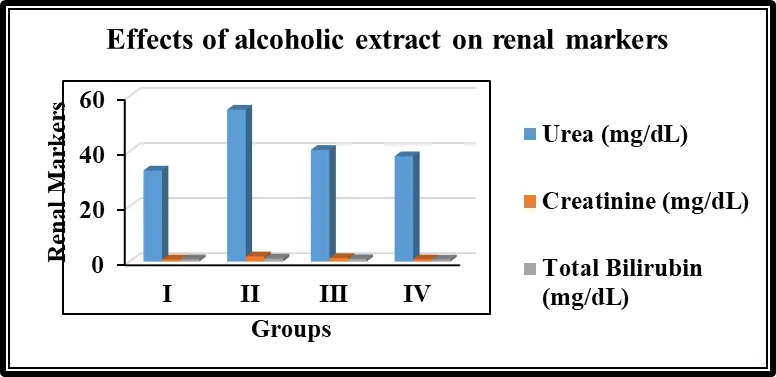
Figure : Effects of alcoholic extract on renal marker
Antioxidant and Membrane Stabilizing Activity
Total bilirubin is an important indicator of liver function, while serum urea and creatinine reflect kidney function. CClâ‚„ administration significantly increased bilirubin, urea, and creatinine levels, indicating hepatic and renal damage. Treatment with the polyherbal formulation reduced these levels, suggesting improvement in liver and kidney functions.The formulation also significantly decreased elevated SGOT, SGPT, and TBARS levels while increasing antioxidant enzymes such as GSH, SOD, and Catalase, demonstrating strong antioxidant and hepatoprotective effects.
Table Effect of Polyherbal Formulation on Oxidative Stress Markers
|
Group |
SGPT (IU/L) |
SGOT (IU/L) |
TBARS |
GSH |
SOD |
Catalase |
|
I (Normal) |
43.55 ± 2.58 |
37.25 ± 3.75 |
1.86 ± 0.23 |
10.82 ± 2.43 |
7.47 ± 1.84 |
93.23 ± 2.45 |
|
II (CClâ‚„) |
139.21 ± 5.88 |
179.24 ± 6.72 |
5.80 ± 1.12 |
4.34 ± 0.95 |
3.02 ± 0.66 |
30.26 ± 0.91 |
|
III (Silymarin + CClâ‚„) |
78.21 ± 4.93 |
98.40 ± 4.72 |
3.04 ± 0.81 |
6.12 ± 1.34 |
5.32 ± 0.89 |
58.23 ± 1.93 |
|
IV (Polyherbal Extract + CClâ‚„) |
49.02 ± 4.13 |
63.34 ± 3.82 |
2.17 ± 0.42 |
8.45 ± 1.98 |
7.35 ± 0.92 |
75.21 ± 2.18 |
The polyherbal formulation significantly reduced oxidative stress and restored antioxidant defense mechanisms in CClâ‚„-induced hepatotoxicity.
Estimation of Membrane-Bound ATPases
Membrane-bound ATPases such as Naâº/Kâº-ATPase, Mg²âº-ATPase, and Ca²âº-ATPase are essential for maintaining cellular ion balance and membrane integrity. CClâ‚„-induced oxidative stress significantly reduced the activity of these enzymes. Treatment with the polyherbal formulation restored enzyme activities nearly to normal levels, indicating protection of cellular membranes from oxidative damage.
Table Effect on Membrane-Bound ATPase Enzymes
|
Group |
Naâº/Kâº-ATPase |
Mg²âº-ATPase |
Ca²âº-ATPase |
|
I (Normal) |
8.5 ± 1.21 |
5.8 ± 0.93 |
3.5 ± 0.73 |
|
II (CClâ‚„) |
3.7 ± 0.32 |
2.2 ± 0.15 |
1.7 ± 0.06 |
|
III (Silymarin + CClâ‚„) |
8.2 ± 1.09 |
5.2 ± 0.64 |
3.1 ± 0.39 |
|
IV (Polyherbal Extract + CClâ‚„) |
8.4 ± 0.08 |
5.7 ± 0.42 |
3.6 ± 0.12 |
Values expressed as µmol Pi/mg protein/hour The polyherbal formulation effectively restored Naâº/Kâº-ATPase, Mg²âº-ATPase, and Ca²âº-ATPase activities, demonstrating membrane stabilizing and hepatoprotective effects comparable to silymarin. Overall, the formulation showed significant protection against CClâ‚„-induced liver injury through antioxidant, anti-inflammatory, and membrane-protective mechanisms.
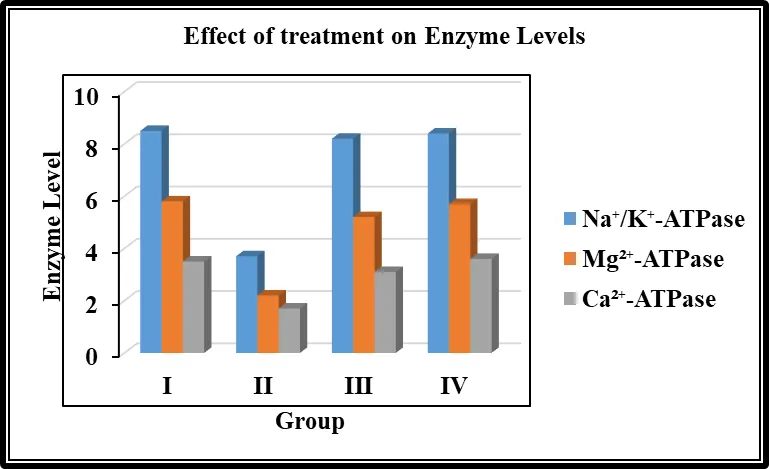
Figure : effect of treatment on enzyme levels
Histopathological Study
Histopathological examination of liver tissues was performed to assess the protective effect of the polyherbal formulation against CClâ‚„-induced liver damage. The normal control group showed intact liver architecture with healthy hepatocytes, distinct nuclei, nucleoli, and a well-defined central vein. In contrast, the CClâ‚„-treated group exhibited severe hepatic damage characterized by centrilobular necrosis, fatty degeneration, ballooning of hepatocytes, inflammatory cell infiltration, vacuolization, and loss of cellular boundaries.Treatment with the polyherbal formulation (PHF) significantly improved liver histology. The liver sections showed near-normal hepatic architecture with markedly reduced necrosis, fatty changes, and inflammatory infiltration, comparable to the standard drug silymarin. Approximately 80% of liver tissues in the treated group exhibited normal histological features.The formulation also enhanced antioxidant defense by decreasing TBARS levels and increasing GSH, SOD, and Catalase activities. Furthermore, PHF significantly reduced inflammatory cytokines such as TNF-α, IL-6, and IL-10, indicating strong anti-inflammatory activity.
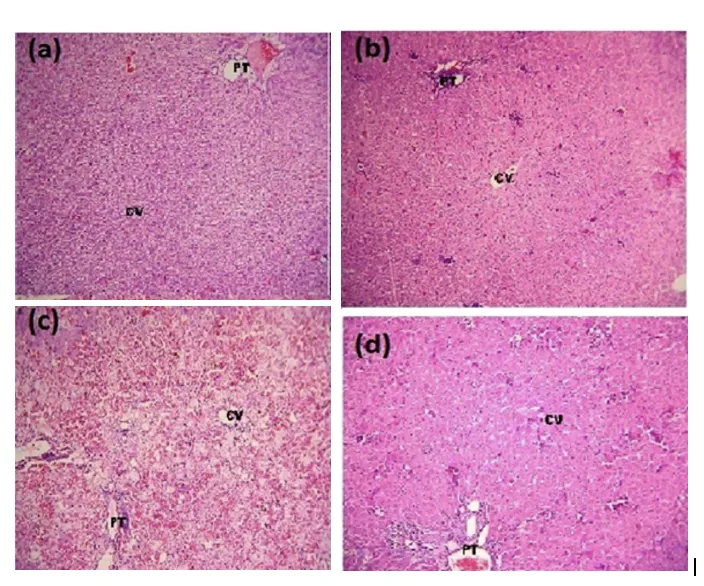
Figure. Histopathological Examination of Liver Tissue (HE × 400)
(d) Extract-Treated Group: Liver tissue showing improved architecture with only moderate inflammatory cell infiltration around the bile duct, demonstrating hepatoprotective activity of the formulation.
CONCLUSION
Medicinal plants play an important role in traditional healthcare systems and are widely used for the treatment of various diseases. In the present study, Michelia champaca, Curcuma longa, and Emblica officinalis were evaluated for their pharmacognostic, physicochemical, and hepatoprotective properties. The results confirmed the authenticity and quality of the selected plant materials.The formulated polyherbal capsules met all quality control parameters and were found to be safe for use. In the CClâ‚„-induced hepatotoxicity model, the formulation significantly reduced elevated liver marker enzymes, bilirubin, urea, and creatinine levels. It also enhanced antioxidant defense by decreasing TBARS and increasing GSH, SOD, and catalase levels.Histopathological studies revealed restoration of normal liver architecture with reduced necrosis, fatty changes, and inflammatory cell infiltration. These findings indicate that the polyherbal formulation possesses significant hepatoprotective and antioxidant activity, comparable to the standard drug silymarin.Overall, the study supports the potential use of this polyherbal formulation as a safe and effective natural hepatoprotective agent. Further studies are required to identify the active constituents and clarify their mechanisms of action.
REFERENCES

Swati Bandu Sabane*, Pallavi Sanjay Narwade, K. R. Biyani, P. N. Folane, R. A. Ingle, Pharmacological Evaluation Of Hepatoprotective Activity Of A Novel Herbal Combination In An Experimental Model, Int. J. Sci. R. Tech., 2026, 3 (6), 148-157. https://doi.org/10.5281/zenodo.20508487
 10.5281/zenodo.20508487