

We use cookies to ensure our website works properly and to personalise your experience. Cookies policy
1Department of Pharmacology, PRES's College of Pharmacy (For Women), Chincholi, Sinnar, Nashik, Maharashtra, India.
2Biotox Laboratories Pvt. Ltd., Nashik, Maharashtra, India.
The present study was aimed at the formulation and evaluation of a fast absorbing hydroalcoholic polyherbal antifungal liquid lotion using selected herbal extracts, namely Azadirachta indica, Curcuma longa and Allium sativum. These herbal ingredients were chosen due to their well-established antifungal, antimicrobial, and anti-inflammatory properties. The objective of the study was to develop a stable, effective, and patient-friendly topical formulation for the management of fungal infections. The formulation was prepared using a phase-wise solubilization technique, incorporating both hydrophilic and lipophilic components into a hydroalcoholic system to enhance solubility and skin penetration of active constituents. A total of five formulations (F1–F5) were developed by varying the concentrations of ethanol, propylene glycol, and surfactant to optimize the formulation. All formulations were evaluated for various physicochemical parameters, including organoleptic properties, pH, viscosity, spreadability, homogeneity, washability, and skin irritancy. The antifungal activity was assessed using the agar well diffusion method against fungal strains such as Candida albicans and Aspergillus niger. Stability studies were conducted for a period of two months to evaluate the robustness of the formulations. The results indicated that all formulations were within acceptable limits for topical application. Among the batches, formulation F2 exhibited optimal characteristics, including suitable pH, moderate viscosity, good spreadability, excellent homogeneity, non-irritant nature, and significant antifungal activity. Although formulation F3 showed slightly higher antifungal activity, it demonstrated lower stability and spreadability. Stability studies confirmed that F2 remained stable over the study period without significant changes in its physicochemical properties. In conclusion, the developed hydroalcoholic polyherbal antifungal lotion, particularly formulation F2, demonstrated promising potential as a safe, effective, and stable topical antifungal preparation. The study highlights the significance of herbal formulations as an alternative approach for the management of fungal infections.
Fungal infections represent a significant global health concern, affecting millions of individuals worldwide and ranging from superficial skin infections to more severe systemic conditions. Among these, superficial fungal infections caused by organisms such as Candida albicans and Aspergillus niger are particularly common, especially in tropical and subtropical regions where humidity and temperature favor fungal growth [1,2]. The increasing prevalence of antifungal resistance, along with the limitations associated with conventional antifungal therapies including adverse effects, high cost and reduced efficacy has prompted the search for safer and more effective alternatives [3,4].
In recent years, there has been growing interest in the use of herbal and plant-based formulations due to their wide therapeutic potential, safety profile, and minimal side effects [5,6]. Medicinal plants such as Azadirachta indica (neem), Curcuma longa (turmeric) and Allium sativum (garlic) have been extensively studied for their antimicrobial and antifungal properties [7–9]. These plants contain bioactive constituents such as azadirachtin, curcumin, and allicin, which exhibit significant inhibitory effects against a broad spectrum of fungal pathogens [10,11]. The synergistic combination of such herbal extracts in a polyherbal formulation can enhance therapeutic efficacy while reducing the likelihood of resistance development [12].
Topical drug delivery systems are widely preferred for the treatment of superficial fungal infections due to their localized action, reduced systemic side effects, and improved patient compliance [13]. Among various topical dosage forms, liquid lotions offer several advantages, including ease of application, rapid absorption, non-greasy nature, and suitability for application over large surface areas of the skin. The incorporation of a hydroalcoholic system further enhances the solubility of active constituents and improves their penetration through the skin, thereby increasing therapeutic effectiveness [14]. Additionally, alcohol acts as a penetration enhancer and provides a cooling effect, which improves patient acceptability. Despite the advantages of herbal antifungal agents and topical delivery systems, there remains a need for the development of optimized formulations that ensure stability, efficacy, and patient compliance [15]. In this context, the present study was designed to formulate and evaluate a fast-absorbing hydroalcoholic polyherbal antifungal liquid lotion using selected herbal extracts. The formulation was optimized by varying the concentrations of key components and evaluated for physicochemical properties, antifungal activity, and stability. The study aims to provide a scientifically validated, safe and effective herbal alternative for the management of fungal infections.
MATERIALS AND METHODS
Materials
The herbal extracts of Azadirachta indica, Curcuma longa and Allium sativum were procured from a certified supplier and used as active antifungal agents. All other reagents and chemicals used were of analytical grade.
Methods
Method of Preparation of Polyherbal Antifungal Hydroalcoholic Lotion (100 mL)
Initially, hydroalcoholic extracts of Azadirachta indica, Curcuma longa and Allium sativum were prepared using ethanol:water (70:30 V/V) by maceration. The extracts were filtered and concentrated to obtain a clear solution. In the next step, the aqueous phase was prepared by dissolving sodium benzoate in a measured quantity of distilled water with continuous stirring until a clear solution was obtained. Separately, the alcoholic phase was prepared by taking ethanol (95%) in a clean beaker, to which the previously prepared herbal extracts were added and mixed thoroughly. Propylene glycol was then incorporated into the alcoholic phase to enhance solubility and skin permeation [16]. In another container, Melaleuca alternifolia (tea tree oil) and Syzygium aromaticum (clove oil), were mixed with Tween 80 to form a clear, homogeneous solution, ensuring proper solubilization of the oils. The alcoholic phase was then added slowly to the aqueous phase under continuous stirring to maintain uniformity and prevent precipitation. Subsequently, the solubilized essential oil mixture was incorporated gradually into the formulation with constant stirring to obtain a clear or slightly translucent liquid. The pH of the formulation was adjusted to 5.0–5.5 using citric acid added dropwise, ensuring compatibility with skin pH. Finally, the volume was made up to 100 mL with distilled water and mixed thoroughly. The prepared formulation was filtered and was stored in a well-closed container at room temperature for further evaluation. Optimization of the formulation was carried out by preparing multiple batches (F1–F5) with varying concentrations of ethanol, propylene glycol, and surfactant (Tween 80). These variations were introduced to study their influence on critical parameters such as solubility, viscosity, spreadability and antifungal activity. The optimized formulation was selected based on overall performance, including stability and therapeutic efficacy [16,17].
Evaluation of Polyherbal Antifungal Hydroalcoholic Lotion
Organoleptic Evaluation
The organoleptic properties of the prepared formulations (F1–F5) were evaluated to assess their physical appearance and aesthetic acceptability. A sufficient quantity of each formulation was transferred into clean, dry glass containers and observed under normal daylight conditions. The evaluation was carried out against a white background to clearly identify any turbidity, precipitation or phase separation. Parameters such as color, odor and clarity were carefully examined. The formulations were checked for the presence of any particulate matter, aggregation or sedimentation, which could indicate instability or improper mixing. The odor was assessed to ensure it was characteristic of herbal components and not unpleasant, as this plays an important role in patient compliance [18].
pH Determination
The pH of the prepared formulations was determined to ensure compatibility with the skin and to avoid irritation upon topical application. The measurement was carried out using a calibrated digital pH meter. Prior to analysis, the instrument was standardized using buffer solutions of pH 4.0 and 7.0 to ensure accuracy. Approximately 10 ml of each formulation was taken in a beaker and, if necessary, diluted with distilled water to allow proper immersion of the electrode. The electrode was then immersed in the sample, ensuring complete contact with the formulation, and the pH reading was recorded once the value stabilized. Care was taken to clean and dry the electrode between measurements to avoid cross-contamination. The acceptable pH range for topical formulations was maintained between 4.5 and 6.5, which is compatible with the natural pH of the skin and helps in minimizing irritation [19].
Viscosity Measurement
Viscosity of the formulations was determined to evaluate their flow behavior and consistency, which directly influence ease of application and spreadability. The measurement was carried out using a Brookfield viscometer under controlled conditions. A sufficient quantity of the formulation was transferred into a clean beaker, ensuring no air bubbles were present, as they could interfere with the readings. An appropriate spindle (such as spindle number 61 or 62) was selected based on the expected viscosity range. The viscometer was operated at a fixed rotational speed, typically 50 rpm, and the readings were recorded once the dial reading became stable. The viscosity was expressed in centipoise (cP). This parameter was critical in comparing different batches, as an ideal formulation should have moderate viscosity, allowing easy application while maintaining sufficient consistency on the skin [19].
Spreadability Test
The spreadability of the lotion was evaluated to determine the ease with which it can be applied over the skin surface. The test was performed using the glass slide method. A fixed quantity of the formulation was placed between two clean glass slides, and a known weight was applied on the upper slide to ensure uniform spreading of the formulation. After a specific time interval, the weight was removed, and the time required for the upper slide to move a predetermined distance under the influence of an applied force was recorded. The spreadability was calculated using a standard formula involving the applied weight, length of movement, and time taken. Higher spreadability values indicate better ease of application, which is desirable for topical formulations as it enhances patient compliance and ensures uniform distribution of the active ingredients [20].
Washability Test
Washability was evaluated to determine the ease with which the formulation can be removed from the skin. A small quantity of the lotion was applied to the skin and allowed to dry. It was then washed with water, and the ease of removal was observed. A good formulation should be easily washable without leaving any residue, ensuring better user acceptability and hygiene [20,21].
Homogeneity Test
The homogeneity of the prepared formulations was evaluated to ensure uniform distribution of all components throughout the system. A small quantity of the lotion was taken and visually inspected for any lumps, coarse particles, or phase separation. Additionally, the formulation was pressed between fingers to assess its smoothness and consistency. A homogeneous formulation is essential for ensuring consistent drug delivery and maintaining the quality and stability of the product. Any sign of non-uniformity would indicate improper mixing or instability in the formulation [22].
Skin Irritancy Test
The skin irritancy test was performed to evaluate the safety and compatibility of the prepared hydroalcoholic polyherbal antifungal lotion for topical application. The study was carried out using a standard patch test method, ensuring that the formulation does not produce any adverse skin reactions such as redness, itching or inflammation. The selected test area, usually the inner forearm or dorsal surface of the hand, was cleaned thoroughly with distilled water and allowed to dry. A small quantity (approximately 0.5 g) of the formulation was applied evenly over a marked area of about 1 cm² of skin. The applied area was left uncovered or optionally covered with a sterile gauze patch. The formulation was allowed to remain in contact with the skin for a period of 24 hours without washing or disturbance. After 24 hours, the application site was carefully examined for any visible signs of irritation such as erythema (redness), edema (swelling), itching or burning sensation. Observations were recorded immediately after removal of the formulation. The results of the skin irritancy test were used to confirm the dermatological safety of the developed formulation and to ensure its suitability for regular application on the skin [23].
Antifungal Activity (Agar Well Diffusion Method)
The antifungal activity of the prepared formulations was evaluated using the agar well diffusion method, which is widely used for determining antimicrobial efficacy. Sabouraud Dextrose Agar medium was prepared and sterilized by autoclaving, then poured into sterile petri plates under aseptic conditions and allowed to solidify. The surface of the agar was inoculated with fungal cultures such as Candida albicans and Aspergillus niger using a sterile swab to ensure uniform distribution of microorganisms. Wells of uniform diameter were created in the agar using a sterile cork borer. A measured quantity of each formulation (F1–F5) was carefully introduced into the wells using a micropipette. A standard antifungal agent was used as a control for comparison. The plates were incubated at 25–30°C for 24–48 hours. After incubation, the diameter of the zone of inhibition around each well was measured in millimeters. The size of the inhibition zone was indicative of the antifungal activity of the formulation, with larger zones representing higher efficacy [24].
Stability Studies
Stability studies were carried out to evaluate the physical and chemical stability of the formulations under different storage conditions. The prepared batches were stored in tightly closed containers and kept at room temperature (25°C ± 2°C). Samples were withdrawn at predetermined time intervals, such as 1 month and 2 months and evaluated for changes in colour, odor, pH, viscosity and phase separation. Each parameter was carefully recorded and compared with the initial values to detect any significant variation over time. Stability studies are essential to determine the shelf life and appropriate storage conditions of the formulation. A stable formulation is expected to show minimal or no significant changes in its physicochemical properties throughout the study period [25].
RESULTS AND DISCUSSION
Evaluation of Polyherbal Antifungal Hydroalcoholic Lotion
Organoleptic Evaluation
The organoleptic evaluation of all prepared formulations (F1–F5) revealed that the lotions were visually acceptable with slight variations in appearance due to differences in composition. All batches exhibited a characteristic herbal odor attributed to the presence of polyherbal extracts and essential oils. The color of the formulations ranged from light yellow to pale brown, which is typical for formulations containing Azadirachta indica, Curcuma longa and Allium sativum extracts. No visible particulate matter, aggregation or sedimentation was observed in any of the batches, indicating proper solubilization and mixing of ingredients. Among the formulations, F3 showed slight turbidity, which may be due to higher concentration of ethanol and surfactant leading to partial phase instability. In contrast, F2 and F4 exhibited better clarity and uniformity, suggesting optimal composition. Overall, all formulations were found to be aesthetically acceptable, with F2 showing the best appearance in terms of clarity and homogeneity.
|
Batch |
Color |
Odor |
Clarity |
|
F1 |
Light yellow |
Characteristic herbal |
Clear |
|
F2 |
Pale yellow |
Pleasant herbal |
Clear |
|
F3 |
Yellowish brown |
Strong herbal |
Slightly turbid |
|
F4 |
Pale yellow |
Mild herbal |
Clear |
|
F5 |
Light yellow |
Herbal |
Clear |
Table 1: Organoleptic Evaluation
pH Determination
The pH values of all formulations were found to be within the acceptable range for topical application (4.5–6.5), indicating their compatibility with skin. Slight variations in pH were observed among the batches, which can be attributed to differences in the concentration of herbal extracts and excipients. Formulation F1 showed a slightly lower pH due to lower ethanol content, whereas F3 exhibited a comparatively higher pH, possibly due to increased solvent concentration. Among all batches, F2 and F4 demonstrated pH values closest to the ideal skin pH, making them more suitable for topical application. The results indicate that the formulation components were well balanced and did not significantly alter the physiological pH range, thus minimizing the risk of skin irritation.
Viscosity Measurement
The viscosity of the formulations varied depending on the concentration of propylene glycol and surfactant used in each batch. F1 showed lower viscosity due to lower levels of thickening and co-solvent agents, resulting in a more fluid consistency. On the other hand, F3 exhibited higher viscosity, which may be attributed to increased concentration of propylene glycol and surfactant, leading to a thicker formulation. Formulations F2 and F4 demonstrated moderate viscosity, which is considered ideal for topical lotions as it ensures ease of application while maintaining sufficient adherence to the skin surface. Excessively high viscosity, as seen in F3, may hinder spreadability, whereas very low viscosity, as in F1, may lead to poor retention. Thus, F2 was identified as the optimized formulation in terms of viscosity.
Spreadability Test
The spreadability results indicated that all formulations could be easily spread over the skin; however, variations were observed among different batches. Formulation F1 exhibited the highest spreadability due to its lower viscosity, allowing it to spread rapidly with minimal resistance. In contrast, F3 showed comparatively lower spreadability due to its higher viscosity, which restricted its flow behavior. Formulations F2 and F4 demonstrated balanced spreadability, indicating an optimal combination of viscosity and flow properties. Good spreadability is essential for uniform application and enhanced patient compliance, and in this regard, F2 was found to be the most suitable formulation.
Washability Test
The washability test demonstrated that all formulations were easily removable from the skin with water, indicating good user acceptability and hygiene. The presence of hydroalcoholic solvent system facilitated quick removal without leaving any greasy residue. Formulations with higher ethanol content, such as F3, showed faster removal, whereas F1 required slightly more effort due to its comparatively lower solvent content. F2 exhibited optimal washability, balancing ease of removal with sufficient retention time on the skin.
|
Batch |
pH (Mean ± SD) |
Viscosity (cP) |
Spreadability (g·cm/sec) |
Washability |
|
F1 |
5.1 ± 0.02 |
120 |
28 |
Good |
|
F2 |
5.5 ± 0.03 |
180 |
24 |
Excellent |
|
F3 |
5.8 ± 0.04 |
240 |
18 |
Excellent |
|
F4 |
5.4 ± 0.02 |
200 |
22 |
Excellent |
|
F5 |
5.2 ± 0.03 |
150 |
26 |
Good |
Table 2: Evaluation of Polyherbal Antifungal Hydroalcoholic Lotion
Homogeneity Test
All formulations were found to be homogeneous with smooth texture and uniform consistency. No lumps, coarse particles or phase separation were observed upon visual inspection and tactile evaluation. This indicates that the phase-wise solubilization technique was effective in achieving proper mixing and distribution of all components. Among the batches, F2 and F4 showed superior homogeneity, while F3 exhibited slight inconsistency due to higher surfactant concentration. However, overall, all formulations met the required criteria for homogeneity.
|
Batch |
Homogeneity |
|
F1 |
Good |
|
F2 |
Excellent |
|
F3 |
Good |
|
F4 |
Excellent |
|
F5 |
Good |
Table 3: Homogeneity Evaluation
Skin Irritancy Test
The skin irritancy test results indicated that none of the formulations caused any visible signs of irritation such as redness, itching, or inflammation after 24 hours of application. This confirms that the formulations are safe for topical use and that the selected herbal extracts and excipients are well tolerated by the skin. The pH range and absence of harsh chemicals contributed to the non-irritant nature of the formulations. These findings suggest that the developed lotion is suitable for regular application without causing adverse dermatological effects.
|
Batch |
Erythema |
Edema |
Irritation |
|
F1 |
Absent |
Absent |
Non-irritant |
|
F2 |
Absent |
Absent |
Non-irritant |
|
F3 |
Absent |
Absent |
Non-irritant |
|
F4 |
Absent |
Absent |
Non-irritant |
|
F5 |
Absent |
Absent |
Non-irritant |
Table 4: Skin Irritation Test
Antifungal Activity (Agar Well Diffusion Method)
The antifungal activity of the formulations was evaluated against fungal strains such as Candida albicans and Aspergillus niger. All formulations exhibited measurable zones of inhibition, indicating effective antifungal activity. Among the batches, F3 showed the highest antifungal activity, which may be attributed to higher ethanol content enhancing the penetration and activity of herbal constituents. However, despite higher activity, its lower stability and spreadability make it less suitable overall. Formulation F2 demonstrated strong antifungal activity along with better physicochemical properties, making it the most balanced formulation. F1 showed comparatively lower activity, likely due to reduced concentration of penetration enhancers. These results confirm that the polyherbal combination provides synergistic antifungal effects.
|
Batch |
Zone of Inhibition (mm) |
Zone of Inhibition (mm) |
|
Against Candida albicans |
Against Aspergillus niger |
|
|
F1 |
12 |
10 |
|
F2 |
18 |
16 |
|
F3 |
20 |
18 |
|
F4 |
17 |
15 |
|
F5 |
15 |
13 |
Table 5: Antifungal Activity (Zone of Inhibition)
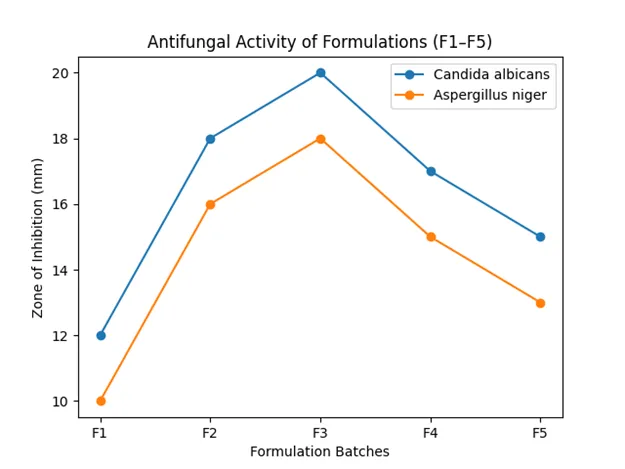
Figure 1: The graphical representation shows that antifungal activity against both Candida albicans and Aspergillus niger
Stability Study of Optimized Formulation (F2)
Stability studies were carried out specifically on the optimized formulation F2 to evaluate its physical and chemical stability under different storage conditions. Based on the overall evaluation of all batches (F1–F5), F2 was selected as the optimized formulation due to its balanced physicochemical properties, good antifungal activity, and excellent initial stability profile. Therefore, further stability assessment was focused on this formulation to determine its suitability for long-term use. The formulation F2 was stored in tightly closed containers and kept at controlled room temperature (25°C ± 2°C). Samples were withdrawn at predetermined time intervals, namely at initial (0 month), 1 month, and 2 months, and evaluated for changes in key parameters including color, odor, pH, viscosity, and phase separation. At the initial stage, F2 exhibited a clear and uniform appearance with no signs of turbidity or precipitation. The pH was found to be 5.5, which is within the acceptable range for topical application, and the viscosity was maintained at 180 cP, indicating appropriate consistency. After 1 month of storage, no significant changes were observed in the formulation. The color and odor remained unchanged, and no phase separation was detected. The pH and viscosity values showed negligible variation, confirming the stability of the formulation under storage conditions. Similarly, at the end of 2 months, the formulation continued to maintain its physical integrity and consistency. The pH remained stable at 5.5, and only a slight decrease in viscosity was observed, which was not significant enough to affect the performance of the formulation. Overall, the results of the stability study indicate that the optimized formulation F2 possesses good stability with minimal variation in physicochemical properties over time. The absence of phase separation and consistent pH and viscosity values confirm the robustness of the formulation. These findings suggest that the developed hydroalcoholic polyherbal antifungal lotion is stable and suitable for storage under normal conditions, with potential for extended shelf life.
|
Parameters |
Initial (0 Month) |
1 Month |
2 Months |
Observation |
|
Color |
No change (Clear, pale yellow) |
No change |
No change |
Stable |
|
Odor |
Characteristic herbal |
No change |
No change |
Stable |
|
pH |
5.5 |
5.5 |
5.5 |
No significant variation |
|
Viscosity (cP) |
180 |
180 |
178 |
Slight decrease, acceptable |
|
Phase Separation |
Absent |
Absent |
Absent |
No instability observed |
Table 6: Stability Study of Optimized Formulation (F2)
CONCLUSION
In the present study, a fast absorbing hydroalcoholic polyherbal antifungal liquid lotion was successfully formulated using selected herbal extracts of Azadirachta indica, Curcuma longa, and Allium sativum. The phase-wise solubilization technique proved effective in developing a stable and homogeneous formulation with desirable physicochemical properties. Among the prepared batches, formulation F2 was identified as the optimized formulation based on its balanced characteristics, including appropriate pH, moderate viscosity, good spreadability, excellent homogeneity, non-irritant nature, and satisfactory washability. The antifungal activity study confirmed that the developed formulations exhibited significant inhibitory effects against Candida albicans and Aspergillus niger, indicating the effectiveness of the polyherbal combination. Furthermore, the optimized formulation demonstrated good stability over the study period, with no significant changes in its physicochemical parameters. Although formulation F3 showed comparatively higher antifungal activity, its lower stability and less favorable application properties limited its suitability. Overall, the developed hydroalcoholic polyherbal antifungal lotion represents a promising, safe, and effective alternative to conventional antifungal formulations. The study highlights the potential of herbal-based topical systems in the management of superficial fungal infections and supports further investigation for clinical application.
REFERENCES

Shubhangi Bhadane*1, Nupur Aher1, Kiran Kotade1, Sangita Bhandare1, Amol More2, Preparation And Evaluation Of Fast Absorbing Hydro Alcoholic Polyherbal Antifungal Liquid Lotion, Int. J. Sci. R. Tech., 2026, 3 (6), 1005-1013. https://doi.org/10.5281/zenodo.20727866
 10.5281/zenodo.20727866