

 Rimmi Rawat*
 Chhavi Juyal
 Akash Kumar
ANXIETY
Uneasiness issue frame a class of psychological well-being analyze that lead to exorbitant anxiety, dread, fear, and stress. And a feeling portrayed by sentiments of strain, stressed considerations and physical changes like expanded pulse.
Nervousness is an ordinary part of life that everybody feels from time to time. For instance, it is ordinary to feel on edge, pushed or stressed before a test or a prospective employee meeting. It is likewise typical to feel on anxious when something risky may be going to occur. A specific sum of nervousness is useful in these circumstances since it makes a difference an individual plan to perform taking care of business or to maintain a strategic distance from unsafe circumstances.
It is a summed up condition of dread or premonition. There is a lot to be on anxious about. Our health, social connections, examinations, professions and states of the condition are nevertheless a couple of wellsprings of conceivable concerns. It is ordinary, what's more, even versatile, to be to some degree on edge about these parts of life. Nervousness serves us when it prompts us to look for customary medicinal checkups or on the other hand propels us to contemplate for tests. Anxiety is a proper reaction to dangers; however it very well may be irregular when its dimension is out of extent to a danger. In outrageous structures, uneasiness can weaken our everyday working.
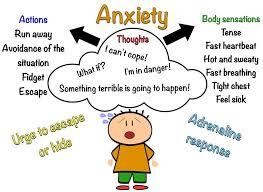
Figure 1: Actions of Anxiety
TYPES OF ANXIETY DISORDERS
There are a few kinds of anxiety disorders, and every ha it’s very own arrangement of normal side effects
-
-
-
- PANIC DISORDER
-
-
Frenzy Disorder is portrayed by unexpected, extreme scenes of dread and nervousness that happen frequently what's more, all of a sudden. Amid a fit of anxiety, physical manifestations, for example, shortness of breath, dashing heart, discombobulating, or feeling flushed regularly happen. Sentiments of falsity and dread of swooning, losing control, or passing on are additionally normal amid frenzy scenes. In spite of the fact that alarm assaults are not physically unsafe in them, the experience can be unnerving. Individuals who experience alarm assaults may end up dreadful of having more, and may start to stay away from open circumstances, for example, gatherings, homerooms or get-togethers. Understudies are in a high hazard age bunch for Panic Disorder, which is most much of the time analyzed amid youthful adulthood. If you don't mind.
-
-
-
- GENERALIZED ANXIETY DISORDER
-
-
Generalized Anxiety Disorder (GAD) is portrayed by over the top misgiving and stress about regular day to day existence occasions that is hard to control. Continuous sentiments of eagerness or feeling keyed up, trouble concentrating; muscle strain or cerebral pain, crabbiness, and trouble resting is regular manifestations of this issue. Individuals who have GAD regularly have a tenacious, farfetched dread that something awful is going to occur. About 5% of the populace experiences GAD.
-
-
-
- FEARS
-
-
A fear is a misrepresented dread of a particular article or circumstance (for example creepy crawlies, flying in an plane, encased spots, blood, statures, hounds, tempests). A fear may make an individual restrict oneself pointlessly on account of the tension related with the likelihood of experiencing what is dreaded. Fears frequently start in youth. In spite of the fact that 5-10% of the populace have been found to have explicit feelings of dread sufficiently serious to be named Phobic, regularly what is unnerving can be kept away from without causing noteworthy trouble throughout everyday life. Be that as it may, treatment is prescribed on the off chance that the dread of the item or circumstance causes visit trouble, or in the event that it prompts huge interruption in schedule, exercises or connections.
-
-
-
- FANATICAL COMPULSIVE DISORDER
-
-
The fixations of Obsessive Compulsive Disorder are diligent contemplations, pictures or motivations that are upsetting. Regular instances of over the top contemplations are questions about having killed an electrical machine or having bolted an entryway, doubtful feelings of trepidation of germs, or aggravating considerations of making hurt a friend or family member. The impulses of OCD are portrayed by the pressing need to plan something for avert or dispose of the uneasiness related with the over the top contemplations.
Impulses incorporate practices, for example, hand washing, checking, or doing things impeccably or on the other hand in a specific request. Numerous individuals have periodic over the top musings or habitual practices. In any case, individuals who battle with this issue go through over an hour daily expended with over the top contemplations and enthusiastic practices, and these indications extraordinarily meddle with day by day life.
-
-
-
- POST-TRAUMATIC STRESS DISORDER
-
-
PTSD may happen in the wake of a horrible mishap, for example, a genuine mishap, sexual or physical ambush, or battle in war. Indications may incorporate shirking or misery at notices of the injury, repeating pictures of the occasion, feeling numb or separated, crabbiness, being effectively alarmed, what's more, having bad dreams or other rest troubles. Not every person who encounters an awful occasion will create PTSD, and usually for individuals to encounter a portion of these side effects in the weeks following a horrible mishap. Notwithstanding, PTSD is analyzed when the side effects continue for over a month after the occasion, and cause critical trouble or weakness in day by day life.
-
-
-
- SOCIAL ANXIETY DISORDER
-
-
Social Anxiety Disorder is a checked and determined dread of social or execution circumstances in which there is presentation to new individuals or the likelihood of judgment by others. These circumstances are maintained a strategic distance from due to the dread of acting in a manner that may embarrass. Whenever the circumstance can't be maintained a strategic distance from, physical side effects of tension, for example, trembling, becoming flushed or queasiness regularly happen. Numerous individuals experience some level of apprehension in social ettings. In any case, people who battle with Social Anxiety Disorder seriously limit what they do to stay away from new circumstances or individuals, and their tension for the most part does not decrease when entirely the unpleasant circumstance.
PATHOPHYSIOLOGY OF ANXIETY
Neurochemicals, for example, Serotonin, GABA, Dopamine, Neuroepinephrin, and numerous others have additionally as of late been connected to tension issue. Every synthetic plays an altogether different, yet similarly significant, job in tension regulation. Three noteworthy synapses are associated with tension: serotonin, nor epinephrine and gamma-amino butyric corrosive. Serotonin assumes a job in the guideline of state of mind, animosity, driving forces, rest, craving, body temperature and torment. A number of meds used to treat tension issue raise the dimension of serotonin accessible to transmit messages. Nor epinephrine is engaged with the battle or flight reaction and in the guideline of rest, temperament and circulatory strain. Intense pressure expands no the arrival of or epinephrine. In individuals with uneasiness issue, particularly those with frenzy issue, the framework controlling no the arrival of or epinephrine has all the earmarks of being inadequately managed. A few meds help to balance out the measure of nor epinephrine accessible to transmit messages. GABA assumes a job in instigating unwinding and rest, and in forestalling over excitation. Prescriptions known as benzodiazepines improve the action of GABA, delivering a quieting impact Dysfunctions of different synapses and receptors in the cerebrum have been embroiled in tension issue. The 3 synapses essentially embroiled in nervousness are GABA, serotonin (5-HT) and noradrenalin .Dysregulations in the noradrenergic frameworks is guessed to happen in tension issue.
SYMPTOMS OF ANXIETY
- Psychic or emotional state.
- Somatic or physical symptoms
- Irrational and excessive fear and worry
- Irritability
- Restlessness
- Trouble concentrating
- Feeling tense
COMMON PHYSICAL SYMPTOMS OF ANXIETY
- Perspiring
- Tachycardia
- Stomach annoy
- Shortness of breath
- Visit pee or looseness of the bowels
- Rest unsettling influences( a sleeping disorder)
- Exhaustion
CAUSES OF ANXIETY
There is no single reason for anxiety. In any case, a few components may add to the advancement of restless contemplation and practices, for example,
- A family history of nervousness
- Learned methods for reacting (e.g., from guardians, companions or teachers)
- Chemical imbalances in the brain
- Life experiences (e.g., family separation, misuse, harassing, relational clash, or then again other horrible accidents)
- Alcohol, tobacco or other medication use
MEDICAL CAUSES
A few people, nervousness might be connected to a hidden medical problem. At times, nervousness signs and side effects are the principal pointers of a restorative sickness. On the off chance that your specialist speculates your uneasiness may have a therapeutic reason; the individual in question may arrange tests to search for indications of an issue.
Instances of restorative issues that can be connected to nervousness include:
- Coronary illness
- Diabetes
- Thyroid issues, for example, hyperthyroidism
- Respiratory disarranges, for example, perpetual obstructive aspiratory sickness (COPD) and asthma
- Medication abuse or withdrawal
- Withdrawal from liquor, against nervousness drugs (benzodiazepines) or different meds
- Endless torment or touchy gut disorder
- Uncommon tumors that produce certain battle or-flight hormones
Some of the time nervousness can be a symptom of specific meds.
- It's conceivable that your uneasiness might be because of a basic ailment if:
- You don't have any blood relatives, (for example, a parent or kin) with a tension issue
- You didn't have an uneasiness issue as a kid
- You don't keep away from specific things or circumstances as a result of tension
- You have an abrupt event of tension that appears to be irrelevant to life occasions and you didn't have a past history of uneasiness
RISK FACTORS
These elements may expand your danger of building up a tension issue:
- INJURY- Youngsters who suffered misuse or injury or saw horrible mishaps are at higher danger of building up an uneasiness issue eventually throughout everyday life. Grown-ups who experience an awful mishap likewise can create nervousness issue.
- WORRY BECAUSE OF AN AILMENT- Having a wellbeing condition or genuine sickness can cause huge stress over issues, for example, your treatment and your future.
- STRESS DEVELOPMENT- A major occasion or a development of littler unpleasant life circumstances may trigger over the top uneasiness — for instance, a passing in the family, work pressure or continuous stress over funds.
- IDENTITY- Individuals with certain identity types are more inclined to uneasiness issue than others are.
- OTHER EMOTIONAL WELL-BEING ISSUE - Individuals with other psychological wellness issue, for example, misery, frequently likewise have a nervousness issue.
- HAVING BLOOD RELATIVES WITH A NERVOUSNESS ISSUE- Nervousness issue can keep running in families.
- MEDICATIONS OR LIQUOR- Medication or liquor use or abuse or withdrawal can cause or compound nervousness.
COMPLICATION
Having an uneasiness issue accomplishes more than make you stress. It can likewise prompt, or intensify, other mental and physical conditions, for example,
- Depression (which frequently happens with an uneasiness issue) or other emotional well- being issue
- Substance abuse
- Inconvenience resting (a sleeping disorder)
- Stomach related or entrail issues
- Migraines and unending agony
- Social confinement
- Issues working at school or work
- Low quality of life
- Suicide
PREVENTION
There's no real way to foresee for certain what will make somebody build up a tension issue, yet you can find a way to decrease the effect of side effects in case you're on edge:
Get help early. Nervousness, in the same way as other emotional well-being conditions, can be more enthusiastically to treat in the event that you pause.
Stay active. Take an interest in exercises that you appreciate and that make you like yourself. Appreciate social association and minding connections, which can decrease your stresses.
Keep away from alcohol or medication use. Liquor and medication use can cause or exacerbate uneasiness. In case you're dependent on any of these substances, stopping can make you on edge. In the event that you can't stop individually, see your specialist or discover a care group to support you.
TREATMENT OF THE ANXIETY
There are three general classifications of treatment for anxiety, these include:
-
- mental medications (talking treatments)
- physical medicines (drugs)
- self improvement and elective treatments.
CONCLUSION
Contingent upon the sort of tension, self improvement and elective treatments can be useful. They can be utilized alone or joined with physical and mental medicines. An intensive appraisal by your specialist is expected to choose the best blend of medicines for you.
The study we are looking at shows a connection between anxiety disorders and the possible benefits of using natural medicinal plants to manage mental health and stop infections from spreading. Anxiety disorders are tough to deal with because they are affected by things like the balance of chemicals in our brain the things that happen to us in life and the stress we get from our surroundings. Chemicals in our brain like serotonin and dopamine help control how we feel how we stressed are and how we react to things emotionally. This study also shows that extracts from plants, especially black pepper and jasmine are very good at fighting off bad bacteria like Salmonella typhi and Escherichia coli. Between the two peppers is better at killing these microbes. When we look closely at the plants we find that they have compounds like phenolics and flavonoids that are good for us. These compounds help fight off infections. May also help protect our brain. This could mean that using plants like black pepper and jasmine might help people feel better mentally and stop them from getting sick.
In the end using things, like black pepper and jasmine might be a good way to help people with anxiety disorders and infections. We need to do research and studies to see how well they really work and to make sure they are safe to use. We should keep looking into pepper and jasmine to see how they can help us.
REFERENCES
- Acharya Yadavji Trikamji, editor, Charaka Samhita of charaka, sutrasthana, 8th chapter, verse no18, 5th Ed, Varanasi: ChoukhambhaPrakashana,2007, p 58.
- Achaya KT (1994). Indian Food: A Historical Companion. OxfordUniversity Press, Delhi.
- Ali, M. (1994). Textbook of Pharmacognosy. Delhi: CBS, 2nd ed, p. 5
- American Psychiatric Association. Diagnostic and Statistical Manual of Mental Disorders. Washington, DC: APA Press, 2000.
- American Psychiatric Association. Practice guidelines for the treatment of patients with major depressive disorder. 2nd ed.September 2007. Accessed January 22, 2010.
- Araujo AC and Leon LL: Biological activities of Curcuma longa L. Mem. Inst. Oswaldo Cruz.; 2001; 96:723–728.
- Ayurveda and its scientific aspects. New Delhi: Department of Ayurveda,Yoga and Naturopathy, Unani, Siddha and Homeopathy and Council ofScientific and Industrial Research, 2006.
- B. G. Katzung., Basic and clinical pharmacology, Mc Graw Hill Publication, 10th edition 781-789.
- Bhavani Shankar TN and Sreenivasa MV: Effect of turmeric (Curcuma longa) fractions on the growth of some intestinal and pathogenic bacteria in vitro. Indian J. Exp. Biol.; 1979; 17: 1363– 1366.
- Brouet I and Ohshima H: Curcumin, an antitumor promoter and anti-inflammatory agent, inhibits induction of nitric oxide synthase in activated macrophages. Biochem. Biophys. Res. Commun.; 1995; 206: 533–540.
- Butt MS1, Pasha I, Sultan MT, Randhawa MA, Saeed F, Ahmed W. Black pepper and health claims: a comprehensive treatise. National Institute of Food Science and Technology, University of Agriculture, Faisalabad, Pakistan.
- Chainani- Wu N: Safety and anti-inflammatory activity of curcumin: a component of turmeric (Curcuma longa). J. Altern. Complement Med.; 2003; 9:161–168.
- Chattopadhyay I, Biswas K, Bandyopadhyay U, and Banerjee RK: Turmeric and curcumin: Biological actions and medicinal applications. CurrSci. 2004; 87:44–50.
- Chattopadhyay I, Biswas K, Bandyopadhyay U, Banerjee RK. Turmeric and curcumin: Biological actions and medicinal applications. CurrSci India 2004;87:44-53.
- Chen IN, Chang CC, Ng CC, Wang CY, Shyu YT, Chang TL. Antioxidant and antimicrobial activity of Zingiberaceae plants in Taiwan. Plant Foods for Human Nut 2008;63:15-20.
- Chopra RN, Nayar SL, Chopra IC. Grossary of Indian Medicinal Plants. Council of Scientific and Industrial Research, New Delhi, India 1956.
- Chiranjib, K. P. Sampath Kumar, Margret Chandira, B. Jayakar Coimbatore Medical College, Coimbatore, Turmeric: A Herbal and Traditional Medicine D Bhowmik et al Arc. Apl. Sci. Res., 1 (2) 86-108.
- Dhingra D, Sharma A; A review on antidepressant plants. Natural product radiance (2005)5(2):144-152.
- Donatus IA, SardjokoVermeulen NP. Cytotoxic and cytoprotective activities of curcumin. Effects on paracetamol-induced cytotoxicity, lipid peroxidation and glutathione depletion in rat hepatocytes. BiochemPharmacol. 1990; 39:1869-1875.
- Durgaprasad S, Pai CG, Vasanthkumar, Alvres JF, Namitha S. A pilot study of the antioxidant effect of curcumin in tropical pancreatitis. Indian J Med Res. 2005;122;315-8.
 10.5281/zenodo.19630001