

We use cookies to ensure our website works properly and to personalise your experience. Cookies policy
Trimurti Institute Of Pharmacy, Paldhi BK, Jalgaon, Maharashtra, India
Caffeine is the most widely consumed psychoactive substance worldwide and has been extensively used to improve alertness, cognitive performance, vigilance, and physical endurance. Increasing occupational demands, prolonged working hours, academic pressure, military operations, shift work, and transportation related activities have created a growing need for rapid and convenient methods of caffeine administration. Conventional dosage forms including coffee, tea, energy drinks, capsules, and tablets often exhibit delayed onset of action because gastrointestinal absorption is required before systemic availability is achieved. Medicated chewing gum has emerged as an innovative drug delivery system capable of providing rapid buccal absorption together with gastrointestinal absorption, resulting in faster pharmacological effects and improved patient convenience. Caffeine infused medicated chewing gum combines the stimulant properties of caffeine with the advantages of oral transmucosal drug delivery, offering a practical dosage form for individuals requiring immediate enhancement of alertness and cognitive performance.This review covers the historical development of medicated chewing gum, the pharmacology and pharmacokinetics of caffeine, mechanisms responsible for enhancement of alertness, formulation approaches for caffeine chewing gum, quality evaluation parameters, drug release mechanisms, clinical evidence from human studies, safety aspects, and emerging technologies including personalized medicine, artificial intelligence assisted formulation development, and controlled release delivery systems. Available evidence indicates that caffeine chewing gum provides faster systemic absorption compared with conventional oral formulations owing to partial absorption through the buccal mucosa during mastication. Clinical investigations have demonstrated improvements in vigilance, reaction time, cognitive function, physical performance, and fatigue management among military personnel, healthcare professionals, athletes, students, drivers, and shift workers. Recent advances in pharmaceutical technology have further improved taste masking, drug stability, dosage uniformity, and manufacturing efficiency, making medicated chewing gum an increasingly attractive platform for rapid drug delivery.
Caffeine is one of the most widely consumed psychoactive compounds worldwide and belongs to the methylxanthine class of naturally occurring alkaloids. It is naturally present in coffee, tea, cocoa, guarana, and yerba mate and is extensively consumed to promote wakefulness, reduce fatigue, improve mental alertness, and enhance physical performance [1,2]. Its widespread use is attributed to its rapid pharmacological action, affordability, accessibility, and established safety profile at recommended doses [3,4]. Maintaining adequate alertness has become increasingly important because of prolonged working hours, shift work, academic demands, sleep deprivation, military activities, transportation-related occupations, and other conditions associated with mental fatigue. Reduced alertness can adversely affect attention, decision-making, reaction time, productivity, and occupational safety [5,6].
The principal stimulant action of caffeine is mediated through competitive antagonism of central adenosine A1 and A2A receptors. By inhibiting adenosine-mediated neuronal suppression, caffeine enhances neuronal activity and influences the release of neurotransmitters such as dopamine, norepinephrine, acetylcholine, glutamate, and serotonin. These effects contribute to improved vigilance, concentration, reaction time, and reduced perception of fatigue, particularly under sleep-deprived conditions [7–9].
Conventional caffeine-containing beverages and oral dosage forms, including coffee, energy drinks, tablets, capsules, and solutions, may have limitations when rapid onset of action is required. Their absorption can be influenced by gastric emptying, food intake, gastrointestinal conditions, and individual physiological variability [10,11]. Therefore, alternative delivery systems capable of providing rapid drug release and convenient administration have gained increasing attention.
Medicated chewing gum represents an innovative oral dosage form that facilitates drug release during mastication, followed by absorption through the buccal mucosa and gastrointestinal tract. Buccal absorption may partially bypass hepatic first-pass metabolism and potentially accelerate systemic drug availability [12,13]. Caffeine-infused medicated chewing gum offers portability, administration without water, rapid drug release, flexible dosing, and improved convenience for individuals requiring immediate enhancement of alertness, including athletes, drivers, military personnel, healthcare workers, students, and shift workers [14,15].
Recent advances in formulation optimization, taste masking, controlled-release systems, novel manufacturing technologies, personalized dosing, and digital health integration have further expanded its potential [16]. This review therefore comprehensively discusses the pharmacology, formulation, manufacturing, evaluation, drug-release mechanisms, clinical applications, safety, regulatory considerations, commercial products, technological advances, research gaps, and future prospects of caffeine-infused medicated chewing gum as an innovative dosage form for enhancing alertness.
2. HISTORY OF MEDICATED CHEWING GUM
The history of chewing gum dates back thousands of years, with archaeological evidence indicating that ancient populations chewed natural plant resins and tree exudates for oral hygiene, relaxation, and recreational purposes. Approximately 9000-year-old birch bark tar containing human tooth impressions has been discovered in Northern Europe, while ancient Greeks used mastic resin (Pistacia lentiscus) for oral cleanliness and breath freshening. Indigenous populations in North America also traditionally chewed spruce resin and sapodilla latex [17,18]. Modern chewing gum production developed during the nineteenth century with the commercial utilization of chicle obtained from the sapodilla tree. Thomas Adams played a major role in establishing commercial chewing gum production during the 1860s. Subsequently, natural gum bases were increasingly replaced by synthetic elastomers and food-grade polymers, improving consistency, stability, shelf life, and manufacturing efficiency [19,20]. The development of medicated chewing gum represented an important advancement in oral drug delivery. Its prolonged residence in the oral cavity permits controlled drug release during mastication, followed by buccal or gastrointestinal absorption. This approach can provide rapid drug availability, convenient administration without water, and partial avoidance of hepatic first-pass metabolism [21]. During the twentieth century, medicated chewing gums containing fluoride, chlorhexidine, xylitol, nicotine, analgesics, vitamins, dimenhydrinate, and caffeine were developed for local and systemic therapeutic applications [22]. Recognition by the European Pharmacopoeia and regulatory acceptance of products such as nicotine gum further established chewing gum as a pharmaceutical dosage form [23,24]. Caffeine subsequently emerged as a promising candidate because of its low therapeutic dose, rapid action, established safety, and potential for rapid buccal and gastrointestinal absorption [25,26].
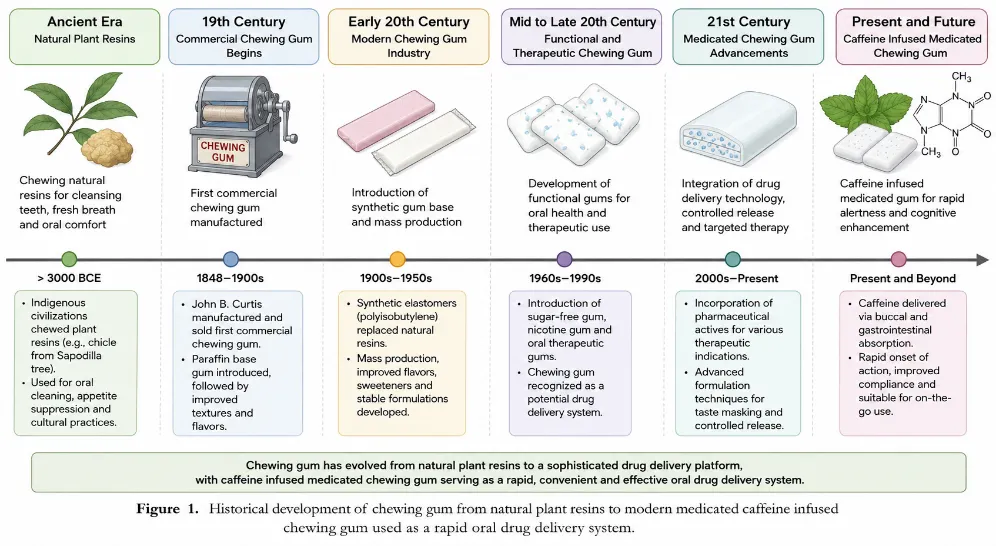
Figure 1. Historical development of chewing gum from natural plant resins to modern medicated caffeine infused chewing gum used as a rapid oral drug delivery system
3. CAFFEINE: AN OVERVIEW
Caffeine is a naturally occurring methylxanthine alkaloid and one of the most widely consumed psychoactive compounds worldwide. Chemically identified as 1,3,7-trimethylxanthine, it belongs to the xanthine family and is widely consumed through coffee, tea, cocoa, chocolate, soft drinks, energy drinks, dietary supplements, and pharmaceutical preparations. Its therapeutic applications include management of fatigue, headache, migraine, neonatal apnea, and enhancement of mental alertness [27]. Caffeine is obtained from natural sources such as Coffea arabica, Coffea canephora, Camellia sinensis, Theobroma cacao, guarana, yerba mate, and kola nuts, as well as through synthetic production. Its molecular formula is C₈Hâ‚â‚€Nâ‚„Oâ‚‚, with a molecular weight of 194.19 g/mol. Caffeine is a white, odorless, crystalline powder with a bitter taste, approximately 14 pKa, and favorable membrane permeability.
Pharmacologically, caffeine primarily acts as a competitive antagonist of adenosine receptors, increasing neuronal activity and promoting wakefulness, attention, vigilance, and reduced mental fatigue. It undergoes rapid absorption, extensive distribution, hepatic metabolism mainly through CYP1A2, and renal elimination. When incorporated into medicated chewing gum, caffeine can undergo both buccal and gastrointestinal absorption, providing faster systemic exposure and rapid onset of action compared with conventional oral dosage forms [28].
4. ALERTNESS AND COGNITIVE PERFORMANCE
Alertness is a dynamic component of cognitive function involving wakefulness, vigilance, attention, and readiness to respond to internal and external stimuli. It is essential for efficient decision making, learning, memory, and psychomotor coordination and is regulated by interactions among the cerebral cortex, thalamus, hypothalamus, reticular activating system, basal forebrain, and brainstem nuclei. Neurotransmitters including dopamine, norepinephrine, acetylcholine, serotonin, histamine, glutamate, GABA, and adenosine contribute to maintaining an appropriate level of arousal [29].
Physiological alertness depends on the balance between homeostatic sleep pressure and circadian regulation. Adenosine progressively accumulates during prolonged wakefulness and promotes sleep by reducing neuronal excitability, whereas dopamine, norepinephrine, acetylcholine, histamine, and orexin support wakefulness and sustained cognitive activity. Disruption of these mechanisms through sleep deprivation, fatigue, circadian misalignment, psychological stress, dehydration, poor nutrition, environmental conditions, or medication use can impair attention, reaction time, working memory, decision making, and occupational performance.
Caffeine is an established pharmacological countermeasure for temporarily improving alertness and cognitive performance. It primarily acts through competitive antagonism of adenosine A1 and A2A receptors, thereby maintaining cortical activation and reducing fatigue. Moderate caffeine doses have demonstrated improvements in vigilance, sustained attention, psychomotor performance, and reaction time, particularly during sleep deprivation and prolonged cognitive activity. Caffeine-infused medicated chewing gum may provide an additional advantage because buccal absorption enables faster systemic exposure and earlier cognitive effects than conventional oral dosage forms [30].
5. MEDICATED CHEWING GUM AS A DRUG DELIVERY SYSTEM
Medicated chewing gum is an innovative oral drug delivery system that combines the functional properties of chewing gum with pharmaceutical technology to provide local and systemic therapeutic effects. During mastication, the active pharmaceutical ingredient (API) is released into saliva and may be absorbed directly through the buccal mucosa or swallowed for subsequent gastrointestinal absorption. This dual absorption pathway can provide rapid drug action and improve patient convenience and compliance [31].
The formulation primarily consists of a gum base, sweeteners, plasticizers, flavoring agents, and the API. The gum base provides elasticity, chewability, and mechanical strength, while modern synthetic gum bases offer improved consistency and manufacturing characteristics. Sugar-free sweeteners such as xylitol, sorbitol, mannitol, and sucralose improve palatability, with xylitol additionally providing anticariogenic benefits. Plasticizers enhance flexibility, whereas flavoring agents assist in masking unpleasant drug taste. Caffeine is particularly suitable for medicated chewing gum because of its favorable solubility, stability, low molecular weight, and ability to undergo rapid absorption [32].
Major advantages include administration without water, improved patient compliance, rapid onset of action, partial avoidance of hepatic first-pass metabolism, and easy termination of drug delivery by removing the gum. However, drug release may vary according to chewing behavior, salivary flow, and formulation characteristics. Other limitations include incomplete release of lipophilic drugs, jaw discomfort, gastrointestinal effects from excessive polyol consumption, specialized manufacturing requirements, and challenges in taste masking.
Drug release begins during mastication through mechanical deformation and diffusion into saliva. The dissolved drug may subsequently undergo buccal absorption, while the remaining fraction is swallowed and absorbed gastrointestinally, making medicated chewing gum a promising platform for rapid oral drug delivery [33].
6. FORMULATION OF CAFFEINE-INFUSED MEDICATED CHEWING GUM
The formulation of caffeine-infused medicated chewing gum requires careful integration of pharmaceutical formulation principles, excipient functionality, drug-release characteristics, and sensory properties. Unlike conventional tablets and capsules, the formulation must provide adequate mechanical strength, elasticity, palatability, dose uniformity, stability, and reproducible caffeine release during mastication. Caffeine is particularly suitable because of its low molecular weight (194.19 g/mol), moderate aqueous solubility, chemical stability, high oral bioavailability, and ability to undergo buccal and gastrointestinal absorption [34].
The selection of excipients is critical for achieving desirable product performance. The gum base provides elasticity, chewability, and structural integrity and generally contains elastomers, resins, waxes, and fillers. Sweeteners such as xylitol, sorbitol, mannitol, maltitol, sucralose, and acesulfame potassium improve palatability and help mask caffeine bitterness. Plasticizers including glycerol, lecithin, propylene glycol, and vegetable oils maintain flexibility and prevent excessive hardness. Flavoring agents such as peppermint, spearmint, menthol, citrus, and fruit flavors further enhance sensory acceptability. Lubricants, antioxidants, and coating materials may additionally improve manufacturing, stability, moisture protection, and taste masking [35].
Several manufacturing approaches are available, including conventional heating and mixing, direct compression, cooling-grinding/freezing, and melt technology. Conventional processing involves softening the gum base, incorporating caffeine and excipients, followed by rolling, cooling, cutting, and conditioning. Direct compression offers simplified processing and reduced thermal exposure, whereas cooling-grinding facilitates uniform mixing by converting gum into a brittle powder [36]. Melt processing enables homogeneous drug dispersion. Advanced approaches, including hot-melt extrusion, continuous manufacturing, multilayer compression, and 3D printing, may further improve dosage accuracy, process control, and manufacturing consistency [37].
7. EVALUATION PARAMETERS
Comprehensive evaluation of caffeine-infused medicated chewing gum is essential to ensure pharmaceutical quality, safety, therapeutic performance, and patient acceptability. Unlike conventional solid dosage forms, these formulations require assessment of physical, mechanical, chemical, drug-release, stability, and sensory characteristics to ensure consistent performance and batch-to-batch reproducibility.
Physical evaluation includes appearance, weight variation, thickness, hardness, and stickiness. Uniform color, shape, surface characteristics, weight, and thickness indicate satisfactory manufacturing consistency, while appropriate hardness and minimal stickiness ensure structural integrity and comfortable handling. Mechanical properties are further assessed using texture profile analysis to determine elasticity, cohesiveness, resilience, adhesiveness, springiness, and chewiness, which influence both mastication and drug release [38].
Drug content uniformity is determined using validated analytical methods such as HPLC or UV-visible spectrophotometry to confirm accurate caffeine dosage. In vitro drug-release studies using specialized chewing apparatus simulate mastication and evaluate the rate and extent of caffeine release. Chewing-time studies further establish the relationship between mastication duration and drug release.
Stability studies assess physical, chemical, microbiological, mechanical, and sensory characteristics under long-term and accelerated conditions. Organoleptic evaluation examines taste, flavor, aroma, mouthfeel, sweetness, texture, aftertaste, and overall acceptability, with particular emphasis on masking caffeine bitterness. Collectively, these evaluations ensure rapid, reproducible caffeine delivery while maintaining product quality and patient compliance [39].
9. CLINICAL APPLICATIONS
Caffeine-infused medicated chewing gum has emerged as a practical rapid-onset dosage form for situations requiring temporary enhancement of alertness, vigilance, concentration, reaction time, and cognitive performance. Its portability, ease of administration, and partial buccal absorption provide earlier systemic caffeine availability than conventional oral formulations, making it useful during prolonged wakefulness, fatigue, and demanding physical or cognitive activities [40].
In military personnel, caffeine chewing gum can serve as a fatigue countermeasure during extended missions involving sleep deprivation, stress, and sustained decision making. Its compact form and rapid onset allow administration without water or interruption of operational activities. It has been associated with improvements in vigilance, target detection, reaction time, and psychomotor performance [41].
Among healthcare professionals, prolonged shifts and overnight duties may cause fatigue and reduced concentration. Rapid caffeine delivery through chewing gum may temporarily improve alertness and vigilance during demanding clinical activities.
For students, caffeine gum provides a convenient alternative to caffeinated beverages, potentially supporting attention and reducing subjective fatigue during prolonged study. Drivers and shift workers may benefit from rapid alertness enhancement during extended or nighttime activities, although caffeine should not replace adequate sleep [42]. Athletes may experience improvements in endurance, reaction time, concentration, and perceived exertion, while emergency response personnel may benefit from improved vigilance and faster reactions during prolonged, high-stress operations. Overall, caffeine-infused medicated chewing gum offers a convenient strategy for temporary cognitive and operational support across diverse settings [43].
10. CLINICAL EVIDENCE
The clinical effectiveness of caffeine-infused medicated chewing gum has been investigated through pharmacokinetic studies, randomized controlled trials, sleep-deprivation experiments, military research, and sports-performance studies. Collectively, these investigations indicate that caffeine chewing gum provides rapid systemic absorption and earlier enhancement of alertness, vigilance, psychomotor performance, and cognitive function compared with placebo and, in some studies, conventional oral caffeine formulations [44].
Human pharmacokinetic studies demonstrate that caffeine administered through chewing gum appears in the systemic circulation within minutes of mastication and generally reaches peak plasma concentrations earlier than conventional capsules or tablets. This rapid absorption is attributed partly to buccal drug uptake, which reduces dependence on gastric emptying. Clinical studies have consequently reported improvements in subjective alertness, concentration, reaction time, and sustained attention following moderate caffeine doses [45].
Randomized controlled studies further support improvements in psychomotor vigilance, sustained attention, reaction time, and perceived mental fatigue compared with placebo. Benefits are particularly evident during sleep deprivation and prolonged cognitive activity, where caffeine can attenuate declines in vigilance and psychomotor performance. Military investigations similarly report improved operational performance, including vigilance and decision making during prolonged missions. Sports studies indicate potential improvements in endurance, reaction time, motor coordination, and perceived exertion [46].
Overall, the available evidence supports caffeine-infused medicated chewing gum as a rapid-onset fatigue countermeasure. However, caffeine does not completely reverse the effects of severe sleep deprivation and should not replace adequate restorative sleep. Further research is warranted to establish individualized dosing, long-term safety, and comparative clinical effectiveness [47].
11. REGULATORY ASPECTS
The development and commercialization of caffeine-infused medicated chewing gum require compliance with regulatory requirements governing pharmaceutical quality, safety, efficacy, manufacturing consistency, and stability. Because this dosage form combines pharmaceutical and confectionery characteristics, regulatory assessment includes both therapeutic performance and consumer acceptability. Classification generally depends on intended use, caffeine dose, therapeutic claims, and the regulatory framework of the target country [48].
In the United States, medicated chewing gum making therapeutic claims is regulated by the Food and Drug Administration (FDA) as a pharmaceutical dosage form. Manufacturers must provide appropriate information on formulation, manufacturing processes, analytical methods, stability, pharmacokinetics, and clinical performance, where required. Compliance with current Good Manufacturing Practice (cGMP) and validated analytical procedures is essential [49].
Within the European Union, regulatory assessment involves the European Medicines Agency (EMA) and national competent authorities [50]. The European Pharmacopoeia provides specialized approaches for evaluating medicated chewing gum, including standardized in vitro drug-release testing using chewing apparatus. Demonstration of content uniformity, reproducible drug release, mechanical properties, stability, and pharmaceutical quality is essential [51].
Quality control should include appearance, weight variation, hardness, drug content, moisture, mechanical properties, microbial quality, impurities, and drug-release characteristics. Labeling should state caffeine content, dosage instructions, maximum intake, storage conditions, warnings, and expiration information. GMP requirements further include qualified raw materials, validated processes, environmental control, documentation, and traceability. Following commercialization, pharmacovigilance, complaint monitoring, stability assessment, and benefit–risk evaluation remain essential for maintaining product safety and quality [52].
12. RECENT ADVANCES
Recent advances in pharmaceutical technology, nanotechnology, material science, and digital health have expanded the potential of caffeine-infused medicated chewing gum as an advanced drug delivery platform. Current research focuses on improving rapid drug release, taste masking, stability, controlled delivery, manufacturing precision, and personalized dosing [53].
Nanoencapsulation involves incorporating caffeine into nanocarriers such as polymeric nanoparticles, solid lipid nanoparticles, nanostructured lipid carriers, liposomes, and polymeric micelles. These systems may improve drug dispersion, stability, taste masking, dissolution, and buccal absorption. Controlled-release chewing gum uses specialized polymers, encapsulated drug particles, multilayer systems, or release-controlling materials to maintain caffeine concentrations for longer periods while potentially reducing repeated administration and excessive peak concentrations [54].
Advanced taste-masking technologies, including microencapsulation, cyclodextrin inclusion complexes, ion-exchange resins, multilayer coatings, and computational flavor optimization, aim to minimize caffeine bitterness while maintaining effective drug release. Personalized caffeine dosing is another emerging approach that considers body weight, genetic variability, habitual caffeine intake, age, and individual sensitivity to optimize therapeutic response [55].
The concept of smart medicated chewing gum integrates biosensors, wearable devices, wireless communication, and artificial intelligence to potentially monitor physiological parameters and support individualized caffeine administration. Furthermore, AI-assisted formulation development can predict excipient compatibility, drug-release behavior, mechanical properties, and critical process parameters while reducing experimental requirements. Three-dimensional printing may enable customized doses, shapes, release profiles, and multilayer formulations. Collectively, these technologies could transform caffeine chewing gum into a personalized, digitally connected, and intelligent drug delivery platform [56].
13. FUTURE PERSPECTIVES
The future of caffeine-infused medicated chewing gum is closely associated with advances in pharmaceutical technology, precision medicine, biomaterials, and digital healthcare. Increasing demand for rapid, portable, and patient-friendly dosage forms is expected to drive the development of formulations offering predictable drug delivery, improved bioavailability, enhanced palatability, and individualized therapeutic outcomes [57].
Personalized medicine and precision dosing represent important future directions because caffeine pharmacokinetics and pharmacodynamics vary according to body weight, age, habitual consumption, liver function, and genetic factors, particularly CYP1A2 activity. Future formulations may therefore provide multiple caffeine strengths or customized doses according to individual requirements and sensitivity. Three-dimensional printing and digital manufacturing could facilitate on-demand production of personalized chewing gum [58].
Combination therapy may enable caffeine to be formulated with complementary ingredients such as L-theanine, vitamins, electrolytes, or other cognitive-supporting agents. However, compatibility, stability, pharmacokinetic interactions, and clinical efficacy would require careful evaluation [59].
Advances in novel polymers and biomaterials may improve flexibility, taste masking, stability, bioadhesion, and controlled drug release. Sustained-release chewing gum could provide prolonged caffeine delivery for military personnel, shift workers, drivers, healthcare professionals, and emergency responders [60].
Integration with digital health and artificial intelligence may enable wearable-based fatigue monitoring, personalized dosing recommendations, adherence tracking, and predictive caffeine administration. Future research should also address long-term safety, comparative effectiveness, pharmacokinetic variability, pharmacogenomics, sustainable manufacturing, biodegradable packaging, and continuous production. Collectively, these developments may transform caffeine chewing gum into a personalized and digitally integrated oral drug delivery platform [61].
CONCLUSION
Caffeine-infused medicated chewing gum represents an innovative and practical oral drug delivery system that combines the established pharmacological effects of caffeine with the advantages of buccal drug delivery. Its partial buccal absorption, followed by gastrointestinal absorption, provides rapid systemic availability and earlier enhancement of alertness, vigilance, attention, and psychomotor performance compared with conventional caffeine tablets and capsules. The dosage form offers several practical advantages, including administration without water, portability, convenient dosing, improved patient compliance, and suitability for occupational and physically demanding environments. Clinical evidence supports its effectiveness in temporarily improving cognitive performance and reducing fatigue, particularly during sleep deprivation and prolonged activities involving military personnel, healthcare professionals, drivers, shift workers, students, athletes, and emergency responders. Successful formulation requires appropriate selection of gum bases, sweeteners, plasticizers, flavoring agents, and manufacturing processes to achieve acceptable taste, mechanical properties, uniform drug content, and predictable release. Emerging technologies such as nanoencapsulation, controlled-release systems, artificial intelligence, personalized dosing, and digital health integration may further enhance its potential. Nevertheless, long-term safety, individualized dosing, comparative effectiveness, and harmonized regulatory approaches require further investigation. Overall, caffeine-infused medicated chewing gum offers considerable promise as an advanced, rapid-onset oral drug delivery platform.
REFERENCES

Deepeshkumar R. Thakare*, Gaurav M. Borse, Gunjan J. Patil, Kundan H. Narkhede, Harshal V. Patil, Harshal G. Patil, Divya P. Patil, Jay I. Patil, Tushar A. Deshmukh, A Comprehensive Review On Medicated Caffeine Infused Chewing Gum For Enhancing Alertness: Formulation, Pharmacology, Clinical Applications, And Future Perspectives, Int. J. Sci. R. Tech., 2026, 3 (8), 496-505. https://doi.org/10.5281/zenodo.21933359
 10.5281/zenodo.21933359