

We use cookies to ensure our website works properly and to personalise your experience. Cookies policy
Department of Computer Science and Data Science, Oriental College of Technology, Bhopal, Madhya Pradesh, India.
Citizens use public grievance systems to report problems involving services such as roads, water supply, sanitation, electricity and local administration. A complaint may be written in everyday language, may contain incomplete information, or may be sent to the wrong department. These issues can make complaint handling harder to organise, particularly when many requests arrive at the same time. India already has the Centralised Public Grievance Redress and Monitoring System (CPGRAMS), which supports online grievance submission, status tracking and feedback. The project described in this paper is an academic prototype concept that explores how a web-based complaint workflow could be supported by optional artificial-intelligence (AI) features. The proposed system uses Python and Flask for the web application, HTML, CSS and JavaScript for the interface, and SQL for structured storage. After a suitable labelled dataset becomes available, natural language processing could be used to suggest a complaint category, priority level and likely department. Similarity matching and short summaries are also considered as support features. These outputs should remain recommendations that an authorised person can review, rather than automatic final decisions. At the time of writing, the team reports that a website/prototype has been developed, but a final dataset and quantitative model evaluation have not been supplied. Therefore, this paper describes the system design and evaluation plan without claiming model accuracy or proven performance gains.
Public services affect everyday life, so citizens need a clear way to report service problems and
follow the action taken. A grievance might concern a damaged road, irregular water supply,
uncollected waste, a faulty streetlight or a delay in a public service. When complaint
descriptions are informal or lack key details, staff may need to read each submission,
determine its subject and decide which office should handle it. This manual work can become
difficult to manage when the number of complaints increases.
Online grievance platforms have already made important parts of this process more
accessible. The official CPGRAMS portal allows citizens to submit grievances to public
authorities and track them through a registration identifier; it also provides feedback and an
appeal process in applicable cases (Department of Administrative Reforms and Public
Grievances, n.d.). The National Government Services Portal describes related online services
for lodging and checking grievance status. The proposed student project does not replace
these services and does not claim official integration. It investigates a smaller, configurable workflow in which AI could help organise complaint text for administrative review.
The main design principle is that automation should assist, not replace, responsible officials. A
model may misread a local place name, mixed Hindi-English sentence, sarcasm or urgent
context. For that reason, category and priority predictions should be visible as suggestions,
with the final assignment and status change controlled by an authorised administrator.
1.1 Problem Statement
Citizens may be unsure how to describe a complaint, which department is responsible, or how
to follow its progress. Administrators may spend time sorting unstructured text, locating
similar reports and preparing summaries. The project explores whether a structured website,
supported by carefully evaluated text-processing tools, can make complaint records easier to
organise and monitor.
1.2 Objectives
Provide a simple web interface for complaint submission and status tracking.
Store complaint details, department information and status history in a relational SQL database.
Design an NLP pipeline that can recommend complaint categories when labelled training data are available.
Explore priority recommendations and category-to-department routing rules, with human confirmation.
Investigate similarity-based duplicate alerts and short summaries for administrative convenience.
Plan Hindi, English and mixed-language support, then evaluate each language setting separately.
Present complaint counts and status information through an administrator dashboard.
Evaluate the system using a documented test set and suitable metrics before making performance claims.
1.3 Scope
The current scope is an academic web prototype intended for demonstration and further
development. It is not an official government service, it is not connected to CPGRAMS unless a
separately authorised integration is established, and it should not be used to handle real
emergencies. Any real-world deployment would require legal and institutional approval, privacy
safeguards, accessibility testing, security review and operational support.
2. Related Work and Background
2.1 Existing public grievance services
CPGRAMS demonstrates that online grievance submission, registration-based tracking and
citizen feedback are established parts of public grievance management. Official government
pages also describe role-based access for ministries and states and an appeal route for
eligible cases. These features provide a useful baseline for understanding the expected
lifecycle of a complaint. The project therefore focuses on a prototype workflow and the
possible addition of AI-assisted organisation, rather than presenting basic online tracking as a
new contribution.
The Open Government Data (OGD) Platform publishes aggregate grievance resources,
including year-wise figures for grievances received and redressed on CPGRAMS from 2020 to
2024 and state/UT-wise resources. Such data can help describe overall workload trends.
However, aggregate counts do not contain the individual complaint text and labels needed to
train a complaint-classification model. A case-level dataset with suitable permissions and
reliable labels would be required for that task.
2.2 AI and text classification
Text classification maps a written document to one of a predefined set of categories. In this
project, categories might represent service areas such as roads, sanitation, water supply or
electricity, but the final taxonomy must be agreed with the intended users. A common baseline converts text into numerical features using Term Frequency–Inverse Document Frequency (TF-
IDF). TF-IDF gives greater weight to terms that are informative for a document relative to the
wider collection; the scikit-learn documentation describes its use in document classification
and information retrieval. A classifier such as Logistic Regression or a linear Support Vector
Machine can then be trained on examples whose categories are known.
More advanced multilingual or transformer-based models may eventually handle context and
language variation better, but they also require careful evaluation and can be harder to explain.
A simple baseline is valuable because it is easier to reproduce and provides a fair comparison
for more complex models. Model selection should be driven by a held-out evaluation set, not by
assumptions that a newer model must be better.
2.3 Design implications from prior systems
Use a clearly defined category list and document who is responsible for maintaining it.
Keep the official complaint record separate from model-generated suggestions.
Measure errors by category and language, rather than reporting accuracy alone.
Treat duplicate detection as an alert for review, because similar wording does not always mean the same incident.
Provide an understandable status history and a way for authorised staff to correct mistakes.
3. Proposed System
The proposed system combines a conventional complaint-management workflow with optional
AI assistance. A citizen enters the complaint through a browser. The application validates
required fields and stores the record in SQL. If the AI component is implemented and evaluated,
it can suggest a category, priority and department based on the complaint text and configured
rules. An administrator reviews the suggestion, updates the record and the citizen can check
progress using the complaint reference.
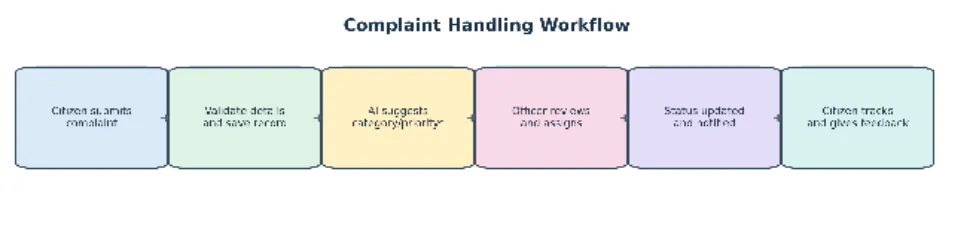
Figure 1. Proposed complaint workflow. AI outputs are suggestions; final assignment remains under authorised human review.
*The AI recommendation step is conditional on the relevant component being implemented,
connected to a suitable dataset and tested.
3.1 Main modules
|
Module |
Purpose |
Important design point |
|
Citizen interface |
Submit complaint, receive reference, track |
Forms should explain required fields and avoid collecting unnecessary personal data. |
|
Complaint validation |
Check required fields and basic input quality before saving. |
Validation should give clear error messages and preserve the original complaint meaning. |
|
Complaint database |
Store complaint details, department, timestamps and status history. |
Access must be role-based; changes should be traceable. |
|
AI/NLP assistance |
Suggest category, priority, similar reports or a short summary. |
Only enable features after evaluation; show |
|
Administrator dashboard |
Review records, assign departments and |
Human review is required for routing, |
|
Notifications and feedback |
update status. |
priority and closure. |
3.2 User roles
Citizen: submits a complaint, receives a tracking reference, checks progress and shares
feedback. Administrator or authorised officer: reviews complaint records, confirms the
department and priority, updates status, and corrects inaccurate AI suggestions. Technical
administrator: manages accounts, category mappings, backups and application configuration.
The precise role model should be adjusted to the final implementation.
3.3 Example use case
Suppose a citizen reports that waste has not been collected from a neighbourhood for several
days. The system stores the description and may suggest “sanitation” as the category. A rule-
based mapping can show the department configured for that service area. If the classifier is
uncertain, the record should be marked for manual review rather than assigned automatically.
The authorised officer confirms the assignment and updates the complaint status as work
progresses.
4. Technology and Methodology
4.1 Technology stack
|
Technology |
Role in the proposed project |
|
Python |
Backend logic and possible text-processing / machine-learning components. |
|
Flask |
Web routes, form handling and application workflow. |
|
HTML, CSS and JavaScript |
Citizen forms, tracking views and dashboard interface. |
|
SQL database |
Structured complaint records, users, department mappings and status history. |
|
scikit-learn (planned for baseline AI) |
TF-IDF feature extraction and baseline text-classification models, if implemented. |
4.2 Dataset plan and constraints
The team has identified official aggregate CPGRAMS datasets on the OGD Platform as a
source for background statistics. The year-wise resource lists fields such as year, carried-
forward cases, receipts and disposed cases. This is useful for describing workload, but it is not
sufficient for supervised complaint-text classification. Before training a model, the team must
identify a dataset that actually contains complaint descriptions and reliable category labels,
confirm its licence or permission, and document its fields and limitations.
Potential case-level fields, if lawfully available, include complaint text, category, responsible
department, service area, submission date and status. Personal identifiers should be excluded
from the training data wherever possible. The team should not assume that restricted
government records are openly downloadable. If suitable case-level data cannot be obtained,
the paper should describe the AI component as a design proposal or use a clearly labelled,
ethically prepared demonstration dataset rather than implying access to real citizen records.
4.3 Data preprocessing
1. Inspect the schema, missing values, class balance, label quality and data-use conditions.
2. Remove exact duplicate records and document how inconsistent labels are resolved.
3. Normalise whitespace and formatting while retaining meaningful terms, negation and local place names.
4. Define how Hindi, English and code-mixed text will be handled; do not call the system bilingual until this is tested.
5. Separate training and test records before model tuning, keeping near-duplicate complaints from leaking across splits where feasible.
6. Record all preprocessing choices so that results can be reproduced.
4.4 Proposed AI pipeline
A practical first experiment would use TF-IDF features with a simple multi-class model such as
Logistic Regression or Linear SVM. The same split and evaluation metrics should be used
when comparing models. If enough labelled data become available, later experiments could
consider multilingual embeddings or transformer models. A priority recommendation may be
based initially on transparent rules agreed by the project team; it should not be inferred solely
from historical closure time, because that could reproduce past delays or bias.
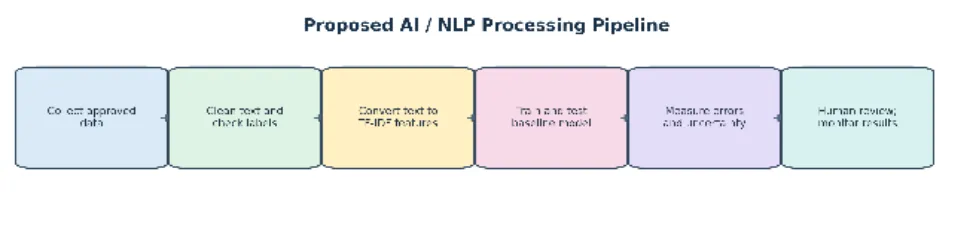
Figure 2. Proposed AI/NLP pipeline. The stages are a plan for evaluation, not evidence that a trained model has already been validated.
4.5 Database design
A relational schema may include Users, Complaints, Categories, Departments,
ComplaintStatusHistory and Feedback. The Complaints table should use a unique complaint
identifier and store submission and update timestamps. Status history should preserve prior
states rather than overwrite the full record without a trace. Department mappings should be
configurable because responsibilities may differ by service and jurisdiction. The final schema
should match the actual prototype rather than the conceptual design shown here.
4.6 Privacy, security and responsible use
Complaint descriptions can contain names, phone numbers, addresses or sensitive
circumstances. The prototype should collect only necessary information, restrict access by
role, protect credentials, validate inputs and use secure transport in any deployed environment.
A retention policy and backup procedure should be defined before real data are used. AI
suggestions should be logged separately from official decisions so that a model error does not
silently change the record. Citizens should have a clear route to request correction or seek help
from a person.
5. System Architecture
The system can be organised into five logical layers. The presentation layer provides forms,
tracking pages and the dashboard. The Flask application layer validates requests and manages
the complaint lifecycle. The AI assistance layer is responsible for text cleaning and any tested
recommendations. The SQL layer stores complaint data and status history. The review and
monitoring layer supports authorised human decisions, audit trails and evaluation.
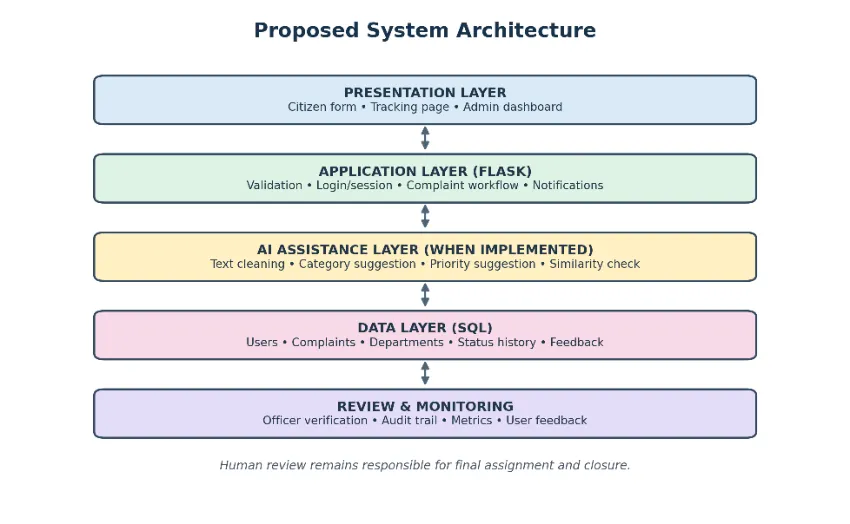
Figure 3. Logical architecture of the proposed system. The AI layer is optional until the required data and tests are available.
A typical request begins in the browser and reaches the Flask backend. The backend checks
the input, saves a record and generates a tracking reference. If the AI module is enabled, it
returns suggestions to the review interface. The authorised officer confirms or changes them.
The application then stores the decision and makes the status available to the citizen. For a
public deployment, the design would also need secure authentication, monitoring, tested
notifications, backups and an incident-response process.
6. Implementation Status
According to the project information provided by the team, a website/prototype has been
developed using Python, Flask, HTML, CSS, JavaScript and SQL. The exact pages, backend
operations and AI modules have not been independently inspected for this paper. The final
submission should therefore distinguish features demonstrated in the prototype from features
that remain planned. The paper does not claim that AI classification, duplicate detection,
bilingual NLP, SMS/email notifications or model evaluation are operational unless the team can
show working evidence.
|
Item |
Status that can currently be stated |
Evidence to add before final submission |
|
Website / prototype |
Reported by the team as developed. |
Screenshots, running demo or code |
|
Complaint submission and tracking |
Intended core workflow; verify actual working behaviour. |
Test cases showing successful submission and status lookup. |
|
SQL storage |
Technology specified by the team; verify schema and persistence. |
Schema screenshot and example test reord with personal data removed. |
|
AI classification / priority |
Proposed; no validated results supplied. |
Dataset description, training code, test protocol and metrics. |
|
Duplicate detection / summaries |
Proposed feature unless working demo is available. |
Examples, acceptance criteria and error review. |
|
Notifications |
Requires external configuration and tests. |
Delivery logs or screenshots from a safe test environment. |
7. Evaluation Plan
A credible evaluation needs a documented dataset and a test set that was not used during
training or model selection. The paper should report the number of records, category
distribution, languages represented, preprocessing steps, train/test split and model
configuration. Accuracy can be included, but it should not be the only metric when some
categories are much more common than others.
|
Measure |
What it tells the reader |
|
Accuracy |
Share of test complaints assigned to the correct category. |
|
Precision |
Among records predicted as a category, how many actually belong to it. |
|
Recall |
Among records belonging to a category, how many the model finds. |
|
Macro-F1 |
Average F1 across categories, giving each category equal weight. |
|
Confusion matrix |
Shows which categories the model most often confuses. |
|
Review rate / uncertainty |
How often the system should defer a prediction to a human reviewer. |
|
Duplicate-alert precision |
How often flagged pairs are genuinely duplicates, based on reviewed examples. |
For a fair baseline, the team can compare a simple rule-based or keyword method with TF-IDF
plus a classifier. All approaches should use the same held-out test data. Language-specific
performance should be reported separately when there are enough examples. A small user test
can also examine whether citizens understand the form and whether administrators can find
and update records without confusion. No numerical evaluation results are included in this
draft because no final dataset or test output has been supplied.
8. Results and Discussion
At the current stage, the supportable outcome is a proposed system design and a website/
prototype reported by the team. There is not enough evidence to report a classification
accuracy, reduction in processing time or improvement in citizen satisfaction. Such claims
should only be added after a repeatable evaluation has been completed.
The proposed design offers a clear sequence from submission to review and tracking. Its
potential value lies in organising information and making possible AI suggestions visible to an
authorised person. The design also acknowledges that existing government services already
provide important grievance functions. As a result, the project should be assessed on the
quality of its own prototype, the clarity of its workflow, the reliability of its data handling and the
measured performance of any implemented AI features—not on feature lists alone.
An important operational risk is that a complaint may describe a time-sensitive or sensitive
situation. An automated score must not block access to official emergency services or prevent
an officer from escalating a case. Similarly, a duplicate detector should flag possible matches
for review instead of automatically deleting or merging records. These safeguards are
necessary because two citizens may report the same continuing problem from different
locations or at different times.
9. Limitations
The final dataset and category taxonomy have not yet been documented in this paper.
No measured classification results or end-to-end test outcomes were supplied.
Hindi, English and mixed-language complaints may require different processing methods and separate evaluation.
Department mappings need to be checked against the correct service area and current administrative
responsibilities.
Priority suggestions may be biased if training labels or historical outcomes are inconsistent.
Similarity detection can incorrectly flag separate complaints about the same recurring issue.
SMS/email delivery depends on external configuration and has not been established by the technology list alone.
The prototype is an academic project and is not an official government portal or validated emergency service.
10. Future Scope
Find and document a lawful case-level dataset with complaint text and reliable labels.
Build a reproducible TF-IDF baseline and compare it with suitable multilingual models.
Test Hindi, English and code-mixed complaints separately, including low-confidence examples.
Add a clear category-to-department mapping with version history and human approval.
Evaluate duplicate detection on reviewed complaint pairs and tune thresholds to reduce harmful false matches.
Add secure notifications, complaint history, exportable reports and dashboard analytics after testing.
Conduct usability testing with participants and document what they found difficult.
Explore official integration only through authorised, documented mechanisms and with appropriate approval.
Publish a model card or short model note describing data, intended use, limitations and evaluation.
CONCLUSION
This paper presents the design of an AI-Based Smart Government Grievance System intended
to support complaint submission, record management, department review and status tracking.
It proposes optional AI assistance for complaint categorisation, priority recommendation,
similarity checking and summarisation. The design uses a conventional web stack and keeps
human review central to decisions that affect complaint handling.
The work is at a prototype and design stage based on the information available from the team.
Official aggregate grievance statistics can provide context, but they do not by themselves
supply the text labels required for supervised complaint classification. A suitable dataset,
documented implementation evidence and a repeatable evaluation are therefore the next
essential steps. Until those steps are completed, the system should be presented as a
prototype with planned AI features rather than as a validated operational service.
REFERENCES





Aastha Baderiya*, Monika Rajput, Chetan Choudhary, Pawan Shah, Dr. Angad Dixit, AI-Based Smart Government Grievance System, Int. J. Sci. R. Tech., 2026, 3 (11), 68-77. https://doi.org/10.5281/zenodo.23913263
 10.5281/zenodo.23913263