

We use cookies to ensure our website works properly and to personalise your experience. Cookies policy
Child Health Nursing Department, Driems University, School of Nursing, Kotasahi, Tangi, Cuttack, Odisha 754022
Harlequin Ichthyosis is a rare, severe, autosomal recessive congenital disorder of keratinization caused by mutations in the ABCA12 gene, leading to defective lipid transport and abnormal skin barrier formation. Affected neonates present with thick, armor-like plates of skin separated by deep fissures, resulting in high risk of dehydration, hypothermia, infection, respiratory compromise, and electrolyte imbalance. Early diagnosis through genetic testing and clinical evaluation is crucial. Management requires intensive neonatal care, including maintenance of a warm humidified environment, strict infection control, fluid and electrolyte monitoring, nutritional support, and specialized skin care with emollients. Systemic retinoids may be considered under expert supervision to improve skin flexibility. Despite high mortality in the past, advances in neonatal intensive care and multidisciplinary interventions have improved survival rates. This study highlights the importance of comprehensive nursing care in optimizing outcomes for neonates with Harlequin Ichthyosis.
Case Scenario:
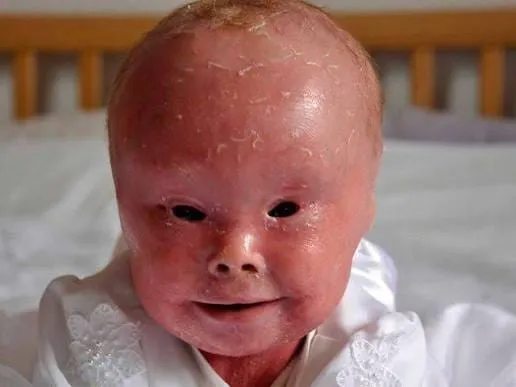
A male neonate was delivered at 38 weeks' gestation via cesarean section to consanguineous parents with a history of one previous child affected by Harlequin Ichthyosis. At birth, the infant presented with thick, shiny, plate-like scales covering the entire body, deep fissures, ectropion, eclabium, and restricted limb movement. The newborn was immediately admitted to the NICU.
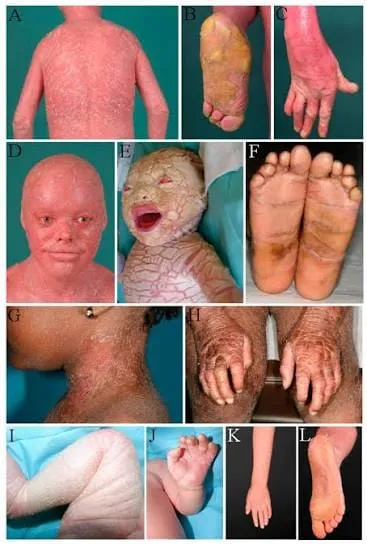
Harlequin Ichthyosis is a rare and severe inherited disorder of Keratinization in which the newborn's skin becomes extremely thick, hard, and dry. The skin develops large, diamond- or plate-like scales separated by deep cracks. Because of severe damage to the skin barrier, affected newborns are at high risk of Dehydration, Infection, Hypothermia, Respiratory problems, and Electrolyte imbalance.1,2,5
Harlequin Ichthyosis is a rare, severe autosomal recessive congenital disorder caused by abnormal formation of the skin barrier, characterized at birth by thick, armor-like plates of skin with deep Fissures over the body.1,2
The major cause of Harlequin Ichthyosis is a mutation in the ABCA12 gene, which plays an important role in the transport of lipids within skin cells. It is inherited in an autosomal recessive pattern, meaning that the child usually inherits one abnormal gene from each parent.4,5,6
ABCA12 Gene mutation
↓
Abnormal lipid transport in epidermal cells
↓
Defective formation of the skin barrier
↓
Excessive and abnormal keratinization
↓
Very thick, rigid skin develops
↓
Deep Fissures are large plate –like scales
↓
Loss of water and heat
↓
Risk of dehydration. Hypothermia and Infection2,5,6
E. Nutritional management
F. Infection prevention and treatment
G. Systemic retinoids
Oral retinoids, particularly acitretin or isotretinoin, may be considered by specialists in severe cases. They can help reduce abnormal scaling and improve skin flexibility. Because these medicines have significant adverse effects, their use requires supervision.
Harlequin ichthyosis was historically associated with very high neonatal mortality; with modern neonatal intensive care, humidified environments, careful fluid and nutritional management, infection prevention, skin care, and appropriate systemic treatment, survival has improved considerably. However, affected children generally require lifelong management of ichthyosis and skin-barrier problems.5,6
Because Harlequin ichthyosis is an inherited disorder, prevention focuses mainly on genetic counseling and reproductive options for families at risk.
12. Role of nurse
Assess the newborn: Monitor skin condition, vital signs, hydration, feeding, respiratory status, and temperature regularly.
Maintain body temperature: Keep the newborn in a warm, temperature-controlled, and appropriately humidified environment.
Provide skin care: Apply prescribed emollients gently and regularly to prevent excessive dryness and cracking.
Prevent skin injury: Handle the baby gently and avoid rubbing, peeling, or forcibly removing skin scales.
Maintain hydration: Monitor intake and output, daily weight, urine output, and electrolyte levels as ordered.
Provide nutritional support: Assess sucking and swallowing; assist with breast or alternative feeding as required.
Prevent infection: Follow strict hand hygiene and aseptic technique and observe for redness, discharge, fever, or other signs of infection.
Provide respiratory care: Monitor respiratory rate, oxygen saturation, chest movement, and signs of respiratory distress.
Provide eye and oral care: Assess for ectropion and eclabium and provide prescribed eye, lip, and oral care.
Administer medications: Give prescribed medications, including topical treatment and systemic medicines, and observe for adverse effects.
Monitor complications: Watch for dehydration, hypothermia, infection, electrolyte imbalance, feeding difficulty, and respiratory problems.
Maintain accurate records: Document assessment findings, skin care, intake/output, feeding, medication, and response to treatment.
Educate parents: Explain the condition,skin-care techniques, feeding, hydration, infection prevention measures, and warning signs.
Provide emotional support: Encourage parents to express their concerns and participate in appropriate newborn care.
Coordinate multidisciplinary care: Collaborate with pediatrician, dermatologist, nutritionists, and other health care professionals.
Prepare for discharge and follow-up: Teach parents about long-term skin care, medications, follow-up visits, and genetic counselling when appropriate.3,5
Nursing diagnosis
1. Impaired skin integrity related to altered skin barrier and abnormal keratinization as evidenced by thick, dry, fissured, and scaly skin.
2. Risk for deficient fluid volume related to excessive transepidermal water loss secondary to impaired skin barrier.
3. Imbalanced nutrition: less than body requirements related to difficulty with feeding secondary to restricted oral movement, as evidenced by poor sucking reflex and poor feeding tolerance.
4. Ineffective thermoregulation related to impaired skin barrier and increased heat loss as evidenced by low body temperature, cold skin, lethargy, and poor feeding.
5. Impaired oral mucous membrane integrity related to altered skin barrier and dryness as evidenced by dry/cracked lips and restricted oral movement.2,3
Nursing Care Plan – Harlequin Ichthyosis
|
Assessment |
Nursing Diagnosis |
Goals / Expected Outcomes |
Nursing Interventions |
Rationale |
Evaluation |
|
Thick, plate-like scales, deep fissures, ectropion, eclabium |
Impaired Skin Integrity related to defective keratinization |
Neonate will maintain intact skin barrier and reduced risk of infection |
- Apply sterile emollients frequently - Maintain warm, humidified incubator - Handle gently to avoid skin trauma - Use aseptic technique during care |
Emollients soften scales, humid environment prevents cracking, asepsis reduces infection risk |
Skin remains moist, fissures reduced, no signs of infection |
|
Restricted limb movement due to thickened skin |
Impaired Physical Mobility related to rigid skin plates |
Neonate will demonstrate improved flexibility and comfort |
- Encourage gentle passive ROM exercises - Collaborate with physiotherapist - Position to prevent contractures |
Early mobility prevents stiffness and supports musculoskeletal development |
Infant shows improved limb movement |
|
Risk of dehydration, electrolyte imbalance |
Risk for Fluid Volume Imbalance related to excessive transepidermal water loss |
Neonate will maintain stable hydration and electrolyte balance |
- Monitor fluid intake/output - Assess daily weight - Provide IV fluids as prescribed - Monitor electrolytes |
Thickened skin increases fluid loss; monitoring prevents imbalance |
Hydration and electrolytes remain within normal limits |
|
Poor feeding due to eclabium and restricted mouth opening |
Imbalanced Nutrition: Less Than Body Requirements related to feeding difficulties |
Neonate will achieve adequate nutrition and weight gain |
- Provide specialized feeding techniques - Use NG tube if oral feeding inadequate - Collaborate with dietician for high-calorie feeds |
Feeding support ensures growth and prevents malnutrition |
Infant maintains weight gain and tolerates feeds |
|
Parents anxious due to previous affected child and current condition |
Anxiety (Family) related to chronic illness and prognosis |
Parents will verbalize reduced anxiety and demonstrate coping |
- Provide emotional support - Offer counseling - Educate parents about condition and care - Connect with support groups |
Family support improves coping and reduces stress |
Parents express understanding and confidence in care |
|
Risk of respiratory compromise due to restricted chest expansion |
Ineffective Breathing Pattern related to rigid thoracic skin |
Neonate will maintain adequate oxygenation and ventilation |
- Monitor respiratory rate, effort, and O2 saturation - Position for optimal breathing - Provide humidified oxygen if needed |
Thickened skin may restrict chest expansion; monitoring prevents hypoxia |
Infant maintains stable respiratory status2 |
CONCLUSION
Harlequin ichthyosis is a rare and severe congenital skin disorder that requires early recognition and intensive neonatal care. Proper management of skin integrity, hydration, body temperature, nutrition, respiratory function, and infection prevention is essential for improving comprehensive care, monitoring complications, administering prescribed treatment and education provided, and supporting the parents with appropriate multidisciplinary care and follow-up; the quality of life and survival of affected children can be improved.
REFERENCES




Bijaya Nayak, Sheeba Anitha Rani*, Yerni Jyothi Kolli, Prathima Prakasam, Cracks That Speak Of Survival; Challenges In Management And Care Of Harlequin Ichthyosis- A Case Report, Int. J. Sci. R. Tech., 2026, 3 (10), 348-355. https://doi.org/10.5281/zenodo.23162906
 10.5281/zenodo.23162906