

We use cookies to ensure our website works properly and to personalise your experience. Cookies policy
Department of Pharmaceutics, K.C.T'S R.G. Sapkal College of Pharmacy, Nashik, Maharashtra, India
Bromelain, a proteolytic enzyme obtained from Ananas comosus (pineapple), possesses well-documented anti-inflammatory, analgesic, anti-edematous and wound-healing activity, but its clinical use via conventional tablets and capsules is limited by delayed onset of action and poor compliance in pediatric and geriatric patients. The present work reports the formulation and evaluation of bromelain-loaded fast-dissolving oral strips prepared by the solvent casting method using hydroxypropyl methylcellulose (HPMC) and polyvinyl alcohol (PVA) as film-forming polymers, glycerol and polyethylene glycol 400 (PEG 400) as plasticizers, and sucralose, citric acid and peppermint oil as taste-modifying excipients. Nine formulations (F1–F9) were prepared by systematically varying the HPMC, PVA and plasticizer ratios and were characterized for thickness, weight variation, folding endurance, surface pH, drug content uniformity, tensile strength, percent elongation, moisture content, disintegration time and in vitro drug release. All batches met pharmacopoeial acceptance limits. Formulation F9 (HPMC 300 mg, PVA 200 mg, glycerol 1.0 mL, PEG 400 1.0 mL) was optimal, showing the highest drug content (99.0%), fastest disintegration (35 s) and maximum cumulative drug release (94%) among the batches tested. Scanning electron microscopy confirmed a smooth, largely homogeneous film surface. These findings indicate that solvent-cast bromelain oral strips are a technically feasible, patient-friendly alternative to conventional oral dosage forms for rapid-onset delivery of a protein-based therapeutic, with potential application in localized plaque and inflammation management.
Oral strip technology (OST) has emerged as a promising drug delivery platform, particularly for pediatric and geriatric patients who experience difficulty swallowing conventional solid dosage forms [1]. An oral strip is a thin, flexible film formulated from hydrophilic polymers that disintegrates rapidly on the tongue or buccal mucosa without the need for water, offering rapid onset of action, improved bioavailability for drugs subject to first-pass metabolism, and superior patient compliance compared with tablets, capsules or orally disintegrating tablets (ODTs), the latter of which typically require costly manufacturing steps such as lyophilization [1,4,5].
Drug transport across the oral mucosa occurs via transcellular and paracellular pathways, and is influenced by the relative permeability of the sublingual, buccal and gingival regions, salivary flow (approximately 1–2 mL/min), and the protective mucin layer of the epithelium [2,3]. These physiological features make the oral cavity an attractive but demanding site for delivering both small molecules and larger, protein-based actives.
Bromelain is a cysteine-protease enzyme complex extracted from the stem or fruit of pineapple (Ananas comosus, EC 3.4.22.32/33) with established anti-inflammatory, analgesic, anti-edematous, fibrinolytic and wound-healing activity, largely attributed to inhibition of inflammatory mediators such as bradykinin and prostaglandins [11,12,18]. Despite being a protein, bromelain is partially absorbed intact across the intestinal and, to a lesser extent, oral mucosa, with detectable plasma activity within 1–2 hours of oral intake, and doses up to 12 g/day have been reported as well tolerated [11,13]. These properties, together with its relevance to oral conditions such as dental plaque and gingival inflammation, make bromelain a rational candidate for local, protein-based oral delivery.
Dental plaque is a bacterial biofilm that forms on the tooth surface through sequential pellicle formation, bacterial colonization, and matrix maturation, and is the principal etiological factor in gingivitis, periodontitis and dental caries [14]. A fast-dissolving, protein-active oral strip capable of releasing a proteolytic, anti-inflammatory enzyme directly at the site of biofilm formation could, in principle, offer a convenient adjunct for plaque-related inflammation, in addition to its established systemic anti-inflammatory and analgesic uses [15].
The objective of the present study was therefore to formulate bromelain-loaded fast-dissolving oral strips by the solvent casting method, to optimize the ratio of film-forming polymers (HPMC, PVA) and plasticizers (glycerol, PEG 400) and to characterize the resulting films for their physicochemical, mechanical and in vitro drug release performance.
MATERIALS AND METHODS
Materials
Bromelain (active pharmaceutical ingredient) was used as received. Hydroxypropyl methylcellulose (HPMC) and polyvinyl alcohol (PVA) served as film-forming polymers; glycerol and polyethylene glycol 400 (PEG 400) served as plasticizers. Sucralose, citric acid and peppermint oil were used as sweetening, saliva-stimulating and flavoring agents, respectively, and distilled water was used as solvent. All other reagents used were of laboratory grade.
Preparation of bromelain oral strips (solvent casting method)
HPMC and PVA were dissolved in distilled water under continuous magnetic stirring to obtain a clear, uniform polymeric solution. Glycerol and PEG 400 were incorporated and mixed thoroughly to impart flexibility and minimize film brittleness. Sucralose, citric acid and peppermint oil were then added sequentially with continuous stirring. Bromelain was incorporated last, with gentle stirring to minimize foaming and avoid enzyme degradation, followed by a deaeration period to remove entrapped air. The bubble-free solution was cast onto a levelled Petri plate and dried at controlled temperature until a flexible, self-supporting film formed. The dried film was cut into uniform strips, packaged in airtight containers, and stored in a desiccator prior to evaluation [16-18].
Nine formulations (F1–F9) were prepared by varying HPMC (200–300 mg), PVA (100–200 mg), glycerol (0.5–1.0 mL) and PEG 400 (0.5–1.0 mL) at a fixed bromelain, sucralose and citric acid content, as summarized in Table 1.
|
Ingredient |
F1 |
F2 |
F3 |
F4 |
F5 |
F6 |
F7 |
F8 |
F9 |
|
Bromelain (mg) |
100 |
100 |
100 |
100 |
100 |
100 |
100 |
100 |
100 |
|
HPMC (mg) |
200 |
250 |
300 |
200 |
250 |
300 |
200 |
250 |
300 |
|
PVA (mg) |
100 |
100 |
100 |
150 |
150 |
150 |
200 |
200 |
200 |
|
Glycerol (mL) |
0.5 |
0.5 |
0.5 |
0.7 |
0.7 |
0.7 |
1 |
1 |
1 |
|
PEG 400 (mL) |
0.5 |
0.7 |
1 |
0.5 |
0.7 |
1 |
0.5 |
0.7 |
1 |
|
Sucralose (mg) |
10 |
10 |
10 |
10 |
10 |
10 |
10 |
10 |
10 |
|
Citric acid (mg) |
10 |
10 |
10 |
10 |
10 |
10 |
10 |
10 |
10 |
|
Peppermint oil (drops) |
1 |
1 |
1 |
2 |
2 |
2 |
3 |
3 |
3 |
|
Distilled water (mL) |
q.s. |
q.s. |
q.s. |
q.s. |
q.s. |
q.s. |
q.s. |
q.s. |
q.s. |
Table 1: Composition of bromelain oral thin film formulations
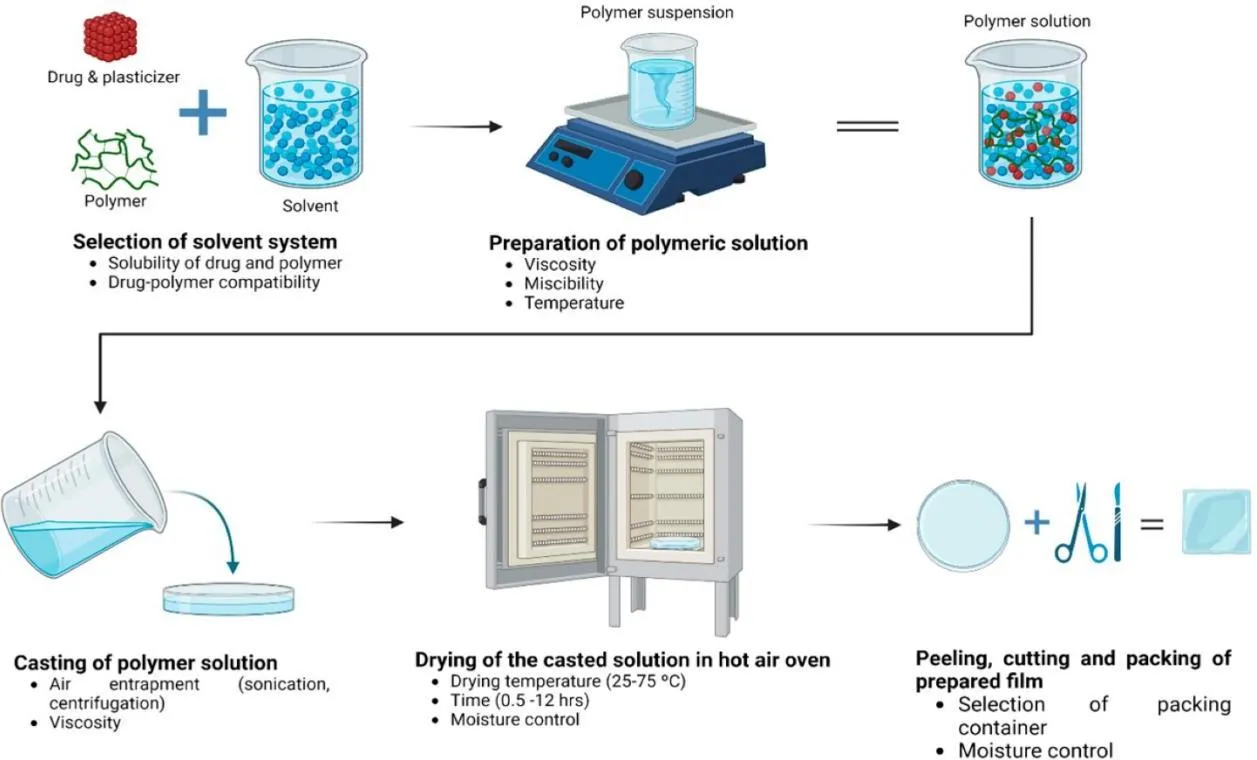
Figure 1: Schematic of the solvent casting process used to prepare bromelain oral strips
Evaluation of Bromelain-Loaded Dissolving Oral Strips
Thickness (mm)
The thickness of the prepared bromelain-loaded dissolving oral strips was determined using a calibrated digital micrometer screw gauge. Measurements were taken at five different locations on each strip, including the center and four corners, to ensure uniformity of film thickness. The average thickness was calculated and expressed in millimeters (mm). Uniform thickness is essential for ensuring consistent drug loading, mechanical strength, and reproducible drug release behaviour [19].
Weight Variation (g)
The weight variation of the oral strips was determined by individually weighing ten randomly selected strips using a calibrated analytical digital balance with a sensitivity of 0.1 mg. The mean weight and standard deviation were calculated to assess the uniformity of the prepared formulations. Consistent strip weight indicates homogeneous distribution of the polymer matrix and bromelain throughout the formulation [20].
Folding Endurance
The mechanical strength and flexibility of the oral strips were evaluated by determining the folding endurance. A strip of defined dimensions was repeatedly folded manually at the same location until it either broke or developed visible cracks. The total number of folds required to break the strip was recorded as the folding endurance. The test was performed in triplicate, and the average value was reported. Higher folding endurance values indicate better flexibility and mechanical integrity of the oral strips during handling and packaging [21].
Surface pH
The surface pH of the bromelain-loaded oral strips was measured to evaluate their compatibility with the oral mucosa. Each strip was placed in a Petri dish containing approximately 1 mL of distilled water and allowed to swell for 30 seconds. The surface pH was then measured by gently placing the electrode of a calibrated digital pH meter directly onto the hydrated surface of the strip. Measurements were performed in triplicate, and the average value was recorded. A surface pH close to neutral (6.5–7.5) is considered desirable to minimize the risk of oral irritation [22].
Drug Content (%)
Drug content uniformity was determined to evaluate the uniform distribution of bromelain within the oral strips. An individual strip was accurately weighed, cut into small pieces, and dissolved in 100 mL of phosphate buffer (pH 6.8). The solution was stirred continuously for 30 minutes to ensure complete extraction of bromelain and then filtered through Whatman No. 1 filter paper. The bromelain concentration was quantified using a UV–Visible spectrophotometer at the predetermined analytical wavelength after appropriate dilution. The percentage drug content was calculated using the following equation:

The analysis was carried out in triplicate, and the results were expressed as mean ± standard deviation.
Disintegration Time (s)
The disintegration time of the oral strips was determined using a modified Petri dish method. A strip was placed in a Petri dish containing 10 mL of phosphate buffer (pH 6.8) maintained at 37 ± 0.5°C to simulate the conditions of the oral cavity. The time required for the strip to completely disintegrate without leaving any visible residue was recorded using a digital stopwatch. Each formulation was evaluated in triplicate, and the average disintegration time was expressed in seconds. Rapid disintegration is considered an important characteristic for dissolving oral strips intended for immediate drug release [23].
In Vitro Drug Release (%)
The in vitro drug release study was carried out using the USP dissolution apparatus II (paddle method). Each oral strip was placed in 300 mL of phosphate buffer (pH 6.8) maintained at 37 ± 0.5°C, and the paddle speed was adjusted to 50 rpm. At predetermined time intervals (1, 2, 3, 5, 10, and 15 minutes), 5 mL samples were withdrawn and immediately replaced with an equal volume of fresh dissolution medium maintained at the same temperature to maintain sink conditions. The collected samples were filtered, suitably diluted when required, and analyzed using a UV–Visible spectrophotometer at the selected analytical wavelength for bromelain. The cumulative percentage drug release was calculated and plotted against time to evaluate the release profile of each formulation [23]. All experiments were conducted in triplicate, and the results were expressed as mean ± standard deviation.
Statistical Analysis
All experimental measurements were performed in triplicate (n = 3), and the results were expressed as mean ± standard deviation (SD). Statistical analysis may be performed using one-way analysis of variance (ANOVA), followed by an appropriate post hoc test, with p < 0.05 considered statistically significant.
RESULTS AND DISCUSSION
Physicochemical Evaluation of Bromelain Oral Thin Films
The physicochemical properties of bromelain-loaded dissolving oral thin films (F1–F9) are presented in Table 2. All formulations exhibited acceptable physical appearance, uniformity, and mechanical characteristics, indicating the successful preparation of oral thin films using different concentrations of polymers and plasticizers.
|
Batch |
Thickness (mm) |
Weight (g) |
Folding endurance |
Surface pH |
Drug content (%) |
Disintegration time (s) |
Drug release (%) |
|
F1 |
0.11 ± 0.01 |
0.120 ± 0.002 |
110 |
6.4 |
92.5 |
55 |
78 |
|
F2 |
0.12 ± 0.01 |
0.122 ± 0.003 |
115 |
6.5 |
94.2 |
50 |
82 |
|
F3 |
0.13 ± 0.02 |
0.125 ± 0.004 |
125 |
6.6 |
96.8 |
45 |
85 |
|
F4 |
0.12 ± 0.01 |
0.121 ± 0.003 |
118 |
6.5 |
95.5 |
48 |
83 |
|
F5 |
0.13 ± 0.01 |
0.124 ± 0.002 |
130 |
6.6 |
97.2 |
42 |
88 |
|
F6 |
0.14 ± 0.02 |
0.126 ± 0.004 |
135 |
6.7 |
98.1 |
40 |
90 |
|
F7 |
0.13 ± 0.01 |
0.123 ± 0.003 |
120 |
6.6 |
95.8 |
47 |
86 |
|
F8 |
0.14 ± 0.01 |
0.127 ± 0.004 |
140 |
6.8 |
98.5 |
38 |
92 |
|
F9 |
0.15 ± 0.02 |
0.129 ± 0.005 |
145 |
6.7 |
99.0 |
35 |
94 |
Table 2: Physicochemical evaluation of bromelain oral thin films (F1–F9)
The thickness of the formulations ranged from 0.11 ± 0.01 mm to 0.15 ± 0.02 mm, demonstrating satisfactory uniformity among the prepared films. A gradual increase in film thickness was observed with increasing concentrations of film-forming polymers (HPMC and PVA), which contributed to the formation of stronger and more uniform films.
The weight variation ranged between 0.120 ± 0.002 g and 0.129 ± 0.005 g, indicating minimal variability and confirming the uniform casting of the films. The low standard deviation values further suggest good reproducibility of the solvent casting process.
The folding endurance values varied from 110 to 145, reflecting excellent mechanical strength and flexibility. Films containing higher concentrations of polymers and optimized plasticizer levels exhibited improved resistance to repeated folding without cracking. Formulation F9 showed the highest folding endurance (145), indicating superior mechanical integrity suitable for handling, packaging, and patient use.
The surface pH of all formulations was found to be within the range of 6.4–6.8, which is close to the physiological pH of saliva. This near-neutral pH suggests that the prepared oral strips are unlikely to cause irritation or discomfort to the oral mucosa upon administration.
The drug content of the formulations ranged from 92.5% to 99.0%, demonstrating efficient incorporation and uniform distribution of bromelain throughout the polymeric matrix. The highest drug content was observed in F9 (99.0%), indicating excellent content uniformity and minimal drug loss during formulation.
The disintegration time decreased progressively from 55 s (F1) to 35 s (F9). This reduction may be attributed to the optimized polymer composition and plasticizer concentration, which enhanced water penetration and rapid film hydration. Faster disintegration is desirable for oral dissolving films as it facilitates rapid drug release and improved patient compliance.
Similarly, the in vitro drug release increased from 78% for F1 to 94% for F9, indicating that formulation variables significantly influenced bromelain release. The enhanced drug release observed in formulations containing higher HPMC concentration and optimized plasticizer levels can be attributed to improved hydration, swelling, and erosion of the film matrix, resulting in efficient diffusion of bromelain into the dissolution medium.
Overall, all formulations exhibited satisfactory physicochemical characteristics; however, Formulation F9 was identified as the optimal formulation because it demonstrated the highest drug content (99.0%), maximum folding endurance (145), rapid disintegration time (35 s), and highest cumulative drug release (94%), while maintaining an acceptable thickness, uniform weight, and near-neutral surface pH. These findings indicate that F9 possessed the most favorable combination of mechanical properties, drug loading efficiency, and release performance, making it the most suitable formulation for further characterization and evaluation as a bromelain-loaded dissolving oral strip for protein-based plaque reduction.
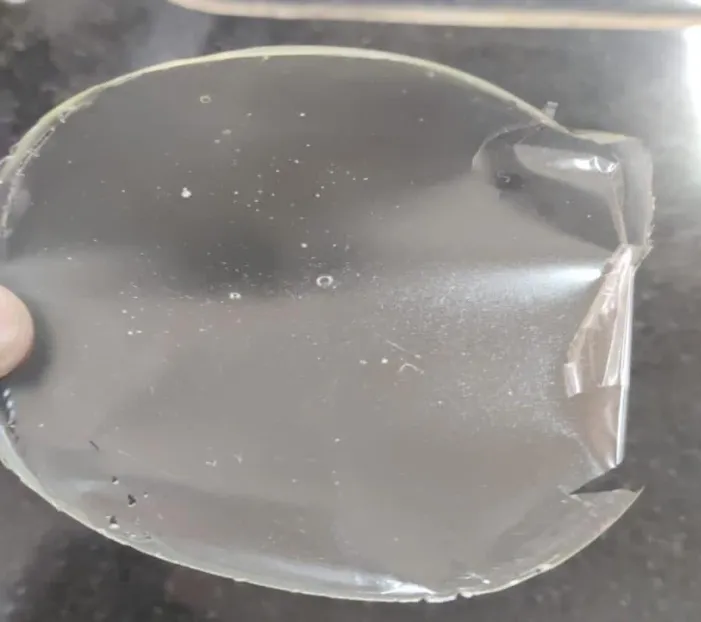
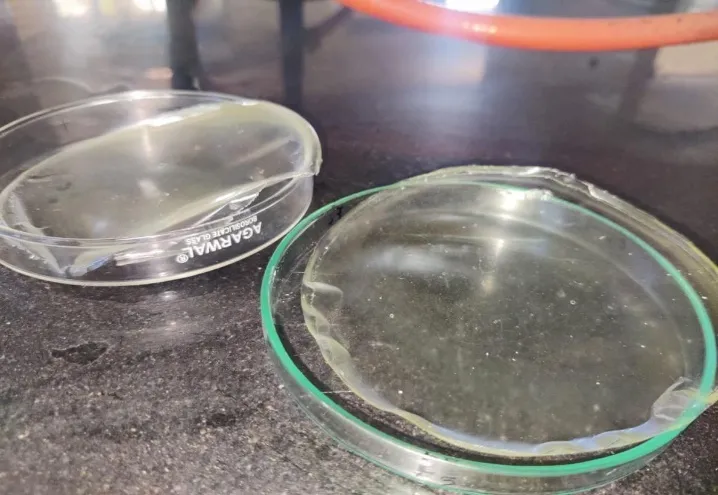
Figure 2: Representative cast bromelain oral strips prior to cutting (optimized batch)
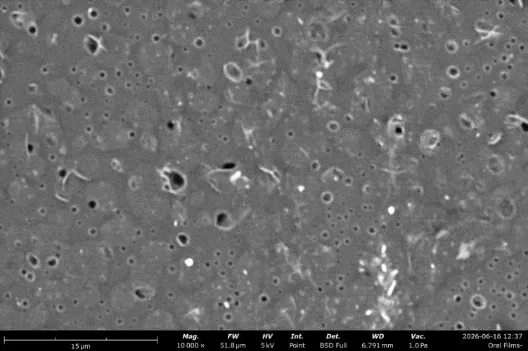
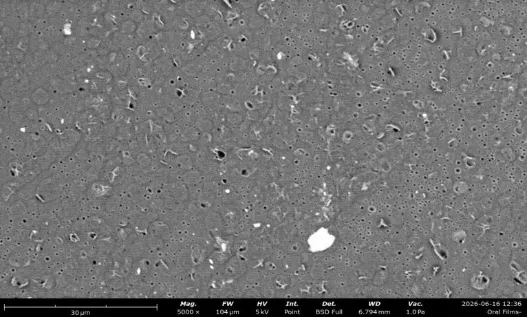
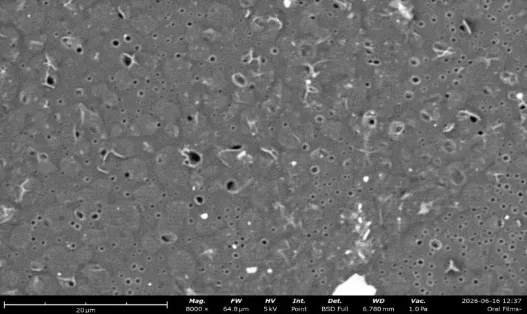
Figure 3 (A–C): Scanning electron micrographs of the optimized (F9) bromelain oral film surface, showing a largely smooth, continuous matrix with minor surface pores consistent with drying-induced solvent loss
Scanning electron microscopy of the optimized film (Figure 3) revealed a predominantly smooth, continuous surface with scattered micron-scale pores, consistent with solvent evaporation channels formed during air-drying rather than gross phase separation between HPMC and PVA. This morphology is compatible with the rapid disintegration and high cumulative release observed for F9, since a continuous but porous matrix favours rapid water ingress without compromising film handling strength.
CONCLUSION
The present study successfully developed and evaluated bromelain-loaded dissolving oral strips using the solvent casting method for the management of protein-based dental plaque. Nine formulations (F1–F9) were prepared by varying the concentrations of HPMC, PVA, glycerol, and PEG 400, and were evaluated for their physicochemical properties, including thickness, weight variation, folding endurance, surface pH, drug content, disintegration time, and in vitro drug release. All formulations exhibited satisfactory physical characteristics, uniform drug distribution, acceptable mechanical strength, and a surface pH compatible with the oral cavity. Among the prepared formulations, F9 demonstrated the most desirable performance, exhibiting the highest drug content (99.0%), excellent mechanical strength (folding endurance of 145), rapid disintegration (35 s), and maximum cumulative drug release (94%), while maintaining appropriate thickness and weight uniformity. These results indicate that the optimized polymer composition and plasticizer concentration significantly improved the quality and performance of the oral strips. Overall, the developed bromelain-loaded dissolving oral strip represents a promising patient-friendly drug delivery system for localized oral therapy. The rapid disintegration and efficient release of bromelain may enhance its proteolytic activity against proteinaceous components of dental plaque, thereby contributing to improved plaque control and oral hygiene. Further in vivo, microbiological, and clinical studies are warranted to confirm its therapeutic efficacy, safety, and long-term stability before clinical application.
REFERENCES

Harshad Vijay Patil*, Divya Dinesh Patil, Development Of Bromelain-Loaded Dissolving Oral Strip For Protein-Based Plaque Reduction, Int. J. Sci. R. Tech., 2026, 3 (8), 238-245. https://doi.org/10.5281/zenodo.21833623
 10.5281/zenodo.21833623