

We use cookies to ensure our website works properly and to personalise your experience. Cookies policy
1University Department of Botany, Babasaheb Bhimrao Ambedkar Bihar University, Muzaffarpur-842001
2H.O.D BOTANY, M.S.M. Samta college Janadaha HAJIPUR
Cynodon dactylon (L.) Pers., Commonly known as Doob grass or Bermuda grass, is an Important Perennial grass species, it Belong to the Poaceae family, in sakra block, they are primarily Found in Agricultural fields, along Roadsides, in grasslands, on wasteland, and in Residential Garden lawns. The present study aims to assess the economic importance and ecological value of Cynodon dactylon (L.) Pers., in Sakra Block of Muzaffarpur District, Bihar, India. From an economic perspective, it serves as fodder for livestock- such as cows, buffaloes, and goats- and also has medicinal uses. Ecologically, its root system, which spreads both below and above the ground, binds the soil particles together, this help soil erosion , maintains vegetation cover, and nutrients to the soil.
Cynodon dactylon (L.) Pers., Commonly known as Doob grass or Bermuda grass, is an Important Perennial grass species, it Belong to the Poaceae family, it is widely distributed in tropical and subtropical regions and commonly found in agricultural fields, roadsides, grasslands, wastelands and residential areas. The block spans an area of ​​216.68 square kilometers, 70–80% of which is under cultivation—with crops such as wheat, paddy, potatoes, maize, and various vegetables. This grass frequently emerges alongside these crops, appearing most prominently between the months of March and October. From an economic perspective, it is primarily used as fodder and also for medicinal purposes. Ecologically, it plays an important role as its roots bind the soil firmly, which helps prevent soil erosion during rainfall.it has antibacterial properties and contains Vitamin A ,C, and k as well as Protein.
3. Economics Importance
A. Fodder Value: It is used as green fodder for cattle, buffaloes, goats, and other grazing animals
It provides an important source of livestock feed in Sakra rural areas.
B. Medicinal importance: In traditional Indian systems of medicine, doob grass is used for various purpose, including traditional remedies for minor wounds and bleeding. its medicinal properties require further scientific Validation.
C. Sakra Block is a rural area where Cynodon dactylon (L.) Pers., is cultivated for various Medicinal purpose. Before using it as medicine, its extract or pest is first Prepared. This pest and extract are used to treat various diseases.
(i) If a person suffers from frequent nosebleeds placing 4-5 drops of Cynodon dactylon (L.) Pers., juice into their nostrils daily for three consecutive days – while simultaneously applying a paste of the same grass to their head – can lead to a gradual improvement in the condition. This same process can also provide relief to women who experience excessive bleeding or serve pain during their menstrual periods.
(ii) If woman experience recurrent miscarriages consuming half cup Cynodon dactylon (L.) Pers., juice and applying a paste of the same grass to the lower abdomen can reduce the problem by up to 70%. This process should be followed by consistently for one week.
(iii) If a woman is suffering from PCOD or PCOS, she can find relief by consuming a mixture of half a bowl of Cynodon dactylon (L.) Pers., juice and one bowl of yogurt, taken daily for one week. Please note that the yogurt should be made from the milk of an indigenous desi cow.
(iv) If a person develops a mouth ulcer, they should place 4–5 drops of Cynodon dactylon (L.) Pers., juice in their mouth and hold it there until the mouth fills with saliva. Afterward, they should rinse their mouth thoroughly with clean water. Doing this twice a day for three consecutive days provides relief from mouth ulcers.
(v) Cynodon dactylon (L.) Pers.aids in the production of prolactin. If a lactating animal (such as a cow, buffalo, or goat) experiences a decline in milk yield, Bermuda grass should be incorporated more frequently into its feed, which helps the animal produce more milk.
(vi) If a person has a stone in their abdomen and is experiencing severe pain, consuming one bowl of Cynodon dactylon (L.) Pers.,juice mixed with mishari (rock sugar) can provide relief from the pain.
(vii) If a person has a discharging ear, putting a few drops of warmed Cynodon dactylon (L.) Pers., juice into the ear can stop the discharge. This should be done twice a day.
(viii) Heat a mixture of Cynodon dactylon (L.) Pers., juice and sesame oil—using a 3:1 ratio—until the Cynodon dactylon (L.) Pers., juice has completely evaporated. Then, apply this oil into the ear of the person experiencing ear noises (tinnitus). Doing this once or twice a day can provide relief from tinnitus.
(ix) If a person suffers from migraines, they can find relief by applying a paste made from crushed Cynodon dactylon (L.) Pers., to their head, while also putting a few drops of the Cynodon dactylon (L.) Pers., juice into their nostrils. Doing this three times a day for three consecutive days provides relief.
(x) For those suffering from itching on their body, applying a paste made from crushed Cynodon dactylon (L.) Pers., to the affected areas provides relief. Additionally, for those suffering from constipation or hemorrhoids (babasir), consuming Cynodon dactylon (L.) Pers., juice mixed into warm milk can help alleviate the condition.
D. Soil Protection: It is used as ground cover to protect agricultural land, field boundaries and open spaces from soil erosion.
E. Traditional and cultural Value: Cynodon dactylon (L.) Pers., has religious and cultural importance in many Indian communities and is used in traditional rituals.
4. Ecological Value:
A. Soil Erosion Control: Its dense network of roots and creeping stems binds soil particles and reduces soil erosion caused by rainfall and surface runoff.
B. Biodiversity support: The layer of grass spread across the ground serves as a habitat for small insect and other ground – dwelling creatures.
C. Carbon Sequestration: Its roots and the parts that remain underground contribute to carbon storage.
D. Moisture Conservation: Layers of dense grass block direct sunlight from reaching the soil, which reduces evaporation.
E. Habitat restoration: This grass grows on barren land, gradually making the soil suitable for cultivation.
F. Nutrient Cycling: As leaves fall, they decompose and return to the soil, Contributing to the nutrient cycling.
G. Climate Adaptation: It can thrive even with limited water , which allows it to persist even changing environment.
H. Soil Conservation: This grass forms a dense layer over the open fields and farmland, which helps maintain the soil structure.
CONCLUSION:
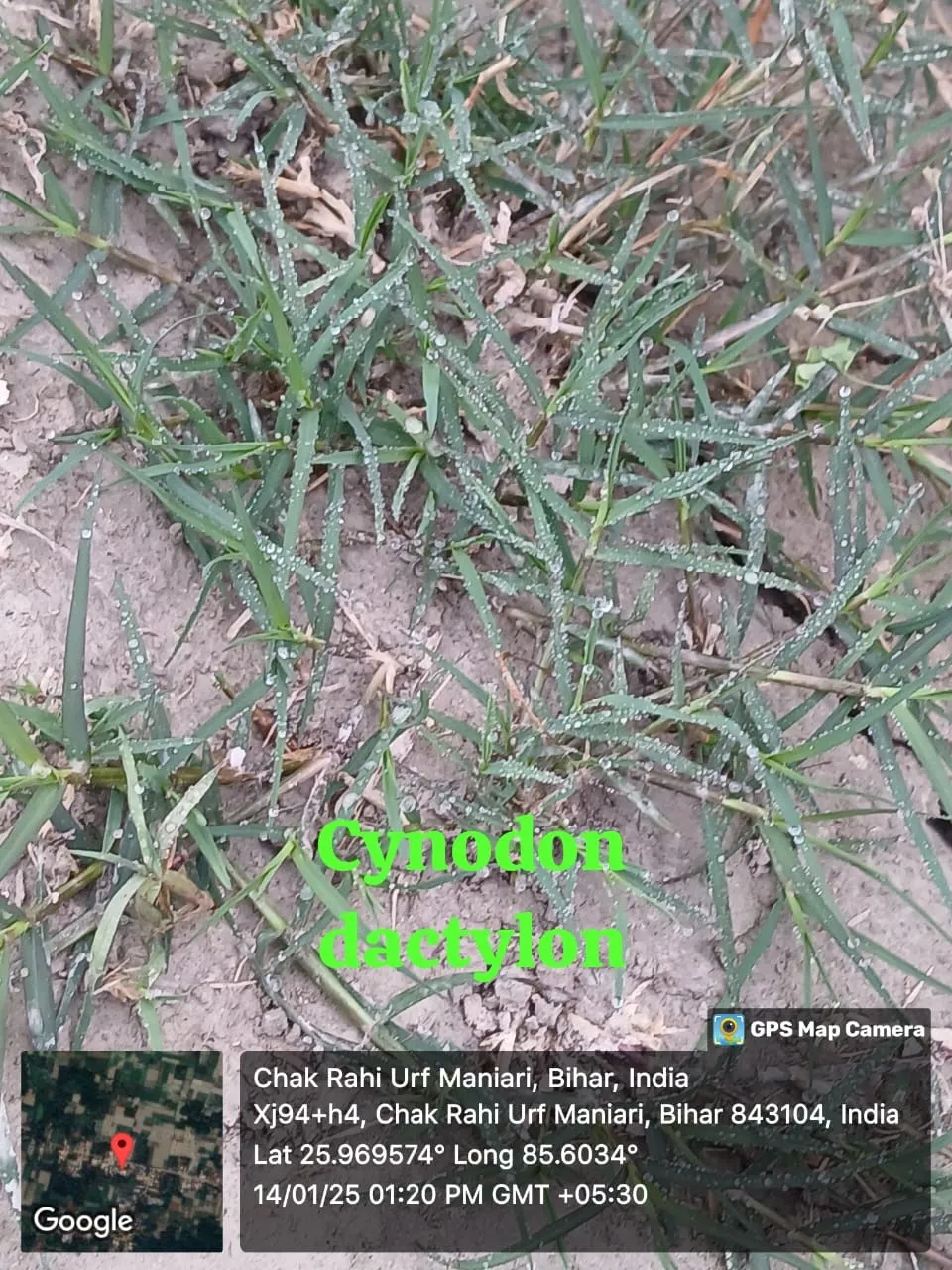
Cynodon dactylon (L.) Pers., a member of the Poaceae family, is significant from both economic and ecological perspectives. In the rural ecosystem of the Sakra block in the Muzaffarpur district of Bihar, it serves various purposes: as livestock fodder, a soil-binding plant, ground cover, and a source of traditional medicine. It is used to treat conditions such as nosebleeds, skin diseases, a burning sensation during urination, headaches, and constipation. It also possesses antibacterial properties. Its roots and stolons (stems that spread along the ground) extend over a considerable distance, which helps in soil conservation and in keeping the vegetation stable. Therefore, the scientific documentation of this grass can be instrumental in understanding local grass diversity, sustainability, agriculture, and rural livelihoods.
6. Acknowledgement
I express my sincere gratitude to Dr. Satyendra Kumar Gupta, H.O.D., Department of Botany, M.S.M. Samta College, Jandaha, Vaishali, for his valuable guidance, encouragement and support throughout this research work.
I am also thankful to the rural people of Sakra Block, Muzaffarpur, Bihar, for sharing their traditional knowledge, valuable information and cooperation during the field survey.
Finally, I extend my heartfelt thanks to everyone who directly or indirectly supported me in completing this research work successfully.
REFERENCES


Kaushal Kumar, Dr. Satyendra Kumar Gupta, Economic Importance and Ecological Value of Cynodon Dactylon (L.) Pers. (Poaceae) in Sakra Block of Muzaffarpur District, Bihar, India., Int. J. Sci. R. Tech., 2026, 3 (11), 973-976. https://doi.org/10.5281/zenodo.24390529
 10.5281/zenodo.24390529