

We use cookies to ensure our website works properly and to personalise your experience. Cookies policy
Osmania University
This paper examines the complex intersection of moral philosophy, political realities, and bureaucratic action under the title "Ethics in Indian Public Administration: Principles, Codes, and Realities." While codified frameworks like the Central Civil Services (Conduct) Rules and the 2nd Administrative Reforms Commission (ARC) establish the formal boundaries of integrity, the actual practice of Indian public administration demands navigating a landscape fraught with political pressure, systemic corruption, and competing values. To bridge the gap between codified ideals and ground realities, this study evaluates the mechanics of ethical choice through three foundational philosophical lenses: Utilitarianism, which risks reducing the public interest to majoritarian math; Intuitionism, which provides immediate moral signals but lacks institutional consistency; and Perfectionism, which elevates the administrative ideal toward excellence and virtue, yet often falters against structural constraints. The paper argues that single-lens philosophies are insufficient for the messy realities of Indian governance. Instead, it proposes operationalising John Rawls’ Justice-as-Fairness theory as a robust, objective framework for administrative decision-making. By applying the "veil of ignorance" and prioritizing the most disadvantaged sections of society, civil servants can insulate their choices from partisan political interference and narrow elite interests. Ultimately, this study redefines "public interest" not merely as the compliance of rules, but as an active, justice-oriented practice that balances political accountability with constitutional morality, offering a pragmatic blueprint for the ethical Indian bureaucrat.
The contemporary Indian bureaucracy operates at a historical and structural crossroads, where an inherited colonial administrative architecture must execute an expansive, modern welfare agenda.This operational model faces severe strain due to a growing compliance-conscience gap, rendering traditional codified conduct rules inadequate when civil servants confront intense political pressures and complex socio-economic dilemmas.To bridge this divide, this study deconstructs the definition of public interest through constitutional morality and operationalises John Rawls’ Justice-as-Fairness framework as a practical, objective blueprint to guide ethical bureaucratic discretion.
1. The modern Indian administrative apparatus operates at a complex crossroads, heavily shaped by its colonial history as a "steel frame" focused primarily on revenue extraction and order.
2. Post-independence, the state attempted to transform this rigid bureaucratic architecture into a proactive, welfare-oriented machinery under the guidance of Sardar Vallabhbhai Patel.
3. This historical shift created an enduring structural conflict, forcing a rigid legalistic framework to execute expansive socio-economic and redistributive welfare programs.
4. To govern this system, India established a formal ethical architecture, primarily operating through the negative prohibitions of the Central Civil Services (Conduct) Rules, 1964.
5. Recognizing these limitations, the Second Administrative Reforms Commission (2nd ARC) later recommended a value-driven "Code of Ethics" to inject moral philosophy into daily governance.
6. However, a profound chasm exists between these codified ideals and the volatile ground reality of a highly politicized, often corrupt bureaucratic ecosystem.
7. This environment has generated a critical "compliance-conscience gap," where existing codes act as negative checks rather than positive guides for complex moral choices.
8. When facing intense political pressure, civil servants are frequently forced to choose between strict administrative directives and the spirit of public welfare.
9. This deficiency becomes severe because conventional administrative discretion remains philosophically unguided when addressing ground-level socio-economic crises.
10. Ultimately, without a systematic framework for moral reasoning, discretion collapses into raw political opportunism or a defensive, rule-bound apathy that compromises the public interest.
1.3 Conceptualization of the "Public Interest “and Significance & Scope of the Study
In a deeply stratified society like India, the public interest cannot be defined through a majoritarian lens, as aggregate progress for a dominant elite frequently results in the systematic exploitation of marginalized communities. Instead, the concept must shift away from rigid legalism toward an active commitment to constitutional morality, transforming public interest into a dynamic practice that prioritizes the rights and upliftment of the most vulnerable sections of society.
1. Deconstructing the concept of the public interest is essential for building a resilient framework for administrative ethics in India.
2. In a deeply stratified society like India, the "public" is not a uniform entity but a highly fragmented mosaic of competing interest groups split along lines of caste, class, and geography.
3. Defining the public interest through a majoritarian lens is highly dangerous, as aggregate progress for an elite group can result in the systematic oppression of marginalized communities.
4. This study argues for a conceptual shift away from rigid legalism toward an active commitment to constitutional morality, a virtue Dr. B.R. Ambedkar noted must be carefully cultivated.
5. Grounding administrative action in constitutional morality requires civil servants to prioritize the defense of constitutional rights and the upliftment of the most vulnerable sections of society.
6. The primary research objectives are to evaluate the limitations of traditional frameworks (Utilitarianism, Intuitionism, Perfectionism) and to demonstrate how John Rawls’ Justice-as-Fairness framework can be operationalized to insulate decisions from partisan influence.
7. The core research question investigates how civil servants can effectively navigate the volatile intersection of politics and administration to make truly ethical choices.
8. This study directly aligns with Mission Karmayogi, supporting its historic transition from a purely "rules-based" model to a dynamic, value-driven "roles-based" competency framework.
9. It offers immediate pedagogical value for the UPSC Civil Services Examination (GS Paper 4) by replacing superficial, generic solutions with a sophisticated, philosophically grounded blueprint for resolving real-world crises.
10. Ultimately, the scope of this research extends to institutional policymaking, providing training academies like LBSNAA with a validated model to transition from primitive compliance systems toward an internalized culture of justice.
2: Literature Review
2.1 The Dichotomy of Politics and Public Administration in India
The structural relationship between the political executive and the permanent bureaucracy stands as one of the most thoroughly analyzed topics in public administration literature. The classical foundation of this discourse traces back to the pioneering work of Woodrow Wilson and the structural sociology of Max Weber. Wilson famously argued for a strict, impenetrable dichotomy between politics and public administration. He asserted that while politics sets the broad tasks and policy directions for the state, administration should remain an entirely separate, non-partisan, and business-like execution of those policies.
Weber expanded this view by conceptualizing the ideal bureaucracy as an entirely impersonal, rational-legal machine. In this model, highly specialized, objective civil servants execute laws strictly according to established procedures, remaining completely insulated from the passion, bias, and erratic shifts of political struggle.
However, modern administrative scholarship has completely dismantled the myth of this absolute separation, proving that the reality is one of deep, unavoidable interdependency. In developing democracies, and within the Indian context specifically, the Wilsonian dichotomy is non-existent. Scholars like C.P. Bhambhri and Rudolph and Rudolph have written extensively on how the expansion of the Indian welfare state inevitably dragged the bureaucracy directly into the political arena. Because policy formulation requires immense technical data and administrative experience, the political executive depends entirely on civil servants to shape legislation.
Conversely, because policy implementation directly impacts local power structures, resource distribution, and electoral dynamics, politicians have a intense interest in controlling the daily actions of the bureaucracy. This structural interdependency has led to what contemporary literature labels the politician-bureaucrat nexus. This nexus marks a complete collapse of rational-legal boundaries, replaced by a system of mutual survival and illicit accommodation.
The literature concerning the structural vulnerabilities of the Indian bureaucracy identifies several highly institutionalized mechanisms that politicians use to compromise administrative autonomy. Foremost among these is the weaponization of arbitrary transfers and postings. As documented extensively in the sociological studies of M.N. Srinivas and modern political scientists like Devesh Kapur and Pratap Bhanu Mehta, the Indian political executive exercises nearly unbridled power to transfer civil servants at will.
Bureaucrats who refuse to bend procurement rules, overlook systemic illegalities, or favor a politician's local clientelist network are immediately hit with punitive transfers to downgraded, resource-starved positions. This creates an environment of perpetual professional insecurity. It forces many public officials to actively join political patron-client networks, trading their constitutional neutrality for career stability and lucrative postings.
This deep systemic degradation has been the focus of numerous official reform committees, whose findings form a critical part of the literature on Indian governance. The Santhanam Committee Report on Prevention of Corruption (1964) was one of the first historical documents to warn that corruption in India was rapidly evolving from isolated transactional bribes into an organized, structural phenomenon embedded within the political-administrative matrix.
Decades later, the Hota Committee Report on Civil Services Reforms (2004) explicitly highlighted that the complete lack of security of tenure was actively destroying the moral backbone of the services. It noted that the transfer mechanism was being used as an extortion tool by political masters to enforce absolute bureaucratic compliance.
Finally, the Second Administrative Reforms Commission (2nd ARC) Fourth Report on Ethics in Governance provided a definitive critique. The 2nd ARC argued that systemic corruption and arbitrary political interference had institutionalized a culture of ethical blind spots. It concluded that the Indian administrative system could not be salvaged by minor legal updates. Instead, it required a complete overhaul of the incentive structures governing the relationship between politicians and bureaucrats, alongside the statutory creation of an independent Civil Services Board to manage transfers objectively.
2.2 Deconstructing Ethical Choice: A Critique of Three Lenses
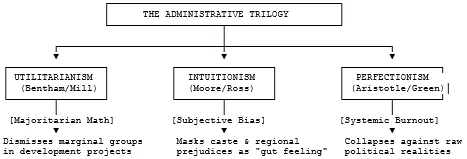
When forced to make complex decisions within this highly politicized environment, an Indian civil servant must rely on an underlying philosophical approach to justify their choices. Administrative literature frequently evaluates these choices through three traditional ethical lenses, each presenting distinct systemic flaws when applied to the realities of Indian governance.
Utilitarianism in Governance
The first lens is Utilitarianism, rooted in the philosophical writings of Jeremy Bentham and John Stuart Mill. This framework posits that the moral worth of any action is determined solely by its consequences, specifically its ability to maximize the greatest happiness for the greatest number of people. In public policy and planning, utilitarianism serves as the underlying justification for standard cost-benefit analyses, macroeconomic optimizations, and large-scale state development projects.
However, contemporary subaltern studies and development literature offer a devastating critique of utilitarian governance within India. Scholars like Ramachandra Guha and Amartya Sen have demonstrated that a strict "greater good" framework consistently provides a convenient moral cover for the systemic exploitation of marginalized populations.
When the state constructs mega-infrastructure projects—such as massive hydroelectric dams, industrial corridors, or mining operations—the utilitarian math invariably favors the urban majority and corporate conglomerates. The devastating costs, however, are borne entirely by localized, disenfranchised tribal communities and small-scale farmers who face forced displacement, cultural erasure, and economic ruin. For an Indian bureaucrat, relying solely on a utilitarian lens means complicity in a form of majoritarian math that silences the constitutional rights of minorities under the wheels of aggregate progress.
Intuitionism and Bureaucratic Discretion
The second lens is Intuitionism, historically developed by philosophers like G.E. Moore and W.D. Ross. Intuitionism argues that fundamental moral truths are self-evident and can be directly known through human intuition and moral consciousness, without the need for empirical calculation or formal legal deduction. In public administration, this manifests as a reliance on unguided administrative discretion, where an officer falls back on their "gut feeling," personal conscience, or professional instinct to resolve an immediate crisis.
The critique of intuitionism within the sociology of Indian administration reveals it to be deeply problematic. India is a society deeply fractured by centuries of institutionalized caste hierarchies, deeply ingrained regionalism, and intense communal biases. As empirical research by scholars like Sukhadeo Thorat demonstrates, when an administrator relies purely on unguided "intuition" during a high-stakes crisis—such as a communal riot or a land dispute—that intuition is rarely a source of pure, objective moral truth.
Instead, it is often a subconscious reflection of the officer’s own socio-cultural conditioning, class privilege, or caste bias. Intuitionist governance strips administration of predictability, transparency, and institutional fairness. It allows personal prejudices to be masked as self-evident moral insights, directly undermining the foundational rule of law.
Perfectionism and Virtue Ethics
The third lens is Perfectionism, a branch of teleological and virtue ethics championed by Aristotle and later adapted by idealists like T.H. Green. Perfectionism asserts that the ultimate moral duty of individuals and state institutions is to pursue absolute excellence, cultivate flawless moral virtues, and realize the highest potential of human nature. In contemporary Indian administrative discourse, this perfectionist ideal has been prominently revived through Mission Karmayogi and its emphasis on cultivating the ideal of the "Karmayogi"—a civil servant of perfect integrity, absolute selflessness, high emotional intelligence, and tireless dedication to public service.
While philosophically inspiring, virtue-centric literature often overlooks the harsh realities of structural design. Scholars of bureaucratic behavior, such as Robert Merton and contemporary Indian analysts, point out that demanding individual perfection within a highly dysfunctional, resource-starved, and corrupt system inevitably leads to widespread structural burnout and pervasive hypocrisy.
When a junior bureaucrat is placed in an environment lacking basic data infrastructure, plagued by massive staff shortages, and subjected to unpredictable political threats, the perfectionist demand for flawless excellence collapses. The civil servant is forced into a state of chronic anxiety, realizing that absolute compliance with an impossible ideal is a recipe for professional suicide. Consequently, perfectionism often functions as an institutional myth. It shifts the blame for systemic failures onto the moral shortcomings of individual officers while leaving underlying structural pathologies completely untouched.
2.3 Rawlsian Justice as an Administrative Tool
Given the severe practical and moral limitations of Utilitarianism, Intuitionism, and Perfectionism, modern administrative theorists have increasingly looked toward the political philosophy of John Rawls to build a functional, resilient framework for public managers. In his seminal work, A Theory of Justice, Rawls presents a powerful alternative to utilitarianism through his conceptual framework of Justice-as-Fairness. The operational brilliance of Rawls’ theory lies in its reliance on an intellectual thought experiment: the Original Position, where individuals design the foundational rules of a society behind a Veil of Ignorance.
Behind this veil, no one knows their place in society, their class position, their social status, their caste, their fortune, or even their individual intelligence. Rawls argues that from this neutral starting point, rational actors will inevitably choose two fundamental principles of justice:
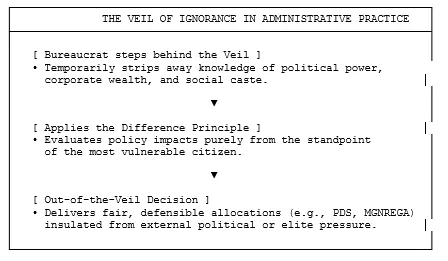
A growing body of global and Indian administrative scholarship has sought to operationalize this abstract theory, converting it into a concrete, practical tool for public managers. Theorists like David K. Hart have argued that the "veil of ignorance" can be used by an administrator as a mental framework to evaluate competing policy choices. When an Indian bureaucrat steps behind the veil, they temporarily strip away their knowledge of who holds political power, who possesses corporate wealth, or which caste holds electoral dominance in their district. From this position, the bureaucrat evaluates the impact of an administrative choice purely from the standpoint of the most vulnerable citizen—such as a landless Dalit laborer or a displaced tribal woman.
In the context of Indian governance, this Rawlsian approach provides an objective, unassailable defense of redistributive welfare programs and targeted social interventions. When managing complex systems like the Public Distribution System (PDS) or allocating budgets under the Mahatma Gandhi National Rural Employment Guarantee Act (MGNREGA), the civil servant frequently faces intense pressure from local elites to divert resources or manipulate beneficiary lists.
By applying the Difference Principle, the bureaucrat gains a clear, systematic rationale to prioritize the absolute baseline security of the poorest sections of society. Rawlsian justice changes the conversation. It ensures that targeting benefits to the marginalized is no longer seen as a matter of political charity or arbitrary welfare whim, but as a mandatory requirement of structural fairness.
Furthermore, this scholarship successfully synthesizes Rawlsian fairness directly with the concept of constitutional morality embedded within the Preamble of the Indian Constitution. The Preamble explicitly prioritizes Justice—categorized precisely as Social, Economic, and Political—before establishing Liberty and Equality. This exact lexical ordering mirrors Rawls’ own emphasis on structural equity.
By linking Rawls’ Difference Principle directly to the Directive Principles of State Policy (Part IV of the Constitution), contemporary legal scholars show that a Rawlsian administrative choice is not an imported Western ideal. Instead, it is the literal execution of the Indian constitutional mandate. It gives the permanent bureaucracy a powerful philosophical tool to resist unconstitutional political directives. It allows them to defend their administrative choices using the objective, legally binding principles of the supreme law of the land.
2.2 Gaps in Existing Literature
Despite the extensive volume of research on Western administrative ethics and the separate, highly detailed legalistic studies on Indian anti-corruption frameworks, a profound and critical gap remains within the existing literature. The vast majority of standard Western literature assumes an operational environment defined by relatively stable institutional boundaries, strong rule-of-law protections, and a functional separation between politics and administration. Consequently, their theoretical applications fail completely when dropped into the volatile, highly politicized, and resource-starved realities of post-colonial developing states like India.
Conversely, domestic literature within India suffers from an acute case of disciplinary fragmentation. On one side, political scientists and legal scholars produce exhaustive, highly legalistic analyses of anti-corruption statutes, the Right to Information (RTI) Act, and the organizational histories of various reform commissions. These studies are valuable, but they remain heavily descriptive. They tend to treat ethics as a mere matter of statutory compliance and administrative restructuring.
On the other side, academic philosophers discuss theories of justice, utilitarianism, and virtue ethics in an abstract vacuum, completely disconnected from the messy, high-pressure mechanics of active state governance.
There is an acute shortage of systematic, interdisciplinary research that directly applies formal moral philosophy—specifically the operational mechanics of Rawlsian justice—to the practical, political realities faced daily by ground-level Indian bureaucrats, such as District Magistrates, Municipal Commissioners, or Superintendent of Police. Existing research fails to provide a clear answer to a critical question: How can an individual officer, caught in the jaws of an aggressive politician-bureaucrat nexus and bound by rigid conduct rules, use systematic moral reasoning to make a defensible ethical choice on the ground? This study directly addresses that gap. It builds a bridge between abstract political philosophy and the lived reality of Indian public administration.
3: Practical Operationalisation—Real-World Case Studies
The theoretical viability of John Rawls’ Justice-as-Fairness framework depends entirely on its adaptability to the volatile reality of field-level governance in India. This chapter provides two detailed, simulated case studies that demonstrate how a District Magistrate (DM) can operationalise the Veil of Ignorance and the Difference Principle to resolve high-stakes administrative crises where legal codes are ambiguous and political pressures are intense.
Case Study 1:
The Dilemma of Urban Eviction vs. Fast-Track Infrastructure
1. The Context & The Crisis
In District X, a major economic hub, the state government has greenlit a high-profile Metro Rail Expansion Project. This project is backed by foreign funding and aggressively pushed by the political executive as a critical milestone for economic growth. The proposed alignment cuts directly through a prime commercial sector but requires the immediate acquisition of adjacent land. This land is currently occupied by an informal, unregistered settlement of over 1,200 migrant and daily-wage families (slum-dwellers) who have lived there for over two decades.
The project layout has been legally validated under the state's urban development laws. The political executive issues a directive to the DM: Clear the settlement within 14 days to meet the funding deadline, using administrative force if necessary.
2. The Competing Imperatives
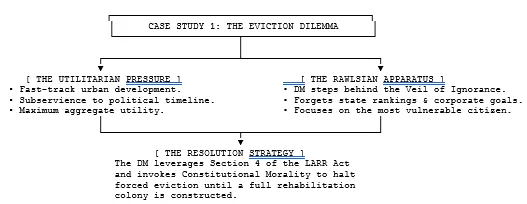
The DM faces an intense ethical and professional conflict:
3. Stepping Behind the Veil of Ignorance
To resolve this crisis without succumbing to political opportunism or rule-bound apathy, the DM mentally enters the Original Position by applying the Veil of Ignorance. The DM strips away all personal stakes: their career trajectory, the fear of a punitive transfer, the corporate targets of the Metro Rail Corporation, and the political capital of the ruling party.
Behind this veil, the DM asks: If I did not know whether I was the CEO of the Metro Corporation, the political leader of the state, an affluent urban commuter, or a landless daily-wage laborer living in that settlement—what structural rule would I consider fair?
From this neutral baseline, a rational actor will instantly reject a rule that allows the immediate, unmitigated destruction of the settlement. The risk of being the displaced laborer, completely ruined by the state, far outweighs the marginal benefit of being the commuter who saves fifteen minutes on a daily journey.
4. Operationalising the Difference Principle
Emerging from the veil, the DM applies Rawls' Difference Principle: any social or economic inequality (or development project) is justified only if it works to the maximum benefit of the least-advantaged members of society. The metro project, in its current execution model, violates this principle by exacerbating the vulnerability of the poorest sector.
The DM leverages this philosophical framework to formulate an unassailable administrative response:
1. Invoking Statutory Safeguards: The DM formally records that while the project serves a valid public purpose, executing the eviction without immediate compliance with the Right to Fair Compensation and Transparency in Land Acquisition, Rehabilitation and Resettlement (LARR) Act, 2013 constitutes a catastrophic legal and systemic risk.
2. The Structural Compromise: The DM issues an administrative order holding the eviction in abeyance for 90 days. Concurrently, they use their discretionary powers to requisition empty state land nearby to construct a temporary, serviced rehabilitation transit colony.
3. Insulating the Choice: When confronted by political handlers regarding the delay, the DM defends the decision not through emotional pleas, but through the hard logic of constitutional morality and long-term risk mitigation. They demonstrate that an unmitigated eviction will trigger immediate judicial intervention, widespread civil unrest, and severe reputational damage—ultimately stalling the project indefinitely. By structuring rehabilitation into the project timeline, the DM ensures that development actively lifts, rather than crushes, the most vulnerable.
Case Study 2
Resource Allocation and Medical Rationing During a Public Health Emergency
1. The Context & The Crisis
During a severe health pandemic, District Y experiences a catastrophic surge in cases. The district's premier public hospital faces an acute, systemic shortage of critical life-support infrastructure: there are only 20 advanced ICU ventilators available, but over 85 patients in critical respiratory failure require immediate intubation.
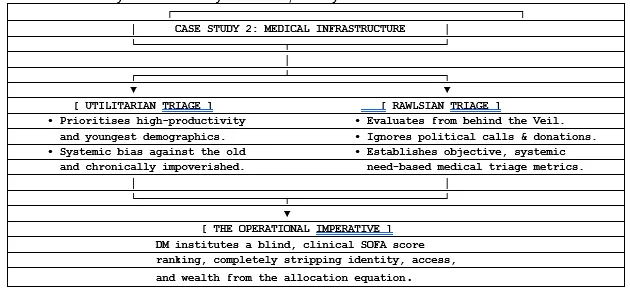
The DM, acting as the Chairperson of the District Disaster Management Authority (DDMA), is tasked with establishing the regulatory protocol for allocating these life-saving resources. Within hours, the DM’s office is flooded with intense external pressures:
2. The Competing Imperatives
3. Stepping Behind the Veil of Ignorance
The DM invokes the Veil of Ignorance to construct a bulletproof, ethically defensible triage protocol. The DM strips away all knowledge of individual identities, socioeconomic backgrounds, political affiliations, and corporate wealth.
Behind the veil, the DM asks: If I were a patient entering this hospital, completely unaware of whether I was a wealthy industrialist, a powerful politician, an elderly marginalized woman, or a young migrant worker—what allocation system would I trust with my life?
Behind this veil of absolute uncertainty, any rational person would immediately outlaw a system that allocates ventilators based on political patronage, bribery, or arbitrary social value. Similarly, they would reject a purely utilitarian framework that treats human lives as numbers on a spreadsheet, recognizing that if they turned out to be an elderly or chronically ill citizen, the system would leave them to die.
4. Operationalising Lexical Priority and Fairness
Emerging from the thought experiment, the DM implements an objective, heavily institutionalized allocation protocol that mirrors Rawls’ emphasis on lexical priority and equal opportunity:
1. The Identity-Blind Protocol: The DM mandates that the allocation of the 20 ventilators be governed exclusively by a clinical scoring system (such as the Sequential Organ Failure Assessment - SOFA score) run by a blind medical board. The board receives patient data identified solely by randomized numerical tracking tokens, completely stripping away names, occupations, castes, or addresses.
2. Neutralizing Patronage: The DM explicitly decrees via the Disaster Management Act that any attempt by an external official or political entity to interfere with or bypass this clinical token allocation will result in immediate criminal prosecution for undermining emergency public health safety.
3. The Structural Defense: When a local minister demands the prioritization of an elite contact, the DM points directly to the institutionalized, blind protocol. By stripping themselves of personal, arbitrary discretion and embedding a Rawlsian system of fair opportunity into the administrative machinery, the DM completely insulates the decision from external coercion. The protocol ensures that the scarce resources are distributed based on transparent, equitable clinical need, successfully preserving the moral integrity of the state during a crisis.
4: Conclusion & Policy Recommendations
4.1 Synthesis of the Study
This study has investigated the core structural tensions within Indian public administration by mapping philosophical frameworks onto the ground realities of governance. The foundational crisis of the Indian civil servant is not a lack of statutory provisions, but rather a profound compliance-conscience gap.
While formal legal rules establish necessary behavioral boundaries, they do not provide a constructive roadmap for resolving complex ethical dilemmas. Traditional moral frameworks fail when applied in isolation to the Indian context:
In response to these systemic limitations, this study has operationalised John Rawls’ Justice-as-Fairness framework as a practical and objective tool for administrative decision-making. By mentally stepping behind a Veil of Ignorance, civil servants can temporarily set aside their personal career anxieties, political pressures, and social positions. This mental shift allows them to evaluate policy implementation through the lens of the Difference Principle, ensuring that administrative choices prioritize the least-advantaged members of society.
As demonstrated through field-level case studies—ranging from urban displacement to emergency medical resource allocation—Rawlsian justice provides bureaucrats with a clear, systematic rationale to uphold constitutional morality, insulate themselves from partisan coercion, and protect the public interest in a fractured society.
4.2 Aligning Rawlsian Justice with Mission Karmayogi
The operational utility of a Rawlsian approach is directly relevant to India's ongoing civil services capacity-building reform: Mission Karmayogi (the National Programme for Civil Services Capacity Building). Launched to transition the bureaucracy from a rigid "rules-based" model to a proactive "roles-based" framework, Mission Karmayogi emphasizes standardizing competencies across the civil services.
However, a purely competency-driven framework risks becoming a technical exercise if it lacks a coherent philosophical foundation. Merely upgrading a bureaucrat's technological or managerial skills does not automatically equip them to resist a politically pressured, ethically compromised directive.
Integrating Rawlsian philosophy into the Framework for Competency-led Strategic Human Resource Management (FRAC) fills this critical gap. It bridges the divide between behavioral competencies and the daily realities of field governance.
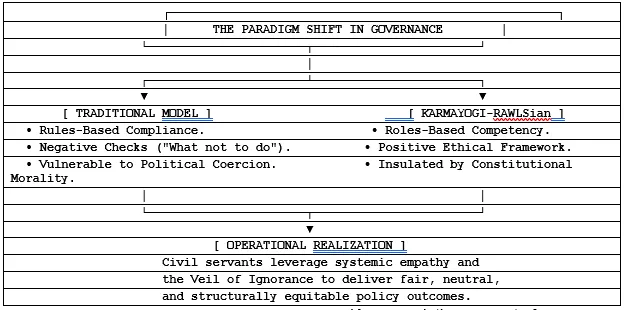
When Rawls' Justice-as-Fairness is aligned with Mission Karmayogi, the concept of a "Karmayogi" evolves from an idealized moral figure into a practically grounded, structurally fair actor. The behavioral competencies championed by the mission—such as systemic empathy, open-mindedness, and civic orientation—find their direct philosophical translation in the Veil of Ignorance.
By embedding Rawlsian logic into the core curriculum of the Integrated Government Online Training (iGOT-Karmayogi) platform, the state can train civil servants to view fairness not as a personal whim, but as a mandatory structural standard. This alignment ensures that as Indian bureaucrats grow more digitally and managerially capable, they also become ethically resilient. They are empowered to deploy their administrative discretion to build a fair, neutral, and constitutionally sound state.
4.3 Policy Recommendations
To institutionalize these ethical frameworks beyond abstract philosophy, the following targeted policy interventions are proposed for the Indian administrative architecture:
1. Reforming the iGOT-Karmayogi Curriculum
2. Statutory Institutionalisation of the Civil Services Board (CSB)
3. Transitioning from Conduct Rules to a Codified Value-Based Framework
4. Implementing "Equity Impact Assessments" in Local Policy Planning
REFERENCES

Dr. Lalith Kumar Dharvath, Ethics in Indian Public Administration: Principles, Codes, and Realities, Int. J. Sci. R. Tech., 2026, 3 (10), 801-812. https://doi.org/10.5281/zenodo.23339062
 10.5281/zenodo.23339062