

We use cookies to ensure our website works properly and to personalise your experience. Cookies policy
The School of Management, The CMR University, Lakeside Campus, Bengaluru, Karnataka, India
Hatti Kaapi represents the entrepreneurial journey of a culturally rooted Bengaluru enterprise seeking to scale without losing its regional identity. The case examines MSME entrepreneurship, product differentiation, operational standardisation, inclusive employment, financing, digital transformation and growth strategy. MSME principally describes the enterprise’s formative stage in this case. Its present statutory classification would depend on the latest audited investment and turnover figures under the applicable Government of India criteria.
The decision
On a busy Monday morning in Bengaluru, the senior management team of Hatti Kaapi met to consider the company’s next phase of expansion. The home-grown coffee brand had travelled a remarkable distance—from a tiny outlet in Gandhi Bazaar to a multi-city chain serving authentic South Indian filter coffee.
Should Hatti Kaapi accelerate expansion across India and selected international markets, or first consolidate South India while strengthening its packaged-consumer-products business?
Accelerated expansion could create first-mover advantages in the organised filter-coffee category. It could also raise operating complexity, weaken quality control and dilute the cultural authenticity that distinguished the brand. The decision required management to determine what Hatti Kaapi fundamentally intended to become: a café chain, a packaged-beverage company, an Indian filter-coffee brand, or a platform connecting coffee growers with urban consumers.
From a 30-square-foot shop to a recognized brand
Hatti Kaapi was established in Bengaluru in 2009 by U. S. Mahendar and his associates. Its first outlet was an approximately 30-square-foot space in Gandhi Bazaar. The proposition was direct: freshly prepared, authentic South Indian filter coffee delivered quickly and at an affordable price.
“Hatti” conveys the idea of home in Kannada, while “kaapi” is the familiar South Indian term for coffee. The name communicated warmth, local identity and the experience of home-brewed coffee. The venture emerged from Karnataka’s coffee-growing ecosystem. Public reporting describes Mahendar as a small grower with experience in coffee trading and links the enterprise with growers in the Sakleshpur region. The first outlet reportedly tested consumer demand with cups priced at ₹5.
The venture began with characteristics common to a microenterprise: limited capital and retail space, a narrow product range, heavy founder involvement, close customer contact and restricted bargaining power. Smallness also provided an advantage—the founders could observe consumer behaviour and refine the offering without the overhead of a conventional café.
Finding a gap in Bengaluru’s coffee market
Bengaluru possessed a deeply rooted coffee culture, but the organised café market was increasingly associated with espresso beverages, premium interiors, seating and comparatively high prices. Hatti Kaapi identified another job to be done. Office workers, commuters, hospital visitors and air passengers often wanted a familiar cup of filter coffee but did not require a prolonged café experience.
The enterprise positioned itself between unorganised neighbourhood establishments and premium national or international café chains. Its value proposition could be summarised as authentic South Indian filter coffee delivered with the speed, hygiene and consistency of an organised retailer. It commercialised local familiarity rather than competing entirely on luxury, ambience or Western-style coffee vocabulary.
Format innovation and location economics
A conventional café requires substantial floor space, interior investment and rental expenditure. Hatti Kaapi developed compact formats suitable for technology parks, airports, hospitals, corporate campuses, transport hubs and commercial districts. These locations offered high footfall but could also impose expensive leases, complex contracts and exacting service standards.
The move into institutional and airport locations extended the brand beyond its original neighbourhood market. Public reporting in 2025 described close to 100 outlets across nine major cities, although outlet counts vary by reporting date and source and should be independently verified before publication.
Outlet contribution = Sales revenue − (ingredients + labour + rent + utilities + local overhead)
A compact format could reduce investment per outlet, but profitability still depended on daily traffic, throughput and rental terms. A small outlet in the wrong location could destroy value as readily as a large one.
Standardising an emotional product
Filter coffee is more than a beverage for many South Indian consumers; its flavour can evoke home, family and regional tradition. That emotional association made authenticity valuable and standardisation difficult. Variations in bean blend, roasting, grinding, water, decoction strength, milk ratio, brewing time, service temperature and employee technique could all alter the cup.
When a business operates only a few outlets, founders and experienced managers can supervise directly. A multi-city network requires formal recipes, central procurement, training protocols, quality audits and technology-enabled monitoring. Too little standardisation produces inconsistent coffee; too much can make the product feel industrial and disconnected from its “home coffee” promise.
Financing growth
Retained earnings could support gradual expansion but might not finance simultaneous investment in new outlets, supply chains, recruitment, packaged products and technology. In 2021, Hatti Kaapi announced a ₹10 crore pre-Series A funding round. At that time, the company reported 115 outlets across nine cities and described plans to expand its retail and cloud footprint and develop its “Six Seconds” ready-to-use portfolio.
|
Potential advantages of equity |
Potential tensions |
|
Growth capital and faster rollout |
Pressure for rapid growth and measurable returns |
|
Professional governance and managerial talent |
Reduced founder autonomy |
|
Investment in technology and supply chain |
Complex reporting and control systems |
|
Access to networks and commercial locations |
Risk of expanding before unit economics are proven |
Diversifying beyond cafés
The COVID-19 disruption demonstrated the vulnerability of a business dependent on physical customer traffic. Packaged coffee powder, ready-to-use decoction and digitally ordered products provided a route into customers’ homes and created a second business model.
|
Café business |
Packaged-products business |
|
Depends on store traffic |
Depends on distribution and repeat purchase |
|
Sensitive to rent and location |
Sensitive to packaging and channel margins |
|
Direct control of customer experience |
Limited control of consumption experience |
|
Immediate consumption |
Shelf-life and inventory requirements |
|
Service, speed and ambience matter |
Brand visibility and retail placement matter |
|
Physical expansion is capital intensive |
Distribution can scale without a full café network |
An omnichannel strategy could increase resilience, but packaged products would expose Hatti Kaapi to established manufacturers, regional brands, supermarket labels and digital-first entrants. The company had to decide whether retail cafés were the core business or the brand-building engine for a broader consumer-products platform.
Inclusive employment
Public company communications in 2021 reported that persons with disabilities and senior citizens represented approximately 10 per cent of a workforce exceeding 400. Inclusive recruitment could improve loyalty, organisational reputation and social impact, but it required accessible facilities, appropriate work design, patient training and sensitive supervision. The policy suggested that social responsibility could form part of operating strategy rather than remain peripheral philanthropy.
The strategic alternatives
The management team considered four broad paths. Each promised growth, but each required a different allocation of capital and managerial attention.
Option 1: Deepen Bengaluru and Karnataka
Strengthen the home market through neighbourhood formats, transport locations, universities and corporate campuses. This offered cultural familiarity and supply-chain density, but geographic concentration could limit long-term growth.
Option 2: Expand aggressively across India
Enter large urban markets such as Mumbai, Delhi, Pune, Hyderabad and Kolkata. The opportunity was substantial, but consumer familiarity with strong South Indian filter coffee varied. Menu localisation, new supply chains and significant marketing would be required.
Option 3: Build packaged consumer products
Use coffee powder and ready-to-use decoction to reach households without developing a full café network. The risk was becoming one packaged-coffee label among many and losing the experiential differentiation created by the outlets.
Option 4: Enter selected international markets
Target Indian diaspora communities and rising global interest in regional Indian food. London, the Middle East and Southeast Asia appeared plausible, but regulatory compliance, unfamiliar labour markets, higher costs and premature overextension increased the risk.
Exhibit 1. Strategic decision matrix
|
Criterion |
Weight |
Management question |
|
Market potential |
25% |
How large and defensible is the opportunity? |
|
Required investment |
20% |
How much capital and working capital will be needed? |
|
Operational feasibility |
20% |
Can quality and service be reproduced reliably? |
|
Brand compatibility |
20% |
Does the path strengthen authentic filter-coffee positioning? |
|
Risk and resilience |
15% |
Can the model withstand demand and location shocks? |
|
Total |
100% |
Students should score each alternative from 1 to 5. |
A hybrid path was also possible: establish selected flagship outlets for credibility, use compact formats for high-throughput locations, and employ packaged products and digital channels for wider coverage. Yet a hybrid strategy could disperse scarce managerial attention.
The decision point
As the meeting concluded, management still had to choose the dominant growth engine for the next three years. The company could not pursue every opportunity at equal intensity. Capital, leadership bandwidth and quality-control capability were finite. The choice would determine organisational design, financing requirements and the meaning of the Hatti Kaapi brand.
What sequence of markets, formats and products would allow Hatti Kaapi to scale while preserving the trust associated with a cup of coffee from home?
Discussion questions
What opportunity did Hatti Kaapi identify in Bengaluru’s coffee market?
Which elements of the original model were especially suitable for a micro or small enterprise?
How did regional culture become a source of competitive advantage?
Apply Porter’s Five Forces to Bengaluru’s organised café industry.
What operational difficulties arise when a traditional beverage is standardised across many outlets?
Should the company prioritise store expansion or packaged consumer products?
What benefits and risks does external equity funding create for a founder-led enterprise?
Can inclusive employment create economic value as well as social value?
Score the four alternatives using Exhibit 1 and explain the assumptions behind the scores.
Recommend a three-year growth sequence and identify the milestones that should trigger the next stage.
Exhibit 2. Selected public milestones
|
Year |
Publicly reported development |
|
2009 |
First approximately 30-square-foot outlet established in Gandhi Bazaar, Bengaluru. |
|
2017 |
A profile reported 46 outlets, annual turnover of ₹15 crore and more than 40,000 cups served daily. |
|
2021 |
Company announced ₹10 crore pre-Series A funding and reported 115 outlets across nine cities. |
|
2025 |
Industry reporting described close to 100 outlets across airports, technology parks, hospitals and corporate campuses; counts vary by date and source. |
This case is written solely as a basis for classroom discussion. It is not intended to illustrate either effective or ineffective management. Publicly reported figures may describe different reporting dates and should be verified against primary records as and when required. Fictionalised deliberations may be clearly disclosed, and any company names, quotations, logos, photographs, internal data or interview material may be used only with due permission/s etc.
CASE STATUS
Development draft based on public sources and company/outlet visit followed by Extensive Research. Certain managerial deliberations are fictionalized for the purpose of classroom use. Before external publication, primary interviews, permissions, verified exhibits and a separate teaching note are prepared.
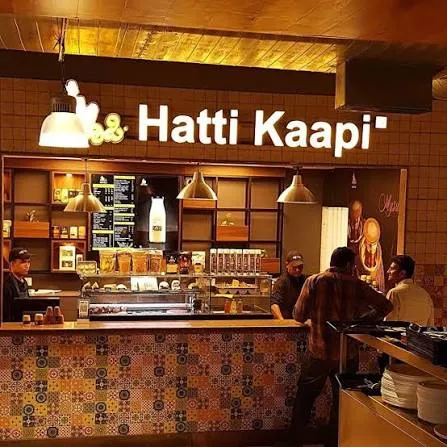

Corresponding JPG Pic format of The Hatti Kaapi is added for further idea
REFERENCES


Rajib Kumar Sanyal*, Santosh Angadi, Aarya Aarya, “Hatti Kaapi” Brewing an MSME Growth Story from Bengaluru, Int. J. Sci. R. Tech., 2026, 3 (7), 1186-1191. https://doi.org/10.5281/zenodo.21716076
 10.5281/zenodo.21716076