

We use cookies to ensure our website works properly and to personalise your experience. Cookies policy
Department of Geography, Raja Harpalsingh Government College Harpalpur, Chhatarpur (M.P.)
Agricultural modernization plays a crucial role in improving farm productivity, increasing income, and promoting sustainable rural development. This study examines the level of agricultural modernization and the adoption of modern farming techniques in Sagar district of the Bundelkhand region, India. The analysis is based on primary data collected from 300 farmers selected through a structured questionnaire. The study evaluates the adoption of key agricultural innovations, including improved seeds, mechanization, irrigation, chemical fertilizers, pesticides, and modern cultivation practices. Descriptive statistical techniques and comparative analysis are used to assess the extent of modernization across different farm-size categories and social groups. The findings indicate considerable variations in the adoption of modern farming techniques, with large farmers exhibiting higher levels of modernization than marginal and small farmers. The study highlights the need to strengthen agricultural extension services, improve access to credit and irrigation, and promote inclusive technology dissemination to achieve sustainable agricultural development in the Bundelkhand region.
Agriculture is the backbone of the Indian economy, providing food security, employment, and livelihood opportunities to a large proportion of the rural population. Although the sector has achieved significant growth over the past decades, it continues to face challenges such as fragmented landholdings, low productivity, climate variability, water scarcity, and limited access to modern agricultural technologies. Agricultural modernization has emerged as an effective approach to addressing these challenges by promoting the adoption of improved seeds, farm mechanization, irrigation facilities, chemical fertilizers, pesticides, information and communication technologies, and scientific crop management practices. These innovations contribute to higher productivity, efficient resource utilization, increased farm income, and sustainable agricultural development (FAO, 2022, 25-48).
The Bundelkhand region, including Sagar district of Madhya Pradesh, is characterized by semi-arid climatic conditions, erratic rainfall, and frequent droughts, making agriculture highly vulnerable. In recent years, government programmes and technological interventions have encouraged farmers to adopt modern farming techniques. However, the level of agricultural modernization varies considerably due to differences in farm size, education, income, irrigation facilities, institutional support, and access to agricultural extension services. Assessing these variations is essential for identifying existing gaps and designing policies that promote inclusive agricultural growth (NITI Aayog, 2018, 56-78).
Therefore, the present study examines the level of agricultural modernization and the adoption of modern farming techniques in Sagar district of the Bundelkhand region. The findings are expected to support evidence-based policy formulation for enhancing agricultural productivity, farmers' livelihoods, and sustainable rural development (Ahirwar, 2025, 45-52).
STUDY AREA:
The study area comprises Sagar District, located in the Bundelkhand Region of Madhya Pradesh, India. The district has a geographical area of 10,252 km², extending between 23°10′N–24°27′N latitude and 78°04′E–79°21′E longitude. Physically, the district forms part of the Vindhyan Plateau and is characterized by gently undulating topography with elevations ranging from about 300 to 600 metres above mean sea level. The region is drained by the Dhasan, Bina, Sonar, and Bewas rivers, while its predominantly black and red soils provide favourable conditions for agricultural activities. These study areas are shown in Figure 1.
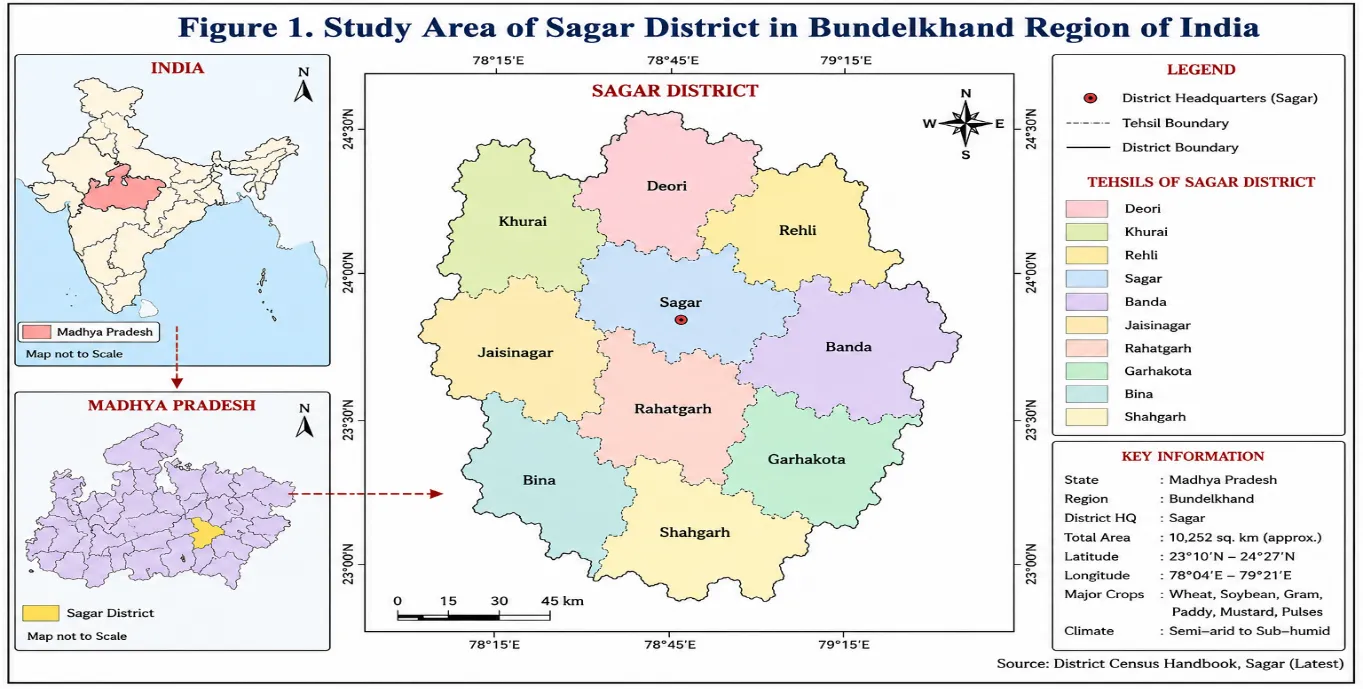
According to the Census of India (2011).The district has a total population of 2,378,458, including 1,255,651 males and 1,122,807 females, with a sex ratio of 894 females per 1,000 males and a literacy rate of 76.46%. Agriculture is the principal occupation, and the net sown area is approximately 5.3 lakh hectares, representing more than half of the district's geographical area. Nearly less than seven-tenths (65 percent) of the total geographical area is under agricultural land use. The district comprises ten tehsils: Sagar, Deori, Khurai, Rehli, Banda, Jaisinagar, Rahatgarh, Garhakota, Bina, and Shahgarh. Major crops include wheat, soybean, gram, mustard, paddy, and pulses, making the district an ideal study area for agricultural modernization and the adoption of modern farming techniques.
OBJECTIVES:
The present study aims to assess the level of agricultural modernization and the adoption of modern farming techniques among farmers in Sagar District. The major objectives of the study are as follows:
SOURCES OF DATA AND METHODS:
The present study is based on both primary and secondary data. Primary data were collected through a structured questionnaire administered via an online survey among farmers from selected villages across different tehsils of Sagar District. The major twenty variables proposed on level of agricultural modernization and adoption and use of farming techniques about the sample farmers survey collected were information on farm mechanization, irrigation facilities, improved seed varieties, fertilizer application, plant protection measures, and the socio-economic characteristics of the respondents. Secondary data were obtained from authentic sources, including the Census of India (2011), the District Statistical Handbook, the Department of Agriculture, and other government publications. Additional information was gathered from books, research articles, journals, and official reports. The integration of primary and secondary data ensured comprehensive and reliable information for the study. The overall data collection framework is shown in Figure 2
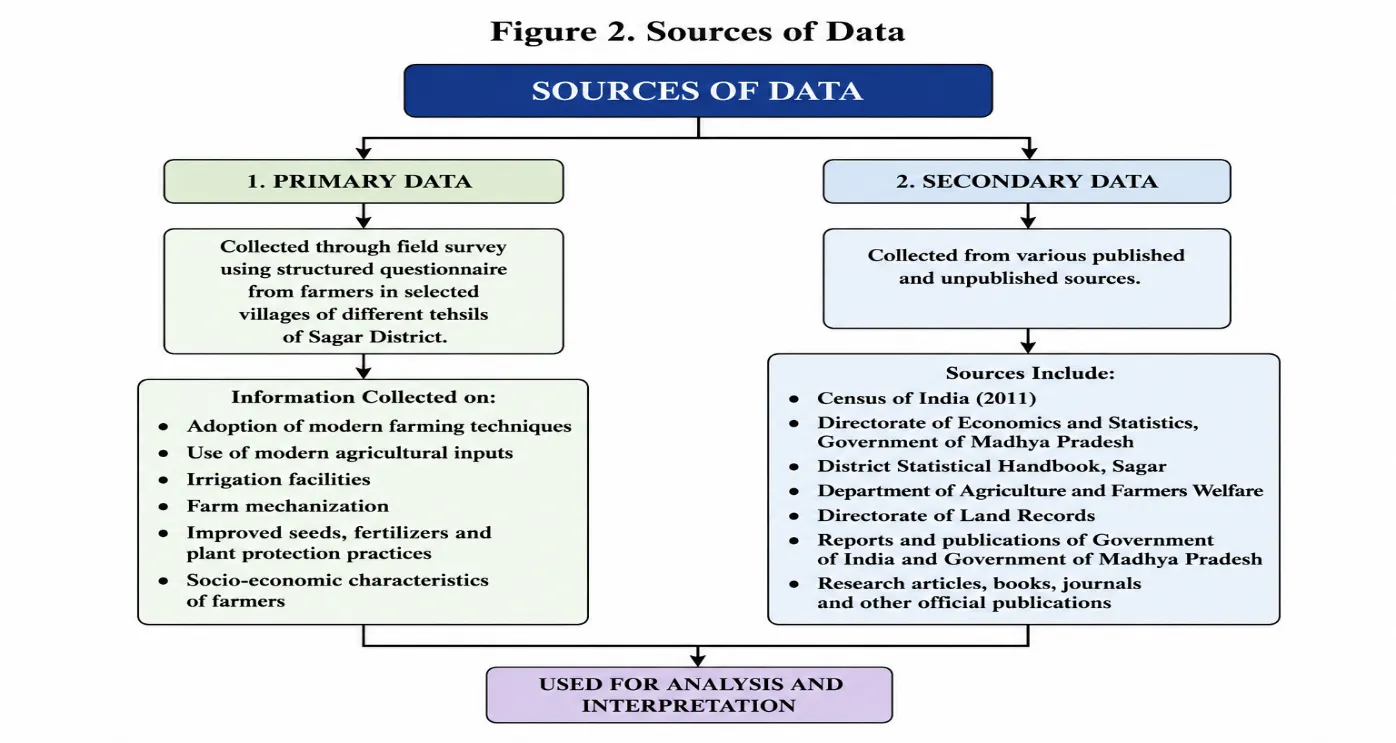
According to the Agriculture Census, Sagar District has approximately 364,000 farmers. Since surveying the entire farming population was not feasible, a sample of 500 farmers was selected using the stratified random sampling technique. The respondents were classified into two categories based on landholding size and social community to ensure representative coverage. The collected data were systematically tabulated and analysed using appropriate descriptive statistical techniques to assess the level of agricultural modernization and the extent of adoption of modern farming techniques in the study area.
REVIEW OF LITERATURE :
Previous studies have highlighted that agricultural modernization plays a vital role in improving farm productivity, income, and rural livelihoods. Researchers have emphasized the importance of farm mechanization, irrigation, improved seed varieties, fertilizers, and plant protection measures in enhancing agricultural development. Several studies have also reported significant spatial and socio-economic variations in the adoption of modern farming techniques (Rogers, 2003, 35). However, limited research has examined the level of agricultural modernization and the adoption of modern farming techniques in Sagar District of the Bundelkhand Region. Therefore, the present study attempts to fill this research gap by providing a comprehensive assessment of agricultural modernization and technology adoption at the district level.
LEVEL OF AGRICULTURAL MODERNIZATION :
Farm size and community characteristics are important socio-economic factors influencing the level of agricultural modernization. Larger landholdings generally enable farmers to adopt improved technologies, mechanization, irrigation, and modern agricultural inputs more effectively due to greater availability of financial and physical resources. In contrast, small and marginal farmers often face financial, technical, and institutional constraints that limit the adoption of modern agricultural technologies. Community characteristics, including education, social status, and access to agricultural extension services, also influence farmers' willingness and capacity to adopt improved farming practices. Therefore, variations in farm size and community characteristics significantly affect the pace and level of agricultural modernization (Swaminathan, 2006, 293-303). The level of agricultural modernization was assessed using the Comparative Z-Score Method based on the mean percentage adoption scores of all sampled farmers across different sizes of holding and community categories. The results of this analysis were classified into three levels (High, Medium and Low) of agricultural modernization, as presented in Figure 3.
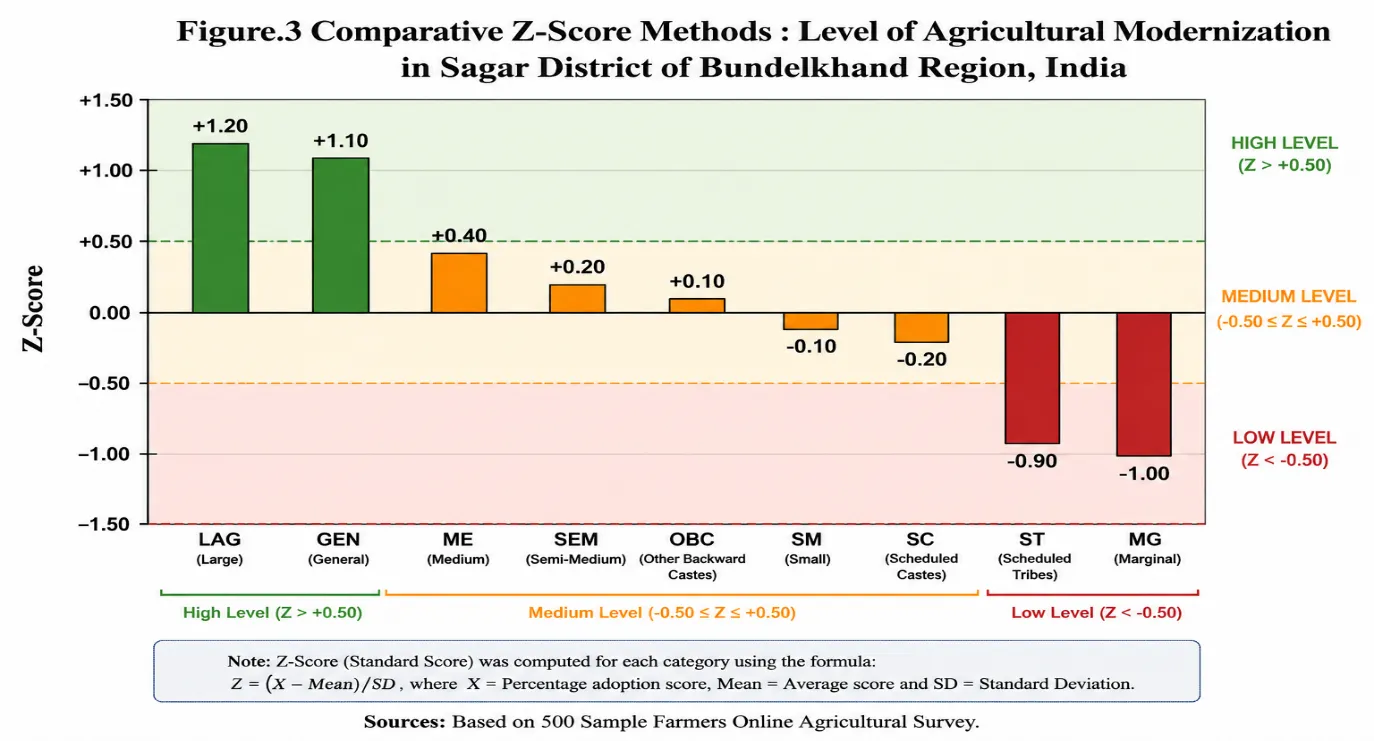
High Level : The analysis indicates that Large farmers (Z = +1.20) and General category farmers (Z = +1.10) fall under the High Level of agricultural modernization. Their positive Z-scores above +0.50 indicate that they have the highest adoption of improved seeds, mechanization, irrigation facilities, fertilizers, pesticides, and other modern agricultural technologies. This higher level of modernization is mainly attributed to better financial capacity, larger landholdings, improved access to institutional credit, extension services, and advanced agricultural information (Singh, 2013, 235-244) .
Medium Level : The Medium Level category includes Medium farmers (Z = +0.40), Semi-medium farmers (Z = +0.20), Other Backward Castes (OBC) (Z = +0.10), Small farmers (Z = –0.10), and Scheduled Castes (SC) (Z = –0.20). Their Z-scores fall between –0.50 and +0.50, indicating a moderate level of adoption of agricultural innovations. Although these groups have adopted several modern farming practices, their adoption remains constrained by limited financial resources, inadequate technical knowledge, and uneven access to agricultural support services.
Low Level : In contrast, Marginal farmers (Z = –1.00) and Scheduled Tribes (ST) (Z = –0.90) are classified under the Low Level of agricultural modernization. Their negative Z-scores below –0.50 reflect the lowest adoption of modern agricultural technologies. Limited landholdings, poor economic conditions, low educational attainment, weak institutional support, and inadequate access to irrigation and extension services are the major factors responsible for their lower level of modernization (Verma, 2026, 121-128)
Overall, the Comparative Z-Score analysis demonstrates that farm size and community characteristics have a significant influence on the level of agricultural modernization. The findings suggest that larger farmers and socially advantaged communities are better positioned to adopt modern agricultural technologies, whereas marginal farmers and tribal communities require targeted policy interventions, financial assistance, and extension support to reduce disparities and promote inclusive agricultural modernization.
USE OF MODERN FARMING TECHNIQUES :
The use of modern farming techniques has significantly improved agricultural productivity and efficiency. Farmers are increasingly adopting improved seeds, farm mechanization, irrigation systems, fertilizers, and precision farming technologies to enhance crop production. These techniques reduce labor requirements, save time, and increase farm income. Modern farming also ensures the efficient use of water, soil, and other natural resources, promoting sustainable agricultural development (Sharma, 1998,165-177). Therefore, the adoption of modern farming techniques is a key driver of agricultural modernization and rural economic growth. Thomas Jefferson emphasized that agriculture is the foundation of economic prosperity, ethical values, and the overall well-being of society. This quotation is highly relevant to topics such as agricultural modernization, sustainable agriculture, and rural development (Jefferson, 1785, 290 -291). The perceptions and views of farmers regarding the use of farming techniques were analyzed based on the size of landholdings and community groups. The variation in these proportions is presented in Figure 4.
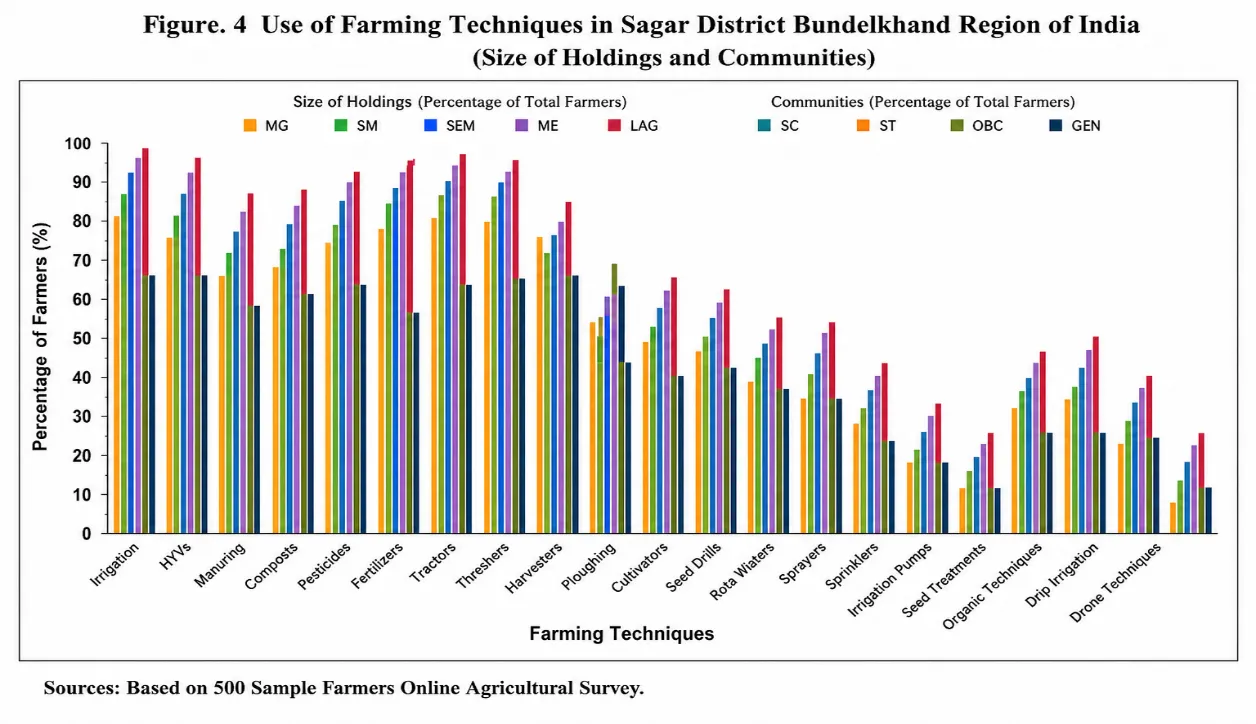
The use of farming techniques varies significantly according to the size of landholdings and communities in the Sagar District of the Bundelkhand Region. Large farmers (LAG) exhibit the highest adoption of modern agricultural technologies, followed by medium (ME), semi-medium (SEM), small (SM), and marginal (MG) farmers. Technologies such as irrigation, HYVs, fertilizers, tractors, threshers, and harvesters record high adoption rates, generally ranging from 80 to 99 percent among medium and large farmers, whereas marginal and small farmers show comparatively lower adoption levels of around 65 to 82 percent. The adoption of advanced technologies, including sprinklers, irrigation pumps, seed treatment, drip irrigation, and drone techniques, remains relatively low, particularly among marginal farmers, with adoption ranging between 8 and 35 percent. Community-wise, the General (GEN) category demonstrates the highest level of technology adoption, followed by OBC, SC, and ST communities. Overall, the findings indicate that both larger landholdings and better socio-economic conditions contribute to higher adoption of modern farming techniques, highlighting the need for targeted financial assistance, training, and extension services for small farmers and socially disadvantaged communities (Ahirwar, 2026, 30-34).
CONCLUSION
The study concludes that the level of agricultural modernization in Sagar District of the Bundelkhand Region varies significantly across different sizes of landholdings and social communities. Large farmers and General category farmers exhibited the highest adoption of modern farming techniques due to better access to resources, technology, and institutional support. Medium, Semi-medium, Small, OBC, and SC farmers showed a moderate level of modernization, indicating gradual adoption of improved agricultural practices. In contrast, Marginal farmers and Scheduled Tribes recorded the lowest modernization levels because of limited financial capacity, poor access to technology, and inadequate extension services. The Comparative Z-Score Method effectively highlighted these disparities among different farmer groups. The findings emphasize the need for targeted government policies, improved credit facilities, technology dissemination, and farmer training programs. Strengthening institutional support and agricultural extension services can accelerate the adoption of modern farming techniques among disadvantaged groups. Overall, inclusive agricultural modernization is essential for enhancing productivity, income, and sustainable rural development in the Sagar District of the Bundelkhand Region, India.
REFERENCES

P. K. Ahirwar*, Level Of Agricultural Modernization And Adoption Of Modern Farming Techniques In Sagar District Of Bundelkhand Region, India, Int. J. Sci. R. Tech., 2026, 3 (8), 332-337. https://doi.org/10.5281/zenodo.21872440
 10.5281/zenodo.21872440