

We use cookies to ensure our website works properly and to personalise your experience. Cookies policy
DOS in Food Science and Nutrition, University of Mysore, Manasagangotri, Mysuru
Depression is a serious public health issue for young people and is linked to problems in education, social life, and long-term mental health. Life skills can help protect against depression by building resilience and lowering stress. This study looked at how life skills relate to depression among youth in Mysuru, Karnataka. Researchers surveyed 1,520 college students aged 18 to 24 years from the UG and PG colleges of Mysuru city. Life skills were assessed using the self-constructed Life Skills Scale, which covers ten key areas, and depression was assessed with the Depression subscale of the DASS-42. The analysis included descriptive statistics, Kruskal–Wallis tests with Bonferroni-corrected Mann–Whitney U post-hoc comparisons, Pearson correlation with bootstrap confidence intervals, and multiple linear regression. Results showed that 61.6% of students had depression symptoms, from mild to extremely severe. Students with no depression had higher life skill scores, while those with extremely severe depression had the lowest. All life skills were negatively correlated to depression (r = -0.168 to -0.301, p < 0.001). Regression analysis found that Interpersonal Relationship (? = -0.350, p < 0.001), Coping with Emotion (? = -0.198, p < 0.001), Creative Thinking (? = -0.152, p = 0.001), and Decision Making (? = -0.103, p = 0.007) were strong predictors of depression. The model accounted for 13% of the variation in depression (R² = 0.130, p < 0.001). In summary, life skills are closely and negatively related to depression in youth. Interpersonal relationships and emotional coping stood out as the most important factors. Programs that build life skills could help to improve mental health and lower depression among youth.
Youth is a critical phase of life characterised by rapid physical, psychological, and social changes, including educational transitions, the development of peer relationships, and increased responsibility in decision-making (1). During this period, stress and depression are highly correlated with other behavioural risk factors, including substance use and unhealthy lifestyles (2).
Depression is a leading cause of disability and disease burden among youth worldwide, affecting an estimated 121 million individuals globally (2). Among young people aged 15–29 years, depression is one of the most common mental disorders, with approximately 50% of adult mental disorders manifesting during adolescence (1). Depression during youth is associated with significant impairments in academic functioning, social relationships, and overall quality of life, and substantially increases the risk of persistent mental health difficulties in adulthood (3). Of particular concern, in low- and middle-income countries such as India, only 1 in 27 people with depressive disorders receive effective treatment (4).
The World Health Organisation has promoted life skills education as an evidence-based approach to enhance young people's resilience to stressors and promote social and emotional development (2). Life skills are defined as psychosocial and interpersonal abilities that help youth make informed decisions, communicate effectively, and develop coping and self-management skills (1).
Given the high prevalence of depression among Indian youth and the established effectiveness of life skills training, there is a pressing need for context-specific intervention studies. The present study aims to assess depression among youth in Mysuru and to check the relationship of life skills.
METHODOLOGY:
RESEARCH DESIGN
In the present study, a cross-sectional survey design was used to examine the prevalence of depression among college students and the relation between life skills. To facilitate systematic measurement and statistical analysis in a large sample. A quantitative approach was adopted. Approval from the University Ethics Committee was obtained to conduct the study.
PARTICIPANTS
This study was conducted in Mysuru, Karnataka, India. The sample consisted of 1,520 individuals aged 18 to 24 years, recruited through convenience sampling from educational institutions in the region. Convenience sampling was selected because the target population was readily accessible within institutional settings and because recruiting a sufficiently large sample within a limited timeframe was necessary. Participants within the specified age range who provided informed consent were included. Individuals with a previously diagnosed psychiatric condition were excluded to ensure that the measures captured subclinical variation in depression and life skills rather than clinical pathology.
MEASURES
The Life Skills Scale assesses adolescents aged 13 to 18 using 150 statements rated on a five-point Likert scale. These statements cover 10 core life skills, with 149 positive items and 1 negative item. The scale can be given individually or in groups, and there are no right or wrong answers—respondents simply rate their agreement. Scoring assigns 5 points for strongly agree on positive items and 1 point for strongly agree on the single negative item. Each core skill is measured by summing its 15 items. The total score ranges from 150 to 750, with higher scores reflecting stronger life skills, interpreted using normative data.
The Depression, Anxiety and Stress Scale – 42 Items (DASS-42) measures depression, anxiety, and stress in three self-report scales of 14 items each. Depression covers mood and motivation; anxiety assesses physical and emotional symptoms; stress measures chronic arousal and irritability. Scores are summed for each scale, reflecting degrees of emotional distress rather than categories. The DASS distinguishes between normative and clinical groups mainly by severity (5).
DATA ANALYSIS
Data were analysed using IBM SPSS Statistics (Version 21). Descriptive statistics, including means, standard deviations, and ranges, were computed for all variables. The one-sample Kolmogorov-Smirnov (K-S) test was used to assess normality. Because all variables deviated significantly from normality (p < 0.001), nonparametric tests were employed for group comparisons. The Kruskal-Wallis H test was used to examine differences in life skill scores across the five DASS-42 depression categories, followed by pairwise Mann-Whitney U post-hoc tests with Bonferroni correction (adjusted α = 0.005) to identify specific group differences. Pearson correlation coefficients with bootstrap confidence intervals (1,000 samples, 95% CI, percentile method) were computed to examine bivariate relationships between life skills and depression. Finally, a standard multiple linear regression analysis (enter method) with bootstrap estimates was conducted to identify significant predictors of depression from among the ten life skills.
RESULTS AND DISCUSSION:
|
Variable |
Category |
N |
% |
|
Age Group |
18–21 Years |
751 |
49.4 |
|
22–24 Years |
769 |
50.6 |
|
|
Gender |
Male |
701 |
46.1 |
|
Female |
819 |
53.9 |
|
|
Education |
Undergraduate (UG) |
774 |
50.9 |
|
Postgraduate (PG) |
746 |
49.1 |
Table 1: Socio-Demographic Profile of the Sample
As shown in Table 1, the sample of 1,520 college students was nearly equally distributed across age groups (18–21 years: 49.4%; 22–24 years: 50.6%) and gender (males: 46.1%; females: 53.9%). Undergraduate (50.9%) and postgraduate (49.1%) students were almost equally represented. This even distribution across demographics provides a balanced context for interpreting the subsequent analyses. Moving forward, we examine the descriptive statistics that form the basis for later comparisons.
|
Variable |
N |
Mean |
Std. Deviation |
KS p |
|
Depression |
1520 |
12.94 |
7.153 |
0.000 |
|
Decision Making |
1520 |
52.37 |
6.912 |
0.000 |
|
Creative Thinking |
1520 |
54.04 |
8.385 |
0.000 |
|
Effective Communication |
1520 |
55.14 |
7.799 |
0.000 |
|
Self-Awareness |
1520 |
53.84 |
8.347 |
0.000 |
|
Coping with Emotion |
1520 |
52.44 |
8.197 |
0.000 |
|
Coping with Stress |
1520 |
43.25 |
6.359 |
0.000 |
|
Problem Solving |
1520 |
53.35 |
8.532 |
0.000 |
|
Interpersonal Relationship |
1520 |
51.42 |
7.515 |
0.000 |
|
Empathy |
1520 |
54.56 |
8.852 |
0.000 |
|
Critical Thinking |
1520 |
54.73 |
9.333 |
0.000 |
Table 2: Descriptive Statistics and Kolmogorov-Smirnov Test Results for All Variables
Note. KS p = Asymptotic significance (2-tailed) from the one-sample Kolmogorov-Smirnov test. All variables deviated significantly from normality (p < .001).
As per Table 2, of the ten life skills, Coping with Stress had the lowest mean (M = 43.25, SD = 6.36), while Critical Thinking (M = 54.73, SD = 9.33) and Empathy (M = 54.56, SD = 8.85) had the highest. These baseline scores inform the interpretation of subsequent analyses of changes in life skills across depression categories.
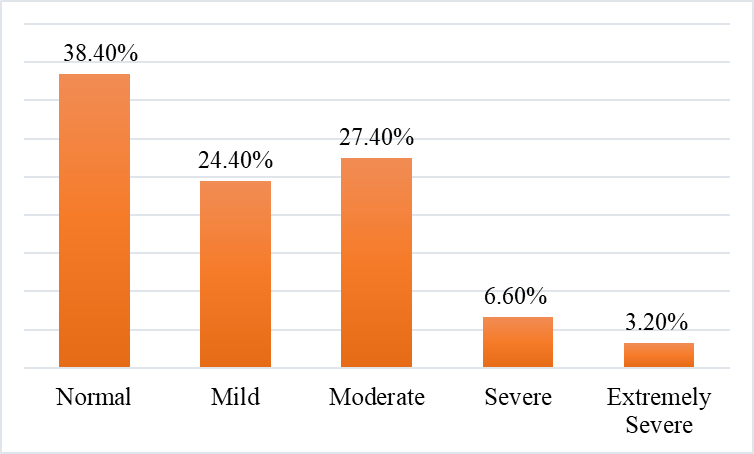
Fig 1: Level of Depression among youth
The distribution of depression levels among the study participants, as classified according to the DASS-42 norms, is shown in Figure 1. The majority of participants fell in the Normal range (38.40%), indicating that slightly more than one-third of the youth sample did not report clinically significant depressive symptoms. A notable proportion, however, reported varying degrees of depression: 27.40% were classified as Moderate, 24.40% as Mild, 6.60% as Severe, and 3.20% as Extremely Severe.
|
Life Skill Variable |
Normal (n=584) Mean ±SD |
Mild (n=371) Mean ±SD |
Moderate (n=416) Mean ±SD |
Severe (n=100) Mean ±SD |
Extremely Severe (n=49) Mean ±SD |
H value p-value |
Mann-Whitney U post-hoc test |
|
Decision Making |
54.24 ±6.42 |
51.68 ±7.09 |
50.64 ±6.93 |
52.74 ±6.44 |
49.02 ±6.24 |
76.747** 0.001 |
1-2, 1-3, 1-5, 4-5 |
|
Creative Thinking |
56.08 ±8.57 |
53.22 ±8.36 |
52.70 ±7.75 |
53.91 ±7.85 |
47.59 ±5.88 |
84.888** 0.001 |
1-2, 1-3, 1-5, 2-5, 3-5, 4-5 |
|
Effective Communication |
56.11 ±8.28 |
55.11 ±7.17 |
54.11 ±7.70 |
55.82 ±6.77 |
51.16 ±7.16 |
28.938** 0.001 |
1-3, 1-5, 2-5, 4-5 |
|
Self-Awareness |
55.69 ±8.22 |
52.95 ±8.16 |
52.48 ±8.30 |
54.39 ±7.65 |
48.90 ±8.06 |
50.703** 0.001 |
1-2, 1-3, 1-5, 4-5 |
|
Coping with Emotion |
54.43 ±8.06 |
51.90 ±8.27 |
51.09 ±7.64 |
51.79 ±7.25 |
45.59 ±9.00 |
70.626** 0.001 |
1-2, 1-3, 1-5, 2-5, 3-5, 4-5 |
|
Coping with Stress |
44.76 ±6.30 |
42.46 ±6.50 |
42.24 ±6.08 |
43.41 ±5.90 |
39.51 ±4.92 |
64.360** 0.001 |
1-2, 1-3, 1-5, 2-5, 3-5, 4-5 |
|
Problem Solving |
55.55 ±8.34 |
52.45 ±8.92 |
51.66 ±7.79 |
53.30 ±8.05 |
48.33 ±8.43 |
71.382** 0.001 |
1-2, 1-3, 1-5, 4-5 |
|
Interpersonal Relationship |
53.24 ±7.33 |
50.77 ±7.72 |
50.02 ±7.03 |
51.62 ±7.27 |
46.04 ±7.05 |
69.978 0.01 ** |
1-2, 1-3, 1-5, 2-5, 3-5, 4-5 |
|
Empathy |
56.82 ±8.40 |
53.25 ±9.53 |
52.95 ±8.40 |
55.53 ±7.58 |
49.29 ±8.15 |
75.093** 0.001 |
1-2, 1-3, 1-5, 4-5 |
|
Critical Thinking |
56.79 ±9.06 |
53.60 ±10.00 |
53.18 ±8.79 |
55.27 ±9.21 |
50.78 ±6.82 |
46.268** 0.001 |
1-2, 1-3, 1-5 |
Table 3: Differences in Life Skills Across Levels of Depression (Kruskal–Wallis Test)
Note: 1 = Normal, 2 = Mild, 3 = Moderate, 4 = Severe, 5 = Extremely Severe. p < 0.001 after Bonferroni correction (adjusted α = .005). Bonferroni correction applied for 10 pairwise comparisons per life skill.
The study comprised 1,520 youth participants. Depression scores ranged from 0 to 37 (M = 12.94, SD = 7.15), indicating variability across the sample. A general pattern of declining life skill scores was observed with increasing age. Building on this, key comparisons reveal that the Normal group consistently recorded the highest mean scores across all 10 life skills, while the Extremely Severe group recorded the lowest. The highest mean scores across all ten life skills were in the Extremely Severe group, while the lowest were in the Extremely Severe group. For example, Coping with Stress showed the steepest decline, dropping from Normal (M = 44.76, SD = 6.30) to Extremely Severe (M = 39.51, SD = 4.92), and Creative Thinking declined from Normal (M = 56.08, SD = 8.57) to Extremely Severe (M = 47.59, SD = 5.88). Additionally, the Severe group scored slightly higher than the Moderate group on several skills, clarifying a non-linear pattern in these comparisons. These distinctions emphasise nuanced relationships between depression and life skills.
To further investigate these observed differences, the Kruskal-Wallis H test was conducted, which indicated statistically significant differences across depression levels for all 10 life skills (Table 3). Creative Thinking yielded the highest H value (H = 84.888, p < 0.001), followed by Decision Making (H = 76.747, p < 0.001) and Empathy (H = 75.093, p < 0.001). Effective Communication yielded the smallest though still significant value (H = 28.938, p < 0.001).
To clarify which pairs of depression groups differed significantly, pairwise Mann-Whitney U tests were conducted for all ten combinations of depression levels for each life skill. Given the large number of pairwise comparisons (10 per life skill), a Bonferroni correction was applied, setting the significance threshold at α = 0.005 (0.05/10).
Table 3 presents the corrected significance values for all comparisons, based on the Kruskal-Wallis test. After applying the Bonferroni correction, several important patterns emerged. The Normal group differed significantly from the Mild, Moderate, and Extremely Severe groups across nearly all life skills (p < .001). However, comparisons between the Normal and Severe groups were uniformly non-significant after correction across all ten life skills, suggesting that youth with severe depression did not differ meaningfully from the normal group on life skills once the conservative threshold was applied. The mean scores of severely depressed individuals are relatively close to normal compared to other levels of depression. People with severe depression may also possess coping mechanisms, social support and adaptive skills which can reduce the difference between the normal. If testing is done for 10 life skills, a Bonferroni threshold of α=0.05/10=0.005 means that moderate differences will often fail to reach significance, even with decent sample sizes (6). Alpha adjustments do not actually reduce Type I error for individual nulls, but simply apply a lower alpha, and their use is often ad hoc and misunderstood (7). Similarly, no significant differences were found between the Mild and Moderate groups, or between the Mild and Severe groups, for any life skill after Bonferroni correction. These results further refine the insights from the group comparison.
Significant differences between Mild and Extremely Severe groups were observed for Creative Thinking (Z = -4.835, p < 0.001), Effective Communication (Z = -3.646, p < 0.001), Coping with Emotion (Z = -4.620, p < 0.001), Coping with Stress (Z = -3.123, p = 0.002), Interpersonal Relationship (Z = -4.209, p < 0.001), and Empathy (Z = -Significant differences between Mild and Extremely Severe groups were observed for Creative Thinking (Z = -4.835, p < 0.001), Effective Communication (Z = -3.646, p < 0.001), Coping with Emotion (Z = -4.620, p < 0.001), Coping with Stress (Z = -3.123, p = 0.002), Interpersonal Relationship (Z = -4.209, p < 0.001), and Empathy (Z = -2.808, p = 0.005). Between Moderate and Extremely Severe groups, significant differences emerged for Creative Thinking (Z = -5.024, p < 0.001), Coping with Emotion (Z = -4.409, p < 0.001), Coping with Stress (Z = -2.985, p = 0.003), and Interpersonal Relationship (Z = -3.271, p = 0.001). Empathy also differed significantly between Moderate and Severe groups (Z = -2.847, p = 0.004). The Severe vs. Extremely Severe comparison was significant for all ten life skills (p < 0.005), reflecting a marked decline in life skills at the extreme end of the depression continuum. Together, these findings deepen understanding of which group contrasts illustrate the impact of depression severity.
Across multiple reviews and empirical studies, life skills—especially decision‑making, interpersonal skills, stress management, and emotion regulation—are consistently associated with lower depression, anxiety, and stress in adolescents and students. Programs that actively teach and practice these skills and reduce avoidant coping appear particularly promising for strengthening mental health and resilience (1,8–10). University students benefit from life‑skills training that helps manage mental health (11,12).
|
Life Skill |
r (Depression) |
Bootstrap 95% CI |
|
Decision Making |
-0.241** |
[-0.287, -0.192] |
|
Creative Thinking |
-0.301** |
[-0.349, -0.253] |
|
Effective Communication |
-0.168** |
[-0.214, -0.118] |
|
Self-Awareness |
-0.232** |
[-0.285, -0.182] |
|
Coping with Emotion |
-0.293** |
[-0.345, -0.240] |
|
Coping with Stress |
-0.265** |
[-0.316, -0.215] |
|
Problem Solving |
-0.266** |
[-0.319, -0.213] |
|
Interpersonal Relationship |
-0.288** |
[-0.339, -0.231] |
|
Empathy |
-0.224** |
[-0.271, -0.171] |
|
Critical Thinking |
-0.228** |
[-0.275, -0.178] |
Table 4: Pearson Correlations Between Life Skills and Depression with Bootstrap 95% Confidence Intervals
Note. Bootstrap results based on 1,000 samples (percentile method). **p < .001 (1-tailed).
Pearson correlation coefficients were computed to examine bivariate relationships between depression scores and the ten life skills. To validate the stability of the correlations, bootstrap confidence intervals (1,000 samples, 95% CI, percentile method) were used. Results are presented in Table 4 and form the basis for the correlation. Pearson correlation coefficients were computed to examine bivariate relationships between depression scores and the ten life skills. To validate the stability of the correlations, bootstrap confidence intervals (1,000 samples, 95% CI, percentile method) were used. Results are presented in Table 4 and form the basis for the correlation analysis discussed below.
This correlation analysis further clarifies the relationship between depression and life skills, complementing the earlier group-comparison findings. Effective Communication had the weakest, though still significant, negative correlation (r = -0.168, 95% CI [-0.214, -0.118]). These findings reinforce the earlier pattern that higher life skill scores are consistently associated with lower depression levels across all ten domains.
|
Predictor |
B |
SE |
β |
t |
p |
Bootstrap 95% CI |
|
Decision Making |
-0.107 |
0.040 |
-0.103 |
-2.686 |
0.007* |
[-0.166, -0.045] |
|
Creative Thinking |
-0.130 |
0.037 |
-0.152 |
-3.468 |
0.001** |
[-0.192, -0.068] |
|
Effective Communication |
0.142 |
0.039 |
0.155 |
3.640 |
0.000** |
[0.072, 0.218] |
|
Self-Awareness |
0.096 |
0.051 |
0.112 |
1.888 |
0.059 |
[0.002, 0.195] |
|
Coping with Emotion |
-0.172 |
0.047 |
-0.198 |
-3.659 |
0.000** |
[-0.272, -0.079] |
|
Coping with Stress |
0.047 |
0.073 |
0.042 |
0.648 |
0.517 |
[-0.081, 0.177] |
|
Problem Solving |
0.051 |
0.054 |
0.061 |
0.933 |
0.351 |
[-0.051, 0.151] |
|
Interpersonal Relationship |
-0.333 |
0.057 |
-0.350 |
-5.830 |
0.000** |
[-0.447, -0.208] |
|
Empathy |
0.087 |
0.046 |
0.108 |
1.875 |
0.061 |
[0.008, 0.175] |
|
Critical Thinking |
-0.012 |
0.053 |
-0.015 |
-0.218 |
0.827 |
[-0.127, 0.096] |
Table 5: Multiple Linear Regression: Life Skills as Predictors of Depression (N = 1,520)
Note. R =0.360, R² =0.130, Adjusted R² = 0.124, F (10, 1509) = 22.473, p <0.001. Bootstrap 95% CIs based on 1,000 samples (percentile method). *p <0.01, **p < 0.001.
A standard multiple linear regression (enter method) was conducted to examine the collective and individual predictive contributions of the ten WHO life skills on depression. Bootstrap estimates (1,000 samples) were used to ensure robustness of the coefficients. The overall model was statistically significant (F (10, 1509) = 22.473, p < 0.001), with the ten life skills collectively accounting for 13.0% of the variance in depression (R² = 0.130, Adjusted R² = 0.124).
As shown in Table 6, five predictors were statistically significant. Interpersonal Relationship was the strongest predictor (β = -0.350, B = -0.333, SE = 0.057, p < 0.001; Bootstrap 95% CI [-0.447, -0.208]), indicating that lower interpersonal skills were associated with higher depression. Coping with Emotion was the second strongest predictor (β = -0.198, B = -0.172, SE = 0.047, p < 0.001; Bootstrap 95% CI [-0.272, -0.079]). Effective Communication showed a positive and significant coefficient (β = 0.155, B = 0.142, SE = 0.039, p < 0.001; Bootstrap 95% CI [0.072, 0.218]); this counterintuitive direction is likely attributable to multicollinearity, as Effective Communication is strongly intercorrelated with other life skills (r = 0.56–0.77). Creative Thinking (β = -0.152, B = -0.130, SE = 0.037, p = 0.001) and Decision Making (β = -0.103, B = -0.107, SE = 0.040, p = 0.007) were also significant predictors. The remaining five predictors — Self-Awareness, Coping with Stress, Problem Solving, Empathy, and Critical Thinking — did not reach significance in the regression model (p > 0.05), despite significant bivariate correlations with depression (Table 4), consistent with multicollinearity among the life skill predictors.
WHO‑core life skills—critical thinking, creative thinking, coping with emotions and stress, self‑awareness, empathy, decision‑making, problem solving, communication, interpersonal relations—are repeatedly highlighted as central (1,13). Concept analysis work distils four attributes as especially important for youth health: decision‑making, effective communication, stress management, and problem solving, linked to reduced risky behaviour, better resilience and lower anxiety/depression (10).
CONCLUSION
The results indicated that a substantial proportion of participants exhibited clinically significant levels of depression, highlighting a considerable mental health burden within this youth population.
A consistent decline in life skill scores was observed as depression severity increased, with the Normal group achieving the highest scores and the Extremely Severe group the lowest across all ten life skill domains. Significant differences in life skills were identified across depression categories, with the most pronounced contrasts occurring between the lowest and highest severity groups. All ten life skills showed significant negative correlations with depression, and several life skills, particularly Interpersonal Relationship and Coping with Emotion, emerged as significant predictors of depressive symptoms.
Collectively, these findings confirm that life skills are significantly and inversely associated with depression among youth. Strengthening specific psychosocial competencies may represent an effective strategy for promoting mental health within this population.
Future research should consider longitudinal designs to clarify the directionality and causal relationship between life skills and depression. Experimental studies evaluating the effectiveness of structured life skills training programs in reducing depression among youth would provide stronger evidence to inform intervention planning.
REFERENCES


Pavan Kumar S. K.*, Komala M., Life Skills As Predictors Of Depression Among Youth, Int. J. Sci. R. Tech., 2026, 3 (6), 1145-1153. https://doi.org/10.5281/zenodo.20773418
 10.5281/zenodo.20773418