

We use cookies to ensure our website works properly and to personalise your experience. Cookies policy
1Child Health Nursing Department, Driems University
2Social Worker & Life Coach Trainer
Child abuse is harm or neglect toward a child by another person, whether an adult or child. It is common in all cultural, ethnic, and income groups. It can be physical, emotional–verbal, sexual, or even neglect. Abuse may cause serious injury and may even result in the death of the child. The aim of the paper is to review the child abuse laws prevalent in our country. Literatures were collected from the Google Scholar and E-Journals of legal services to get a sight of the child protection laws and to enlighten indigent children. Even though our country has different sections in the Indian penal code and many laws for the protection of children, still at the zeroth hour many corrupt rises.
“Children do not constitute anyone’s property: they are neither the property of their parents nor even the society. They belong only to their freedom.”
Child abuse is a detriment to, or neglect of, a child by another person, whether adult or child. Child abuse happens in all cultural, racial, and income groups. Different types of child abuse are physical, emotional–verbal, sexual, or can be child neglect. Abuse may beget serious injury to the child and may indeed affect death.1
The World Health Organization (WHO) defines child maltreatment as “all forms of physical and emotional ill-treatment, sexual abuse, neglect, and exploitation that results in actual or potential harm to the child’s health, development or dignity.”2
Child abuse laws live on the civil, state, and local levels. More than 250 statutes in India, going by the Union and State Governments, affect children. In addition to those child protection laws, we have several criminal laws which give protection to children. These statutes include the Indian Penal Code (IPC), 1860, Indian Evidence Act, 1872, and Criminal Procedure Code, 1973.2-4
The main aim of our study is to review the laws for the protection of children and to give awareness about those laws. Giving awareness to the common people that, offences against children are punishable, is the only way to stop the crimes against children otherwise our state may rise to the top most position in the cases of child maltreatment.11
MATERIALS AND METHODS
Google Scholar, E-Journals of legal services PubMed, Medline, and Web of Science databases were screened for preparing this narrative review article. Articles other than those in the English language were excluded. For the review, the complete texts of 51 papers were acquired, with 20 of them being included in the review. Only articles that were pertinent to the review’s substance were included. Keywords, such as child abuse, laws, the IPC, child rights, protection act, and sexual abuse, were used to search the databases. Articles based on case reports, reviews, and cross-sectional studies were all included in the literature.5,8,14
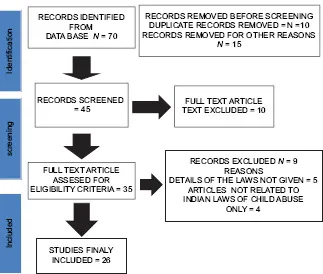
Figure :1 Case report on Child Neglect
Definition: Child neglect is a form of child maltreatment in which a parent, caregiver, or responsible person fails to provide the basic physical, emotional, educational, or medical care necessary for the child’s health, safety, and development.1
Types of Child Neglect
|
Type |
Description |
Examples |
|
Physical neglect |
Failure to meet basic physical needs |
Inadequate food, clothing, shelter, hygiene, or supervision |
|
Medical neglect |
Failure to provide necessary healthcare |
Not seeking treatment, missing essential medications or vaccinations |
|
Educational neglect |
Failure to meet educational needs |
Persistent non-attendance at school, failure to address learning needs |
|
Emotional neglect |
Failure to provide affection, attention, and emotional support |
Ignoring the child, lack of affection, rejection |
|
Supervisory neglect |
Failure to protect the child from danger |
Leaving a young child alone or with an unsafe caregiver |
|
Nutritional neglect |
Failure to provide adequate nutrition |
Persistent inadequate or inappropriate feeding |
Risk Factors
Signs and Symptoms
Physical signs
Behavioral signs
Effects on the Child - Child neglect can affect:
Long-term neglect may increase the risk of developmental difficulties, mental health problems, substance misuse, and difficulties forming healthy relationships.
Child Neglect Laws In India
Child neglect and abandonment in India are primarily addressed under the Juvenile Justice (Care and Protection of Children) Act5,6, 2015 and the older Indian Penal Code (IPC), 1860.7
Legal Provisions
Section 75 of the Juvenile Justice (JJ) Act, 2015: Punishes anyone having actual charge or control of a child who assaults, abandons, abuses, exposes, or neglects the child in a manner causing mental or physical suffering. Penalty includes imprisonment up to three years or a fine of up to one lakh rupees, or both. Heavier penalties apply if the child is severely injured or incapacitated.5
Section 317 of the IPC, 1860: Specifically penalizes the abandonment and exposure of a child under the age of 12 years by a parent or person having care of the child. It carries an imprisonment term of up to seven years, a fine, or both.7
Children in Need of Care and Protection (CNCP): Under the Juvenile Justice Act, neglected, abandoned, or destitute children are categorized as CNCP, triggering intervention by local Child Welfare Committees (CWCs) to provide shelter, rehabilitation, and care.5,6,
|
Laws |
Year |
Punishment |
|
Juvenile justice act [amended as] Juvenile justice act care and protection Juvenile justice act care and protection for children5,6 |
1986 2000 2015 |
Imprisonment up to 5 years |
|
Indian penal code,7 |
1860 |
Death penalty. Life imprisonment. Imprisonment. Rigorous/simple. Forfeiture of property/ Fine. |
|
Protection of children from sexual offenses act8 |
2012 |
The minimum term of rigorous imprisonment is up to 10 years |
|
Immoral traffic act |
1987 |
1-2 Years of rigorous imprisonment and a fine of up to rs 10,000. |
|
The criminal law (amendment) act, |
2013 |
Imprisonment to 3 years |
|
Commission for protection of child rights |
2005 |
|
|
Child marriage act12 |
1927 |
2 Years of rigorous imprisonment or with a fine which may extend to 100,000 or with both. |
|
Child labor (prohibition and regulation) act13 |
1986 |
Imprisonment between 6 months and 2 years (from 3 months to 1 year) or a fine of rs 20,000-50,000 (from rs 10,000 to 20,000) or both. |
|
Right to education (RTE) act14 |
2009 |
Fine which may extend to rs 25,000 for the first contravention and rs 50,000 for each subsequent contravention.4-5 |
Table 1. Child protection laws- “When Care is Denied, Childhood Is Stolen”
Emergency Reporting
Multidisciplinary Management
Prevention
Key point: Neglect is not simply “poor parenting.” It is a child-protection concern, and healthcare professionals have an important role in early identification, documentation, reporting according to applicable law/policy, and ensuring the child's safety.8
CONCLUSION
“Children Belong to Their Future, Not Our Neglect” Child neglect remains one of the most pervasive yet under-recognized forms of child maltreatment. Unlike overt physical or sexual abuse, neglect is often hidden within households and communities, making early identification and intervention challenging. Its impact, however, is profound—affecting a child’s physical growth, cognitive development, emotional stability, and long-term social functioning. India has established a robust legal framework through the Juvenile Justice (Care and Protection of Children) Act, 2015, the Indian Penal Code (IPC, 1860), and complementary statutes such as the Protection of Children from Sexual Offenses Act (2012) and the Right to Education Act (2009). Despite these provisions, gaps in enforcement, corruption, and lack of awareness continue to hinder effective child protection. Healthcare professionals, particularly nurses, play a pivotal role in bridging this gap. Through vigilant assessment, documentation, reporting, and family-centered education, they act as frontline defenders of child rights. Preventive strategies—such as parent education, community awareness, and strengthening social support systems—are equally vital to reduce risk factors and safeguard vulnerable children. Ultimately, neglect is not merely a reflection of poor parenting but a serious child-protection concern. Addressing it requires a multidisciplinary approach that integrates law, healthcare, education, and community participation. By ensuring accountability, promoting awareness, and fostering compassion, society can uphold the dignity, safety, and future of every child.5,14
“To Ignore a Child is to Abandon Tomorrow”
REFERENCES


Sheeba Anitha Rani*1, Suresh Babu2, Neglect Is Invisible - It Leaves Unseen Scars: A Review On Child Neglect, Int. J. Sci. R. Tech., 2026, 3 (9), 59-64. https://doi.org/10.5281/zenodo.22246807
 10.5281/zenodo.22246807