

We use cookies to ensure our website works properly and to personalise your experience. Cookies policy
Department of Computer Science and Engineering, Avanthi’s St Theressa Institute of Engineering and Technology, Garividi, Andhra Pradesh, India.
Forest fires are among the most destructive natural disasters, posing significant threats to wildlife, ecosystems, and human life. In recent years, the probability and intensity of wildfires have increased considerably due to climate change and rising global temperatures. This project focuses on developing an automated forest fire detection system using deep learning techniques, particularly Convolutional Neural Networks (CNNs). The primary objective is to enable an early warning mechanism by accurately and rapidly detecting fire through the analysis of visual data. The proposed system is trained on a labeled dataset containing both fire and non-fire images, allowing the model to effectively learn and distinguish between these two classes. By leveraging image recognition capabilities, the system can identify fire occurrences in real time, thereby helping to prevent the rapid spread of wildfires. The solution is entirely software-based, making it lightweight, cost-efficient, and easy to deploy without the need for additional hardware components. Experimental results indicate that deep learning models can achieve high effectiveness in wildfire detection, even at the prototype stage. With further optimization and integration into larger monitoring frameworks, this approach can significantly enhance forest fire surveillance and management systems, improving overall accuracy and response efficiency.
Forests are among the most valuable natural resources on Earth, playing a vital role in maintaining ecological balance. They support biodiversity, regulate climate, produce oxygen, and provide habitat for numerous species, including human communities in certain regions. However, forest ecosystems have become increasingly vulnerable to wildfires due to factors such as deforestation, global warming, and human negligence. Once ignited, forest fires can spread rapidly, causing extensive destruction within a short period. These incidents pose a significant threat to both the environment and human life. In recent years, the frequency and intensity of wildfires have risen substantially, largely driven by the escalating impacts of climate change. Beyond the immediate loss of vegetation and wildlife, wildfires also contribute to environmental degradation by releasing large quantities of harmful gases and pollutants into the atmosphere, further accelerating global warming. Early detection of forest fires is critical to preventing their rapid spread and minimizing irreversible damage. In recent years, the frequency and intensity of wildfires have increased at an alarming rate across the globe. Several major incidents highlight the severity of this issue, including the devastating Maui wildfires in 2023, which destroyed entire communities and resulted in significant loss of life, as well as the Canadian wildfires of the same year, which burned millions of hectares and spread smoke across large parts of North America and even into Europe. Similarly, the Australian bushfires of 2019–2020 caused unprecedented ecological damage, burning vast areas of land and leading to significant biodiversity loss.
In India, recurring forest fires in regions such as Uttarakhand and Himachal Pradesh have disrupted fragile ecosystems and displaced local populations, particularly during the dry summer season. Traditionally, forest fire detection has relied on methods such as satellite monitoring, sensor-based systems, and human surveillance. While these approaches have been widely adopted, they often suffer from limitations including delayed response times, high operational costs, and limited coverage, especially in remote or densely forested areas. These challenges underscore the need for more efficient, intelligent, and scalable detection mechanisms. With rapid advancements in technology, deep learning techniques have emerged as powerful tools for automated hazard detection. In this context, this study proposes a Convolutional Neural Network (CNN)-based approach for forest fire detection. The model is trained on a labeled dataset comprising fire and non-fire images, enabling it to learn distinctive visual features associated with fire. Once trained, the system can accurately classify new images and detect fire in real time. The primary objective of this work is to develop a reliable, efficient, and scalable software-based fire detection system that reduces dependency on manual monitoring while significantly improving detection speed. By leveraging deep learning, the proposed approach aims to enhance environmental protection and support effective forest management through timely and accurate fire detection. This research proposes the use of Convolutional Neural Networks (CNNs), a deep learning-based approach, for the detection of forest fires.
The model is trained on a labeled dataset consisting of fire and non-fire images, enabling it to learn distinguishing visual features associated with fire occurrences. Once trained, the system can accurately identify the presence of fire and classify new input images in real time. The implementation is carried out using Python and is designed to run efficiently on cloud-based platforms such as Google Colab. It utilizes widely adopted deep learning libraries, including TensorFlow, Keras, and OpenCV, for model development, training, and image processing tasks. The primary objective of this project is to develop a reliable, efficient, and scalable software-based forest fire detection system capable of real-time operation. By reducing reliance on manual monitoring and enhancing detection speed, the proposed approach aims to support effective forest management and contribute to environmental protection.
LITERATURE REVIEW
This study builds upon recent advancements in deep learning for wildfire detection by incorporating improved object detection and classification techniques. In particular, enhanced versions of the YOLOv5 model, combined with global attention mechanisms and advanced convolutional operations, have demonstrated significant improvements in fire detection performance. Prior research has explored a variety of artificial intelligence, machine learning, and deep learning approaches for fire prediction and detection, highlighting their effectiveness in identifying fire-related patterns in visual data [1–9]. The integration of attention mechanisms further enhances the model’s ability to focus on critical regions, thereby improving detection accuracy and recall, especially in real-time small-scale fire scenarios [10]. Additionally, researchers have proposed SegNet, a convolutional neural network designed for wildfire detection using UAV imagery. This approach improves early fire detection by enhancing pixel-level feature representation and reducing noise, aligning with the objective of achieving rapid and accurate fire identification [11]. Similarly, the introduction of the FIgLib dataset, containing approximately 25,000 labeled wildfire smoke images, facilitated the development of SmokeyNet, a spatiotemporal deep learning model that achieves near human-level performance in real-time smoke detection [12].
These advancements emphasize the importance of large-scale, high-quality datasets in improving model robustness. Furthermore, satellite-based wildfire detection systems utilizing architectures such as EfficientNet-B0 have achieved accuracy levels exceeding 92% when trained on datasets like CWGID, demonstrating the effectiveness of optimized CNN models for large-scale monitoring [13]. Other studies employing modified versions of ResNet-50 and Xception have reported accuracy levels approaching 99–100% on benchmark datasets. These findings further validate the capability of deep convolutional neural networks in achieving high-performance forest fire detection and directly support the methodology adopted in this work [14]. To reduce risks associated with manual monitoring, several studies have explored the use of unmanned aerial vehicles (UAVs) combined with deep learning techniques for automated fire detection. These approaches focus on integrating autonomous surveillance systems with vision-based recognition models to enable early disaster warning, which closely aligns with the objectives of the proposed work [15]. In addition, comprehensive reviews of satellite imagery-based, AI-driven fire detection systems highlight the effectiveness of deep learning models, particularly Convolutional Neural Networks (CNNs) and image segmentation techniques, in accurately identifying smoke and flame patterns [16]. Lightweight deep learning architectures have also gained attention due to their efficiency and high accuracy. For instance, the FireNet-CNN model achieves accuracy exceeding 99%, demonstrating the capability of CNN-based approaches in precise fire classification, further enhanced through the use of explainable AI techniques [17].
Similarly, modified deep CNN frameworks designed for real-time video-based forest fire detection have been proposed, leveraging feature fusion and transfer learning to improve detection accuracy while minimizing false alarms. These approaches share similar goals with the proposed system, particularly in achieving reliable and real-time fire classification [18]. Beyond detection, secure storage and management of fire-related data have also been investigated using multi-cloud environments to ensure reliability and data protection [19-23]. Furthermore, lightweight CNN architectures such as MobileNetV2, Yolo and ShuffleNet have been explored for efficient wildfire detection, particularly in aerial image analysis. Cross-dataset evaluations demonstrate that these models maintain strong performance while significantly reducing computational complexity, making them suitable for real-time and resource-constrained applications [24-27].
METHODOLOGY
A systematic and structured approach was adopted to develop a reliable and responsive forest fire detection system. The overall framework consists of several stages, including data preparation, model design, training, evaluation, and real-time testing. The primary objective is to automatically classify images into fire and non-fire categories using Convolutional Neural Networks (CNNs). The dataset used in this study is divided into two classes: Fire and No Fire. During preprocessing, all images are resized to a uniform resolution of 128 × 128 pixels to ensure consistency in input dimensions. Pixel values are normalized to improve convergence during training, and data augmentation techniques such as zooming and horizontal flipping are applied to enhance model generalization and reduce over fitting. The dataset is efficiently loaded in batches using the Image Data Generator provided by Keras. The CNN model is implemented using TensorFlow and Keras. It comprises multiple convolutional layers for feature extraction, followed by max-pooling layers to reduce spatial dimensions and computational complexity. A dropout layer is incorporated to prevent over fitting, while fully connected dense layers perform the final classification.
The output layer uses a sigmoid activation function to produce a binary prediction, indicating the presence (1) or absence (0) of fire in the input image. For training, the model employs the Adam optimizer along with the binary cross-entropy loss function. Accuracy is used as the primary evaluation metric. The model is trained over multiple epochs (typically 10), after which its performance is evaluated using a separate test dataset. In the deployment phase, a prediction module is used to analyze new input images. If fire is detected, the system displays a “Fire” label and triggers an alert sound to notify the user. Otherwise, it displays a “No Fire” label. This end-to-end pipeline—from data preprocessing and model training to real-time prediction and alert generation—demonstrates an effective and practical solution for early forest fire detection.
1. Dataset collection and labeling (Fire / No Fire)
Initially, a dataset comprising images of forest fire scenarios and non-fire scenes was collected from publicly available sources, including platforms such as Kaggle and other open-access fire detection repositories. The collected images were carefully organized and manually categorized into two distinct classes: Fire and No Fire. Separate directories were created for each class, forming a structured dataset that serves as the foundation for training and evaluating the proposed model. The dataset collection and labeling process is a crucial step in developing an accurate forest fire detection system. The quality and diversity of the dataset directly influence the performance and generalization capability of the Convolutional Neural Network (CNN) model. The dataset is divided into two primary classes:
Each image in the dataset is manually labeled into one of the two categories:
Before training, the dataset undergoes preprocessing:
2. Image preprocessing (resizing, normalization, augmentation)
Image preprocessing is a critical stage in the proposed forest fire detection system, as it ensures that the input data is consistent, clean, and suitable for effective training of the Convolutional Neural Network (CNN). This step improves model performance, accelerates convergence, and enhances generalization.
2.1. Image Resizing: All input images are resized to a fixed dimension of 128 × 128 pixels. Since images collected from different sources may vary in size and resolution, resizing ensures uniformity across the dataset. The image resizing reduces computational complexity, Ensures compatibility with CNN input layer and maintains consistent feature extraction.
2.2. Normalization: Pixel values in images typically range from 0 to 255. These values are scaled to a range of 0 to 1 by dividing each pixel value by 255.

2.3. Data Augmentation: To increase dataset diversity and prevent over fitting, data augmentation techniques are applied during training. This artificially expands the dataset by creating modified versions of existing images.
3. Data Loading Using Image Data Generator
Efficient data loading is essential for training deep learning models, especially when working with large image datasets. In this study, the ImageDataGenerator class is used to load, preprocess, and augment images in real time during training. This approach minimizes memory usage and improves training efficiency by generating data in batches. The dataset was loaded into the model using batch processing to ensure efficient memory utilization and faster training. It was systematically divided into training and testing subsets, where the training data was used to learn the model parameters, and the testing data was utilized to evaluate its performance. Additionally, the data loading mechanism incorporated real-time augmentation techniques, enabling the model to receive dynamically transformed images during training. This approach improves generalization and reduces overfitting while maintaining a continuous and efficient data flow to the model. Two generators are typically created as Training Generator (with augmentation) and Validation/Test Generator (without augmentation). The data image generator shown on Figure 1.
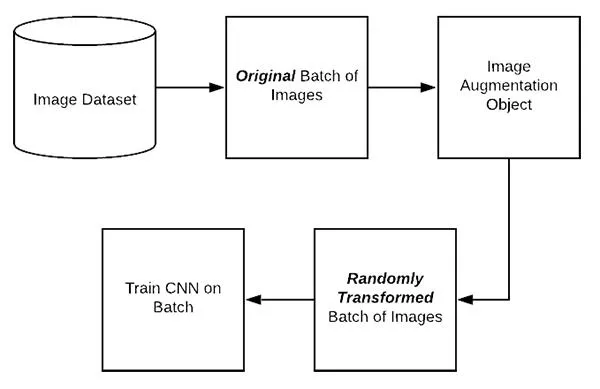
Figure 1. Data Loading Using Image Data Generator
4. CNN Model Construction (Conv + Pool + Dense layers)
The Convolutional Neural Network (CNN) model is designed to automatically learn and extract meaningful features from input images for accurate classification of Fire and No Fire categories. The architecture follows a sequential structure consisting of convolutional, pooling, and fully connected layers. The CNN model includes the following components.
4.1. Convolutional Layers (Conv2D): These layers apply multiple learnable filters to the input image to extract low-level and high-level features such as edges, textures, smoke patterns, and flames. The Rectified Linear Unit (ReLU) activation function is used to introduce non-linearity.
4.2. Pooling Layers (MaxPooling2D): Pooling layers reduce the spatial dimensions of feature maps, decreasing computational complexity while retaining the most significant features.
4.3. Flatten Layer: The extracted feature maps are converted into a one-dimensional vector to serve as input for the fully connected layers.
4.4. Fully Connected (Dense) Layers: Dense layers perform high-level reasoning and classification based on the extracted features.
4.5. Dropout Layer: A dropout layer is included to randomly deactivate neurons during training, reducing over fitting and improving generalization.
4.6. Output Layer: A single neuron with a sigmoid activation function is used to perform binary classification:
5. Model compilation (Adam + Binary Cross entropy)
5.1. Optimizer (Adam): The model utilizes the Adaptive Moment Estimation (Adam) optimizer, a widely used optimization algorithm in deep learning. Adam combines the advantages of both Momentum and RMSProp, enabling faster convergence and efficient handling of sparse gradients.
5.2. Loss Function: Binary Cross-Entropy: Since the task is a binary classification problem (Fire vs No Fire), the Binary Cross-Entropy (BCE) loss function is used to measure the difference between predicted and actual outputs.

5.3. Evaluation Metric: Accuracy is used as the primary metric to evaluate model performance.

6. Model training (epochs and validation)
Model training is the phase where the CNN learns patterns from the input data by iteratively updating its weights. This is achieved by feeding the training dataset to the model over multiple iterations, known as epochs, while monitoring performance on a separate validation dataset.
6.1. Training Process: During training the model processes data in batches. For each batch Forward propagation computes predictions, Loss is calculated using binary cross-entropy and Back propagation updates weights using the Adam optimizer. An epoch represents one complete pass through the entire training dataset. Typically, the model is trained for 10 epochs depending on dataset size and convergence behavior.
6.2: Validation Strategy: To ensure the model generalizes well to unseen data, a portion of the dataset is reserved for validation. The two types of data taken is Training Set (Used to learn model parameters) and Validation Set (Used to monitor performance during training).
7. Performance Evaluation (Accuracy, Loss)
Performance evaluation is a critical step used to measure how well the trained CNN model classifies images into Fire and No Fire categories. This evaluation is carried out using standard metrics such as accuracy and loss, which provide insights into the model’s effectiveness and reliability.

8. Real-time prediction system
The trained model is integrated with a tested data for real-time prediction. The steps for prediction is take tested data, resize and preprocess frame, send frame to trained CNN model, predict fire or non-fire class, and display prediction label instantly. This enables continuous monitoring and instant detection.
9. Alert generation (sound + label display)
When fire is detected, the system generates an alert to notify users immediately. The alert features are display “Fire Detected” label on screen, play warning sound/alarm and trigger emergency notifications.
RESULTS AND DISCUSSIONS
The results obtained from the forest fire detection system demonstrate that the trained Convolutional Neural Network (CNN) model performs effectively in identifying fire and non-fire images. The model successfully classified the test images into two categories, namely “Fire” and “No Fire,” as illustrated in the corresponding output screens. The developed system also provides a user-friendly real-time interface that displays the prediction result directly on the image and generates an alert sound whenever fire is detected. For fire images, the system produces a beep sound alert indicating the presence of active fire, which serves as an immediate real-time warning notification. Additionally, the label “Fire” is clearly displayed below the image in large, visible text, as shown in Figure 2. For non-fire images, the system displays the label “No Fire” beneath the image, as illustrated in Figure 3.
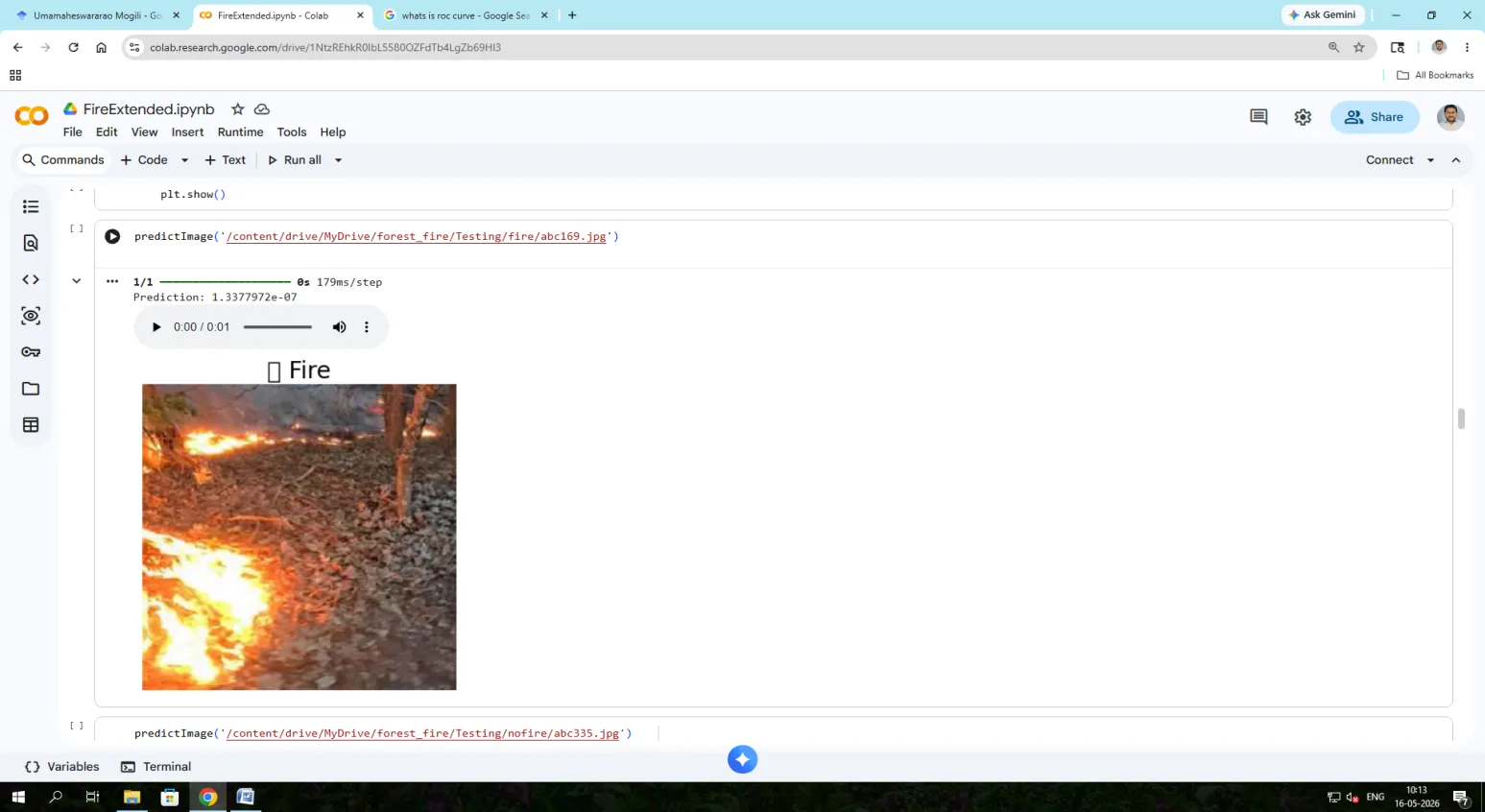
Figure 2. System Detect the “Fire”
This clear visual output allows users to easily understand the prediction result without analyzing complex probability values or raw prediction data. Overall, the experimental results confirm that the proposed CNN-based forest fire detection system is capable of providing accurate predictions along with effective real-time alert functionality, making it suitable for smart environmental monitoring and early fire warning applications.
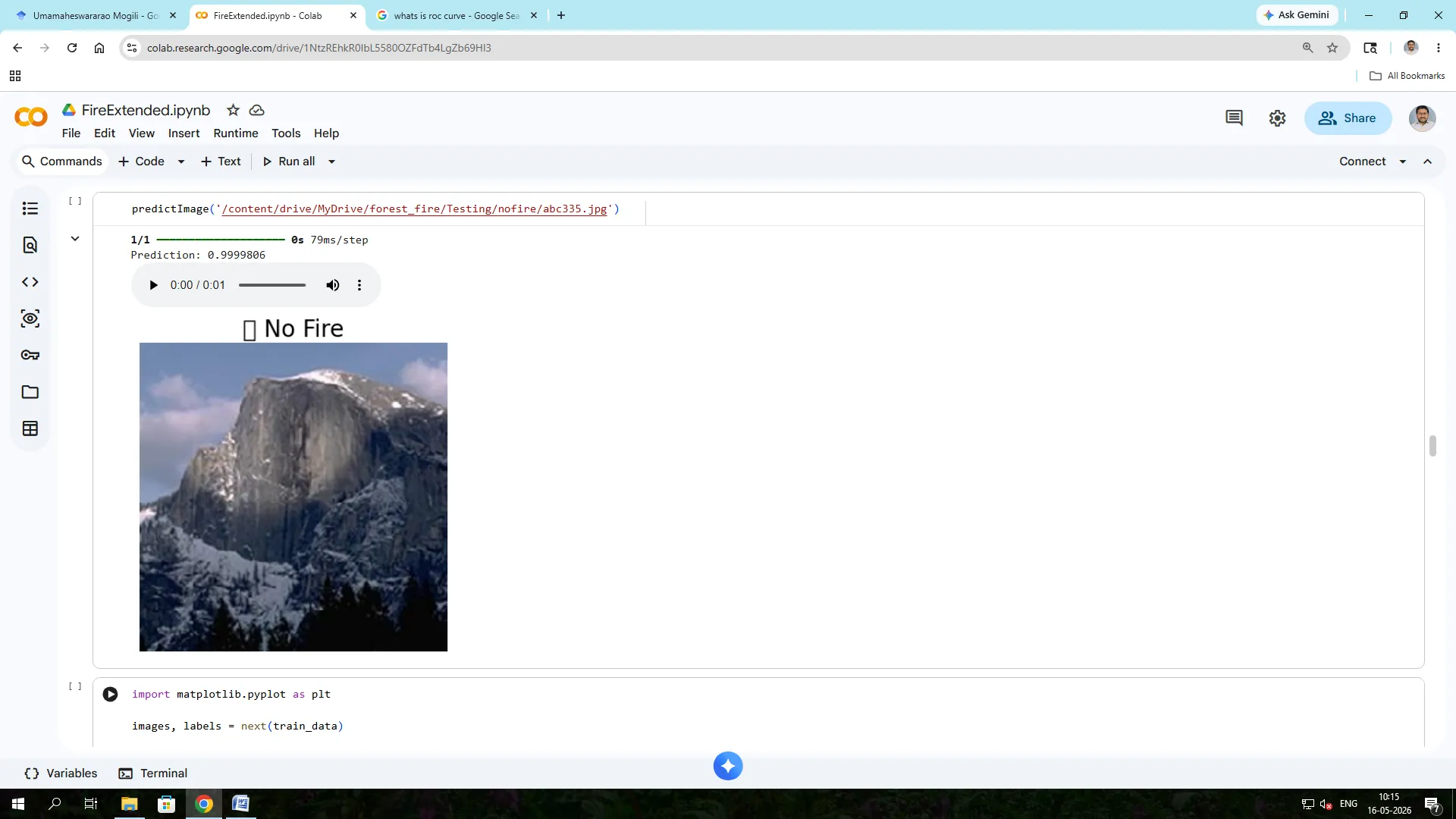
Figure 3. System Detect “No Fire”
In the proposed forest fire detection system, the ROC (Receiver Operating Characteristic) curve is used to evaluate the performance of the CNN-based classification model by analyzing the relationship between the True Positive Rate (TPR) and False Positive Rate (FPR) shown in Figure 4. The True Positive Rate represents the proportion of actual fire images that are correctly identified by the model, while the False Positive Rate indicates the proportion of non-fire images incorrectly classified as fire. By plotting TPR against FPR at different threshold values, the ROC curve provides a clear visualization of the model’s ability to distinguish between fire and non-fire conditions.
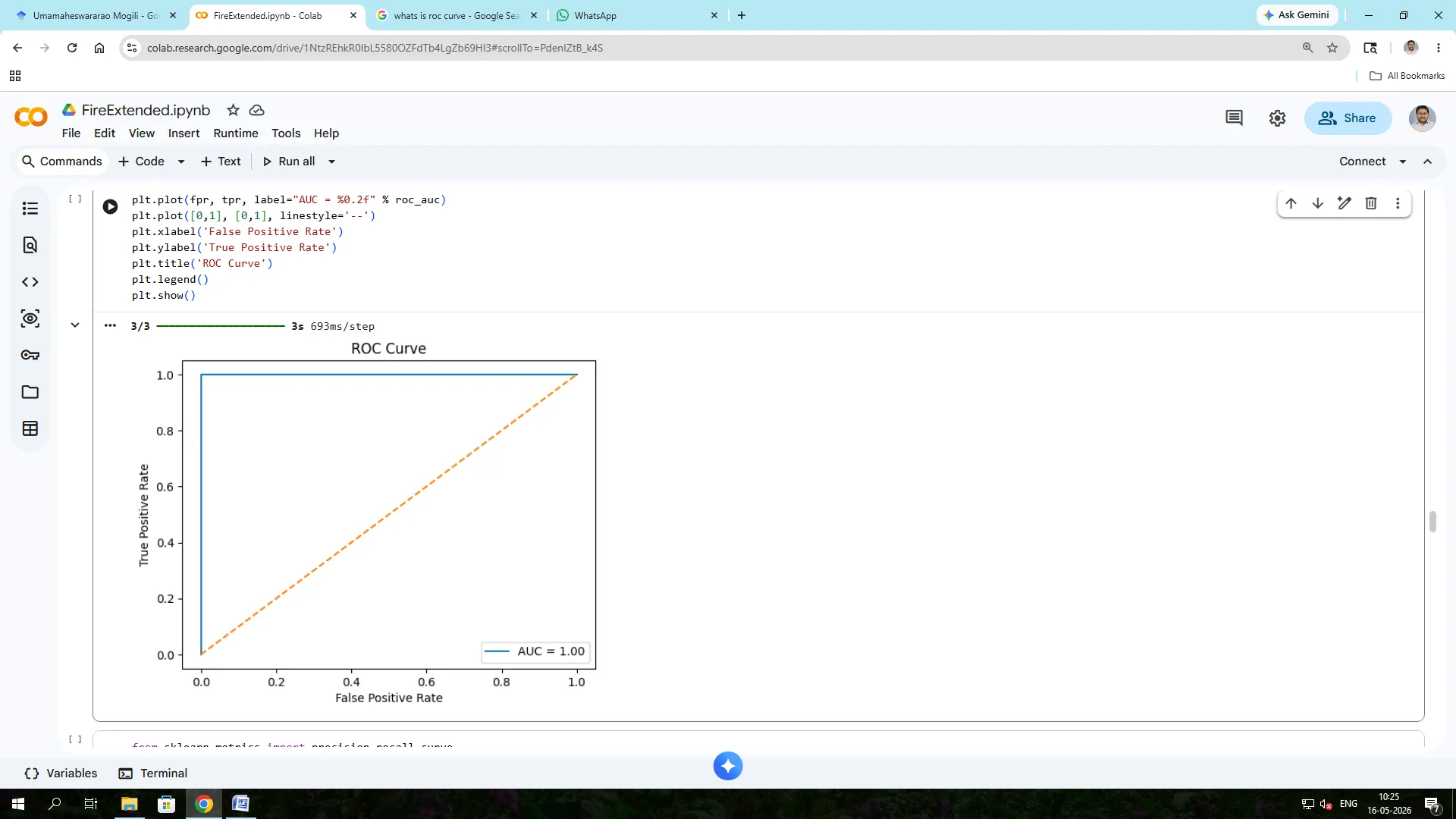
Figure 4. ROC Curve for true and false positive rate
The Precision–Recall (PR) curve is an important evaluation metric used in the proposed forest fire detection system to measure the performance of the CNN-based classifier, especially when dealing with imbalanced datasets shown in Figure 5. The curve illustrates the relationship between Precision and Recall at different classification thresholds. Precision represents the proportion of correctly predicted fire images among all images classified as fire, while Recall indicates the proportion of actual fire images successfully detected by the model. A high Precision value reduces false fire alarms, whereas a high Recall value ensures that most fire incidents are detected at an early stage. By plotting Precision against Recall, the PR curve helps evaluate the trade-off between accurate fire prediction and detection sensitivity.
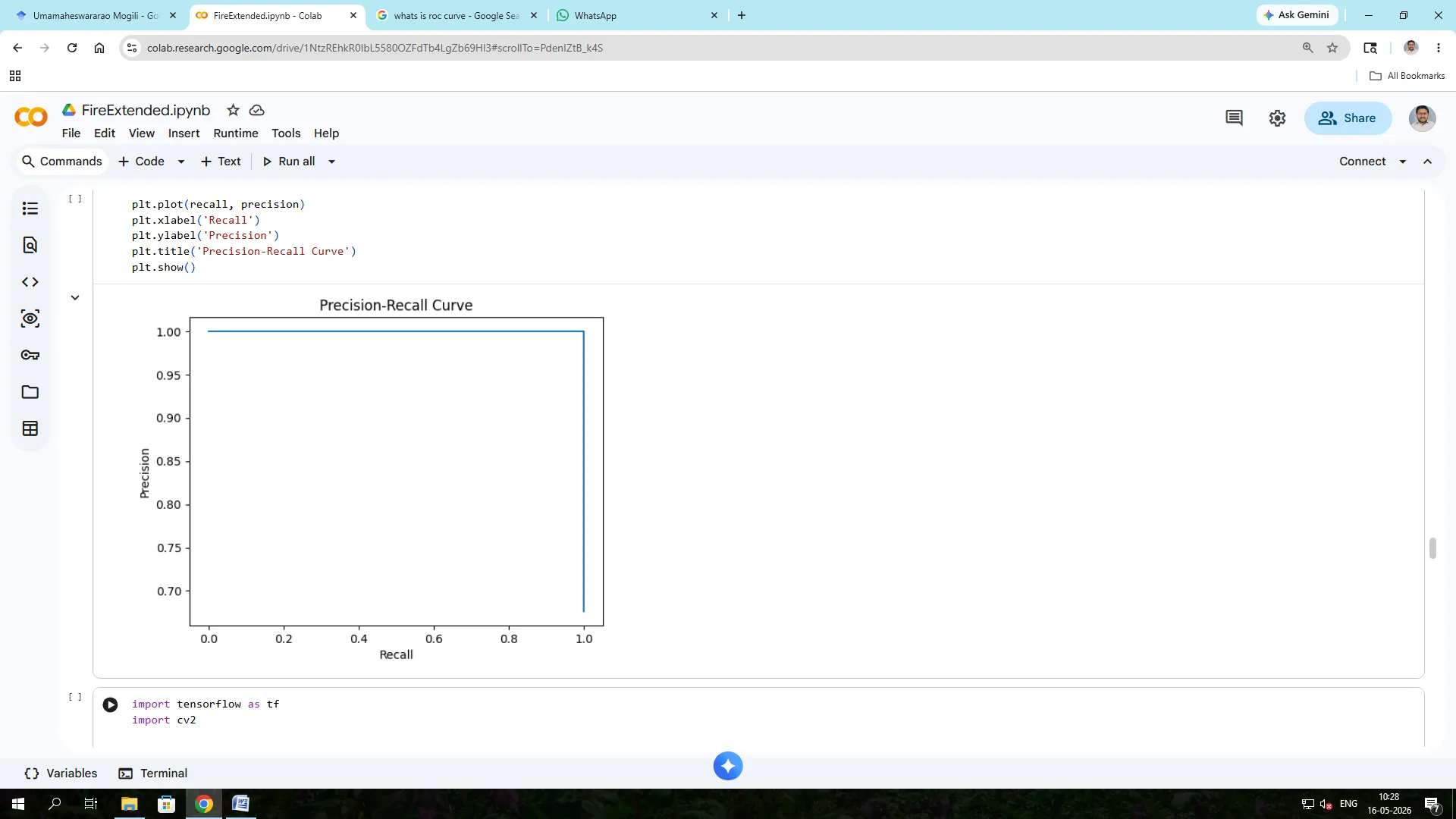
Figure 5. Precision-Recall curve
CONCLUSION
The proposed project successfully demonstrates the application of deep learning techniques, particularly Convolutional Neural Networks (CNNs), for early forest fire detection through image classification. The developed model effectively identifies fire and non-fire images, making it a practical and scalable solution for real-time fire monitoring systems. By enabling early detection, the system can help reduce environmental damage, protect wildlife, and support faster emergency response operations. The experimental results indicate that the CNN-based approach provides reliable prediction accuracy and efficient performance for wildfire identification. In addition to image classification, the system also offers real-time alert functionality, which enhances its usefulness in smart surveillance and disaster prevention applications. Although the current implementation represents a prototype-level system, it demonstrates significant potential for future enhancement and large-scale deployment. With further improvements in model accuracy, dataset size, and processing speed, the proposed system can be integrated into advanced technologies such as surveillance drones, IoT-based forest monitoring systems, satellite imaging platforms, and disaster management frameworks. Overall, the study confirms that deep learning techniques can play a major role in intelligent wildfire detection and environmental monitoring. Future developments can focus on improving detection accuracy, reducing false alarms, and integrating the system into automated emergency response networks for more effective forest fire management.
Future Scope
Future enhancements of the proposed forest fire detection system can significantly improve its accuracy, scalability, and real-time monitoring capabilities. One important improvement is the integration of IoT-based devices and environmental sensors such as temperature, humidity, smoke, and gas sensors along with optical image-based fire detection. Combining sensor data with CNN-based visual detection can increase the reliability and accuracy of early fire detection while reducing false alarms. Another major enhancement involves developing a mobile or smart phone application that enables firefighters, forest officials, and emergency response teams to receive instant fire alerts and monitor fire locations in real time through map-based visualization. Such an application would support faster communication, efficient decision-making, and rapid emergency response during wildfire incidents. In the future, the system can also be integrated with advanced technologies such as surveillance drones, satellite imagery, GPS tracking, and IoT-enabled smart forest monitoring networks. These improvements can transform the proposed prototype into a comprehensive intelligent wildfire management system capable of supporting environmental protection and disaster prevention on a larger scale.
REFERENCES


Mammula Venkatesh, Umamaheswararao Mogili*, M. John Timothy, Sirela Meena, Next-Generation Forest Fire Detection System Using Deep Learning And Multi-Sensor Data Fusion For Environmental Disaster Resilience, Int. J. Sci. R. Tech., 2026, 3 (6), 121-130. https://doi.org/10.5281/zenodo.20503323
 10.5281/zenodo.20503323