

We use cookies to ensure our website works properly and to personalise your experience. Cookies policy
1Dept. Of Oral and Maxillofacial Surgery, Hi-Tech Dental College and Hospital
2Dept of Periodontics, Mullana Dental College, Ambala.
Oral cancer remains a major clinical challenge, particularly in relation to early diagnosis, accurate assessment, effective surgical treatment, and functional rehabilitation. Advances in molecular biology and salivary diagnostics have encouraged the investigation of potential biomarkers, while developments in reconstructive surgery have emphasized the importance of restoring speech, swallowing, and quality of life after oncologic resection. This narrative review examines current approaches to oral cancer diagnosis and management, focusing on emerging diagnostic methods, surgical outcomes, and preventive strategies. Relevant evidence from oral and maxillofacial practice is also considered to explore broader implications for clinical assessment, treatment safety, and patient outcomes. The review highlights the need for rigorous validation of emerging diagnostic techniques, standardized evaluation of surgical outcomes, and further clinical research to support their integration into routine practice.
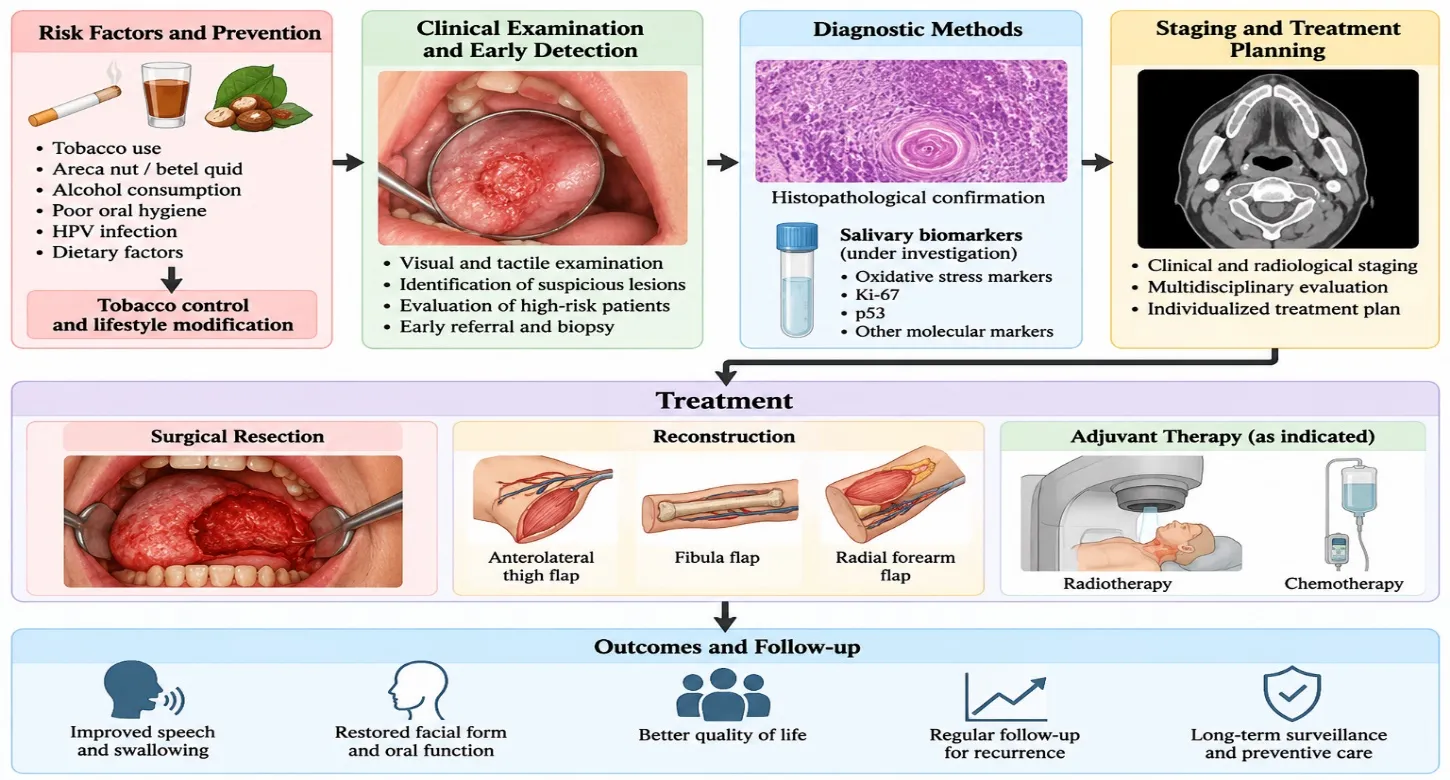
Oral cancer is a significant public health concern requiring timely diagnosis, effective treatment, and long-term functional rehabilitation. Oral squamous cell carcinoma is the most common malignant tumour of the oral cavity, and its management depends on clinical assessment, histopathological confirmation, appropriate staging, and individualized treatment planning [1,2]. Tobacco exposure remains an important preventable risk factor, highlighting the need for effective prevention and early-detection strategies [3].
Research into molecular biomarkers and salivary oxidative stress has generated interest in developing non-invasive approaches to support conventional diagnostic methods [4]. However, their clinical usefulness requires validation in adequately designed studies. Surgical management also presents important challenges, particularly when extensive resection necessitates reconstruction to restore speech, swallowing, and quality of life [5].
This review examines diagnostic advances, surgical outcomes, and preventive approaches in oral cancer, while considering relevant evidence from broader oral and maxillofacial practice. It aims to identify current clinical challenges and research priorities without assuming that emerging technologies are ready for routine clinical use.
2. Diagnostic Advances and Early Detection
Early detection is essential for improving oral cancer management. Clinical examination and histopathological confirmation remain fundamental, while molecular biomarkers are being investigated for their potential to improve diagnostic and prognostic assessment. Ki-67 and p53 are among the markers discussed in oral cancer research, although their clinical interpretation depends on the tumour characteristics and supporting evidence [6].
Salivary diagnostics offer a non-invasive approach to investigating biological changes associated with oral potentially malignant disorders and oral cancer. Research comparing salivary oxidative stress markers in these conditions provides a basis for further investigation, but diagnostic accuracy and clinical utility require independent validation [7]. Similarly, an observational study examining dermatoglyphic fingerprint patterns in patients with oral squamous cell carcinoma explores a possible association rather than establishing a reliable screening method [8].
Clinical assessment must also account for variations in tumour location and presentation. Buccal mucosal carcinoma and uncommon oral lesions may require coordinated clinical, radiological, and histopathological evaluation [9,10]. Effective prevention remains equally important, particularly through tobacco-control initiatives and improved access to timely assessment [3].
Although emerging diagnostic approaches may complement conventional methods, their routine implementation should depend on reproducibility, diagnostic performance, and demonstrated clinical benefit.
3. Surgical Outcomes and Broader Clinical Perspectives
Surgical management is a major component of oral and maxillofacial care, particularly when malignancy requires extensive tissue removal. Tongue reconstruction following oncologic resection aims to restore speech, swallowing, and oral function, making functional outcomes essential measures of treatment success [11]. Evidence from reconstructive surgery in cleft lip repair and comparative studies of mandibular fracture management also highlights the importance of appropriate technique selection, complication prevention, and postoperative assessment [12,13].
Other maxillofacial conditions provide important lessons for individualized treatment planning. Reports involving temporomandibular joint ankylosis, joint dislocation, and uncommon odontogenic lesions illustrate the diagnostic and functional challenges encountered in clinical practice [14–16]. Airway assessment is similarly important in patients undergoing orthognathic surgery or treatment for obstructive sleep apnea, while pharyngeal packing requires reliable protocols to minimize preventable perioperative complications [17–19].
Additional research concerning metabolic health, orthodontic interventions, and temporomandibular joint assessment emphasizes the value of considering systemic conditions and functional outcomes alongside local pathology [20,21]. Forensic identification research and studies of dental education contribute further perspectives on diagnostic reasoning and professional competence [22,23].
Although these studies address different clinical questions, they collectively demonstrate that effective oral and maxillofacial care requires evidence-based decision-making, appropriate patient selection, multidisciplinary collaboration, and systematic evaluation of treatment outcomes.
CONCLUSION
Early diagnosis, validated diagnostic methods, effective surgical management, and functional rehabilitation remain central to improving oral cancer care. Molecular and salivary biomarkers offer promising research directions, but their clinical utility requires further validation. Reconstructive surgery and multidisciplinary management are important for addressing functional deficits and improving patient outcomes. Evidence from broader oral and maxillofacial practice also emphasizes prevention, individualized treatment planning, perioperative safety, and continued clinical research. Future studies should prioritize reliable diagnostic markers, standardized surgical outcome measures, and evidence-based approaches that improve patient care.
REFERENCES

Dr. Kohinoor Acharya1*, Dr. Supriya Singh1, Dr. Simran Mohanty1, Dr. Shreya Bakshi1, Dr. Aman Kumar Verma1, Dr. M. Akankhya2, Oral Cancer: Diagnostic Advances, Surgical Outcomes, and Clinical Perspectives, Int. J. Sci. R. Tech., 2026, 3 (10), 1329-1332. https://doi.org/10.5281/zenodo.23683876
 10.5281/zenodo.23683876