

We use cookies to ensure our website works properly and to personalise your experience. Cookies policy
Lucknow Model College of Pharmacy, Lucknow
Rivaroxaban is a popular direct oral anticoagulant (DOAC) for prevention and treatment of thromboembolic events, such as deep vein thrombosis, pulmonary embolism and non-valvular atrial fibrillation. Although rivaroxaban has a favorable pharmacological profile, it has low aqueous solubility and dissolution-limited absorption, which could be responsible for its low oral bioavailability. Solid lipid nanoparticles (SLNs) have emerged as an interesting lipid based nanocarrier technology that could overcome the challenge of improving the solubility, stability and gastrointestinal absorption of poorly water soluble drugs. Besides this, the application of Quality by Design (QbD) approach helps to offer a systematic approach to creating robust and reproducible pharmaceutical formulations by identifying critical formulation variables and optimizing manufacturing processes. The current review summarizes the pharmacological properties of rivaroxaban, and the drawbacks of its former oral administration and highlights the potential of the SLNs to enhance the oral delivery of the drug. The review also outlines the basic principles of QbD such as Quality Target Product Profile (QTPP), Critical Quality Attributes (CQAs), Critical Material Attributes (CMAs), Critical Process Parameters (CPPs), and Design of Experiments (DoE), in optimizing rivaroxaban-loaded SLNs. Moreover, recent research, formulation strategies, evaluation parameters and future perspectives are presented. In conclusion, the use of SLNs and the QbD approach is a potential new strategy to improve the oral bioavailability, therapeutic efficacy and product quality of rivaroxaban, along with the possibility of regulatory compliance and future pharmaceutical development.
Thromboembolic disorders, such as deep vein thrombosis, pulmonary embolism, atrial fibrillation, and ischemic stroke continue to be important causes of morbidity and mortality. Effective anticoagulant therapy is a key element in preventing formation of a thrombus and risk of a subsequent thromboembolic event. Although a variety of conventional anticoagulants, including unfractionated heparin, low-molecular-weight heparin and vitamin K antagonists, have been widely used in clinical practice, they each have a number of drawbacks such as variable pharmacokinetics, many food and drug interactions, the need for frequent coagulation monitoring, and complex dose adjustment requirements. The success of the development of direct oral anticoagulants (DOACs) that are more effective, have more predictable pharmacokinetics, and are more convenient for patients has been aided by this. The first direct factor Xa inhibitor to be approved for the prevention and treatment of a variety of thromboembolic disorders is rivaroxaban. Rivaroxaban interferes with the process of coagulation, specifically by inhibiting factor Xa, which prevents the formation of thrombin and the process of forming fibrin clots, but not platelet aggregation. Fast acting, with predictable pharmacokinetics and a fixed dose regimen, rivaroxaban is an important therapeutic option in the treatment of venous thromboembolism, non-valvular atrial fibrillation, and other cardiovascular diseases. Although these benefits, rivaroxaban is poorly soluble in water, it is therefore a Biopharmaceutics Classification System (BCS) Class II, in which dissolution is the rate-limiting step for absorption. Therefore, improvement of its solubility and oral bioavailability is of pharmaceutical interest.
The oral administration of nanocarriers containing poorly water soluble drugs has become a promising approach. The solid lipid nanoparticles (SLNs) have gained much attention in these systems owing to their potential to increase the drug solubility, protect the drug from degradation, promote lymphatic uptake, improve bioavailability and controlled drug release. Moreover, SLNs are made up of physiologically acceptable lipids, are fairly biocompatible, and can be produced by scalable production methods, which makes them an interesting option for oral drug delivery applications.
In order to ensure product quality, there is a need to understand the successful development of nanomedicines and a systematic formulation approach is crucial. According to the ICH guidelines (Quality by Design – QbD), it is important to establish quality objectives before the start of development, understand the formulation variables from a scientific standpoint, make a risk assessment and optimize the process during the product development. The use of the principles of QbD for rivaroxaban formulation allows identification of critical material attributes (CMAs), critical process parameters (CPPs) and critical quality attributes (CQAs), which will result in a more robust, reproducible and regulatory-compliant formulation. The pharmacological properties of rivaroxaban are summarized and the problem of oral delivery is discussed followed by a summary of recent advances in development and optimization of rivaroxaban loaded solid lipid nanoparticles by using QbD approach to achieve an enhanced oral bioavailability and therapeutic performance of the drug.
4. RIVAROXABAN
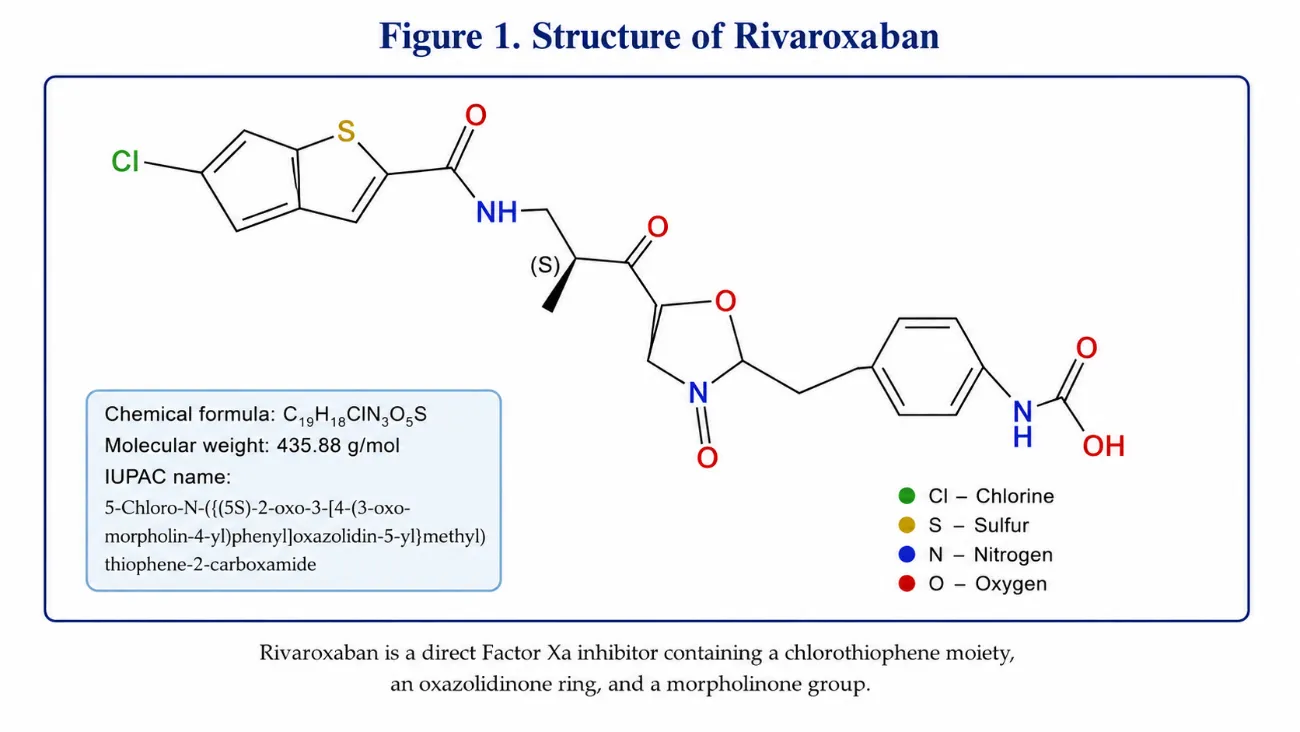
Rivaroxaban is a highly selective, reversible direct activated coagulation factor Xa (FXa) inhibitor that is administered orally. Indirect anticoagulants require the cofactor, antithrombin, to bind to factor Xa and activate it, thereby inhibiting the formation of fibrin clots by the inhibition of prothrombin to thrombin; rivaroxaban can bind directly to free factor Xa, clot-associated factor Xa and to prothrombinase-bound factor Xa, thereby inhibiting fibrin clot formation through inhibition of prothrombin to thrombin. This selective mechanism does not directly impair platelet function, and therefore the effects of this drug on platelet function are predictable with no undesirable anti-coagulation side effects.
Rivaroxaban is well absorbed after oral administration with peak plasma concentration typically occurring 2-4 hours after taking the tablet. The drug is highly bioavailable orally at lower doses, has a moderate volume of distribution and high plasma protein binding. Cytochrome P450 enzyme metabolism, P-glycoprotein transport systems and renal excretion. These favourable pharmacological properties allow such a treatment without the need for regular coagulation monitoring and this is a difference from other anticoagulants like warfarin.
The indications for the use of rivaroxaban include: prevention of stroke and systemic embolism in patients with non-valvular atrial fibrillation; treatment and secondary prevention of deep vein thrombosis and pulmonary embolus; thromboprophylaxis after hip or knee replacement surgery. Because of its effectiveness, the dose-response relationship and its ease of oral administration, rivaroxaban is one of the most prescribed direct oral anticoagulants in the world.
4.2. Limitations of oral delivery.
Some physicochemical and biopharmaceutical difficulties have limited the oral delivery of rivaroxaban, which showed good clinical efficacy. The drug is poorly water soluble and as a result poorly aqueous soluble, this retards the dissolution of the drug into the gastrointestinal fluid and therefore its absorption. The dissolution rate is the rate-limiting step for BCS Class II drugs, and poor drug solubility can cause the oral bioavailability to vary, especially with different physiological conditions.
The oral absorption of rivaroxaban may be influenced by other factors such as gastrointestinal pH, food intake with higher doses, intestinal permeability, efflux transporters and metabolic enzymes. Moreover, traditional oral formulations may also result in a lack of protection of the drug from degradation or in a low peak therapeutic plasma level. These constraints highlight the need for more complex drugs delivery systems, which can enhance the dissolution, intestine wall permeation, bioavailability and efficacy of the drug.
In this aspect, the various formulation approaches investigated have proven to be promising lipid-based nanocarriers for the delivery of rivaroxaban in SLN. They have been demonstrated to be good candidates for both improving gastrointestinal absorption and/or drug release of poorly water-soluble drugs and for facilitating lymphatic transport of the drug. Furthermore, by incorporating the principles of QbD in the development of the SLN process, a systematic approach that optimizes the SLN process and ensures the quality of the SLN and its regulatory acceptance throughout the pharmaceutical development process can be achieved.
5. SOLID LIPID NANOPARTICLES (SLNs)
5.1 Concept and Advantages
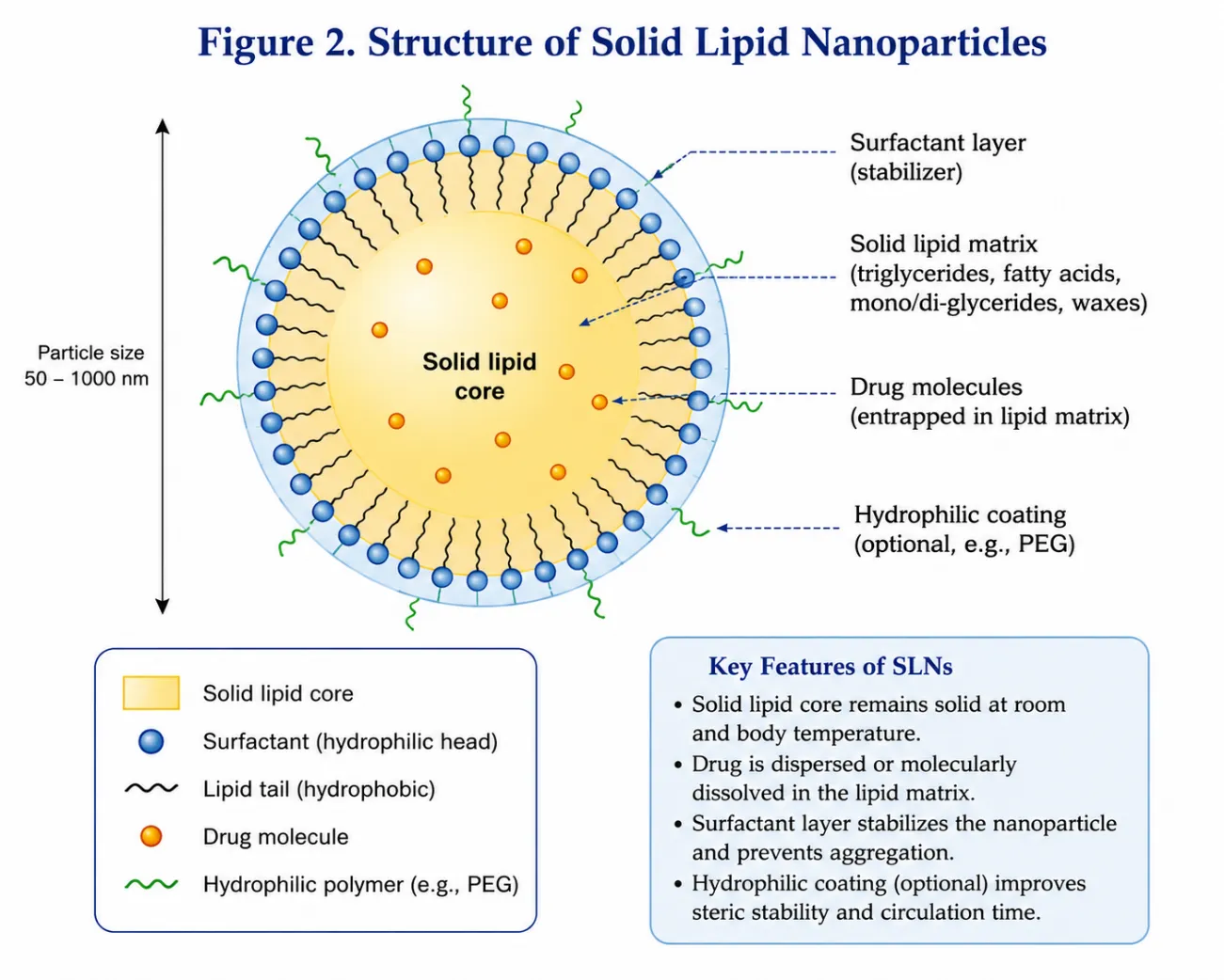
Solid lipid nanoparticles (SLNs) are submicron colloidal carriers containing physiologically compatible solid lipid particles stabilized by surfactants. SLNs were developed as an alternative to polymeric nanoparticles and emulsions in the early 1990s and have been developed with a number of the benefits of lipid-based carriers, but reduced limitations. The lipid matrix is solid at room temperature and body temperature, and it is highly effective to encapsulate lipophilic and moderately hydrophilic drugs. SLNs have been one of the most widely studied nanocarriers for drug delivery systems due to their properties of improving the solubility of the drugs, protection of labile drugs, controlled drug release, and oral bioavailability.
Oral delivery of the drug rivaroxaban has been shown to have enhanced gastrointestinal absorption by SLNs, resulting in reduction of hepatic first-pass metabolism because of increased dissolution rate as well as lymphatic transport. Furthermore, SLNs have unique properties such as biocompatibility, low toxicity, large-scale manufacturing capability, and physical stability for long periods of time. The benefits of these make them appropriate for the improvement of poorly water soluble drugs' therapeutic activity, as well as increasing patient compliance.
5.2 Composition
SLNs typically consist of a solid lipid base, surfactants, co-surfactants and the enclosed drug. The lipid matrix is a structural backbone of the nanoparticles, which influences the loading of the drug, drug release and formulation stability. The most popular lipids are glyceryl monostearate, stearic acid, tristearin, cetyl palmitate, glyceryl behenate (Compritol® 888 ATO) and Precirol® ATO 5, which are known to possess an excellent safety profile and are biodegradable.
To prevent aggregation during storage and maintain the stability of the dispersion of the nanoparticles, they are incorporated with a surfactant. Commonly used surfactants are Tween 80, Poloxamer 188, Poloxamer 407, lecithin, sodium cholate and polyvinyl alcohol. Both the type and concentration of lipids and surfactant has a significant effect on the particle size, zeta potential, EE, and drug release profile. Thus, it is necessary to carefully select the formulation components for obtaining stable and reproducible SLN formulations.
5.3 Preparation Methods
There are various methods for preparation of SLN based on the physicochemical properties of the drug and the formulation requirements. The most common method is high-pressure homogenization which is scalable, reproducible and can be industrialised. Can be done hot or cold depending on the temperature stability of the drug used.
Other methods that are also commonly used are ultrasonication, solvent emulsification–evaporation, microemulsion technique, solvent injection, double-emulsion and solvent emulsification-melt. The characteristics of SLNs, such as particle size distribution, drug encapsulation efficiency, and release behaviour, are affected by each of the preparation methods. The method of preparation can be chosen according to the properties of the product that is required and the practicality of the manufacturing process.
6. QUALITY BY DESIGN (Qbd) APPROACH
6.1 QbD Principles
Quality by Design (QbD) is a systematic, science-based, risk-focused method to developing a pharmaceutical product that focuses on making quality an integral part of the product from the very beginning of its formulation. The International Council for Harmonisation (ICH) has introduced the concept as guidelines like Q8 (Pharmaceutical Development), Q9 (Quality Risk Management), and Q10 (Pharmaceutical Quality System). QbD promotes comprehensive knowledge of formulation variables and manufacturing processes from formulation through to shelf stability to assure product quality, safety and efficacy over the product life cycle.
A key benefit of QbD in the formulation of nanoparticles is that it aids in systematically optimizing the formulation through prioritization of variables that have a significant influence on the product performance. It brings several benefits, especially for complex lipid-based nanocarrier systems like SLNs such as minimizing the batch-to-batch variation, increasing the robustness of the manufacturing process, reducing development time, and improving the regulatory acceptance.
6.2 Quality Target Product Profile (QTPP), Critical Quality Attributes (CQAs), Critical Material Attributes (CMAs) and Critical Process Parameters (CPPs)
The QbD approach starts with the definition of the Quality Target Product Profile (QTPP), which specifies the desired attributes of the actual drug product (such as dosage form, route, strength, product stability and therapeutic performance). Based on the QTPP, Critical Quality Attributes (CQAs) are identified. These consist of particles size, polydispersity index, zeta potential, drug loading, drug entrapment efficiency and drug release profile, which all have an impact on the quality and efficiency of SLNs.
The physicochemical properties of formulation ingredients like the type of lipids, surfactant concentration, and drug properties are referred to as Critical Material Attributes (CMAs) while the processing conditions such as homogenization pressure, stirring speed, temperature, sonication time, and cooling rate are known as Critical Process Parameters (CPPs). The desired CQAs are always met in formulation development and scale up, when the CMAs and CPPs are properly controlled.
6.3. Design of Experiment (DoE)
Within the QbD framework, Design of Experiments (DoE) is a very crucial statistical tool to systematically evaluate several formulation and process variables at the same time. DoE is different from the traditional method of one factor at a time because it recognizes the interaction between the independent variables as well as the effect of all independent variables combined on the responses of the formulation. Full factorial design, fractional factorial design, Box–Behnken design, Central Composite Design (CCD) and response surface methodology are the design of experiments (DoE) commonly used.
DoE is extensively used in the optimization of formulation parameters in the case of rivaroxaban-loaded SLNs, including the lipid concentration, surfactant concentration, conditions during homogenization, and sonication time, to obtain the required particle size, entrapment efficiency, and controlled release of the drug from the SLNs. DoE has proven to be a powerful tool that enhances the robustness and repeatability of formulations, as well as understanding of processes, and can markedly reduce the number of experimental trials, making it an essential technique in modern pharmaceutical development.
7. QbD-BASED OPTIMIZATION OF RIVAROXABAN-LOADED SOLID LIPID NANOPARTICLES
7.1 Formulation Strategies
In order to develop successful rivaroxaban loaded solid lipid nanoparticles (SLNs), the selection and optimization of formulation components and processing variables must be done systematically. For the QbD formulation development process, the first step is to establish the QTPP, then the Critical Quality Attributes (CQAs), Critical Material Attributes (CMAs) and Critical Process Parameters (CPPs) are identified. The choice of a lipid is particularly important as it may impact the drug solubility, encapsulation efficiency, and release rate. In fact, common lipids, like glyceryl behenate (Compritol® 888 ATO), glyceryl monostearate and stearic acid, have been widely investigated for the production of SLNs containing rivaroxaban because of their biocompatibility and high drug loading capacity.
The effect on the stability of the nanoparticles and the particle size will be similar, depending on the type of surfactant. Poloxamer 188, Tween 80 and soya lecithin are widely used for controlling the lipid dispersion and aggregation. Factorial design, Box–Behnken design and Central Composite Design (CCD) are some of the statistical optimization methods commonly used to optimize the lipid concentration, the surfactant concentration, the homogenization pressure, and the sonication time. These approaches can be systematic and applied to optimize formulations with less experiments with maintaining the formulation reproducibility.
7.2 Evaluation Parameters
After optimization, the product is characterized thoroughly to guarantee product quality and performance of the optimized SLN. Dynamic light scattering is used to determine particle size and polydispersity index (PDI); zeta potential is used to determine the colloidal stability. The efficiency of entrapment and the loading of drug is then determined in order to assess the quantity of drug that has been incorporated into the lipid matrix. Scanning electron microscopy (SEM) or transmission electron microscopy (TEM) is the method that is usually used for morphological analysis which includes the surface morphology and shape of the particles.
Other characterization techniques are differential scanning calorimetry (DSC), Fourier-transform infrared spectroscopy (FTIR), and X-ray diffraction (XRD) to study drug–excipient compatibility, crystallinity and the physical state of the encapsulated drug. In vitro drug release studies are conducted to examine the release kinetics and stability studies are conducted to check the long term physico-chemical integrity of the optimized formulation. Together these evaluation parameters validate the quality, stability and therapeutic potential of the formulated SLNs.
7.3 Bioavailability Improvement
Enhancing the drug's oral bioavailability is one of the main goals in developing SLNs loaded with rivaroxaban. Rivaroxaban was formulated into a solid lipid matrix to overcome one of the major disadvantages that BCS Class II drugs have, the apparent aqueous solubility and dissolution rate. Besides this, the nanoscale particle size makes more surface area available to be dissolved, leading to better gastrointestinal absorption.
Lipid nanoparticles also enhance lymphatic uptake, resulting in an increased portion of the absorbed drug reaching the systemic circulation and hence an increase in systemic drug exposure. Moreover, SLNs exhibit controlled release properties, which allow achieving therapeutic plasma concentrations for a prolonged time and decreases the number of doses. The potential of optimized SLNs as an advanced oral drug delivery system has been demonstrated in several experimental studies, which proved that optimized SLNs showed significantly better dissolution efficiency and oral absorption than conventional formulations leading to better pharmacokinetic performance.
8. CURRENT RESEARCH AND APPLICATIONS.
The utilization of solid lipid nanoparticles for delivery of poorly water-soluble drugs like rivaroxaban has been greatly broadened in recent times due to the progress of nanotechnology. Many studies have shown that optimizing a formulation using QbD results in more robust formulations, better particle size control, more efficient entrapment and drug release profiles, and scales up and meets regulatory standards. Thanks to the incorporation of the statistical optimization tools, researchers have been able to formulate reproducible and provide formulations that have physicochemical stability and consistent therapeutic performance.
SLNs have been successfully used as an oral delivery system for several cardiovascular drugs, anticancer drugs, anti-inflammatory drugs and antimicrobial drugs in addition to rivaroxaban. All these studies show better dissolution rate, oral bioavailability, controlled release of the drug as well as better compliance of the patients when compared to conventional dosage forms. The use of lipid based nanocarriers, in association with QbD methodology, has been found to be a very promising approach to speed up pharmaceutical development and enhance the quality of products.
Furthermore, new research projects are ongoing to develop hybrid lipid nanoparticles, surface-tethering SLNs, and applying AI to optimize formulations, enhancing the targeting ability and manufacturing efficiency of SLNs. It is hoped these innovations will have a great influence in the future development of oral nanomedicines, with the expectation that they will increase therapeutic efficacy and still remain quality, safe and regulated.
9. CHALLENGES AND FUTURE PERSPECTIVES
Although solid lipid nanoparticles (SLNs) have a great potential to prove successful in the field of drug delivery, there are still many obstacles in the way of making a successful transition from laboratory to market. The main drawbacks are the physical and chemical stability of the product during storage. The adverse effects on formulation performance and shelf life may be caused by expulsion of drugs due to the lipid crystallization, the aggregation of particles, polymorphic transformations of lipids and change in particle size. Another point is that the processing variables should be well controlled if it is required to produce SLNs on a large scale in order to reproduce the batches and maintain the product consistency.
One of the major problems is the low drug-loading capacity of SLNs, especially those of poorly lipid-soluble drugs. The choice of appropriate lipids and surfactants is still very important to obtain high entrapment efficiency and formulation stability. Moreover, lipid-based nanomedicines must be thoroughly characterized, assessed for safety and have meaningful quality control protocols approved by the regulators. The QbD approach will help to systematically develop the product and comply with regulatory requirements but more work is needed to develop standardised manufacturing protocols and harmonised regulatory guidelines for nanopharmaceuticals.
In the future more advanced lipid based nanocarriers with high loading capacity, improved stability and targeted delivery of the drug need to be developed. The use of artificial intelligence (AI), machine learning, and advanced Design of Experiments (DoE) tools are expected to speed up the formulation optimization process by providing predictive information about how formulation components will affect product performance. Surface functionalized SLNs, hybrid lipid nanoparticles and tailor-made nanomedicine solutions are other promising strategies that can be used to enhance therapeutic efficacy and patient outcome. Moreover, it should be necessary to conduct thorough in vivo research, pharmacokinetic analysis and appropriately designed clinical trials to make sure that the rivaroxaban loaded SLNs are clinically effective and safe for oral drug delivery over the long term.
CONCLUSION
Rivaroxaban is a very effective direct oral anticoagulant, however its dissolution and aqueous solubility is limited, limiting bioavailability when administered orally. Solid Lipid Nanoparticles (SLN) are a novel promising lipid-based nanocarrier system that have a wide range of potential applications from improving the solubility, to increase gastrointestinal absorption, to induce a controlled release of the drug and to increase the drug efficacy. Using QbD approach, formulation development can be systematically achieved by scientific risk assessment, optimization of formulation variables and effective control of manufacturing processes, which provides robust and reproducible SLN formulations.
The quality of optimized SLNs can be significantly improved by the principle of QbD, as revealed by the recent studies, where the physicochemical properties, stability and bioavailability of the SLNs containing rivaroxaban were optimized. There are challenges to manufacturing, stability and regulatory, but continued development of nanotechnology, statistical optimization and pharmaceutical manufacturing is expected to aid in successful clinical translation of these systems. In general, QbD-directed rivaroxaban-loaded SLNs could serve as a viable approach to enhance oral drug delivery, and could make more patient-friendly, effective and safe anticoagulants in the future.
REFERENCES


Priyanshu Yadav, Shashank Tiwari*, Najeebullah, Qbd-Based Development And Optimization Of Rivaroxaban-Loaded Solid Lipid Nanoparticles For Improved Oral Delivery, Int. J. Sci. R. Tech., 2026, 3 (7), 732-742. https://doi.org/10.5281/zenodo.21473823
 10.5281/zenodo.21473823