

We use cookies to ensure our website works properly and to personalise your experience. Cookies policy
Department of Education, Modern College of Professional Studies, Mohan Nagar, Ghaziabad, Uttar Pradesh, India
Commerce education plays a significant role in developing financial literacy, entrepreneurial thinking, economic awareness, and decision-making competencies among learners. The effectiveness of commerce education, however, depends not only on the subject content but also on the pedagogical competencies of teachers. In this context, the pedagogy of commerce in Bachelor of Education (B.Ed.) programmes requires renewed attention to experiential learning, digital integration, competency-based instruction, inclusive classroom practices, and reflective teaching. The National Education Policy (NEP) 2020 emphasizes conceptual understanding, experiential learning, critical thinking, and competency-based assessment, providing an important policy foundation for transforming commerce pedagogy.¹ This paper adopts a conceptual and analytical approach to examine the principles, challenges, and emerging practices associated with teaching commerce in teacher education. It explores the integration of case-based learning, project work, simulations, collaborative learning, digital resources, and formative assessment into commerce classrooms. The paper also proposes a pedagogical framework connecting subject knowledge, practical application, technological competence, reflective practice, and professional ethics. It argues that B.Ed. programmes should prepare prospective commerce teachers to connect theoretical concepts with real-life economic situations while promoting financial responsibility, entrepreneurship, sustainability, and inclusive learning. The proposed framework offers practical directions for teacher educators, curriculum planners, and institutions seeking to strengthen the quality and relevance of commerce education.
Commerce education contributes to the development of knowledge and skills related to business, accounting, economics, finance, entrepreneurship, marketing, and commercial activities. In contemporary society, these areas are closely connected with everyday financial decisions, employment opportunities, technological development, and economic participation. Therefore, commerce teaching should extend beyond the transmission of definitions, principles, and theoretical information to the development of analytical abilities, practical competencies, ethical awareness, and problem-solving skills.
The pedagogy of commerce refers to the principles, methods, strategies, resources, and assessment practices used to facilitate effective teaching and learning in commerce-related subjects. It requires an appropriate relationship between content knowledge, pedagogical knowledge, learners' experiences, and classroom practices. Shulman emphasized the importance of pedagogical content knowledge, highlighting the need for teachers to transform subject matter into forms that learners can understand.² This perspective is particularly relevant to commerce education, where abstract concepts often require practical illustrations and contextual explanations.
B.Ed. programmes have a central role in preparing prospective teachers to teach commerce effectively at the school level. Student-teachers must develop subject-specific teaching competencies, lesson-planning abilities, classroom management skills, assessment literacy, and reflective practices. The National Curriculum Framework for Teacher Education also emphasizes the professional preparation of teachers through a connected understanding of theory, practice, and the social context of education.³
NEP 2020 further encourages interactive, experiential, and competency-oriented approaches that promote conceptual understanding instead of rote memorization.¹ Consequently, commerce pedagogy in B.Ed. programmes needs to integrate established teaching principles with contemporary learning requirements, including digital literacy, financial awareness, entrepreneurship, and responsible economic decision-making.
This paper examines how commerce pedagogy can be strengthened through learner-centred strategies, practical learning experiences, technology-supported instruction, and competency-based assessment.
CONCEPTUAL UNDERSTANDING OF PEDAGOGY OF COMMERCE
Pedagogy of commerce is a specialized area of teacher education concerned with the effective organization and delivery of commerce-related knowledge. It involves selecting appropriate teaching methods, identifying learning objectives, designing instructional materials, providing learning experiences, and evaluating learners' progress.
Commerce subjects frequently involve both conceptual and procedural knowledge. For example, accounting requires learners to understand principles and apply procedures, while economics requires the interpretation of relationships among variables and the analysis of real-world situations. Business studies involve decision-making, organizational understanding, and the application of management principles. These varied learning requirements call for flexible pedagogical approaches.
The pedagogy of commerce should therefore be guided by the following principles:
1. Learning by doing: Learners should engage in meaningful activities that connect concepts with practical experiences.
2. Correlation with daily life: Commercial concepts should be related to banking, budgeting, markets, taxation, savings, and consumer decisions.
3. Active participation: Learners should participate in discussions, problem-solving, projects, and collaborative tasks.
4. Conceptual understanding: Teaching should emphasize reasoning and application rather than memorization alone.
5. Inclusiveness: Learning experiences should accommodate different abilities, backgrounds, languages, and levels of digital access.
6. Ethical responsibility: Commerce education should promote honesty, consumer awareness, financial responsibility, and sustainable business practices.
7. Continuous assessment: Feedback and assessment should support improvement throughout the learning process.
These principles provide the foundation for developing effective commerce teachers who can respond to changing educational and economic needs.
OBJECTIVES OF THE STUDY
1. To examine the significance of pedagogy of commerce in B.Ed. teacher education.
2. To analyse the relevance of experiential and learner-centred teaching strategies in commerce classrooms.
3. To explore the role of digital technologies in strengthening commerce teaching and learning.
4. To identify pedagogical challenges faced by prospective commerce teachers.
5. To propose a framework for competency-based, inclusive, and reflective commerce pedagogy.
METHODOLOGY
The paper adopts a conceptual and analytical approach based on a review of selected policy documents and established literature related to teacher education, experiential learning, pedagogical content knowledge, and educational technology. The discussion draws upon NEP 2020, the National Curriculum Framework for Teacher Education, Kolb's experiential learning theory, Shulman's work on pedagogical content knowledge, and UNESCO's framework for teachers' information and communication technology competencies.¹–âµ
The literature is examined thematically to identify pedagogical principles and translate them into practical strategies suitable for B.Ed. commerce methodology classes. The framework presented in this paper is a proposed conceptual model rather than an empirically validated intervention. No primary survey, experimental study, or statistical analysis was conducted.
THEORETICAL FOUNDATIONS OF COMMERCE PEDAGOGY
Experiential Learning Theory
Experiential learning emphasizes the relationship between experience, reflection, conceptual understanding, and subsequent application. Kolb presented learning as a process involving concrete experience, reflective observation, abstract conceptualization, and active experimentation.â´ In commerce education, this approach can be applied through simulated banking activities, preparation of household budgets, business-plan development, market surveys, and classroom accounting exercises. Such experiences enable student-teachers to understand how theoretical knowledge can be transformed into meaningful learning activities.
Pedagogical Content Knowledge
Shulman's concept of pedagogical content knowledge emphasizes the ability of teachers to represent subject matter through appropriate explanations, examples, illustrations, and instructional strategies.² In commerce teaching, this competence includes explaining difficult accounting procedures through worked examples, using market situations to teach demand and supply, and demonstrating business concepts through case studies.
Constructivist and Learner-Centred Approaches
Learner-centred pedagogy recognizes learners as active participants in constructing knowledge. Rather than relying exclusively on lectures, teachers facilitate discussion, inquiry, collaborative work, and reflection. In commerce classrooms, learners can investigate local businesses, compare financial products, analyse advertisements, and discuss ethical dilemmas in commercial decision-making. These theoretical foundations support the integration of practical activities, conceptual understanding, and reflection into B.Ed. commerce methodology.
CONTEMPORARY TEACHING STRATEGIES FOR COMMERCE EDUCATION
Case-Based and Problem-Based Learning
Case-based learning presents learners with realistic business or economic situations requiring interpretation and decision-making. For example, a case may involve a small business experiencing declining sales. Student-teachers can analyse customer preferences, pricing, promotion, competition, and operating costs before recommending possible solutions. Problem-based learning similarly encourages learners to investigate a question or challenge, identify relevant information, consider alternative explanations, and justify their decisions. These strategies develop critical thinking, communication, and analytical abilities.
Project-Based Learning
Project work enables student-teachers to investigate practical issues over a defined period. Possible projects include preparing a household budget, conducting a consumer-awareness survey, developing a small-business plan, analysing local market prices, and examining digital payment practices. Each project should include clearly defined learning outcomes, a task description, appropriate evidence collection, a final presentation, and a reflective component. Assessment should consider both the learning process and the quality of the final product.
Simulation and Role-Play
Simulation creates a structured environment in which learners practise commercial activities without the risks associated with actual transactions. Role-play can involve a bank employee assisting a customer, a seller negotiating with a buyer, an entrepreneur presenting a business proposal, or a consumer resolving a complaint. These activities improve communication, negotiation, decision-making, and understanding of commercial procedures. They also help prospective teachers develop confidence in managing activity-based lessons.
Collaborative Learning and Discussion
Group discussions, peer teaching, cooperative assignments, and debates encourage learners to examine alternative perspectives. Topics such as responsible advertising, consumer protection, ethical business practices, digital transactions, and sustainable entrepreneurship can be used to promote reasoned discussion. The teacher should establish clear roles, ensure balanced participation, and provide constructive feedback so that collaborative learning remains purposeful.
INTEGRATION OF DIGITAL TECHNOLOGIES IN COMMERCE PEDAGOGY
Digital technologies provide opportunities to enrich commerce teaching through interactive presentations, spread sheets, educational videos, online quizzes, virtual demonstrations, and learning management systems. UNESCO's ICT Competency Framework for Teachers highlights the importance of teachers' abilities to integrate technology into teaching, learning, assessment, and professional development.âµ In B.Ed. programmes, student-teachers should learn to select digital resources according to instructional objectives rather than using technology merely for presentation.
Examples of technology-supported commerce activities include:
Digital pedagogy must also address accessibility, privacy, cyber security, copyright, and unequal access to devices or internet connectivity. Teachers should provide alternative offline resources where required and verify the accuracy of digital content, including material generated by artificial intelligence.
COMPETENCY-BASED LEARNING AND ASSESSMENT
Competency-based commerce education focuses on what learners can understand, demonstrate, explain, and apply. It requires learning objectives, classroom activities, and assessment methods to be aligned with one another. NEP 2020 supports movement towards competency-based learning and assessment of conceptual understanding.¹ Assessment in B.Ed. commerce methodology should therefore include more than written examinations. A combination of diagnostic, formative, practical, and summative assessment can provide a broader picture of student-teachers' professional development.
Examples include:
Table: 1 Alignment of Learning Outcomes, Teaching Strategies, and Assessment
| Learning Outcome | Suggested Teaching Strategy | Assessment Method |
|---|---|---|
| Explain accounting concepts | Worked examples and demonstrations | Written and practical exercises |
| Interpret economic data | Graphs, datasets, and discussion | Data-analysis task |
| Apply business concepts | Case studies and role-play | Case-based rubric |
| Develop financial awareness | Budgeting and consumer scenarios | Project and presentation |
| Integrate digital resources | Spread sheet and presentation activities | Digital teaching portfolio |
| Demonstrate teaching competence | Microteaching and peer teaching | Observation rubric |
Source: Author's conceptual synthesis based on the reviewed literature and policy documents.
Proposed Framework for Effective Commerce Pedagogy In B.Ed.
The following framework is proposed to connect subject knowledge, practical application, digital competence, assessment, and professional reflection.
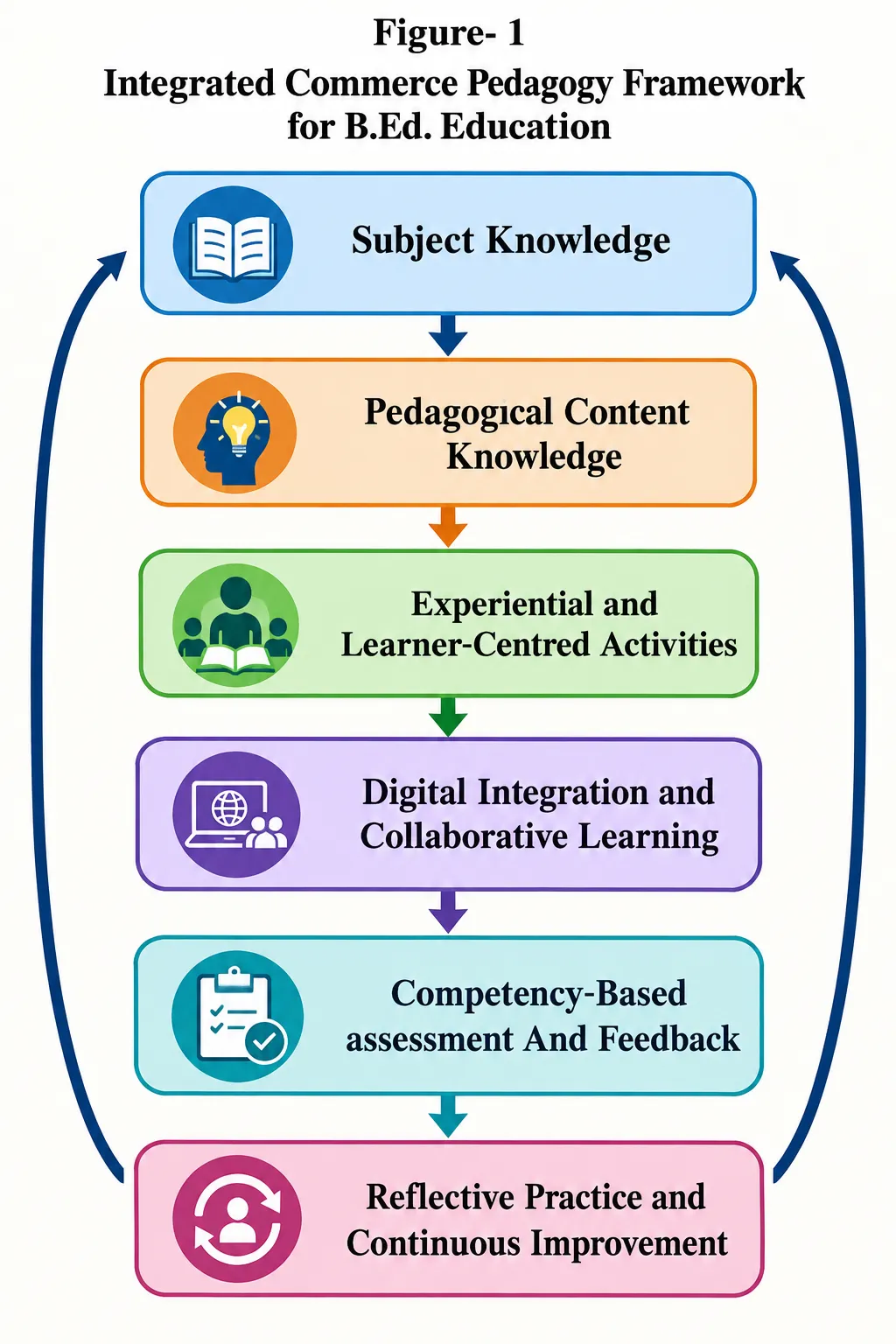
Source: Author's proposed conceptual framework.
The framework is designed as a flexible cycle rather than a strictly linear process. Feedback from assessment and reflection should inform the selection of content, teaching strategies, and learning activities in subsequent lessons.
Subject Knowledge and Pedagogical Planning
Student-teachers should develop a clear understanding of commerce concepts and identify common learner difficulties. They should then formulate measurable learning outcomes and select suitable examples, teaching aids, and assessment techniques.
Experiential and Digital Learning
Learning experiences should connect commerce concepts with authentic situations. Digital tools can strengthen these experiences by enabling calculations, visualizations, simulations, and collaborative work. Technology should complement rather than replace meaningful teacher–learner interaction.
Assessment, Feedback, and Reflection
Assessment evidence should guide instructional decisions. Student-teachers should analyse which concepts learners understood, identify misconceptions, and modify teaching strategies accordingly. Reflective journals and peer feedback can help them develop professional judgement and confidence.
ROLE OF THE COMMERCE TEACHER IN THE CONTEMPORARY CLASSROOM
The contemporary commerce teacher performs several interconnected roles.
First, the teacher acts as a facilitator of learning, encouraging learners to investigate, question, discuss, and apply concepts. Second, the teacher serves as a designer of learning experiences, selecting suitable activities and instructional resources. Third, the teacher functions as an assessor and mentor, providing feedback and supporting individual progress.
The commerce teacher also promotes financial literacy, ethical awareness, entrepreneurship, and responsible consumer behaviour. Learners should be encouraged to understand the social consequences of commercial decisions, including environmental sustainability, fair business practices, and digital responsibility. In addition, teachers need continuing professional development to keep pace with curriculum changes, educational technologies, and evolving workplace requirements. Professional learning communities, workshops, peer observation, action research, and reflective practice can support this development.
CHALLENGES IN IMPLEMENTING EFFECTIVE COMMERCE PEDAGOGY
Despite its potential, the implementation of innovative commerce pedagogy may encounter several challenges.
Examination-Oriented Teaching
An excessive emphasis on completing the syllabus and preparing for examinations can restrict classroom discussion, practical activities, and independent inquiry. A balanced approach is needed to maintain subject coverage while providing meaningful learning experiences.
Limited Practical Resources
Some institutions may lack adequate digital facilities, updated teaching materials, or opportunities for authentic commercial simulations. Low-cost activities, locally available resources, open educational materials, and peer collaboration can provide practical alternatives.
Variation in Learners' Prior Knowledge
Learners may differ in their understanding of mathematics, accounting, economics, and digital applications. Diagnostic assessment, differentiated instruction, guided practice, and peer support can help address these differences.
Insufficient Pedagogical Practice
Prospective teachers may understand commerce concepts but have limited experience translating them into effective classroom instruction. Regular microteaching, lesson demonstrations, supervised teaching practice, and constructive mentoring should therefore form integral components of teacher preparation.
Responsible use of Digital Technologies
Technology can introduce concerns related to misinformation, privacy, plagiarism, unequal access, and overdependence on automated tools. Teacher education should promote critical digital literacy, responsible use of artificial intelligence, and the verification of online information. Addressing these challenges requires coordinated efforts among teacher educators, institutions, curriculum planners, and educational policymakers.
Implications for B.Ed. Curriculum and Teacher Education
The proposed framework has several implications for B.Ed. programmes.
CONCLUSION
Pedagogy of commerce is an essential component of B.Ed. education because it prepares prospective teachers to transform commerce-related knowledge into meaningful learning experiences. Effective commerce teaching requires more than subject expertise; it also demands pedagogical content knowledge, practical teaching skills, digital competence, inclusive classroom practices, and reflective professional judgement. Experiential learning, case studies, projects, simulations, collaborative activities, and competency-based assessment can strengthen the connection between theoretical knowledge and practical application. Digital technologies can further enrich these approaches when selected purposefully and used responsibly. These directions are consistent with the emphasis on experiential learning, conceptual understanding, and competency-based education reflected in NEP 2020.¹
The proposed integrated framework brings together subject knowledge, pedagogical planning, active learning, digital integration, assessment, and reflection. Its implementation may help B.Ed. programmes prepare commerce teachers who can promote financial literacy, analytical thinking, entrepreneurship, ethical awareness, and lifelong learning. However, the framework requires classroom-based evaluation before its effectiveness can be established empirically. Strengthening commerce pedagogy through systematic teacher preparation and continuous professional development can contribute to more relevant, inclusive, and application-oriented commerce education.
REFERENCES

Dr. Rajni Sharma, Dr. Seema Sharma, Rethinking Pedagogy of Commerce in B.Ed. Education: Integrating Experiential Learning, Digital Technologies, and Competency-Based Teaching for the 21ST Century, Int. J. Sci. R. Tech., 2026, 3 (10), 1243-1249. https://doi.org/10.5281/zenodo.23662185
 10.5281/zenodo.23662185