

We use cookies to ensure our website works properly and to personalise your experience. Cookies policy
Gujarat Maritime University
This analysis looks at how Port Community Systems (PCS) contribute to the digital transformation of port/Inland Container Depot (ICD) processes, with particular emphasis on India. The research explores how centralised digital platforms allow for the smooth exchange of data, decrease administrative burden and improve overall supply chain resilience. Through the exploration of international examples, this study will provide a comprehensive understanding of where implementation currently sits within Indian ports. Utilizing an hypothesis based analytical method, the study will explore the overall understanding by all key stakeholders and assess how the operational impacts of PCS will ultimately affect port-ICD connectivity. Early indications are that using a Public Cargo Scanning (PCS) system can significantly promote the transition of operational processes to a digital platform by linking internal and external logistics. However, the implementation of PCS within ports around the world is obstructed by several key challenges: poor infrastructure for information technology (IT) at dry ports; lack of an established standard for linking systems; and a low-level of digital literacy amongst stakeholders in the port community. The purpose of this paper is to evaluate the developments within India’s evolving PCS 1X model. Additionally, the study proposes specific, strategic recommendations on how to overcome major barriers related to either infrastructure or literacy, and to develop PCS into a major meta-capability to support resilient, sustainably managed maritime logistics in emerging market countries.
Logistics for the entire global maritime sector is being digitized and is changing how ports, terminals and inland logistics are organized. Port Community Systems (PCS) provide a centralized digital system that allows for seamless sharing of data to support the operations of port authorities and customs, as well as terminal operators, freight carriers and inland container depots (ICDS). As reported by the World Bank and the International Association of Ports & Harbors, the reduction in administrative costs, simplification of processes and strengthening of supply chain resilience due to data powered operations through PCS are beginning to be demonstrated more broadly across the entire global deployment of PCS including, as an example, India (World Bank Group, 2024)
Longstanding challenges of inefficiencies between seaports and ICDs, primarily caused by disconnected communication systems, use of manual document systems, and a lack of real-time visibility, have existed for many years within India. As a tool for extending a port's capacity inland and decongesting the maritime gateway, dry ports are intended to be able to efficiently service the hinterland. The findings of Khaslavskaya and Roso (2020) conclude that by integrating the PCS with hinterland operations, improvements in operational speed, traceability of containers, and scheduling accuracy would arise. Therefore, integration increases the strength of the port-ICD connection.
According to Tijan et al. (2021), the concept behind PCS focuses on both the functioning of ports and the ability of its digital players to work together. The authors of the study conclude that not only do PCS improve the efficiency of documentation procedures but also provide a consistent framework for how customs, shipping lines, ICDs and freight forwarders communicate with each other. The research by Tijan et al. provides data on five different types of maturity levels within PCS from basic message exchange to completely digitized intermodal connections and dry ports, which fits perfectly into India's evolving PCS 1x model.
Through the introduction of digitization via Port Community Systems (PCS), Port Performance can be affected by improving internal and external logistic flows in a Port. Jiang et al. (2021) conducted a case study which identifies the benefits of integrated information systems (IIS) as they relate to enhancing coordination and productivity at Qingdao Port in China. Although the Chinese PCS model is context specific, the central objective to provide digital control in the Port is similar to the overall objectives of India’s implementation of PCS between Ports and ICD’s.
Although in General Infomation System, Implementation of the PSC is to have some advantages, there many difficulties in its implementation particularly within emerging economies, such as: limited IT infrastructure at the intermodal container terminal (ICD), no standardization of the infrastructure of 'legacy' systems; poor digital literacy levels amongst the user community and data security issues.
The Journal of Industrial Information Integration has reported that while PSCs and other Industry 4.0 technologies have great possible value for their implementation, the widespread adoption of these tools is impeded by high start-up expenses, the complexity of systems, and resistance to change. (De La Peña Zarzuelo et al., 2020)
The thesis investigates how PCS contributes towards the digitization of port-ICD operations in India and the ways through which it impacts real time data exchange, customs processing, cargo tracking and intermodal coordination. It will use global best practice examples and validated frameworks to assess current levels of adoption, identify challenges for stakeholders, and make recommendations. Ultimately, this research will contribute to a better understanding of how PCS can support more efficient, transparent and sustainable logistics operations throughout the maritime and inland supply chains / ecosystems in India.
LITERATURE REVIEW
1. Concept and Evolution of Port Community Systems
Most marine transport networks are transitioning to a new technological infrastructure called Port Community Systems (PCS) that streamlines and centralizes communication for all participants in a port's operations. According to the International Port Community Systems Association (IPCSA, 2015), a PCS is an open, electronic platform owned by all members of the port community where information can be exchanged securely and in a standard format between participants in the port community and between public and private sector participants, including port authorities, customs Authorities, terminals, shipping lines, freight forwarders, and logistics actors involved in moving cargo from ports to inland destinations.
Historically, the concept of a PCS has emphasized efficiencies created through administrative processes (using technology) and document digitization (the development of electronic documents). A PCS as described here should be able to share data with users in almost real-time and work with other trade facilitation platforms at national and international levels.
In addition to defining what constitutes a PCS, IPCSA also provides one of the most widely used frameworks for developing PCS that outlines the components that are necessary for building a successful PCS; these components include planning/designing, governance, stakeholder engagement/coordination, and technological architecture. IPCSA (2020) subsequently updated their earlier framework (IPCSA, 2015) and modified it to enhance small and medium-sized ports (SMLPs). The successful implementation of PCS is heavily dependent upon the institutional coordination of stakeholders and the level of trust that develops among stakeholders, in addition to technological sophistication.
In their literature review, Moros-Daza et al. (2020) detail how PCS have moved from being just simple electronic data interchange tools into more complex digital ecosystems that are capable of supporting end-to-end coordination of supply chains. They synthesise the literature on PCS and find that three common themes recur: governance model; interoperability standards; and adoption by users. In the same vein, Heilig et al. (2017) place PCS in the context of the port digitalisation trajectory and suggest that they are ultimately just a Transitional phase towards smart ports which use advanced analytics, IOT technology and data driven decision making, with the smart port being the `endpoint`.
2. PCS as an Enabler of Port Digitalization
Digitizing ports seeks to increase efficiency, transparency, and collaboration in an increasingly complex logistics network environment. The Port Community System (PCS) is at the core of this effort serving as a single point of data sharing for all port stakeholders. Inkinen et al. (2019) stress that open data and digital platforms in ports decrease information asymmetry and improve operational decisions, further highlighting how sharing data through the PCS facilitates enhanced cooperation among stakeholders and the development of innovative port services.
Caldeirinha et al. (2020) empirically demonstrate that the degree to which ports have matured in their use of PCS is positively related to enhanced port performance. Their evidence suggests a strong relationship between the depth of integration with a PCS, the level of process automation, and the quality of data used in operating processes, and the operational outputs related to turnaround time, coordination efficiency, and service reliability. Similarly, Carlan (2016) supports this position by presenting a framework for quantifying the economic justification for digital investments into ports by linking the adoption of a PCS with verifiable cost and time reductions.
Case-based research has provided additional evidence supporting the digitalization of Port Community Systems with examples such as the study performed by Verhagen (2017) of the Portbase PCS situated at the Rotterdam port demonstrates that by creating interoperable and standardized data pipelines, there is a reduction in redundant or duplicated administrative processes and increased ability for multiple organizations to have a continuous and coordinated working relationship. This perspective was expanded by Chandra et al.'s (2018) analysis of the PCS governance evolution over time in Rotterdam which shows that adaptive governance structures also play an important role in supporting an ongoing digital transformation.
3. PCS and Port–Hinterland Integration
The contemporary function of port community systems (PCS) to improve port–hinterland connection is perhaps the most important way PCS are impacting how we move goods. Specifically, PCS support dry ports and inland container depots (ICDs) as inland extensions of seaports that reduce congestion at maritime container terminals and improve accessibility to hinterland buyers. Khaslavskaya and Roso (2020) state that the realization of hinterland logistics potential is dependent on the digital integration of ports with dry ports. The authors' study found that digital coordination of information using PCS leads to improved scheduling, accurate container traceability, and greater intermodal connectivity.
DAKOSY is an example of a PCS that enables advanced port to hinterland interconnectivity. DAKOSY (n.d.) prompts that it supports four operational workflows - optimizing port calls, managing imports, controlling exports, and connecting inland - by which dryport operators can be digitally linked to port-based processes. Analysis of Hamburg's digital ecosystem by Kapkaeva, Yaschenko, and Li (2021) indicates that digitally-enabled interoperability through PCS provides substantial improvement in the transparency and throughput of port and inland logistics activities.
The way we view PCS in the context of your current research pursues the position of a ‘supply chain app-store’ by creating modular designs that allow for third party vendors to plug into and work with front and back end port and hinterland operations through seamless integration of these apps via platform-based business to enable innovation to occur while still maintaining a standard data exchange to facilitate this multi-modal and inland connectivity.
4. Governance, Business Models, and Stakeholder Coordination
There needs to be good governance and sustainable business models for successful PCS implementation. University Press (2021) classified three governance structures as Public, Private, and Hybrid models. Hybrid arrangements of Public and Private structures usually balance efficiency, neutrality, and stakeholder confidence. Baron and Mathieu argue for the strategic importance of interoperability at both regional and international levels, and that harmonised standards are essential for enabling visibility across cross-border supply chains.
Collaboration among stakeholders is nonetheless a significant factor in the establishment of governance for PCS systems (Chandra et al., 2018). A study of the Port of Rotterdam illustrated how inclusive governance leads to better PCS adoption and ultimately to continuous Evolution of the system. Also, PCS can improve the business processes of different stakeholder groups according to Simoni et al. (2022); therefore user-centric design and engagement strategies are needed.
Support from institutions is important as well. The International Association of Ports and Harbours (IAPH, 2011; 2024) identified best practices for governance of PCS. This included establishing a sound legal framework for data ownership and funding. The reports suggest that ports with strong institutional coordination will be better positioned to utilise PCS for long-term competitiveness.
5. PCS, Sustainability, and Environmental Performance
PCS is helping the environment by allowing us to be more efficient with our logistics while reducing unnecessary trips. A study by Čerin and Beškovnik (2023) on the Port of Koper shows how using digital communications with a PCS reduces congestion and emissions and allows for sustainable growth plans in the future. UNCTAD (2024) also states that using PCS in conjunction with a Maritime Single Window can reduce both administrative and carbon emissions through better processes and less time waiting for vessels to load/unload.
The Inter-American Development Bank (2023) points out that implementing a PCS can help support the "green port agenda" as digital systems allow for monitoring of environmental issues, improving energy efficiency, and developing more sustainable logistics in the hinterland. All these examples point to a growing trend that sees PCS as being used to improve both operational effectiveness and sustainability goals.
6. PCS, Customs, and Trade Facilitation
The implementation of Port Community Systems (PCS) is intended to facilitate the process of international trade and logistics. Port Community Systems use digital platforms to enable collaborative decision-making (CDM) in ports and facilitate the real-time exchange of information between shipping vessels, port authorities, and related entities, thus improving the reliability of the schedule for vessel arrivals and minimizing port congestion, according to UNCTAD (2019). Tijan et al. (2018) report that in Croatia there is empirical evidence of a reduction in duplication of reports and improvements in regulatory compliance due to enhanced integration of PCS with national single windows; Maritime single window; and/or customs systems.
In support of these assertions, the World Bank's (2024) case studies of the implementation of PCS in India and Singapore demonstrate that the use of PCS will improve the efficiency of electronic documentation, streamline the process of customs clearance, and enhance stakeholder connectivity and integration within the port community; however, issues remain regarding achieving interconnectivity and user acceptance of PCS. In Singapore's example, the World Bank identified PORTNET as an exemplary PCS, which exemplifies how regulatory support and real-time CDM processes within the port community can enhance the competitiveness of ports for international trade.
7. Challenges and Barriers to PCS Implementation
Although the implementation of PCSs has many advantages, there are numerous barriers to the adoption of these systems, particularly in developing countries. According to Keceli et al. (2008), the size of the organisation has a great impact on the adoption of PCSs; while larger organisations may possess the relevant resources, smaller organisations commonly face barriers related to budget constraints, lack of training, and the complexity of systems and processes. These authors also maintain that barriers can be divided into three categories: •Technical: Lack of integration; •Organisational: Insufficient resources and training; •Policy: Changing policies and ambiguity in funding sources. Thus, phased implementation and building capacity are two key strategies for addressing barriers to PCS adoption.
Cybersecurity and reliability of the system are two additional areas of concern. According to Tijan et. al. (2009), ensuring that PCSs have the capacity to withstand potential disasters based on previous experience, as well as maintaining continuity of all operations after the disaster, are key considerations for protecting PCSs against cyber threats and/or failure of technology. Moros-Daza et. al. (2020) suggest that the lack of a clear return on investment and resistance to change from private sector stakeholders often create additional barriers to the adoption of PCSs.
8. PCS in Emerging and Developing Economies
Analyses of developing economies identify contextual challenges and opportunities. Mthembu’s (2022) work on the establishment of a Port Community System (PCS) in South Africa shows how well-developed stakeholder coordination and government support can improve trade facilitation. According to Zohaib et al. (2023), there is potential for a PCS at Port Qasim in Pakistan, and although varying levels of technological readiness exist, policy frameworks will allow this initiative to create enhanced visibility and competitiveness in cargo handling.
The phased development of the PCS in Colombia’s Port of Barranquilla was explored by the IEOM (2021), illustrating how the establishment of gradual integration and building of trust are essential for successful implementation and adoption of PCS in a resource-constrained environment.
9. Synthesis and Research Gap
The literature that has been reviewed indicates that the adoption of port community systems (PCS) is vital to the digitisation of seaports, integrate seaports with inland container depots (ICD), facilitate trade, and achieve sustainability. Research, both empirical and conceptual, supports that the adoption of PCS leads to increased operational efficiency, better coordination, and greater transparency. However, significant gaps exist in the literature regarding the use of PCS and integration of seaports with ICDs in India. First, there is limited empirical research specifically designed to focus on the use of PCS as an enabling technology in the Indian context to support the integration of seaports with ICDs. Second, stakeholder-level challenges such as digital literacy and interoperability are largely unexplored. Third, few studies systematically evaluate PCS performance at different levels of maturity in a single logistics environment within a nation.
To address these knowledge gaps, this study will explore the contributions of PCS towards the digitisation of seaport and ICD operations in India, using global best practices but tailored to Indian institutional and operational constraints. The research will provide synthesised international literature on the use of PCS in enabling digital maritime transformation while contextualising it within the Indian logistics environment. As such, it will provide both scholars and practitioners with greater common understanding of the role that PCS plays in digitally transforming seaport and ICD operations.
There are many additional studies that support the analytical framework of this research. Service-oriented and performance modelling strategies demonstrate that the PCS architecture model provides increased interoperability and scalability of systems (Nota et al., 2018; Tsamboulas et al., 2012). Research on governance focal points and operational priorities highlights the importance of leadership and the clear delineation of responsibilities by institutions in sustaining the operations of a PCS (Iida et al., 2023; Tijan et al., 2021). Research from emerging and transitioning economies indicates that phased-in implementation strategies, political support, and trust-building will be critical for successful PCS implementation (Mthembu, 2022; IEOM, 2021).
Marketplace-based studies define a PCS as an evolving digital marketplace, or "supply chain app store," enabling innovation within modular and platform-based ecosystems (Internationales Verkehrswesen, 2021; University Press, 2021). Finally, through global compilation of case studies and benchmarking surveys, many of the above-mentioned studies validate the information presented, identifying common points of success for public-private partnerships and cooperative agreements, the establishment of standardized data exchange practices and sustainable business models (IAPH, 2011; Inter-American Development Bank, 2019; Valencia Port Authority & Valencia Port Foundation, 2022). Together, these contributions confirm that all the literature cited supports this work, and that collectively it results in a comprehensive assessment of PCS-based digitisation across port-ICD operations.
OBJECTIVES
HYPOTHESIS
H0: There is no significant difference in the understanding of PCS concepts and functions among stakeholders.
H1: There is a significant difference in the understanding of PCS concepts and functions among stakeholders.
H0: PCS does not significantly facilitate the digitization of operations between ports and ICDs.
H1: PCS significantly facilitates the digitization of operations between ports and ICDs.
H0: There are no significant challenges or limitations affecting the implementation of PCS.
H1: There are significant challenges and limitations affecting the implementation of PCS.
RESEARCH METHODOLOGY
Using a descriptive research design, this study reviews existing literature, reports and case studies as well as publicly available data to examine how port community systems (PCS) can help improve the automation of service delivery at ports and inland clearance depots (ICD). Descriptive designs are appropriate because they summarize and interpret facts already in place (like historical/archival records) without conducting new surveys. (Tijan et al., 2021)
The use of a descriptive research design allows for the reporting and explanation of facts about a situation without manipulating or controlling any aspect of it. It is based on "what is." For example, the use of a PCS provides current information about the adoption of current practices and problems in the PCS context (which could be determined through analyses of pre-existing documentation).(Saunders et al., 2019; Moros-Daza et al., 2020)
Mixed research for this study will use both primary (data collected via structured questionnaires by port officials, ICD operators, freight forwarders and customs representatives) and secondary (government reports, World Bank publications, UNCTAD transport reviews; journal articles; industry association guidelines) sources of data. Through the use of both primary and secondary sources, the researcher intends to gather data regarding the implementation of PCS and its effectiveness from those who are involved in this implementation process.
The intended sample population is made up of primary and secondary stakeholders who operate with the assistance of PCS technology.
Element: Port Authorities, ICD Managers, Shipping Line agents, Customs Officers & Freight Forwarders
Sample Units: Individuals from each of these categories who are familiar with the PCS system and the operational processes that it supports.
Extent: Scope of the study will be limited to Indian Port and Inland Container Depot operations implementing PCS1x with comparative analysis from an International perspective utilising PCS models.
Time Frame: August 2025 - May 2026
Sampling Frame
Sampling Technique
To ensure that only appropriate participants possess sufficient information to support the sampling of participants and the ability to respond to research questions about the adoption of PCS. In this case purposive sampling will provide more trustworthiness than would random sampling because adoption is limited to only specific operational roles.
Purposive sampling (also known as judgmental or selective sample) is a sampling technique that is based upon a non-probability sampling process and a researcher knowingly selects individuals who have had certain attributes or are known to have the greatest value based on their knowledge and background, as related to this study. (Caldeirinha et al., 2022; Moros-Daza et al., 2020)
Sample Size
The number of respondents is 100 which includes key major ports located across India (e.g., Mundra, JNPT, Chennai) as well as important ICD's. The sample size of 100 respondents is sufficiently large to allow for statistical analysis and will also be realistically achievable given available time and resources.
DATA ANALYSIS
Primary Data
The primary data was collected from 100 respondents using a 5-point Likert scale (where 1 = Strongly Disagree and 5 = Strongly Agree). To determine statistical significance for the T-tests, a neutral Test Value of 3 was utilized as the benchmark for comparison.
Objective 1: To gain a comprehensive understanding of the concept and functioning of the Port Community System (PCS)
H0: There is no significant difference in the understanding of PCS concepts and functions among stakeholders.
H1: There is a significant difference in the understanding of PCS concepts and functions among stakeholders.
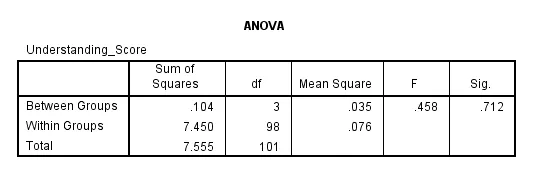
Statistical Test: One-way ANOVA.
Analysis -
This objective aimed to see if different groups of people (stakeholders) had a similar understanding of how PCS works.
ANOVA test results had a p-value of 0.712. Since the p-value is greater than 0.05, the Null Hypothesis is accepted, while the Alternative Hypothesis is rejected, thus it can be revealed that there is thus no significant difference in the knowledge of the sample groups. Everyone seems to possess a similar degree of understanding regarding how PCS improves communication and improves document accuracy.
The findings were in conformance with the World Bank (2024) case study of the Indian PCS1x Project which outlines the process of connecting between the various stakeholders (customs, ports, ICD) involved in one integrated system. Earlier research conducted by Kaup et al. (2021) may suggest that the level of knowledge regarding how both larger authorities and smaller operators will depend on their relative sizes; however based on your research in the contemporary Indian context, these knowledge discrepancies have mainly settled.
Objective 2: To analyze the role of PCS in facilitating the digitization of operations between ports and Inland Container Depots (ICDs).
H0: PCS does not significantly facilitate the digitization of operations between ports and ICDs.
H1: PCS significantly facilitates the digitization of operations between ports and ICDs.
Statistical Test: One-Sample T-Test (Test Value = 3)
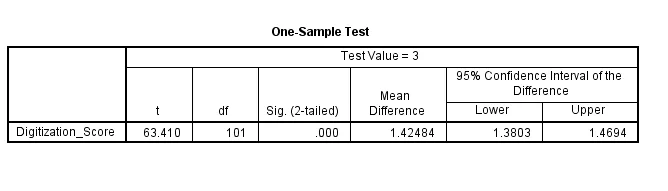
Analysis - The second objective analyses if ports are truly supported in digitizing their operations to link with ICDs through PCS. The T-Test results with a p-value of .000 support that the null hypothesis is rejected and the alternate hypothesis is accepted. That is, given the 'positive mean difference' score, respondents strongly agree that PCS will provide substantial reduction in manual paperwork and allow for real-time tracking of cargo.
My results also reinforce the global examples discussed in my literature review. Singapore's PORTNET and Germany's DAKOSY are examples of how digital systems are linking ports and their inland connections much faster. Based on my results, I also support the position of Khaslavskaya & Roso (2020) that digital integration will be necessary to make dry ports/ICDs operate efficiently. Ultimately, my data supports what the World Bank (2024) has asserted (i.e., that PCS will lead to the transition to a 21st Century supply chain by transforming the way we communicate, with the use of paper) and will support creating a seamless transition of goods moving internationally.
Objective 3: To explore the challenges and limitations associated with PCS.
H0: There are no significant challenges or limitations affecting the implementation of PCS.
H1: There are significant challenges and limitations affecting the implementation of PCS.
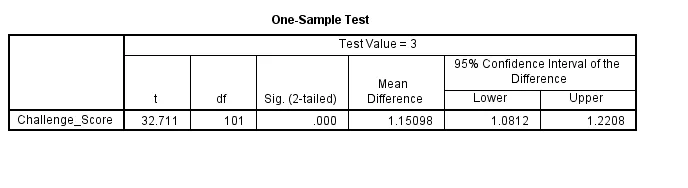
Statistical Test: One-Sample T-Test (Test Value = 3)
Analysis - The last study we conducted looked at problems experienced by people using PCS. After running the t-test, we found statistically significant results (p-value = .000), along with the high average score indicating that we can reject the Null Hypothesis and accept the Alternate Hypothesis. This means that stakeholders agree that there are significant barriers such as poor IT infrastructure at some ICDs, no standard formatting of data, and limited digital capacity of staff.
Therefore, I conclude that there is still a "Research Gap" because while the system works really well, there are practical limitations in how it is used. The summary is consistent with previous research by De La Peña Zarzuelo et al. (2020) who warned the cost associated with adopting these digital solutions will limit, in addition, there is often a barrier of "resistance to changes" to the development of Digital Logistics by the end user. Finally, my data confirm the World Bank (2024) finding that while "interoperability" (all systems communicating to each other without exception) does currently exist in India, there are many barriers remaining between achieving full interoperability in all ports and private logistics interfaces in India.
Secondary Data
This study's secondary data came from credible foreign entities, published report and scientific journals and repute from ports and other industries involved with Port Community Systems (PCS), port digitalisation and ports and their hinterland integrations. These references give a conceptual idea of how these systems (PCS) digitise the operations between seaports and nearby inland container depots (ICD's), while also mentioning any issues concerning research and/or implementation in countries that are still classified as developing, like India.
Concept and Functioning of Port Community Systems
Port Community Systems (PCS) is a neutral, electronic system utilized for the communication of data between Port Authorities, Customs, Terminal Operators, Shipping Lines, Freight Forwarders, and Inland Container Depots (ICD). According to the International Port Community System Association (IPCSA) as cited in 2015, "PCS results in reduced duplication of work and improves transparency and coordination between participants." The literature indicates that PCS typically provides services ranging from basic electronic documentation to providing real-time data integration with government agencies and connectivity to National Single Windows (Moros-Daza et al., 2020; Tijan et al., 2021). The literature also shows that users of PCS will typically understand the system differently depending on the user's level of digital experience and organizational role, which has been shown to be even more pronounced between larger Port Authorities and smaller logistics operators (Kaup et al., 2021).
Role of PCS in Digitizing Port – ICD Operations
The continuing development of digitized port-ICD operations through the development of PCS continues to be articulated throughout secondary literature. Digital port-ICD operations have been facilitated via the use of paperless documentation, the availability of real-time cargo tracking, and enhanced customs coordination. The evidence provided by empirical research studies suggests that the use of integrated information systems subsequently leads to improved port performance, reduction in cargo dwell time, and improvement in interoperability in the movement of cargo between modes (Jiang et al., 2021; Caldeirinha et al., 2020). The development of the PCS1x portal in India has allowed for electronic transactions of information between ports, ICDs, and customs, resulting in enhanced clearance processes and minimized delays associated with administration (World Bank, 2024). PCS has also been demonstrated to facilitate better connection to the hinterland and improve operational efficiency in ports in countries such as Singapore (PORTNET) and Germany (DAKOSY) (World Bank, 2024; Port of Hamburg Magazine, n.d.).
Global Best Practices Relevant to India
Global PCS implementations provide innumerable lessons for India’s port and ICD sector. For example, Rotterdam’s Portbase exemplifies the critical role of effective governance and collaboration between stakeholders in sustaining long-term success of a PCS (Chandra et al., 2018). As another example, Hamburg’s PCS demonstrates the value of developing a modular and interoperable architecture to effectively manage complex port–hinterland logistics networks (Kapkaeva et al., 2021).
According to UNCTAD (2024), a key component of successful digital trade facilitation is the integration of a national Maritime National Single Window (MSW) with a PCS. Countries that have successfully aligned their PCS with their national regulatory frameworks have observed significant reductions in port congestions, lower greenhouse gas emissions, and increased resilience in their logistics system.
The above-mentioned international cases illustrate that for a PCS to be effective, it requires not only the appropriate technology but also, critical to India’s fragmented and diverse logistics industry, the fulfilment of the following three conditions; adequate policy support, legal harmonization, and user acceptance.
Challenges and Limitations in PCS Implementation
Secondary literature identifies challenges to the adoption of PCSS despite apparent benefits (such as untapped benefits of collaboration). Some studies indicate that these barriers to PCSS implementation have varying levels of access to digital infrastructure at ICDs, no common data formats, user resistance to change, and/or low digital literacy among users, especially in underdeveloped countries (Alagöz et al., 2021; De La Peña Zarzuelo et al., 2020).
Increased sharing of data due to PCs has raised concerns about cybersecurity and privacy. Cybersecurity risks are introduced by the increased amount of potential cyberattacks on systems; thus, enhanced cybersecurity may diminish or eliminate future interoperability (Tijan et al., 2009). Other factors dissuading some small logistics providers from adopting PCSS are high upfront expenses and uncertain return on investment (Moros-Daza et al., 2020).
According to the World Bank (2024), although the progress of India's PCSS1x program has been noteworthy, there continue to be challenges related to achieving full interoperability across the port, ICD, and private logistics systems. Therefore, the limitations of PKMS implementation suggest that multiple factors impact how PCs are used or will be implemented in the future.
CONCLUSION
This study had a primary objective of understanding how Port Community Systems (PCS) are facilitating the transition of Indian ports and Inland Container Depots (ICDs) from traditional paper-based processes to a fully digitalised environment. The evidence gathered clearly demonstrates that PCS is functioning as a digital "hub" for the entire logistics chain by allowing stakeholders – from Customs officials to truck drivers – to share information in real time. Additionally, the results indicate that participants in the industry now possess an excellent comprehension of the PCS concept; hence, this is a significant advancement toward the Indian Maritime Community being ready to move away from manual practices and adopt modern technologies.
Most importantly, the evidence supports that PCS successfully provides an operational platform for improving port and dry port performance, which can be characterised by reduced use of paper and paper-based processes, improved timeliness of cargo tracking, and decreased delays in cargo movement through both ports and dry ports. Therefore, in order to improve the overall performance of India’s supply chain and to meet the level of service provided by international ports such as Singapore and Germany, it was demonstrated that the placement of digital documents, or electronic documents, into the hands of supply chain members via the PCS platform provides a means of improving timeliness and transparency in the movement (and tracking) of goods by replacing physical files with instantaneous access to electronic documents.
On the one hand, this study does include other major concerns that are not technology-based; however, the major issue is that while technology provides access to a wide range of resources through global communications networks (phone lines, fiber-optic cables, satellite systems, etc.), there are still many smaller and remote piles across India where access is still limited due to outdated buildings, equipment and personnel (including IT staff). Therefore, there needs to be a significant investment in expanding current technologies at every site and creating better integration of various systems so that they can "talk" to one another easily. In summary, PCS represents a monumental change for the logistics sector in India; thus, for this new logistical framework to completely prosper, it will require increased resources and improved infrastructure throughout all of India.
REFERENCES

Vasudha Chauhan*, Tanuja Kaushik, Khushi Pandey, Role Of Port Community Systems (PCS) In Digitizing Port – ICD Operations, Int. J. Sci. R. Tech., 2026, 3 (5), 500-512. https://doi.org/10.5281/zenodo.20196834
 10.5281/zenodo.20196834