

We use cookies to ensure our website works properly and to personalise your experience. Cookies policy
Department Of Pharmaceutics, Anuradha College Of Pharmacy, Chikhli,Dist. Buldana (M.S.) 443201
The pharmaceutical industry faces a persistent challenge in the development of new chemical entities (NCEs), where an estimated 40–70% of candidates exhibit poor aqueous solubility. This physicochemical limitation severely hampers oral bioavailability, leading to erratic absorption and therapeutic failure. Solid dispersion (SD) technology has emerged as one of the most effective and commercially viable strategies to overcome these hurdles. This review provides an in-depth analysis of solid dispersion systems, exploring the theoretical mechanisms of solubility enhancement, such as particle size reduction, improved wettability, and amorphization. We critically examine the classification of SDs, ranging from first-generation eutectic mixtures to third-generation surfactant-based systems. Furthermore, this article details the evolution of manufacturing techniques—from traditional solvent evaporation to modern industrial processes like Hot-Melt Extrusion (HME) and KinetiSol. Finally, we discuss key characterization methods, stability challenges, and the future outlook of this technology in drug delivery.
Oral administration remains the most preferred route for drug delivery due to its non-invasiveness, patient compliance, and cost-effectiveness. However, for a drug to be absorbed into the systemic circulation, it must first dissolve in the gastrointestinal (GI) fluids. This process is governed by the drug's aqueous solubility. In recent decades, the advent of combinatorial chemistry and high-throughput screening has led to a surge in the discovery of lipophilic compounds with high molecular weights [1]. According to the Biopharmaceutics Classification System (BCS), drugs are categorized based on their solubility and permeability:
Drugs belonging to BCS Class II and IV present the most significant formulation challenges. For Class II drugs, dissolution is the rate-limiting step for absorption. Consequently, enhancing the dissolution rate directly correlates to improved bioavailability [2].
Various techniques have been employed to address poor solubility, including salt formation, micronization, prodrugs, and cyclodextrin complexation. However, Solid Dispersion (SD) has distinguished itself as a versatile and robust approach. Defined as the dispersion of one or more active ingredients in an inert carrier or matrix at the solid state, SDs physically modify the drug to a high-energy state, thereby significantly increasing its apparent solubility [3].
2. Theoretical Aspects and Mechanisms of Action
The mechanism by which solid dispersions enhance solubility is multifactorial. It is best understood through the Noyes-Whitney Equation,
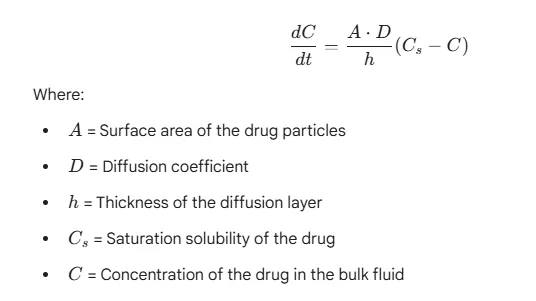
Solid dispersions favorably alter these parameters through three primary mechanisms:
2.1. Particle Size Reduction (Increasing $A$)
In a solid dispersion, the drug is dispersed within a carrier matrix at a molecular or micro-particular level. This results in a massive increase in the specific surface area available for contact with the dissolution medium compared to conventional micronized powders, where agglomeration often reduces effective surface area [4].
2.2. Improved Wettability
Most carriers used in SDs (e.g., PEG, PVP) are hydrophilic. When the formulation enters the GI tract, the carrier dissolves rapidly, lowering the interfacial tension between the hydrophobic drug particles and the aqueous medium. This improved wettability allows the solvent to penetrate the drug particles more effectively, enhancing the dissolution rate [5].
2.3. Amorphization
Perhaps the most critical mechanism is the conversion of the drug from a crystalline to an amorphous state. Crystalline drugs possess a rigid, ordered lattice structure that requires significant energy to break (lattice energy). In contrast, the amorphous state is thermodynamically unstable and possesses higher internal energy and molecular mobility. This "spring" effect results in a transient supersaturation where the apparent solubility is significantly higher than that of the stable crystal [6].
3. Classification of Solid Dispersions
Solid dispersions are classified based on the physical state of the drug and carrier, as well as the number of components involved.
3.1. Based on Chronological Development (Generations)
The earliest SDs used crystalline carriers like urea and sugars. They formed eutectic mixtures where the drug and carrier crystallized simultaneously. While they improved solubility, they were thermodynamically unstable and released the drug slowly due to the crystalline nature of the carrier [7].
This generation introduced amorphous polymers (e.g., PVP, HPMC, PEG). These polymers act as anti-plasticizers, raising the glass transition temperature of the mixture and mechanically inhibiting drug recrystallization. This is the most common form of SD used today [8].
To further prevent precipitation and improve bioavailability, surfactants (e.g., Poloxamer, Tween 80) or self-emulsifying carriers are incorporated into the polymer matrix. These systems not only stabilize the amorphous drug but also prevent in vivo precipitation after the drug is released [9].
3.2. Based on Molecular Arrangement
4. Carriers and Materials
The choice of carrier is pivotal in SD formulation. The carrier must be non-toxic, pharmacologically inert, and compatible with the drug.
4.1. Polyethylene Glycol (PEG)
PEGs (MW 1500–6000) are widely used due to their low melting point (< 65°C), making them ideal for melt-based preparation. They are highly hydrophilic and capable of solubilizing many actives [10].
4.2. Polyvinylpyrrolidone (PVP)
PVP is an amorphous polymer with a high. It is excellent at stabilizing amorphous drugs through hydrogen bonding. However, it is hygroscopic, which can lead to moisture-induced recrystallization if not stored properly [11].
4.3. Cellulose Derivatives (HPMC, HPMCAS)
Hydroxypropyl methylcellulose (HPMC) and its acetate succinate derivative (HPMCAS) are extensively used, particularly in spray-dried dispersions. HPMCAS is pH-sensitive (enteric), protecting the drug in the stomach and releasing it in the upper intestine, which effectively generates supersaturation [12].
5. Manufacturing Techniques
The preparation method determines the physical properties and stability of the solid dispersion.
5.1. Solvent Evaporation Method
The drug and carrier are dissolved in a common organic solvent (e.g., ethanol, methanol, dichloromethane). The solvent is then removed via evaporation (vacuum drying, rotary evaporation).
5.2. Melting (Fusion) Method
The carrier is heated to a molten state, and the drug is added and mixed. The mixture is then rapidly solidified (e.g., on an ice bath or stainless steel plates).
5.3. Hot-Melt Extrusion (HME)
HME has revolutionized SD manufacturing. It involves pumping a mixture of drug and polymer through a heated barrel with rotating screws. The combination of heat and shear force converts the material into a molecular dispersion, which is extruded through a die.
5.4. Spray Drying
In this technique, a solution of drug and polymer is atomized into a hot gas stream. The rapid evaporation of the solvent "freezes" the drug in an amorphous state within the polymer matrix.
5.5. KinetiSol Technology
A novel high-energy manufacturing process that uses friction and shear rather than external heat to melt the polymer. It allows for the processing of high-melting-point polymers (like Eudragit) without thermal degradation of the drug.
6. Characterization of Solid Dispersions
Rigorous characterization is essential to confirm the formation of a solid dispersion and ensure its stability.
6.1. Thermal Analysis (DSC)
Differential Scanning Calorimetry (DSC) is the gold standard for analyzing SDs. A pure crystalline drug exhibits a sharp endothermic melting peak. In a successful solid dispersion, this peak disappears, indicating the conversion of the drug to an amorphous state [16].
6.2. X-Ray Diffraction (XRD)
Powder X-Ray Diffraction (PXRD) complements DSC. Crystalline materials show sharp, intense diffraction peaks. Amorphous SDs display a broad "halo" pattern, confirming the lack of long-range crystal order.
6.3. Fourier Transform Infrared Spectroscopy (FTIR)
FTIR is used to detect drug-polymer interactions. Shifts in peak positions (e.g., Carbonyl stretching) often indicate hydrogen bonding between the drug and the carrier, which is a mechanism for stabilization.
6.4. In Vitro Dissolution Studies
Dissolution testing compares the release profile of the SD against the pure drug and physical mixtures. It validates the solubility enhancement and evaluates the "spring and parachute" effect (rapid dissolution followed by sustained supersaturation).
7. Challenges and Future Perspectives
Despite its success, solid dispersion technology faces hurdles:
Future Trends:
The future of SDs lies in the development of new polymers with higher $T_g$ and better stabilizing properties. Additionally, predictive modeling (using Molecular Dynamics simulations) is being used to screen drug-polymer miscibility before lab work begins, streamlining formulation development. There is also a growing interest in co-amorphous systems, where two small molecules (e.g., drug-drug or drug-amino acid) stabilize each other without a large polymer bulk [18].
CONCLUSION
Solid dispersion technology remains a cornerstone in the formulation of poorly water-soluble drugs. By leveraging the principles of surface area reduction and amorphization, SDs offer a reliable pathway to enhance bioavailability for BCS Class II and IV drugs. While challenges regarding physical stability persist, advancements in manufacturing technologies like Hot-Melt Extrusion and the introduction of third-generation surfactant-based carriers have expanded the commercial applicability of this technique. As the pharmaceutical pipeline continues to be dominated by lipophilic candidates, the role of solid dispersions will only grow in significance.
REFERENCES

Swapnil Shejul*, U. M. Joshi, Aijaz A. Sheikh, K. R. Biyani, Study On Use Of Solid Dispersion Technique To Improve The Solubility Of Poorly Water Soluble Drug, Int. J. Sci. R. Tech., 2026, 3 (5), 1118-1122. https://doi.org/10.5281/zenodo.20445322
 10.5281/zenodo.20445322