

We use cookies to ensure our website works properly and to personalise your experience. Cookies policy
¹Librarian, Bajaj College of Science, Wardha, Maharashtra, India
²Librarian, Shri Vyankatesh Arts, Commerce and Science College, Deulgaon Raja, Maharashtra, India
Library websites act as the principal virtual gateway through which scholars, students and faculty access information services, e-resources and research support. This paper reports a comparative web-content analysis of the library websites of all seven Indian Institutes of Science Education and Research (IISERs) and a purposive sample of seven All India Institutes of Medical Sciences (AIIMS) library websites, undertaken as an empirical extension of a doctoral synopsis on the subject. A ten-criterion checklist — covering OPAC availability, e-resources, working hours, digital repository, remote access, automation technology, library rules, contact information, collection statistics and value-added research services — was applied through direct observation of each website in July 2026. Results show that IISER library websites recorded a markedly higher mean compliance score (48.6%) than the sampled AIIMS library websites (31.4%). OPAC availability (85.7%) and e-resource listing (71.4%) were the most widely adopted features across the full sample, while library rules/policies (14.3%), digital repository linkage (21.4%) and collection statistics (21.4%) were the least represented. The findings partially support the hypotheses framed in the parent synopsis and indicate a pronounced content and structural gap between the two library systems. The paper concludes with recommendations for standardised content frameworks, particularly for AIIMS libraries whose websites remain comparatively underdeveloped.
In the present techno-savvy era, exponential growth in digital technology has caused knowledge-based resources and information to cross geographical boundaries. Present-day learners increasingly rely on online sources and digital platforms rather than traditional physical library visits, favouring the speed and convenience of one-click information retrieval. In response, academic and research libraries worldwide have become technologically advanced, offering OPAC interfaces, virtual cataloguing, automated referencing and downloadable media accessible from computers and mobile devices.
A library website functions as the virtual public face of the library — the digital equivalent of the front door, signage and pathfinders that connect users to the collection, services and staff of the institution. As library websites compete with numerous other information services for user attention, they must be useful, innovative and interactive, provide the library with a distinct identity, and simplify user tasks (McGillis & Toms, 2001; Walia & Gupta, 2013).
1.1 The World Wide Web and Library Websites
The World Wide Web was invented by Tim Berners-Lee at CERN in 1989, built on three foundational technologies — Hyper Text Markup Language (HTML), the Uniform Resource Identifier (URI) and the Hypertext Transfer Protocol (HTTP). The Web functions simultaneously as a medium and a container for content, allowing institutions to disseminate information and services to a global audience (Jones & Johnson, 2006).
1.2 Web Content and Content Analysis
Web content refers to the topics, ideas, facts or statements presented on a webpage, delivered through text, images, audio and video, and serving to inform, educate, entertain and connect users. Content analysis is a systematic and largely qualitative-cum-quantitative method for making valid, replicable and objective inferences about a message from the standpoint of its sender, content or receiver (Prasad, 2008). Although rooted in mass-communication research since the 1950s, content analysis is now widely applied in Library and Information Science (LIS) to evaluate the structure, quality and completeness of institutional and library websites.
1.3 IISERs and AIIMS: An Overview
The Indian Institutes of Science Education and Research (IISERs) are premier public research institutions established by the Government of India through the National Institutes of Technology, Science Education and Research (Amendment) Act, 2010, to integrate collegiate science education with research at the undergraduate level. Seven IISERs presently operate across the country — at Pune, Kolkata, Mohali, Bhopal, Thiruvananthapuram, Tirupati and Berhampur.
The All India Institutes of Medical Sciences (AIIMS) are autonomous public medical universities under the Ministry of Health and Family Welfare, Government of India, declared Institutes of National Importance by an Act of Parliament. AIIMS New Delhi, established in 1956, was the forerunner institute; subsequent AIIMS were established under the Pradhan Mantri Swasthya Suraksha Yojana (PMSSY) and later phases at Bhopal, Bhubaneswar, Jodhpur, Patna, Raipur, Rishikesh and other locations.
Because both systems serve a research-intensive academic community, their library websites are expected to provide comparable standards of digital access, e-resources and user services. However, as this paper demonstrates, the two systems show markedly different levels of web content maturity.
2. REVIEW OF LITERATURE
Dastani, Panahi and Sattari (2019) conducted a webometric analysis of 41 Iranian medical-sciences university websites between September 2016 and March 2017 and found wide variation in Webometrics rank and growth rate across universities, concluding that only a limited number of institutions possessed high-quality websites.
Brahma and Verma (2018) evaluated the websites of national libraries of BRICS countries using search-engine-based metrics such as domain and page authority, finding that the National Library of China led in authority while the National Library of Russia led in web-impact factor; the authors recommended stronger interconnection among national libraries.
Gadhavi (2017) analysed the content of eight library websites of Institutes of National Importance in Gujarat and found that while institute-level information was almost universally present, coverage of online catalogues, current-awareness services and social-media integration (present on only 12.5% of sites) was much weaker.
Devi and Verma (2016) compared the design and content features of the North-Eastern Hill University (NEHU) and Mizoram University (MZU) websites and found NEHU scoring markedly higher (85.51%) than MZU (68.11%) on a shared evaluation checklist.
K. S. and Kenchakaller (2016) analysed engineering-college library websites in Mysore and found that automation and open-access links were common, but social-networking integration was available at only four of the sampled colleges.
Verma and Devi (2016) studied the web-content and design trends of Indian Institutes of Management (IIM) library websites and found substantial inconsistency: only seven of twelve IIMs maintained a separate library webpage, and none of the IIM websites offered an RSS feed.
Kalita (2021), in a case study of the Dr. B. B. Dikshit Library at AIIMS New Delhi, documented an automated, LIBSYS-based library operating with round-the-clock access, an ERMED e-journal consortium subscription and a substantial allocation of the library budget (about 80%) to e-resources, illustrating that flagship AIIMS libraries can attain a high level of digital maturity even where many peer AIIMS institutions lag behind.
Research Gap Observed
The reviewed literature confirms that webometric and web-content-analysis studies have been conducted extensively on national libraries, university libraries, engineering colleges and management institutes; however, no dedicated comparative study evaluates IISER and AIIMS library websites side by side using a common content-analysis checklist. This paper addresses that gap by directly observing and scoring the websites of all seven IISERs and a representative sample of AIIMS libraries.
3. STATEMENT OF THE PROBLEM
“Web Content Analysis of Indian Institute of Science Education and Research and All India Institute of Medical Sciences Libraries’ Websites: A Comparative Evaluation.”
4. OBJECTIVES OF THE STUDY
1) To develop and apply a content-analysis checklist for evaluating IISER and AIIMS library websites.
2) To evaluate the structure, content and library services displayed on the respective library websites.
3) To examine the availability of e-resources, digital repositories and remote-access facilities.
4) To assess the accessibility, currency and user-friendliness of the library websites.
5) To compare the web-content maturity of IISER and AIIMS library websites.
6) To recommend content-improvement measures for the library websites of IISERs and AIIMSs.
5. HYPOTHESES
H1: The websites of IISER and AIIMS libraries will be highly beneficial for scholars, students and faculty.
H2: Websites of IISER and AIIMS libraries will provide good information retrieval, information services and inter-library cooperation.
H3: The library websites of IISERs and AIIMSs will be enriched with e-resources, services and important links.
H4: The presentation and performance of IISER and AIIMS library websites will be good.
H5: There exist significant differences in the domain-name/URL structure preferred by IISER and AIIMS library websites.
H6: There exists a significant difference in the number of webpages, self-links and external links among IISER and AIIMS library websites.
6. RESEARCH METHODOLOGY
6.1 Research Design
This study adopts a descriptive, comparative content-analysis design based on direct observation of live library websites, consistent with the survey-and-observation method proposed in the parent doctoral synopsis (Prasad, 2008).
6.2 Population and Sample
The population comprises the library websites of all 7 IISERs and all 19 operational AIIMS institutions (as listed by the Ministry of Education, Government of India). Given the empirical scope of this paper, all seven IISER library websites were studied exhaustively, while a purposive sample of seven AIIMS library websites — New Delhi, Bhopal, Bathinda, Kalyani, Jodhpur, Rishikesh and Raipur — was drawn to represent the earliest-established AIIMS (Delhi), the first PMSSY-phase AIIMS (Bhopal, Raipur, Rishikesh) and more recently established AIIMS (Bathinda, Kalyani, Jodhpur). The total sample size is N = 14 institutional library websites (Table 1).
|
S.No. |
Institution |
Library Name |
Est. Year |
Website / Portal |
|
1 |
IISER Pune |
Srinivasa Ramanujan Library |
1969*/2006 |
iiserpune.ac.in/library |
|
2 |
IISER Kolkata |
IISER-K Library |
2006 |
iiserkol.ac.in |
|
3 |
IISER Mohali |
Central Library |
2007 |
library.iisermohali.ac.in |
|
4 |
IISER Bhopal |
Central Library |
2008 |
library.iiserb.ac.in |
|
5 |
IISER Thiruvananthapuram |
Central Library |
2008 |
iisertvm.ac.in |
|
6 |
IISER Tirupati |
G. N. Ramachandran Library |
2015 |
iisertirupati.ac.in/library |
|
7 |
IISER Berhampur |
Central Library |
2016 |
library.iiserbpr.ac.in |
|
8 |
AIIMS New Delhi |
Dr. B. B. Dikshit Library |
1956 |
aiims.edu/index.php/en/library |
|
9 |
AIIMS Bhopal |
Central Library |
2012 |
library.aiimsbhopal.edu.in |
|
10 |
AIIMS Bathinda |
Central Library |
2019 |
aiimsbathinda.edu.in |
|
11 |
AIIMS Kalyani |
Central Library |
2021 |
aiimskalyanilibrary.org |
|
12 |
AIIMS Jodhpur |
Central Library |
2012 |
aiimsj-opac.kohacloud.in |
|
13 |
AIIMS Rishikesh |
Central Library |
2013 |
lib.aiimsrishikesh.edu.in |
|
14 |
AIIMS Raipur |
Central Library |
2012 |
aiimsraipur.edu.in |
Table 1: Institutions and Library Websites Included in the Study
6.3 Content-Analysis Instrument
A ten-criterion checklist (F1–F10) was developed from the review of literature and the objectives of the parent synopsis, covering OPAC access, e-resources, library hours, digital repository, remote access, automation technology, library rules, contact information, collection statistics and value-added research services. The full criteria are defined in Table 2.
|
Code |
Content-Analysis Criterion |
|
F1 |
OPAC / online catalogue accessible from the website |
|
F2 |
E-journals / e-books / online databases listed or linked |
|
F3 |
Library working hours / timings displayed |
|
F4 |
Digital institutional repository linked |
|
F5 |
Remote access facility (proxy / OpenAthens / VPN) for off-campus use |
|
F6 |
Library automation software or technology (Koha, LIBSYS, Virtua, RFID, etc.) named |
|
F7 |
Library rules, membership or borrowing policy published |
|
F8 |
Contact details / named librarian or library staff provided |
|
F9 |
Collection statistics (books, journals, theses count) displayed |
|
F10 |
Value-added research support services (plagiarism check, ILL, SDI/CAS, reference management) |
Table 2: Web Content-Analysis Checklist — Criteria and Codes
6.4 Data Collection Procedure
Each of the 14 websites was directly visited and examined in July 2026. A feature was scored ‘present’ (1) only where it was explicitly and verifiably visible on the website or its linked library sub-pages at the time of observation; where a feature could not be confirmed within the accessible pages, it was recorded as ‘not evident within study scope’ rather than assumed absent, in keeping with sound content-analysis practice.
6.5 Scope and Limitations
The AIIMS component of the sample (7 of 19 institutions) is purposive rather than exhaustive; consequently, AIIMS-related findings should be read as indicative of the sampled institutions rather than as a claim about all AIIMS libraries. Because websites are dynamic, the features recorded reflect the specific date of observation and may since have changed. Screen-reader-only or login-gated content that was not accessible without institutional credentials could not be scored.
7. RESULTS AND ANALYSIS
Table 3 presents the full content-analysis matrix for the 14 sampled websites against the ten checklist criteria.
|
Library Website |
F1 |
F2 |
F3 |
F4 |
F5 |
F6 |
F7 |
F8 |
F9 |
F10 |
Total (/10) |
|
IISER Pune |
✓ |
✓ |
✓ |
✓ |
✓ |
✓ |
– |
– |
✓ |
✓ |
8 |
|
IISER Kolkata |
✓ |
✓ |
✓ |
✓ |
– |
✓ |
✓ |
✓ |
✓ |
– |
8 |
|
IISER Mohali |
– |
✓ |
– |
– |
– |
– |
– |
– |
– |
– |
1 |
|
IISER Bhopal |
✓ |
✓ |
– |
– |
– |
✓ |
– |
– |
– |
✓ |
4 |
|
IISER Tirupati |
✓ |
✓ |
– |
– |
✓ |
– |
– |
✓ |
– |
– |
4 |
|
IISER Thiruvananthapuram |
✓ |
✓ |
– |
– |
✓ |
✓ |
– |
– |
– |
✓ |
5 |
|
IISER Berhampur |
✓ |
✓ |
– |
– |
✓ |
– |
– |
– |
– |
✓ |
4 |
|
AIIMS New Delhi |
✓ |
✓ |
✓ |
✓ |
✓ |
✓ |
✓ |
✓ |
– |
– |
8 |
|
AIIMS Bhopal |
✓ |
– |
– |
– |
– |
– |
– |
✓ |
– |
– |
2 |
|
AIIMS Bathinda |
– |
✓ |
✓ |
– |
– |
– |
– |
– |
– |
– |
2 |
|
AIIMS Kalyani |
✓ |
✓ |
– |
– |
✓ |
✓ |
– |
✓ |
✓ |
– |
6 |
|
AIIMS Jodhpur |
✓ |
– |
– |
– |
– |
✓ |
– |
– |
– |
– |
2 |
|
AIIMS Rishikesh |
✓ |
– |
– |
– |
– |
– |
– |
– |
– |
– |
1 |
|
AIIMS Raipur |
✓ |
– |
– |
– |
– |
– |
– |
– |
– |
– |
1 |
|
Total present (N=14) |
12 |
10 |
4 |
3 |
6 |
7 |
2 |
5 |
3 |
4 |
|
|
% of sample |
85.7% |
71.4% |
28.6% |
21.4% |
42.9% |
50.0% |
14.3% |
35.7% |
21.4% |
28.6% |
|
Table 3: Web Content-Analysis Matrix (✓ = feature confirmed present; – = not evident within study scope)
The mean score of the seven IISER library websites was 4.86 out of 10 (48.6%), compared with 3.14 out of 10 (31.4%) for the seven sampled AIIMS library websites — a difference of 17.2 percentage points. Figure 1 presents this comparison graphically.
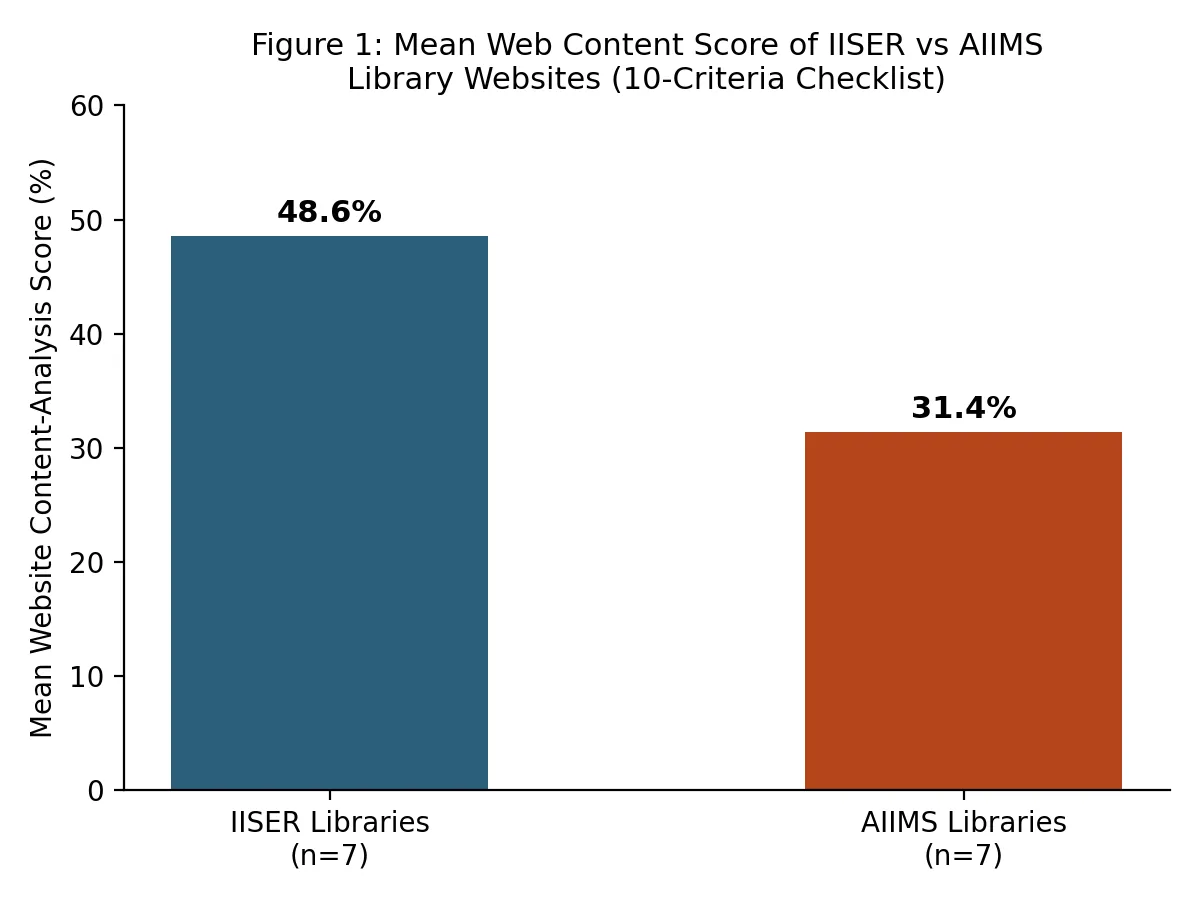
Figure 1: Mean Web Content-Analysis Score, IISER vs. AIIMS Library Websites
Feature-wise, OPAC availability (F1, 85.7%) and listing of e-resources (F2, 71.4%) were the most consistently observed features across the full sample of 14 websites, reflecting near-universal automation of catalogue access. In contrast, published library rules or membership policy (F7, 14.3%), digital repository linkage (F4, 21.4%) and displayed collection statistics (F9, 21.4%) were the least represented features, indicating that most library websites in the sample provide access mechanisms but relatively little descriptive or policy content. Figure 2 shows the feature-wise compliance across the pooled sample.
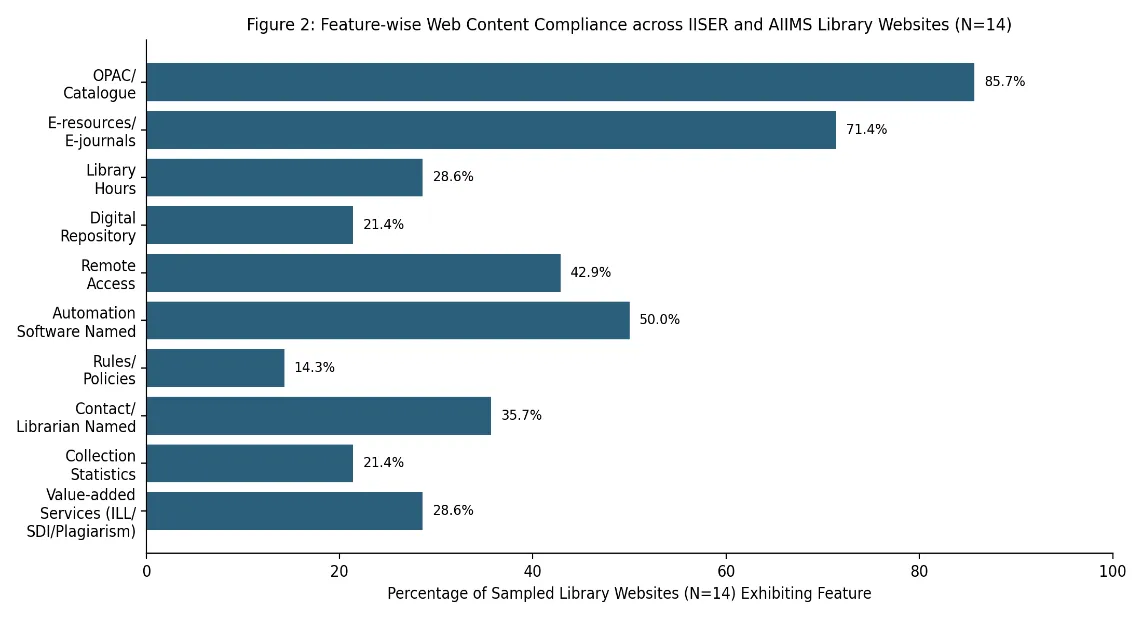
Figure 2: Feature-wise Web Content Compliance, Pooled Sample (N = 14)
7.1 Hypothesis-wise Discussion
Table 4 summarises the outcome of each hypothesis framed in the parent synopsis against the content-analysis evidence collected in this study.
|
Hyp. |
Hypothesis (abridged) |
Result |
Basis of decision |
|
H1 |
IISER and AIIMS library websites are highly beneficial for scholars, students and faculty. |
Partially supported |
IISER sites (mean 48.6%) show stronger academic support features than the sampled AIIMS sites (mean 31.4%); benefit is uneven across the two systems. |
|
H2 |
Websites provide good information retrieval, information service and inter-library cooperation. |
Not supported for the full sample |
Only 4 of 14 websites (28.6%) displayed inter-library loan/SDI/CAS or reference-support services (F10); the majority did not evidence such services online. |
|
H3 |
Library websites are enriched with e-resources, services and important links. |
Supported for IISER; partially for AIIMS |
F2 (e-resources) was present on all 7 IISER sites but only 3 of 7 sampled AIIMS sites. |
|
H4 |
Presentation and performance of the websites will be good. |
Not supported |
Several AIIMS websites (Rishikesh, Raipur, Jodhpur, Bathinda) exposed only a single OPAC link with minimal descriptive content; one IISER page returned a broken/'data unavailable' error at the time of observation. |
|
H5 |
Significant differences exist in domain-name/URL structure between IISER and AIIMS library websites. |
Supported |
IISER libraries mostly use institute sub-domains (e.g., library.iiserb.ac.in), while several AIIMS libraries use independently hosted domains or third-party OPAC clouds (e.g., aiimsj-opac.kohacloud.in), confirming structural divergence. |
|
H6 |
Significant differences exist in the number of webpages, self-links and external links. |
Supported (directional) |
IISER sites consistently exposed more internal sub-pages (about, OPAC, e-journals, repository, rules) than the four AIIMS sites that exposed only a single library page. |
Table 4: Hypothesis Testing Summary
8. MAJOR FINDINGS
1) All seven IISER library websites provide a working OPAC or online catalogue link, whereas one of the seven sampled AIIMS websites (Bathinda) did not expose a direct catalogue link on its library page at the time of observation.
2) IISER library websites are considerably richer in descriptive content — named librarians, collection statistics, library rules and digital repositories — than the sampled AIIMS websites, most of which present only a single OPAC-linked page.
3) The Dr. B. B. Dikshit Library website of AIIMS New Delhi is the only AIIMS site in the sample that matched the content depth of the leading IISER websites (score 8/10), reflecting its status as the oldest and most established AIIMS library.
4) Remote access facilities (proxy/OpenAthens/VPN) were found on less than half the sampled websites (42.9%), indicating that off-campus access to subscribed e-resources remains unevenly implemented.
5) Value-added research support services such as inter-library loan, SDI/CAS and plagiarism-checking tools were explicitly advertised on only four of the fourteen websites, all of which were IISER or AIIMS New Delhi sites.
6) One IISER library sub-page (IISER Kolkata’s facilities/library route) returned a 'data unavailable' error at the time of observation, illustrating that even comparatively mature library websites are not free from broken-link or maintenance issues.
9. SUGGESTIONS AND RECOMMENDATIONS
1) AIIMS libraries, particularly the newer PMSSY-phase institutions, should develop a dedicated, content-rich library sub-site rather than a single OPAC-linked page, following the model demonstrated by AIIMS New Delhi and the IISER library websites.
2) All library websites should publish library rules, membership and borrowing policies, and collection statistics, since these criteria were the least represented across the sample.
3) Remote-access facilities (OpenAthens, VPN or proxy-based access) should be extended to all sampled AIIMS libraries to ensure equitable off-campus access to subscribed e-resources, consistent with the model already implemented at IISER Thiruvananthapuram and AIIMS Kalyani.
4) Digital institutional repositories should be established and linked from the library homepage at all AIIMS libraries sampled in this study, mirroring the practice already adopted at IISER Pune and IISER Kolkata.
5) Regular website audits should be instituted to detect and correct broken links or unavailable pages, an issue observed even at a well-resourced IISER library.
6) A standardised, ministry-level web-content framework for IISER and AIIMS library websites would reduce the wide variance in content maturity documented in this study.
CONCLUSION
This study operationalised the content-analysis methodology proposed in the parent doctoral synopsis by directly observing and scoring the library websites of all seven IISERs and a purposive sample of seven AIIMS institutions against a ten-criterion checklist. The results reveal a clear and measurable content gap: IISER library websites recorded a mean compliance of 48.6% against 31.4% for the sampled AIIMS websites, with the widest gaps in remote access, digital repositories, and value-added research services. While catalogue access (OPAC) has become nearly universal, richer descriptive and policy content remains unevenly developed, particularly among AIIMS libraries outside New Delhi. These findings offer an empirical baseline that can inform the full-scale doctoral study proposed in the synopsis and support evidence-based recommendations for strengthening library website content across both institutional systems.
REFERENCES

Praful B. Bhoyar¹*, U. B. Deshmukh², Web Content Analysis Of Indian Institutes Of Science Education And Research (IISER) And All India Institutes Of Medical Sciences (AIIMS) Library Websites: A Comparative Evaluation, Int. J. Sci. R. Tech., 2026, 3 (7), 480-488. https://doi.org/10.5281/zenodo.21410685
 10.5281/zenodo.21410685