

 Ajay Kawar*
 Shantanu Kamble
Growth is an essential Feature of life of a Child that distinguishes him or her from an adult The process of growth starts from the time of conception and continues until child grows into adult the terms “growth and development are often used together but they represent two different facets of the Dynamic of change. i.e. quantity and quality the entire course is a Dynamic process that encompass several interrelated dimensions Growth refers to an increase in size or mass of the tissues it is largely attributed to multiplication of cells and increase in intracellular substance it can be majored in inches, centimeters, kilograms and pounds. So it is a quantitative term Function term. Every child has the right to grow up in a healthy home, school, and community. The future development of our children and of their world depends on their enjoyment. A baby becomes a children and then reaches puberty, passes through the life of his or her life and future. Developmental events are certain activities that most children’s can do at a are particular age. All thought each record is age – specific, the actual age at which a schooler child reaches that age may differ slightly every child” is unique. Assessment of child’s development is a team effort in which the family plays and important role the mother can even notice minor changes in the growth and development of her child. Also parents are the child’s Frist teacher and plays a vital role in their child’s learning and development. Developmental milestones in children or infants area a certain set of skills or age-specific tasks. Missed or delayed milestones in infancy can be symptoms of serious medical conditions. If parents understand their children’s development, they can tailor their expectations and provide stimulation. This study was conducted to assess the level of knowledge regarding the development milestones of infants among mothers Because of this, evaluating a child’s growth requires collaboration, with the family playing a crucial Part. By making observations, mothers are able to determine an Infant’s milestone growth. A woman can discuss any issues or concerns she may have with the baby’s physician. Additionally, Developmental screening is a tool that pediatricians may use to detect children who may be at risk for Developmental delay. It consists of a series of Questions and observations designed to determine the Child’s capacity to complete specific tasks that are age-appropriate Thus, missed milestones may indicate developmental delays, which may be linked to more severe Medical issues. Child development is a fundamental reflection of a child's overall growth and physical maturity. “Developmental milestone” is a descriptive term used to denote physical, cognitive, social, and language skills demonstrated by a child as he grows up. It is essential to understand that these milestones are different for each age range. Developmental milestones in children are a certain set of skills or age-specific tasks. Missed or delayed milestones in infancy can be symptoms of serious medical conditions. If mothers understand their children’s development, they can tailor their expectations and provide stimulation. This study was conducted to assess the level of knowledge regarding the development milestones of children among mothers. A developmental milestone is a collection of practical abilities or a particular task that the majority of children can perform by a given age. The ability of a kid to do more complicated tasks as they get older is referred to as child development. Thus, missed milestones may indicate developmental delays, which may be linked to more severe Medical issues. Parents should schedule a visit with their usual healthcare provider and inquire about the outcomes of the most recent developmental screening test if they believe their child has missed any Developmental milestones. Studies revealed that kids who are identified and treated earlier have better Outcomes in development, school performance and social skill.
Need of study: Research on the developmental milestones of school-going children is important because it helps identify if a child is developing. Normally as if they need extra support This research can also help parents and educates understand how to best support children’s development Identify developmental delays it can help identify if a child is developing normally or if are delayed in a certain areas providing support or extra support physical therapy, parents and educators understand how to best support children’s development It can Research can help educate parents about developmental milestone so they can monitor their child’s growth and address delays to assess the growth and global developmental delay among school going children in a rural community of India.
Operational Definitions:
Assess: According to oxford dictionary “Assess means to evaluate or estimate the nature or quality about something or somebody.
Knowledge: According to Oxford dictionary: knowledge is the fact, information and skills acquired through experience or education
Developmental milestones: According to Oxford dictionary: Developmental milestones are behaviors or physical skills seen in infants and children as they grow and develop.
- Criteria for selection of sample
Inclusive criteria:
- Selected mothers in rural areas
- Mothers who are willing to participate
- Mother who will understand Marathi and English
Delimitations: A study is delimited to mother in selected rural areas of Karad
Ethical considerations: -Approval from research committee and ethical committee
-Permission will take from college.
Summary: This chapter of introduction deals with a descriptive study to assess the knowledge of mothers regarding developmental milestones among their school going children in selected rural areas. And descriptions of need for study and background of study, including problem statement, objective, operational definition, criteria for selection of sample, ethical consideration
REVIEW OF LITERATURE:
1. How aware are mothers about early childhood developmental milestones? A cross-sectional study at a maternity hospital in rural South India This was a cross-sectional study among mothers with a child under the age of 3 years, availing of health and immunization services at the rural hospital. The interview schedule included 4 items pertaining to risk factors associated with delayed milestones and 32 items regarding awareness of ECDM across four domains: Gross motor, fine motor, social, and language. Each correct answer was awarded 1 point. Awareness among rural mothers regarding ECDM across all four developmental domains was found to be inadequate. Poor maternal awareness, of milestones that are the first to be achieved, is likely to result in delayed recognition and intervention for DD. Community-level workers must educate mothers regarding ECDM during immunization sessions and home visits, using the Mother and Child Protection Card as an educational tool.
2. A descriptive cross sectional study was conducted among Mothers’ knowledge of child development is closely associated with the positive child developmental outcomes the sample consists of 174 mothers by using simple random sampling techniques The questionnaire has Questions from the following domains: socio Demographic, maternal knowledge of child Developmental milestones, maternal Knowledge about the parenting skill The results of our study showed that the level of maternal knowledge about child developmental milestones in Kanchipuram is relatively low. Among the developmental milestones, physical and language milestones have the least knowledge. And majority of parents have the average knowledge on parenting skills Past research
RESEARCH METHODOLOGY:
Research Approach: The approach of research study depends on several factors, but primarily on natural phenomenon under the study. Qualitative approach was considered an appropriate one. In this study qualitative research approach is used.
Research Design: In The present study survey design was used to assess the knowledge of mothers regarding developmental milestones. Close ended list of questions aimed at extracting specific data from a particular group of school going children.
Variables: Variables are qualities, properties or characteristics of person, thing situation that change or vary, means a characteristic of an individual or object that differs among the individual or object that are being studied. Variables are classified based on their nature, action, and effects on the variable. The dependent and independent variables that are interrelated and mainly observed in correlational, interventional, pre-experimental, quasi-experimental and experimental research studies. The variables for the present study is dependent variable, demographic variable and independent variables is questionnaire.
- Dependent Variable
The dependent variable usually is that the researcher is interested in understanding. Explaining or predicting. It means the change in the dependent variables that is effect that influenced by the independent variable. It is presumed outcome or response due to the effect of independent variables, which researcher wants to predict and explain. In this study dependent variable is knowledge regarding developmental milestones among their school going children’s.
- Demographic Variables:
In most research study, researcher make the attempt to study sample characteristics and present them in a research findings. Sometimes researcher ever try to establish relation of demographic Variable with the research variable. Demographic data in different variables such as Age, Religion, Area of residence, Educational status of school going children and mothers, Occupational status of mother. Have you ever participated in developmental milestones project.
- Setting Of The Study: Settings is the more specific places where data collection will occur. Setting refers to area where the study is conducted. Settings is the physical location and condition in which data collection takes place in a study. The study was conducted at selected rural area Karad. The rationale for the selection of this setting was that adequate no of samples are available. Investigator had an easy access to this setting.
- Population: “Population the entire aggregation of cases that meet a designed set of criteria. The population refers to a total category of person of objects that the criteria for the study established by the researcher, any set of person objects or measurements having observable characteristics in common “The accessible population is the population of subjects which can he enumerated and studied. The target population is the total group of subjects abo which the investigator is interested to make generalization population for the present study is school going childrens.”
- Sample and Sample Size: Research is a systematic way of approaching a problem to find answer to the questions. The research problem needs to be broken into a set of questions that will extract the desired answers from the chosen unit of population. Sample size should be adequate to represent the population. A small and nonrandom sample is used in qualitative studies. Qualitative researchers are also concerned to obtain a representative sample, so that measurement obtained from study sample accurately reflects the population and thus result can be generalized to the population. Sample consists of a subset of a population selected to participate in research study. In the present study school going childrens who met the inclusion criteria were selected as samples. The sample size for the present study is 30.
- Sampling Technique: Sampling is the process of selecting representative part of the population. Sampling technique is the procedure, which the researcher adopts in selecting the sample for the study, simple random sampling technique is used for the present study.
Sampling Criteria: Sampling criteria specifies the characteristics that the sample in the population must process. The following criteria are used in the present study to select sample.
Inclusive criteria:
- Developmental milestones.
- Developmental milestones who will be present during data collection.
- Developmental milestones who are willing to participate.
- Developmental milestones who will understand Marathi and English.
Development of Tools
Data collection tools are the procedure or instrument used by the researcher observe and measure the key variables in the research problem. A semi- structured questionnaire was prepared to assess the level of knowledge of mother regarding developmental milestones among their school going children. The following steps were adopted in the development of tools.
- Consultation and discussion with research guide
- Opinion from experts and discussion with experts
Selection of The Tools: A semi- structured questionnaire selected on the basis of the objective of the study. Semi structured questionnaire was prepared in the basis of review of literature and in consultation with experts in the field of child health nursing, as is considered as the most appropriate instruments to elicit response from the participants.
- Description of The Tools: The researcher developed a semi- structure questionnaire to assess level of knowledge of mother regarding developmental milestones among their schooler’s which consisted of following aspects.
- Section A: Demographic data of schooner’s.
- Section 1: Semi- structured questionnaire knowledge of mother regarding developmental milestones among their schooler’s
- Testing of The Tool: The tool prepared for the data collection was tested for its content validity from the expert.
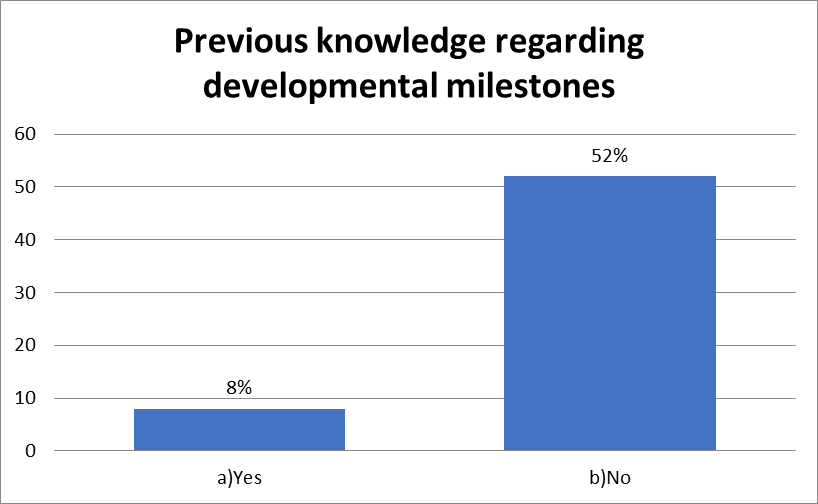
Figure: Bar graph showing percentage of subject according to previous knowledge regarding development milestones.

 10.5281/zenodo.19028699