

We use cookies to ensure our website works properly and to personalise your experience. Cookies policy
The Institute of Judicial Adminstration (IJA) Lushoto, P. O. Box 20, Lushoto, Tanga.
The study aimed to promote a positive transformation of the mindset and perception of women to be entrepreneurs by creating, inventing and initiating their own services or products for income generations. The finding from the study revealed that the majority of women fail to change their mindset and perception in creating, inventing and initiating their own services or products for income generations. The study used the qualitative and quantitative approach. The cross-sectional research design was used. The research tools/technique use were the questionnaire, checklist (include Interview Guide, Focus Group Discussion Guide, Observation Guide and Documentary Review).The study used the sample size of 88 respondents and employed the simple random sampling, stratified sampling and purposive sampling during the data collection. The qualitative and quantitative research was used. The study adopted the Cross-Sectional Research Design. Statistical Package for Social Science (SPSS Version 20) was used to analyze the data. The study concludes that there were poor mindset and perception of women to be entrepreneurs. The study recommends that the women should transform the mindset and perception to be innovative, creative and curious of creating their own enterprises through improving access to finances.
Study aimed to enhance the women entrepreneurship on SMEs in Tanzania. Specifically, study focuses on promoting mindset and perceptions transformation on financial intelligence skills that will create business opportunities for their income generation (World,Bank,2020).WSME development and demonstration effect, funding leverage/unlocked, analysis of development outcomes, implementation arrangements and monitoring and evaluation(Zhou, 2023).The majorities of women are limited financially for instance in Africa, about 30 percent of women depend on men and cannot survive without the support from men(URT,2021). Outcomes of their funds earned cannot help to survive and the majority of them live below 1 dollar per day (WB, 2020).
The entrepreneurship for women will be succeeded if they will access to finance: Evaluate the availability of financial resources for women entrepreneurs, including loans and grants. Training and capacity building: Assess the effectiveness of training programs aimed at enhancing business skills and knowledge. Networking and mentorship: Investigate the role of networking opportunities and mentorship programs in supporting women entrepreneurs. Government policies and support: Analyze existing policies and initiatives aimed at promoting women entrepreneurship in SMEs (WB, 2020).
Different scholars identify ?indicators?/ keys of a good entrepreneur such as :vision, creativity, risk taker, courage, responsiveness to opportunities, learning every time, choose and decide every time, flexible ,tolerance and personal discipline on behavior, time and money (URT,2021).Several reviews observed the factors which promote/influence entrepreneurship? such as: good science and technology (Innovation, inventing and discovering of tools, machines and equipment).Good governance (Rule of law, transparence, accountability, equity, ant-corruption, democracy, freedom and responsibility, good human and natural resources(mines, trees, land, mountains, oceans, rivers, animals, birds and others).Good agricultural methods and techniques (advanced tools, scientific seeds, fertilizers, pesticides). Agricultures involve fishing, timbering, animals keeping, bird keeping, bee keeping and cultivation of crops).Good Infrastructure (Transports-roads, railways, ports and harbours) building-houses, markets, offices, water systems and energy systems) and communications(radio,newsletter,magazines,televsions,socialmediawhasap,youtube, instagrame and twitter) Good Financial education (Relevant education to need).Good education system(suitable and help people to be independents by using their environment and solve their? problems- can be financial, social and? technology (Castro, et,al.2022& Zhou,2023). Several reviews observed some general the factors which hinder entrepreneurship in Africa such as: poor science and technology (lack of innovation, inventing and discovering, poor governance (in lack of rule of law, transparence, accountability, equity, ant-corription, democracy, freedom and? poor responsibility, poor human and poor utilization of natural resources, poor agricultural methods and techniques (poor tools, scientific seeds, fertilizers, pesticides) (agricultures involve fishing, timbering, animals keeping, bird keeping, bee keeping and cultivation of crops),poor infrastructure (transports, building and poor communications), poor financial education (irrelevant education to need),poor education system, laziness and drunkard -over drinks (Jasim, 2023; Zhou, 2023 &? Wangm. 2023).
Women are facing numerous challenges on their-owned enterprises by mention some include: lack of access to key networks, lack of support from government and stakeholders, poor financial policies, dominance from men, lack of awareness of financial intelligence skills and poor perceptions of being cared and kept by men. (URT,2018). The strategies to initiate and promote transformation of mindset and perception of women to be innovative, creative and curious of creating their own enterprises and improve the access to finance from financial institutions and other stakeholders (Dhasarathy & Khan, 2020).
The transformation of the mindset and perception of women to be innovative, creative and curious of creating their own enterprises through improving access to finance (Zhou & Wangm. 2023).The strategic approaches of being innovative were done as follows: ?initiation and promotion of the voice of women to be heard and trusted in different financial institutions for additional assistance to be created and innovated with little success (Chiemo,2020).The connection and network needed with different institutions and other stakeholders that they can do and show their potentialities for the entrepreneurial growth (Rhazzi & Dhiba 2022).
The promotion of women entrepreneurs creates linkages, networks, exposures and connections between women and various institutions for financial assistance (Castro, et,al.2022).The various groups of women and individuals are registered, known and seen for what they want to invent and create by being given loans and financial assistances (Msunga, 2024).The measures taken by governments and development stakeholders to ensure every woman realizes and identifies their? potentialities by knowing how to start, monitor and implement her own business project (Castellanos, 2019). Some Women ?from different areas given capacity building? in improving the entrepreneurship by empowering ?their financial literacy, power and time to create and invent services or products (Zhou &? Wangm, 2023).?The women entrepreneurs should get expertise from different examples of women who have succeeded financially and convince and persuade to think, plan and enter into entrepreneurship. (Jasim, 2023).The collaborations and partnership with various public and private organizations which have willing to support women to be innovative, creative and curious for their own business projects (Jasim,2023).The women of whatever they do have values and increase incomes for their daily activities (Zhou & Wangm. 2023). The initiation and promotion ?the unity and collaborations among enablers to have one goal and target in fulfilling their duties and responsibilities of enhancing women to create their own business projects (Chiemo,2020 &Msunga, 2023).
The promotion of women to be entrepreneurs by creating, inventing and initiating their own services or products for income generations (Castro, et, al.2022). The ability and capacity of expertising knowledges,skills and professionalism in enhancing women to be entrepreneurs little done by several institutions in Tanzania(EIB,2022).The innovative approaches to build a supportive ecosystem for women?s entrepreneurship aimed at improving access to finance for WSMEs achieved (Jasim, 2023).
According to Msunga (2024) has observed some reasons on why?men entrepreneurs die first compared to women entrepreneurs at family level in Africa. Most of men die first compared to women some of them include: The nature of the work: the majority of men do heavy duties compared to women. Over thinking?s-Future thinking, the life plan takes years to plan for his life and family (Torm,2020).? Most of men lack of corporation from couples, poor balanced diet Frustrations (from fear, financial bankrupts, conflicts, anxiety, jealous, revenge, separation, divorce, death and so on) (Zhou,2023). Most of men think personally too much to solve their own problems. Most of men take time to look for the consensus. Some men are killed by their couples for some of the families. Most of men lack of sympathy and encouragements from couples (Chiemo,2020 &Msunga, 2023).
Most of men lack proper physical exercises-The majority of men become tired early compared to women as a results it is easy to be affected by the diseases due to the lacking of body immunity, most of men lack of care, dependence of men to daily activities at old age for the majority of men home activities. Most of men have extra sexual intercourse. Most of men fail to attain their objectives/Goal. Most of men are Risk takers for most of men (work, position, location and others). Most of men fail to have a personal positive life style. Most of men keep secret and privacy in heart and mind for most of men and most of men are drunkards -Over Drinking (Zhou, &? Wangm. 2023). The development of innovative ways to disseminate advisory services addressing capacity constraints, skills enhancement and digital presences for WSMEs obtained and enhance visibility and access to mentorship and role models for WSMEs applied and obtained (Zhou, 2023). ?The WSME has contributions in the development of individuals and all groups of women in the world. It has effects in incomes, social services, economic on GNP and NGP, political and social effects (Aga, et al.,2015).?Several studies which conducted by different scholars did on SMEs such as WB (2020) focused on improving SMEs, Nguyen. et.al.,(2019) on SMES credit constraints, Zhou (2023)? on WSMEs ?accessibility ?and Aga,et.al., (2015) on SMEs through ?Age and jobs. From the previous studies, positive change of the mindset and perception for women entrepreneurship on SMEs is unknown and not clearly stated as a filling gap. Therefore the study aimed to promote of positive change of mindset and perception for women entrepreneurship on SMEs.
MATERIAL AND METHODS
2.1 Description of Lushoto Ward
The study was conducted at. lushoto ward ?which comprises of six streets such as Dochi, Chakechake, Kitivo, Yoghou and Maguzoni. Lushoto district is known for its agricultural activities, particularly in the cultivation of tea, maize, and horticultural products. Small-scale businesses and trade, especially in local markets, also play a critical role in the district's economy a total of 58,199 of people (URT, 2012).
2.2 Data Collection Methods
From the primary data, the researcher gets the actual and real information by taking physically from the field. Some methods of data collection include: the documentary reviews which is secondary data, Household Survey Questionnaire and Key Informant Interview to get primary data and documentary review? ??to get secondary data.Data collection in this research were be done in two phases; the first phase was ?pre-testing which aimed in testing the validity of data collection tools through questionnaire, guide and checklist and The pre -testing phase was done to modify tools for actual data collection during questionnaire, checklists? and observation guide during the data collection.
2.2.1Sample Size
The sample size has been reached through a simplified formula provided by Yamane (1967) suggests a sample of at least 30 units is statistically significant to present any population. The formula for calculating the sample size is:
n=z2 pq/d2
22(0.50x0.50)/(0.05)2
1/0.0025=100 respondents
Therefore n=100,??? where
p=Proportion in the target population estimate to have a particular characteristics; if not known use 50% , n= Sample Size when population is greater than 10,000 people , q=1.0 ?p , d=Degree of Accuracy Desired, set at 0.5 or 02(standard error) , z=Standard Normal Deviation, set at 1.96(? 2.0) corresponding to 95%confidential level, Actual values of p*q and d are 0.5* 0.5 and 0.005 respectively. Therefore the sample size used was 100 respondents from residences of Lushoto ward.
RESULTS AND DISCUSSION
3.1 3.1The Type of SMEs in Lushoto District
The data from findings observed that types of SMEs project ?which were done by most of women in Lushoto District such as: the respondents who replied that agricultural enterprises? were done most of residents? were 37(42.1 %). the respondents who replied that there were small kiosks enterprises 23 (26.1%). who replied that there were wood selling enterprises 7 (7.9%), the respondents who replied that selling foods enterprises were 7(7.9%), ?selling clothes ?enterprises were 6 (6.8%),the respondents who replied that selling fruits and vegetables enterprises were ?5 (5.6%) as shown in Table 1.
Table1: The Type of SMEs at Lushoto Ward
|
Types of SMEs |
Frequency |
Percent |
|
Agricultural Enterprises |
37 |
42.1 |
|
Small kiosks Enterprises |
23 |
26.1 |
|
Wood selling Enterprises |
10 |
11.3 |
|
Selling foods Enterprises |
7 |
7.9 |
|
Selling Clothes Enterprises |
6 |
6.8 |
|
Selling Fruits and Vegetables Enterprises |
5 |
5.6 |
|
Total |
88 |
100.0 |
???????? Source: Field Data, 2024.
The awareness to women to reduce limitations concerning women on having access to finances. It will corporate with the government institutions and private organization to make sure those women entrepreneurs have access to finances for their own enterprises. It is known that numbers of women compared to men are low by 35% in developing countries like African countries. For example, in Africa, the majority of women live below one dollar per day and 40 percent are employed in public institutions and 30 percent at private institutions (Jasim, 2023).
3.2 Challenges Facing Women Entrepreneurship at Lushoto Ward.
From the field, it was found that number of respondents who replied that the most of women lack access to key networks were 33(37.5%). The respondents who replied that the women have poor support from government and other financial stakeholders were 24(27.3%). Who replied that they have poor financial policies were13(14.8%). The respondents who replied that there was men dominance were 7(8%). Most of women have the negative perception on income generation were 4(4.4%) and ?lastly, most of women lack? of awareness of business enterprises were? 3( 3.4 %). As shown in table 2.
Table 2: Challenges Facing Women Entrepreneurship on SMEs
|
Challenges |
Frequency |
Percent |
|
Lack of access to key networks |
33 |
37.5 |
|
Lack of stakeholder s Support |
24 |
27.3 |
|
Poor financial policies |
13 |
14.8 |
|
Dominance from men |
7 |
8.0 |
|
Negative Perceptions |
4 |
4.4 |
|
Lack of Awareness |
3 |
3.4 |
|
Total |
88 |
100 |
Source: Field Data, 2024.
3.2 Challenges in Changing the Mindset and Perception for Women
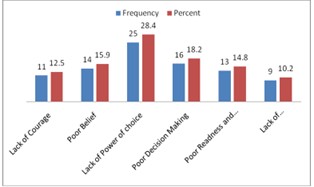
From the field, the challenges in changing the mindset and perception for most of women such as: who replied that they lack of courage were 11(12.5%). The respondents who replied that the women have poor belief concerning entrepreneurship were 14(15.9%). Who replied that they lack power of choice were 25(28.4%). The respondents who replied that there was poor decision making were 16(18.8%). Lack of readiness or access to financial opportunities were 13(14.8%) and the respondents who replied that there were a lack of innovative or creativity of women in entrepreneurship were 9(10.2%) as shown in Table 3.
Table 3: Challenges of Changing the Mindset and Perception for Women on Income Generation
|
Change |
Frequency |
Percent |
|
Lack of Courage |
11 |
12.5 |
|
Poor Belief |
14 |
15.9 |
|
Lack of Power of choice |
25 |
28.4 |
|
Poor Decision Making |
16 |
18.2 |
|
Poor Reading and Access |
13 |
14.8 |
|
Lack of Innovative/Creativity |
9 |
10.2 |
|
Total |
88 |
100.0 |
Source: Field Data, 2024
From the findings observed that the lack of power of choice by 25(28.4%) was more compared to other due to the following reasons:? the majority of women depend on men, poor responsibility and lack of confidence as shown in Figure2.
? ? ? ?
? ? ? ? ? ? 
? ? ? ?
Figure 3: Challenges of Changing the Mindset and Perception for Women on Income Generation at Study Area
Source: Field Data, 2024.
The findings from the study observed that the women have potentialities and capabilities if could have?? awareness were 11(12.5%). The respondents who replied that the women have ability or capacity to initiate their projects were 15(15.9%). Who replied that they have skills in creating their projects were 25(28.4%). The respondents who replied that women have knowledge by 17(18.8%). The women were ready to access the financial opportunities were 11(11.8%). The respondents who replied that women? were self recognized were 10 (10.2%) and the respondents who replied that the women have power or energy in creating and innovating their projects were ?8(9.2%).
? ? ? ?
? ? ? ? ? ? 
? ? ? ?
Source: Field Data, 2024.
Figure4: Women Entrepreneurs on potentialities and capabilities of SMEs
From the findings observed that the availability of skills by 25(28.4%) appeared more compared to other due to the following reasons: few of women were illiterate and believed that the women not required to have more skills due to the perception since past generations. During the interview, one of respondents replied that: ?The study should involve various beneficiaries from different groups especially women, government, donors and others stakeholder in entrepreneurship activities. The majority of women are poor and their potentialities are limited to political, economic, social and cultural aspects?(Interviewer, November. 2024). According to Torm (2020) argues that the study will make sure that the gender is considered in all sectors and remove limitations of genders from all jobs and opportunities from public and private institutions. The presence of women has biggest and greatest success from all angles of development (Zhou, 2023).
The government and development stakeholders should make sure that the gender is considered in all sectors and remove limitations of genders from all jobs and opportunities from public and private institutions .The presence of women has biggest and greatest success from all angles of development (Zhou,2023). Where there is a success of man, there is women behind and where there is a success of women there is man behind. Both man and women have contributions of development especially the economic development (Castro, et, al.2022). For most of the time, where there is a success of man, there is women behind and where there is a success of women there is man behind. Both man and women have contributions of development especially the economic development (Chiemo,2020).
3.4 The factors which Promote Women Entrepreneurship on SMES at Study Area
From the field, there were general factors which promote women entrepreneurship it was found that number of respondents who replied that good science and technology help to promote women entrepreneurship were 14(15.9%). The respondents who replied that good governance by 11(12.5%). Who replied that good human and natural utilization of resources were 25 (28.4%). The respondents who replied that good agricultural methods and techniques were 13(14.8%) and respondents who replies that the good infrastructure help to promote women entrepreneurship were 16(18.2%).
? ? ? ?
? ? ? ? ? ? 
? ? ? ?
Figure5: The factors which Promote Women Entrepreneurship on SMEs
Source: Field Data, 2024.
During the interview, one of respondents replied that:
?The government should promote the women entrepreneurship in order to raise the incomes of women at their areas? (Interviewer, November. 2024). From the review, the women entrepreneurship needs a personal choice, commitment and personal identity in doing a business project for income generations (Okafor, 2021).
CONCLUSION AND RECOMMENDATIONS
4.1 Conclusion
Most of women were confronted by several challenges in entrepreneurship on SMEs such as: lack of access to key networks, lack of support, poor policies, dominance from men, lack of awareness of financial intelligence skills and negative perceptions of being cared and kept by men.
4.2 Recommendations
The ministry of Industry and trade should promote of women entrepreneurs create linkages, networks, exposures and connections between women and various institutions for financial assistance.? It will make sure that various groups of women and individuals are registered, known and seen for what they want to invent and create by being given loans and financial assistances. The ministry of education and ministry of social development should make sure the measures taken to make sure every woman realizes and identifies her potentiality by knowing how to start, monitor and implement her own business project. Women should build of what they have in their mind, power and time to create and invent services or products. The Private and other development partners should empower the women entrepreneurs should get expertise from different examples of women who have succeeded financially and convince and persuade to think, plan and enter into entrepreneurship. It will make sure that there are collaborations and partnership with various public and private organizations which have willing to support women to be innovative, creative and curious for their own business projects. The stakeholders should make sure the women of whatever they do have values and increase incomes for their daily activities. It will initiate and promote the unity and collaborations among enablers to have one goal and target in fulfilling their duties and responsibilities of enhancing women to create their own business projects.
The central government, ministries and other development stakeholders should promote women to be entrepreneurs by creating, inventing and initiating their own services or products for income generations. It has the ability and capacity of expertizing knowledge and professionalism in enhancing women to be entrepreneurs. The central government should make sure that innovative approaches to build a supportive ecosystem for women?s entrepreneurship aimed at improving access to finance for WSMEs achieved. The development stakeholders should develop proper innovative ways to disseminate advisory services addressing capacity constraints, skills enhancement and digital presences for WSMEs obtained and enhance visibility and access to mentorship and role models for WSMEs applied and obtained. The women entrepreneurs should transform their mindset and perception on income generations through SMEs in order to raise their financial status.
The study will enhance the Policy reformation: Suggest improvements to policies that support women entrepreneurship, such as access to finance and training. It will help to strengthen the Strategies for Stakeholders: Provide actionable strategies for government, NGOs, and the private sector to promote women entrepreneurship. The study will help for Future Research Directions: Identify areas for further research to continue exploring women?s entrepreneurship.
The potential outcomes of study such as an increased awareness: Greater understanding of the barriers and facilitators of women entrepreneurship, enhanced support systems: Development of more targeted programs to support women-led SMEs, economic empowerment: Insights that can contribute to the economic empowerment of women at Lushoto Ward. This research can significantly impact the promotion of women entrepreneurship, helping to create a more inclusive and supportive environment for women at Lushoto Ward.
REFERENCE

Romulus E. Msunga, Promoting Of Women Entrepreneurship On Smes In Lushoto District, Int. J. Sci. R. Tech., 2024, 1 (12), 249-256. https://doi.org/10.5281/zenodo.14517498
 10.5281/zenodo.14517498