

 Aiah Joseph Kamanda*
4.1 Background of Education Reforms in Sierra Leone
Sierra Leone's education sector has undergone significant transformations in the post-conflict era, moving from rebuilding basic infrastructure to addressing systemic issues of access, equity, and quality. Decades of underinvestment and the legacy of civil war left the education system fragile, characterised by poor learning outcomes, high dropout rates, and significant disparities between urban and rural areas (World Bank, 2020). The immediate post-war years focused on bringing children back to school and rehabilitating damaged classrooms, but this focus on access soon revealed a deeper crisis in the quality of learning that children experienced once enrolled. Subsequent reform efforts, including the 2004 Education Act, sought to establish a more robust governance framework, yet progress remained uneven, hampered by persistent poverty, cultural barriers to girls' education, and a chronic shortage of qualified teachers. It became increasingly clear that a more comprehensive and radical intervention was required to break the cycle of low educational attainment and its consequent impact on the nation's development.
4.2 Overview of the FQSE Policy
In a bold move to accelerate progress, the Government of Sierra Leone launched the Free Quality School Education (FQSE) policy in 2018. This flagship program aims to eliminate financial barriers to education by covering tuition, examination fees, and providing teaching and learning materials for students in government-approved schools from pre-primary to senior secondary levels. The policy's ambition is to dramatically increase access, improve retention, and ultimately enhance the quality of education to drive national human capital development. By shifting the financial burden of schooling from households to the state, the policy sought to level the playing field for children from the poorest communities, particularly girls and those in rural areas. The FQSE also introduced direct school grants, the provision of core textbooks, and a renewed focus on teacher training, signalling a shift from simply enrolling children to ensuring they are actually learning. This comprehensive approach positioned the policy as the central plank of the government's strategy for sustainable development and poverty reduction.
4.3 Importance of School Leadership in Policy Implementation
National policies, however, succeed or fail at the school level. The head teacher, as the school's chief executive, is the pivotal actor in this process, acting as the crucial link between the Ministry's vision and the daily experiences of teachers and pupils. School leadership is no longer just about administration; it is about translating abstract policy directives into daily classroom realities, requiring a complex blend of management, pedagogical expertise, and community relations. Leaders are responsible for fostering a positive school culture, managing resources like the Annual School Grant, supervising instruction to ensure quality, and engaging the community—all of which are central to the FQSE's success. Their ability to interpret the policy, motivate their staff to embrace its challenges, and adapt its requirements to their school's unique context can mean the difference between meaningful reform and a superficial compliance that fails to improve learning. Therefore, understanding the lived experiences and leadership practices of head teachers is not merely an academic exercise, but a critical prerequisite for understanding the true impact and sustainability of the FQSE policy itself.
5. Problem Statement
Despite the noble intentions and increased government spending on the FQSE, persistent challenges have emerged. Reports of teacher absenteeism, inadequate instructional materials, leakage of funds, and a disconnect between policy promises and school-level realities are common (MBSSE, 2021). This points to a critical problem: a significant gap exists between the design of the FQSE policy and its effective implementation. The role of school leadership in either bridging or widening this gap remains underexplored in the Sierra Leonean context.
6. Purpose of the Study
This study aims to investigate the impact of school leadership practices on the implementation of the FQSE policy in Sierra Leone. It specifically focuses on how leadership accountability, resource management, and community engagement influence the emergence of policy-practice gaps.
7. Research Questions
1. How do school leadership practices influence the implementation of the FQSE policy in schools in the Western Rural Area of Sierra Leone?
2. What are the key leadership accountability mechanisms affecting FQSE implementation?
3. How do head teachers manage and allocate FQSE resources at the school level?
4. What is the role of community engagement in supporting school leadership to implement the FQSE policy?
5. What are the primary policy-practice gaps in FQSE implementation, and how are they linked to leadership practices?
8. Significance of the Study
This research will provide empirical evidence from the local context to inform national policy. Its findings will be valuable for the MBSSE in designing targeted leadership training programs, for school leaders seeking to improve their practice, and for development partners aiming to support sustainable education reform. By focusing on the "how" of implementation, it moves beyond policy rhetoric to offer practical solutions.
9. Conceptual and Theoretical Framework
9.1 Conceptual Framework
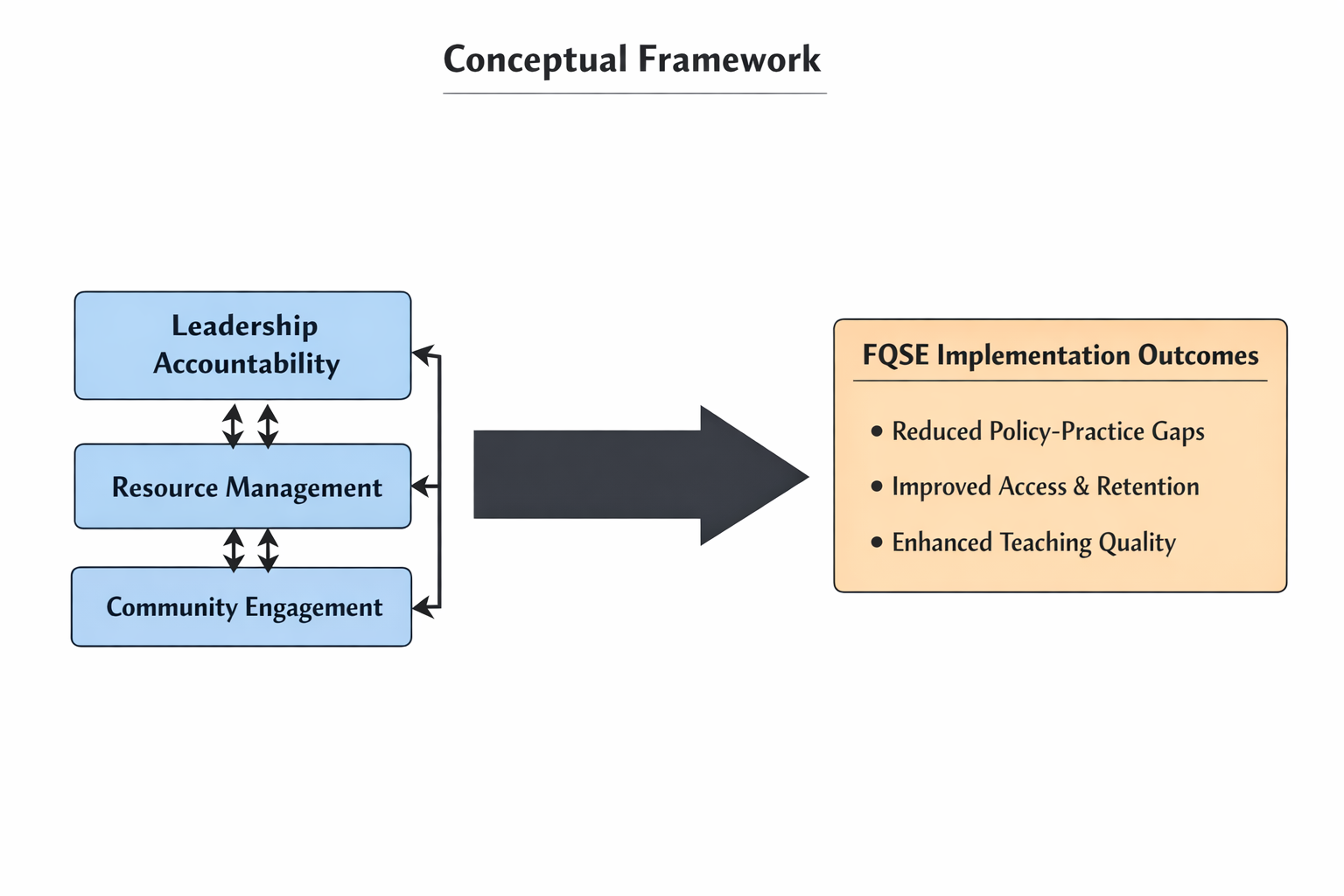
This study is built on a conceptual framework that posits a direct relationship between specific school leadership practices and the outcomes of FQSE policy implementation. The core leadership practices under investigation are:
-Leadership Accountability: Encompassing internal mechanisms (teacher supervision, performance monitoring) and external ones (reporting to education authorities and School Management Committees).
Resource Management: The processes by which head teachers receive, allocate, account for, and utilise financial and material resources provided under the FQSE.
Community Engagement: The strategies used by school leaders to involve parents, SMCs, and the wider community in the life and oversight of the school. These leadership practices are not silos but are deeply interconnected. For example, strong community engagement can enhance accountability, which in turn can lead to more transparent resource management. Conversely, weak accountability can foster mismanagement of resources, which discourages community participation. The interplay of these practices directly shapes the nature and extent of policy-practice gaps the misalignment between the FQSE's goals and the realities in schools ultimately impacting student participation, access, retention, and teaching quality.
9.2 Theoretical Framework
This study is grounded in two complementary leadership theories that, together, provide a comprehensive lens for examining the multifaceted role of head teachers in implementing the Free Quality School Education (FQSE) policy.
Instructional Leadership Theory: This theory focuses on the leader's role in shaping the school's instructional environment. An instructional leader defines the school's mission, manages the instructional program, and promotes a positive learning climate (Hallinger & Murphy, 1985). In the context of the FQSE, this theory helps analyse how head teachers use their leadership to ensure that the policy's "quality" component is addressed amidst the drive for increased access. It relates to the variables by focusing on how leaders supervise teachers, monitor student progress through data, and ensure that FQSE-provided materials like textbooks and teaching guides are used effectively to improve teaching and learning. Furthermore, this theoretical lens allows for an examination of how head teachers coordinate professional development and shield instructional time from administrative distractions, thereby directly influencing the pedagogical core of the school. Ultimately, it positions the head teacher as the primary driver of academic focus, whose actions in managing the curriculum and giving feedback to teachers are critical determinants of whether increased resources translate into better student outcomes.
Transformational Leadership Theory: This theory centres on the leader's ability to inspire and motivate followers to achieve extraordinary outcomes and develop their own leadership capacity (Bass & Avolio, 1994). A transformational leader builds consensus, fosters commitment through a shared vision, and empowers others to take initiative beyond their immediate job descriptions. In this study, it provides a lens to understand how head teachers engage with their communities and staff, moving beyond transactional exchanges to build genuine partnerships. It relates to community engagement by exploring how leaders inspire parents and SMCs to move from passive observers to active owners of the school's development and challenges. It also connects to accountability by examining how leaders move beyond top-down, compliance-based supervision to create a shared sense of responsibility and professional growth among teachers, thereby fostering an internal culture of commitment rather than mere compliance. By applying this theory, the study can explore how head teachers build trust, model desired behaviours, and provide intellectual stimulation to solve the complex, local problems that inevitably arise during large-scale policy implementation.
LITERATURE REVIEW
10.1 School Leadership and Policy Implementation
Globally, research has established school leadership as second only to classroom teaching in its impact on student outcomes (Leithwood et al., 2004). This influence is exerted through the shaping of a school's vision, the motivation of staff, and the fostering of a professional learning environment. In the African context, studies in countries like Ghana and Kenya have shown that head teachers are the linchpins of reform, acting as intermediaries between the Ministry and the classroom (Oduro, 2008). They are the primary agents responsible for translating broad, often abstract, national policy directives into concrete, actionable routines within the unique context of their school. Their ability to interpret, adapt, and drive policy at the school level is crucial for success, as they must manage the competing demands of administrative compliance, instructional leadership, and community relations. Consequently, the head teacher's beliefs, skills, and commitment can either be the catalyst for effective change or a significant barrier to its realisation, making them the ultimate "street-level bureaucrats" of the education system.
10.2 Leadership Accountability
Accountability in education involves a multi-layered framework of transparency, answerability, and enforceability, ensuring that educators and administrators fulfil their professional duties. In Sierra Leone, formal accountability structures include hierarchical supervision from district education officers, who are tasked with monitoring school performance, and local oversight by School Management Committees (SMCs). However, literature suggests that these mechanisms are often weak and inconsistently applied, undermining their potential to drive improvement. A study by the Policy and Planning Unit of the MBSSE (2021) noted that supervision visits were infrequent and poorly executed, often reduced to administrative checks rather than pedagogical support. Internally, effective head teachers fill this void by establishing clear expectations for teacher performance, conducting regular classroom observations, and providing constructive, actionable feedback. This internal approach fosters a culture of professional accountability, shifting the focus from top-down inspection to collaborative, collegial responsibility for student learning outcomes.
10.3 Resource Allocation and Management
The FQSE policy channels significant government funding directly to schools through the Annual School Grant (ASG) and provides essential learning materials like textbooks and teaching aids to remove financial barriers to access. Effective management of these resources is critical, as their mere presence does not guarantee improved learning; their strategic and transparent use is what matters. Research in similar contexts indicates that challenges arise when financial management is opaque, when procurement processes are unclear or circumvented, or when head teachers lack basic financial management and record-keeping skills (Chapman et al., 2010). This can lead to the misappropriation or diversion of funds, the procurement of sub-standard or irrelevant materials, and persistent shortages of essentials like textbooks due to poor inventory control. Ultimately, such mismanagement results in a failure to improve the learning environment as intended, eroding trust among parents and teachers and wasting the very resources meant to foster equity and quality.
10.4 Community Engagement
The role of communities, particularly through School Management Committees (SMCs), is formally recognised in Sierra Leone's Education Act of 2004 as a cornerstone of local governance and ownership. SMCs are intended to be the vital bridge between the school and the community, with responsibilities ranging from overseeing the school development plan and budget to supporting school leadership in mobilising resources and encouraging enrolment (Bray, 2003). Effective community engagement, when functioning well, can lead to better monitoring of teacher and head teacher performance, increased local resource mobilisation for school improvement, and stronger parental support for children's learning at home. However, the functionality of SMCs varies greatly across schools, and is often hampered by low literacy levels among members, a lack of clarity about their defined roles and powers, and passive domination by head teachers who may view them as a rubber-stamp rather than a genuine oversight body.
10.5 Policy–Practice Gaps
Policy-practice gaps, also known as implementation deficits, are pervasive challenges in education reform, particularly pronounced in developing countries with resource and capacity constraints. These gaps arise when policy design is overly ambitious, lacks contextual sensitivity to local realities, or fails to anticipate systemic constraints such as infrastructure deficits or teacher shortages (Dyer, 2015). In Sierra Leone, for instance, the FQSE policy's success is predicated on the widespread availability of trained teachers and adequate classroom conditions—conditions that are not universally met, especially in remote rural areas. A tangible gap emerges when a policy mandating smaller class sizes for quality pedagogy meets the reality of overcrowded classrooms, a direct result of increased enrolment without corresponding investment in classrooms and teachers. Leadership practices at the school level are thus central to navigating these unavoidable gaps, either by mitigating their impact through innovative local solutions like shift teaching or peer tutoring, or by exacerbating them through inaction, rigid compliance, or mismanagement that widens the chasm between policy intent and classroom reality.
10.6 Research Gap
While existing literature acknowledges the challenges of FQSE implementation, it often focuses on macro-level issues like financing and national policy design. There is a notable lack of empirical research that drills down to the school level to systematically examine how leadership practices directly mediate these challenges in Sierra Leone. This study addresses this gap by providing a nuanced, qualitative exploration of the interconnected roles of accountability, resource management, and community engagement in shaping policy outcomes at the school level.
METHODOLOGY
11.1 Research Design
This study employed a qualitative case study design. This approach is appropriate as it allows for an in-depth, contextualised exploration of a complex social phenomenon the implementation of the FQSE policy as influenced by school leadership. The case is the implementation of the FQSE policy in selected schools within a specific geographical area.
11.2 Study Area
The research was conducted in the Western Rural Area of Sierra Leone. This area provides a rich context, comprising a mix of peri-urban and rural communities with diverse socio-economic backgrounds, offering a varied picture of implementation challenges. It is also within accessible distance of Freetown, facilitating in-depth fieldwork.
11.3 Population and Sample
A purposive sampling strategy was used to select participants who could provide rich information on the research topic. The sample included:
Head Teachers (n=6): From six different primary and secondary schools.
Teachers (n=12): Two teachers from each of the six schools, selected to represent different grade levels and genders.
Education Officials (n=3): From the MBSSE district office, responsible for supervising the selected schools.
Community Stakeholders (n=6): Including chairpersons of School Management Committees (SMCs) and parent representatives.
11.4 Data Collection Methods
Semi-structured Interviews: Conducted with all head teachers, education officials, and SMC chairpersons to gain in-depth perspectives on leadership, accountability, and management.
Focus Group Discussions (FGDs): Two FGDs were held, each with six teachers from different schools, to explore collective experiences and perceptions of school leadership and resource availability under the FQSE.
Document Analysis: Key policy documents (FQSE guidelines, MBSSE circulars) and school-level records (attendance logs, school development plans, financial records) were reviewed to triangulate interview data.
11.5 Data Analysis
Data from interviews and FGDs were transcribed verbatim and analysed using thematic analysis. This involved familiarisation with the data, generating initial codes, searching for themes, reviewing themes, and defining them. The analysis was guided by the study's conceptual framework, focusing on themes related to accountability, resource management, community engagement, and policy-practice gaps.
11.6 Ethical Considerations
Ethical approval was sought from relevant authorities. Informed consent was obtained from all participants after explaining the purpose of the study, ensuring voluntary participation, and guaranteeing confidentiality and anonymity. Pseudonyms are used in the reporting of findings.
12. Findings
The findings are organised around the four core areas of the study, with evidence from participant narratives.
12.1 Leadership Accountability in FQSE Implementation
Accountability practices varied significantly among head teachers. Some demonstrated strong internal accountability.
"Every Monday, we have a staff meeting to review the previous week's work and plan for the new one. I also do unannounced visits to classrooms to see if teachers are actually teaching. If a teacher is absent, I want to know why." (Head Teacher, School A)
However, this was not the norm. Many teachers reported infrequent supervision.
"The head teacher is often busy in town with meetings or trying to find additional funding for the school. He rarely comes to my classroom to see what I'm doing." (Teacher, FGD 1)
External accountability to education officials was described as a "tick-box" exercise focused on paperwork rather than pedagogical quality.
"The supervisors come maybe once a term. They look at the logbook and the attendance register, ask if we have received our grants, and then they leave. There is no real discussion about our challenges." (Head Teacher, School C)
12.2 Resource Allocation and Management Practices
While the FQSE was praised for providing much-needed funds and materials, management at the school level was a major challenge. A key finding was the lack of transparency.
"We are told the government has given money for school feeding and materials, but as teachers, we are not involved in any planning on how it is spent. The head teacher and the SMC chairperson handle everything." (Teacher, FGD 2)
This lack of transparency bred suspicion and, in some cases, was linked to mismanagement. One SMC member described their own limitations:
"We, the SMC, are supposed to oversee the finances. But the head teacher presents a long paper with many figures. Most of us have not been to school for long. How can we verify if the money for 50 bags of rice was actually spent on rice?" (SMC Chairperson, School B)
Schools that managed resources better had clear, participatory processes.
"We have a School Development Committee that includes the head teacher, a teacher rep, and the SMC treasurer. We jointly decide on our priorities for the term's grant. Every expenditure is recorded and shared at the next parent meeting." (Head Teacher, School D)
12.3 Role of Community Engagement
Community engagement was seen as vital, but its effectiveness was highly dependent on the head teacher's initiative. Successful schools had leaders who actively built relationships.
"When I came here, the community was not interested in the school. I started by visiting the village chief, talking to the elders, and inviting them to see what their children were learning. Now, they help us maintain the buildings and even report when a teacher is not in class." (Head Teacher, School E)
In contrast, where head teachers were passive, community involvement was minimal. Parents felt disconnected.
"The only time we hear from the school is when our child has done something wrong or when they need us to pay for something, even though the school is supposed to be free." (Parent, School F)
12.4 Nature of Policy–Practice Gaps
The most frequently cited policy-practice gap was the "hidden costs" of "free" education. Despite the FQSE, schools were still charging unofficial fees.
"The government gives us chalk and some textbooks, but it's not enough. We have to pay for extra-mural teachers because the classes are too big. We have to buy brooms and soap. So, we ask parents for a small 'development fee'. We know it's against the policy, but without it, the school cannot function." (Head Teacher, School B)
Another major gap was in teacher quality. The policy increased enrollment, but the quality of teaching did not automatically improve. Teachers felt unsupported and de-motivated.
"They talk about 'quality' but we are still using the same old methods. We have no in-service training. The FQSE has brought more children, but we don't have the skills to teach them all, especially the slow learners." (Teacher, FGD 1)
DISCUSSION
The findings illuminate the critical mediating role of school leadership in FQSE implementation, confirming the study's conceptual framework. The data shows that leadership accountability, resource management, and community engagement are not separate functions but are deeply intertwined, and their interplay directly determines the scale of policy-practice gaps. From the lens of Instructional Leadership Theory, the study reveals a significant deficit. While some head teachers (e.g., School A) engaged in core instructional leadership tasks like supervising teaching, many did not. This failure to manage the instructional program directly contributes to the policy-practice gap concerning teaching quality. Head teachers were often consumed by administrative and financial management, neglecting their primary role as the lead learner and instructional guide. This finding echoes Hallinger's (2005) assertion that instructional leadership is often the first casualty of increasing administrative burdens.
The relevance of Transformational Leadership Theory is evident in the contrasting cases of community engagement. Head Teacher E exemplified transformational leadership by inspiring and empowering the community to take ownership of the school. By building a shared vision and trust, they fostered a sense of collective responsibility, which enhanced both resource mobilisation (in-kind support) and accountability (community monitoring). Conversely, where head teachers failed to engage communities (School F), the community remained a passive recipient of the policy, unable to hold leaders accountable, thus perpetuating a cycle of weak oversight. The interconnectedness of the variables is stark. The findings show that weak accountability (infrequent supervision, opaque reporting) creates an environment where resource mismanagement can thrive. When teachers and SMCs are not involved in or informed about resource allocation, it fosters suspicion and disengagement. This poor community engagement then removes a crucial external check on the head teacher's power, further weakening accountability. This vicious cycle is the engine that drives the policy-practice gaps like the unofficial fees—as school leaders find themselves forced to make decisions that contradict policy, while lacking the trust and collaborative structures to find legitimate alternatives. What is "working" is the spirit of the policy and the increased enrolment. However, what is "not working" is the systematic support for the human element the school leader who is expected to manage this influx without adequate training, support, or robust accountability structures. The gaps exist not primarily because of a lack of funds, but because of a lack of capacity, transparency, and shared ownership at the school level, a problem identified in other post-conflict contexts (Nicolai, 2009).
14. Policy Implications
This study has profound implications for the Ministry of Basic and Senior Secondary Education (MBSSE), school leaders, and their partners.
For the MBSSE: There is an urgent need to move beyond policy declaration to implementation support. The Ministry must:
1. Invest in Leadership Development: Establish a mandatory, ongoing certification program for head teachers focused on instructional leadership, financial management, and community engagement.
2. Reform Accountability Systems: Move supervision from infrequent, administrative checks to a system of regular, supportive, and pedagogical-focused coaching and mentoring by circuit supervisors.
3. Mandate Transparency: Develop and enforce a simple, standardised financial reporting template for schools that must be publicly displayed and discussed at parent and SMC meetings.
For School Leaders: Head teachers must embrace their role as instructional leaders and community builders.
1. Adopt Participatory Management: Involve teachers and SMCs in school development planning and resource allocation to build trust and shared ownership.
2. Prioritise Pedagogy: Dedicate time for regular classroom observation and feedback, focusing on improving the quality of teaching that the FQSE promises.
For Donors and NGOs: Support should be targeted at systemic capacity building.
1. Fund Leadership Academies: Partner with the MBSSE to develop and deliver high-quality, contextually relevant training for head teachers.
2. Support SMC Empowerment: Fund programs that build the financial and operational literacy of SMC members to enable them to effectively fulfil their oversight role.
RECOMMENDATIONS
Based on the findings, the following actionable recommendations are proposed:
1. Strengthen Leadership Training: The MBSSE should develop a national professional qualification for head teachers that includes modules on instructional leadership, transparent financial management, and school-community relations.
2. Improve Accountability Systems: Revitalise the circuit supervisor system, reducing the supervisor-to-school ratio and retraining supervisors to be mentors and coaches rather than inspectors.
3. Enhance Transparent Resource Management: Mandate the public disclosure of all school grants and expenditures. Schools should hold termly "accountability forums" where the head teacher and SMC present financial reports to parents and the community.
4. Strengthen Community Participation: Provide targeted literacy and numeracy training for SMC members to empower them in their oversight role and clarify the distinct roles of the head teacher and the SMC in school governance.
5. Bridge Policy–Practice Gaps: The MBSSE should conduct a rapid, participatory review of the "hidden costs" issue, working with school leaders to find legal, transparent ways to cover essential costs without charging parents, such as through strengthened school farming or partnerships with local businesses.
CONCLUSION
This study set out to investigate the impact of school leadership practices on the implementation of Sierra Leone's FQSE policy. The findings firmly establish that school leadership is the central nervous system of policy implementation. The success of this ambitious reform hinges not just on the policy's design, but on the capacity of head teachers to translate it into reality. The study has shown that the interconnected challenges of weak accountability, opaque resource management, and inconsistent community engagement are the primary drivers of persistent policy-practice gaps. Improving school leadership is therefore not a peripheral activity but a core strategic imperative. By investing in the people who lead schools, Sierra Leone can transform the promise of the FQSE into a lived reality for every child.
17. Limitations of the Study
This study's findings are context-specific to the Western Rural Area and may not be generalizable to all regions of Sierra Leone, particularly more remote rural areas. The reliance on self-reported data from interviews and FGDs carries the risk of social desirability bias, where participants may present themselves or their schools in a favorable light. The small sample size, while appropriate for qualitative inquiry, means the study offers depth rather than breadth.
18. Suggestions for Future Research
Future research could build on this study in several ways:
Comparative Studies: A comparative study between regions (e.g., urban vs. remote rural) could reveal how different contexts shape leadership challenges.
Longitudinal Research: A longitudinal study tracking a cohort of head teachers over several years could assess the long-term impact of leadership training on school performance and policy implementation.
Policy Impact Evaluation: A large-scale, mixed-methods evaluation could quantify the relationship between specific leadership practices (e.g., financial transparency scores) and student learning outcomes.
REFERENCE
- Ncube LK, Ude AU, Ogunmuyiwa EN, Zulkifli R, Beas IN. Environmental Impact of Food Packaging Materials: A Review of Contemporary Development from Conventional Plastics to Polylactic Acid Based Materials. Materials. 2020;13(21):4994.
- Agumba DO, Pham DH, Kim J. Ultrastrong, Hydrostable, and Degradable Straws Derived from Microplastic-Free Thermoset Films for Sustainable Development. ACS Omega. 2023;8(8):7968-7977.
- Fatia N. Analyzing the Influence of Product Attributes and Customer Characteristics Towards Customer's Purchase Intention on Edible Cutlery. Jurnal Integrasi Sains Media. 2019.
- Gupta V, Biswas D, Roy S. A Comprehensive Review of Biodegradable Polymer-Based Films and Coatings and Their Food Packaging Applications. Materials. 2022;15(17):5899.
- Li X, Li F, Zhang X, Tang W, Huang M, Huang Q, et al. Interaction mechanisms of edible film ingredients and their effects on food quality. Current Research in Food Science. 2024; 8:100696.
- Karnwal A, Kumar G, Singh R, Selvaraj M, Malik T, Al Tawaha ARM. Natural biopolymers in edible coatings: Applications in food preservation. Food Chemistry: X. 2025; 25:102171.
- Singh A, Benjakul S, Prodpran T, Nuthong P. Development and Characterization of Edible Straws Based on Corn and Rice Starch Blends. Food Hydrocolloids.2025;158:110452.
- Zhao L, et al. Comparative study on the film-forming properties of cassava starch and soy protein isolate for single-use applications. Journal of Polymers and the Environment.2026;34(2):412-425.
- Garcia-Maestro A, et al. Seaweed-based polysaccharides as a sustainable matrix for edible straws: A review of Agar, Alginate, and Carrageenan performance. Algal Research. 2026; 78:103341.
- O'Sullivan C, et al. Ulvan extracts from green algae (Ulva lactuca) as antimicrobial and colorant agents in biodegradable packaging. Green Chemistry Letters and Reviews. 2026;19(1):15-28.
- Zhang Y, et al. Oxygen barrier and mechanical properties of Whey Protein Isolate (WPI) straws produced via extrusion. Food Packaging and Shelf Life. 2025; 41:101210
- Kumar S, et al. Reinforced Gelatin Composites: The role of Cellulose Nanofibrils in enhancing the hydro-stability of edible items. International Journal of Biological Macromolecules. 2026;256(Pt 2):128334.
- Lee J, et al. Bacterial Nanocellulose (BNC) as a reinforcement agent for high-purity edible drinking straws. Cellulose.2026;33(4):2155-2170
- Silva M, et al. Oleogels and Carnauba wax coatings: A solution to Soggy Straw Syndrome. ACS Sustainable Chemistry & Engineering. 2026;14(8):2890-2901.
- Chen H, et al. The B9 Formulation: Optimizing Starch-Agar ratios for high-performance edible straws in carbonated beverages. Carbohydrate Polymers. 2026; 325:121560
- Müller P, et al. Protein-polysaccharide hybrid matrices: Engineering the next generation of flexible edible straws. Trends in Food Science & Technology. 2026; 143:104289
- Li X, Zhang L, et al. Thermal and mechanical stability of edible biopolymer straws: A study on glass transition and thermogravimetric analysis (TGA). Journal of Food Engineering. 2026; 382:111890
- Glicerina V, et al. Hydrophobicity enhancements in edible packaging: Evaluating contact angle and swelling behavior of waxed biopolymers. Food Packaging and Shelf Life. 2025; 44:101255
- Ncube LK, et al. Mineralization kinetics and microbial decomposition of seaweed-derived edible straws in marine and soil environments. RSC Sustainability. 2026;4(1):88-102.
- Devi LS, Jaiswal AK. Bioactive fortification of edible straws: Controlled release of antioxidant polyphenols and antimicrobial agents. Trends in Food Science & Technology. 2026; 145:104312
- Vidal L, Ares G, et al. The Golden Ratio of Flavor: Balancing base and top notes in sustainable edible packaging. Food Quality and Preference. 2026; 114:105120.
- Spence C, et al. Olfactory Pre-conditioning and Retronasal Congruence: Why the scent of edible straws determines consumer trust. Chemical Senses. 2026;51(1):22-35.
- Santagiuliana M, et al. Rheology and mouthfeel dynamics of biopolymer matrices: Measuring cohesion and clearing time for premium edible articles. Journal of Texture Studies. 2025;56(3):312-328.
- Hadjichristidis N, et al. Chromatic Integrity and Visual Aesthetics: The impact of natural colorants on Gen Z's perception of "Ultra-Processed" vs. "Sustainable." Sustainable Chemistry and Pharmacy. 2026; 38:101455.
- Klaus S, et al. Ethical Pragmatism and Bio-Hacking: Analyzing Generation Z’s shift toward functional and transparent food packaging systems. International Journal of Consumer Studies. 2026;50(2):445-460.
- Oldring PKT, et al. Migration limits and safety assessment of bio-based food contact materials: A 2026 perspective on edible accessories. Food Additives & Contaminants: Part A. 2026;43(2):112-128.
- Martinez-Lopez B, et al. Microbiological stability and allergen management in the production of cereal-based edible straws. Journal of Food Protection. 2026;89(4):560-575.
- Grob K, et al. Regulatory challenges for edible food contact materials: Comparing FDA, EFSA, and FSSAI frameworks. Trends in Food Science & Technology. 2025; 146:104350.
- Rao AS, et al. FSSAI standards for edible packaging in India: A review of migration testing and labeling compliance. Journal of Food Science and Technology. 2026;63(1):15-29.
- Heidbreder S, et al. Life Cycle Assessment (LCA) of edible vs. paper straws: Balancing marine compatibility with agricultural resource intensity. Resources, Conservation and Recycling. 2026; 205:107542.
- Petrova A, et al. Enhancing interfacial bonding in starch-nanocellulose composites for high-stiffness edible articles. Cellulose. 2026;33(2):1145-1162.
 10.5281/zenodo.19500218