

We use cookies to ensure our website works properly and to personalise your experience. Cookies policy
Department of Orthopaedics Physiotherapy, Coimbatore, R.V.S College of Physiotherapy Coimbatore, The Tamil nadu Dr. MGR Medical University Chennai, Tamil Nadu, India.
Background: The purpose of the study was to check the comparative study on the effectiveness of rocabado exercises in the management of pain, mouth opening, and functional ability in subjects with temporomandibular joint dysfunction. Methodology: The study was done with 30 subjects were selected and divided into two equal groups A and B. Group A subjects were treated with Maitland mobilization technique and group B subjects treated with Maitland mobilization technique and rocabado exercises. Before and after completion of 6week treatment, the pain mouth opening and functional ability were measured by numerical pain rating scale, ruler method and jaw functional limitation scale. Conclusion: The study on effectiveness of rocabado exercises shows significant improvement in pain, mouth opening and functional ability, by evaluating before and after the treatment over the period 6 weeks among the 18-40 years subjects.
The temporomandibular joint is unique in both structure and function. structurally, the mandible is a house shoe shaped bone that articulates with temporal bone at each posterior superior end and produces two distinct but highly interdependent articulations. Each temporomandibular joint contains a disc that separates the joint into upper and lower articulations. Functionally, mandibular movement involves concurrent movement in the four distinct joints, resulting in a complex structure that moves in all planes of motion to achieve normal function (Cynthia C Norkin 2005).
The term temporomandibular joint dysfunction (TMJ) describe a group of conditions, that occurs in the region of temporomandibular, which is represented by pain in temporomandibular joint (TMJ) or in masticatory muscles, or both. In about 20% to 85% of the population, there is prevalence of temporomandibular dysfunction with an incidence of more among female, 6.3% than male 2.8%. In a population, jaw pain related to temporomandibular dysfunction takes place in about 5% to 6%, with pain upto 19% and mouth opening impairment upto 23%, and is commonly found in population with 20 to 40 years of age group (sushma pundkar 2019).
The physical examination should involve through palpation of the TMJ and masticatory muscles, abnormal movements, tenderness. Normal jaw opening ranges from 35-45mm, a measurement below 25mm suggest jaw dysfunction. Temporomandibular joint dysfunction can confirm the presence of crepitus or clicking or popping sound during opening, pain during jaw movements (Gauer 2015).
Numerical pain rating scale is one of the basic pain measurement tools which consists of 10 cm horizontal line with 2 end point labeled respectively. One end is labeled as 0 for no pain and other is labeleb as 10 for sever pain (Susan O Sullivan 2014).
The jaw functional limitation scale (JFLS) is a clinical assessment tool that provide information regarding the severity of temporomandibular dysfunction. The JFLS is a relatively simple patient report that measures functional limitation that is independent of pain related behaviors. It is a new tool and requires pencil and paper administration. The use of JFLS to determine how temporomandibular dysfunction is affecting the patients daily activity. This tool would also be useful to determine functional goals. This tool is clinically relevant and easy to use, responsive to change (Margaret weightman2014).
The aim of these exercise developed by rocabado is the re-education of neuromuscular structures and restoration of mandibular function. Rocabado exercises consist of six exercises specially for mandibular rest position, shoulder and head posture, and jaw movements in the line with this purpose (Musa Eymir2024).
Maitland joint mobilization technique is one of the mainstream physical therapies in the field of musculoskeletal rehabilitation, which is mainly used to improve the range of motion of the joint while manipulate the stiff joint, bone and joint pain and limited movement, such as functional impairment with chronic neck pain and temporomandibular joint dysfunction. The clinical experience in the field of musculoskeletal rehabilitation suggest that joint mobilization technique can reduce the muscle tension, enhance the proprioception of joints, and help to establish normal movement patterns (Ziqing 2024).
Statement of study
A comparative study on the effectiveness of rocabado exercises in the management of pain, mouth opening and functional ability in subjects with temporomandibular joint dysfunction.
Hypothesis
METHODOLOGY
Study design and setting
The study was conducted in Physiotherapy department of R.V.S college of Physiotherapy, Sulur, Coimbatore. The study design used pre-test and post-test experimental design. Pre-treatment assessment and post- treatment assessment were taken.
Sampling Design
Purposive sampling technique
Study Duration
The study duration is 3 months.
Inclusion criteria
Exclusion criteria
Outcome measures
Pain numerical pain rating scale (NPRS) 0= No pain, 10= worst pain
Ruler method- normal value 35-45mm, below 25mm is TMJ dysfunction.
|
Maitland mobilization |
Treatment Procedure |
|
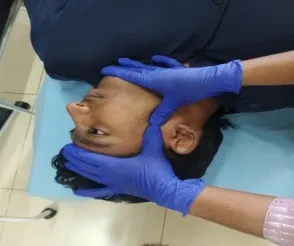
TMJ medial and lateral glide
|
Patient position: Supine lying Therapist position: Standing near to the patient Procedure: The therapist left hand hold around the patient’s head, fix head against the table. Right hand is positioned, so that the hypothenar eminence is placed just caudal to the right temporomandibular joint. The fingers wrapped around the patient jaw. Asked the patient to swallow. The hypothenar eminence acts as a pivot joint as the mandible is glided forward and medially to the right. |
|
TMJ Caudal traction

|
Patient position: Supine lying Therapist position: Standing near to the patient Procedure: Standing at the patient’s side and faces right side of the patient’s head. Left hand and forearm are placed around patient’s head, fixating head against table. Right hand holds, with thump in the mouth over the right inferior molars and with the fingers outside around the patient’s jaw. Asked the patient to swallow. While maintaining the forearm in a straight line, apply traction caudally. |
The table shows that Maitland mobilization technique for temporo mandibular joint dysfunction patient.
|
Rocabados exercises |
Treatment procedure |
|
Tongue at rest position

|
Patient position: Sitting Therapist position: Standing near to the patient Procedure: Ask the patient to place the front one third of the tongue gently against the roof of the mouth just behind the front teeth. The patient should hold the tongue in that position while breathing in and out through the nose. |
|
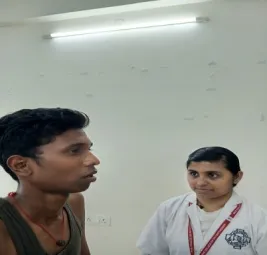
Controlled TMJ rotation and opening
|
Patient position: Sitting Therapist position: Standing near to the patient Procedure: Ask the patient to place the front one third of the tongue gently against the roof of the mouth just behind the front teeth. Patient should hold tongue in that position while slowly opening and closing the mouth |
|
Mandibular rhythmic stabilization

|
Patient position: Sitting Therapist position: Standing near to the patient Procedure: Ask the patient to place the tongue at the roof of the mouthjust behind the front teeth. The patient should place a fist under the chin andApply light resistance while opening the mouth. Hold this position for few seconds. |
|
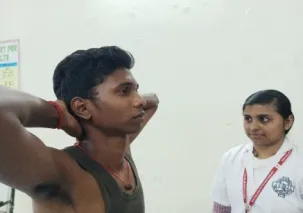
Stabilized head flexion
|
Patient position: Sitting Therapist position: Standing near to the patient Procedure: Ask the patient to place both hands behind their head with finger interlocked or clasp. The head should be straight then gently apply pressure to the head for controlled flexion. |
|
Axial extension of cervical spine

|
Patient position: Sitting Therapist position: Standing near to the patient Procedure: Ask the patient to sit up straight and pull the chin backward or trying to make a double chin, while keeping the head and neck tall and straight. |
|
Shoulder girdle retraction

|
Patient position: Sitting Therapist position: Standing near to the patient Procedure: This exercise aimed to correct abnormal scapular protraction by promoting shoulder girdle retraction and also promote good breathing pattern. Ask the patient to sit straight than squeeze shoulder blades back and together. |
The table shows that Rocabados exercises for temporo mandibular joint dysfunction patient.
RESULT
|
|
Groups |
Test |
Mean |
Mean difference |
Standard deviation |
Paired t value |
||||
|
Pain |
Group A |
Pre test |
7.13 |
3.6 |
0.909 |
15.326 |
||||
|
Post test |
3.53 |
|||||||||
|
Group B |
Pre test |
6.8 |
2.6 |
0.632 |
15.92 |
|||||
|
Post test |
4.2 |
|||||||||
|
Mouth opening |
Group A |
Pre test |
2.82 |
0.56 |
0.248 |
8.817 |
||||
|
Post test |
3.39 |
|||||||||
|
Group B |
Pre test |
2.828 |
0.742 |
0.279 |
10.247 |
|||||
|
Post test |
3.57 |
|||||||||
|
Functional ability |
Group A |
Pre test |
5.74 |
0.62 |
0.230 |
11.319 |
||||
|
Post test |
5.12 |
|||||||||
|
Group B |
Pre test |
5.56 |
0.63 |
0.168 |
26.708 |
|||||
|
Post test |
4.93 |
|||||||||
|
The table shows mean value, mean difference, standard deviation and paired ‘t’ value between pre test and post test scores of pain, mouth opening and functional ability among Group A and Group B. |
||||||||||
|
|
Groups |
Mean |
Mean difference |
Standard deviation |
Unpaired t value |
|||||
|
Pain |
Group A |
2.6 |
1 |
0.784 |
3.49 |
|||||
|
Group B |
3.6 |
|||||||||
|
Mouth opening |
Group A |
0.56 |
0.182 |
0.264 |
27.08 |
|||||
|
Group B |
0.742 |
|||||||||
|
Functional ability |
Group A |
0.62 |
0.01 |
0.196 |
17.33 |
|||||
|
Group B |
0.63 |
|||||||||
The table shows mean value, mean difference, standard deviation and unpaired t value between Group A and Group B scores of pain, mouth opening and functional ability.
DISCUSSION
The aim of the study is to compare the effectiveness of rocabado exercises on pain mouth opening and functional ability among patients with temporomandibular dysfunction.
The above study is supported by Merve et al., (2023) conducted a study to determine the effect of core stability training on pain, function, quality of life and posture in individuals with temporomandibular disorder. It consists of two groups core stability group and control group. Rocabados exercise is applied for control group and spinal stabilization is applied for core stability group for 6 weeks. The outcome of the study is chronic pain scale, oral health impact profile-14 (OHLP-14), jaw functional limitation scale (JFLS), new york scale. The result of the study is both the exercises are effective in quality of life and oral health. rocabado execise provide significant changes in chronic pain scale, disability score. It concluded that core stability training with rocabado exercises provides more significant changes.
Hence the null hypothesis is rejected.
CONCLUSION
A comparative study was conducted to the effectiveness of rocabado exercise on pain mouth opening and functional ability among patients with temporomandibular dysfunction.
30 subjects with temporomandibular joint dysfunction were included in the study and randomly divided into two equal groups. Group A - Maitland mobilization technique, Group B - Maitland mobilization technique and Rocabado exercises.
Pain, mouth opening and functional ability were assessed before and after intervention by numerical pain rating scale, ruler method and jaw functional limitation scale.
From statistical results, it is concluded that the rocabado exercises and Maitland mobilization technique are effective in the management of pain, mouth opening and functional ability among patients with temporomandibular joint dysfunction.
Limitation
Suggestion
REFERENCES



Sneha Sureshkumar*, Mahalakshmi S., Franklin Shaju. M. K., A Comparative Study On The Effectiveness Of Rocabado Exercises In The Management Of Pain, Mouth Opening And Functional Ability In Subjects With Temporomandibular Joint Dysfunction, Int. J. Sci. R. Tech., 2026, 3 (6), 1307-1313. https://doi.org/10.5281/zenodo.20797179
 10.5281/zenodo.20797179