

We use cookies to ensure our website works properly and to personalise your experience. Cookies policy
R.V.S College Of Physiotherapy, Coimbatore, The Tamil Nadu Dr. M.G.R. Medical University, Chennai, Tamil Nadu, India.
Effectiveness of Extracorporeal Shock Wave Therapy and hip abductor strengthening exercise in the management of pain and functional ability among runners with Medial Tibial Stress Syndrome. Background: Medial Tibial Stress Syndrome (MTSS), commonly known as shin splints, is a frequent overuse injury among runners caused by repetitive stress on the tibia. It often results in pain and reduced functional ability. Objective: To determine the effectiveness of extracorporeal shock wave therapy (ESWT) combined with hip abductor strengthening exercises in reducing pain and improving functional ability among runners with medial tibial stress syndrome. Methods: A pre-test and post-test experimental study was conducted among 15 runners diagnosed with medial tibial stress syndrome. Participants received extracorporeal shock wave therapy along with hip abductor strengthening exercises for four weeks. Pain was assessed using a Pressure Pain Threshold Algometer, and functional ability was measured using the Lower Extremity Functional Scale (LEFS). Data were analyzed using a paired t-test. Results: The results showed significant improvement in pain and functional ability after the intervention. The calculated paired t-value for pain was 14.80 and for functional ability was 16.28, which were higher than the table value of 2.977 at the 0.005 level of significance. Conclusion: Extracorporeal shock wave therapy combined with hip abductor strengthening exercises is effective in reducing pain and improving functional ability in runners with medial tibial stress syndrome.
Medial Tibial Stress Syndrome (MTSS), commonly referred to as shin splints, is characterized by exercise-induced pain along the distal third of the posteromedial tibial border. It typically occurs due to repetitive loading stress during activities such as running and jumping. MTSS is one of the most common overuse injuries in athletes, with incidence rates ranging from 4% to 35%. Recreational runners account for approximately 13–20% of lower-leg injuries, while track and field athletes show an incidence rate between 9% and 16%.
The condition is more frequently observed in female athletes than males. Biomechanical factors such as excessive foot pronation, limited ankle dorsiflexion, tight calf muscles, tibial varus alignment, and weakness of hip abductors and external rotators contribute significantly to the development of MTSS. These abnormalities increase stress along the medial tibial border, leading to pain and functional limitations.
The pathophysiology of MTSS is thought to involve periosteal irritation or bone stress reaction due to repeated traction forces from surrounding muscles. If left untreated, the condition may progress to stress fractures of the tibia.
Various treatment methods have been proposed for MTSS, including rest, activity modification, ice therapy, stretching, strengthening exercises, and orthotic support. Recently, Extracorporeal Shock Wave Therapy (ESWT) has gained attention as a non-invasive treatment modality for musculoskeletal disorders. ESWT produces high-pressure acoustic waves that stimulate tissue healing and reduce pain.
Strengthening of hip abductors is also important because weakness in these muscles can lead to altered lower limb biomechanics during running, increasing tibial stress.
Therefore, the present study aims to evaluate the effectiveness of extracorporeal shock wave therapy combined with hip abductor strengthening exercises in reducing pain and improving functional ability among runners with medial tibial stress syndrome.
METHODOLOGY
Study setting
The study was conducted in Physiotherapy outpatient department of RVS College Of Physiotherapy.
Study design and study duration
The study design was a pre test and post test experimental study conducted over a period of 4 months.
Inclusion criteria
Exclusion criteria
Orientation to subjects
Before the collection of data all the subjects were explained about the purpose of the study. The invigilator had given a detailed orientation about the various test procedure such as Pressure Pain Threshold Algometer to measure pain and Lower Extremity Functional Scale (LEFS) to measure functional ability. The concern and full cooperation of each participant was sought after complete explanation of the condition and demonstration of the procedure involved in the study.
Procedure
Measurement procedure
A. Pressure Pain Threshold Algometer
The Pressure Pain Threshold Algometer is a subjective measure of pain. The algometer probe is applied perpendicular to the test site, and pressure is increased gradually. The patient is instructed to indicate when the pressure is applied.
B. Lower Extremity Functional Scale
The Lower Extremity Functional Scale (LEFS) is an outcome measure for the measurement of lower extremity function. The LEFS consist of 20 items, with score ranging from 0 (extreme difficulty / unable to perform activity) to 4 (no difficulty). The total score can be obtained by summing the scores of 80 which indicates no functional limitation and the minimum score of 0 indicates extreme limitation.
Treatment procedure
A. Extracorporeal Shock Wave Therapy (ESWT)
Procedure:
The patient is lying in supine with their knees slightly flexed and rested on pillow. Place the extracorporeal shock wave therapy head perpendicular to the medial side of shin of the tibia. The treatment given with the frequency of 10 Hz, bar strength of 2.7 and 2000 pulses. The head of extracorporeal shock wave therapy is moving from proximal aspect to distal aspect of tibia. The procedure is repeated with an interval of 5 days between each session.
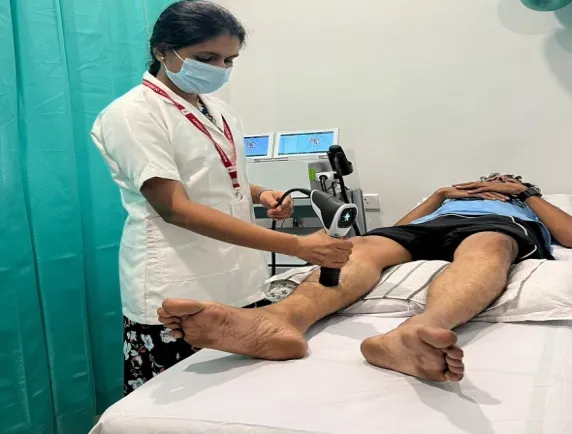
Application of Extracorporeal Shock Wave Therapy
B. Hip abductor strengthening exercise
1. Side lying hip abduction exercise
Procedure:
The patient asked to lie on the side with legs straight and feet to touching. Slowly lift top leg, keeping knee straight. Lift leg to a comfortable height, typically around 30-40 degrees. Hold the position for 10 seconds. Slowly lower leg back.
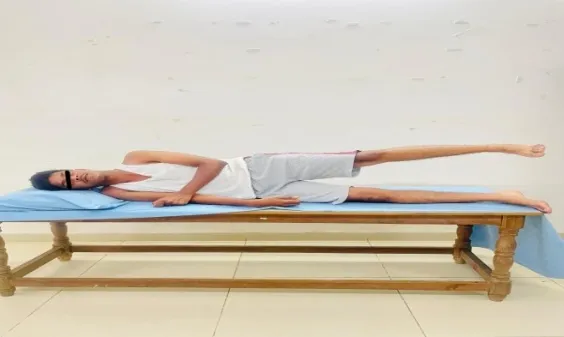
Hip Abduction Exercise.
2. Calm shell’s exercise
Procedure:
The patient asked to lie on side with legs bent and feet touching and a resistance band in between the knees. Keep knees together and ankle touching. Slowly lift top knee away from bottom knee keeping feet together. Hold the position for 10 seconds. Slowly lower top knee back to starting position.
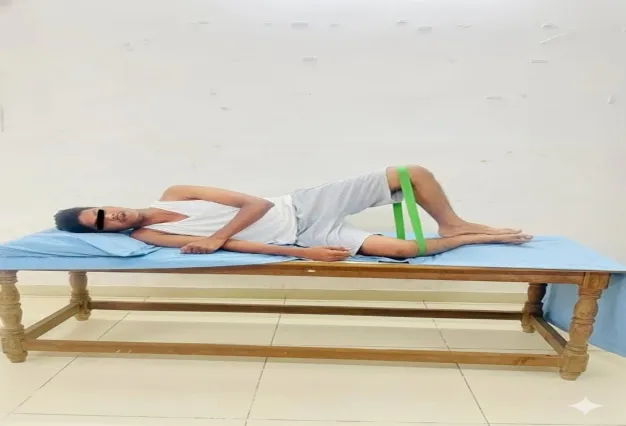
Calm shell’s exercise.
3. Side lunges
Procedure:
The patient asked to stand with feet hip width apart or together. Ask patient to take a large step to one side keeping back straight and front knee behind toes. Then lower body down into a lunge bending front knee and keep back leg straight. Ask patient to keep weight in front heel and push hip back, lower down until thigh is parallel to the ground. Slowly push back to starting position.
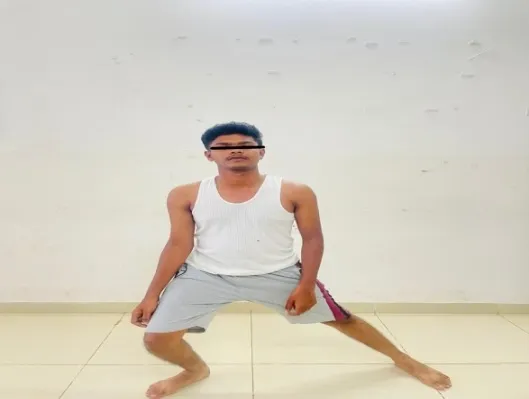
Side Lunges.
4. Single leg bridging
Procedure:
The patient is asked to lie on back with knees apart, bent and feet flat on bed. Then lift one leg off the bed, keeping it straight. Slowly lift hips off the ground, squeezing gluteus and lower back muscles. Hold the position for 10 seconds. Slowly lower hip back.
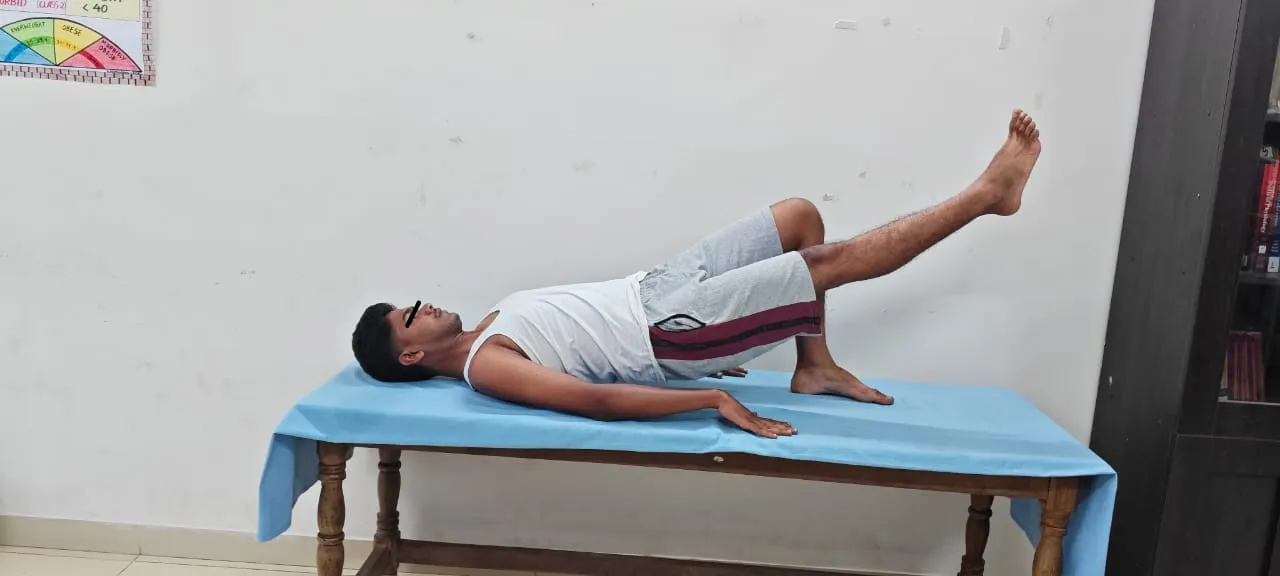
Single leg bridging.
DATA ANALYSIS AND RESULTS
|
Variables |
Pre test Mean |
Mean difference |
Standard deviation |
Paired ‘t’ test |
|
Post test Mean |
||||
|
Pain |
55.8 |
16.4 |
0.286 |
14.80 |
|
72.2 |
||||
|
Functional ability |
61.4 |
3.9 |
0.918 |
16.28 |
|
57.5 |
*0.005 level of significance
Table : 1 Shows mean value, mean difference, standard deviation and paired ‘t’ test value between pre and post test of pain and functional ability.
The calculated paired ‘t’ value of pain and functional disability is 14.80 and 16.28 respectively and the ‘t’ value is 2.977 at 0.005 level of significance. Since the calculated ‘t’ is more than the ‘t’ table shows there is a significant difference in pain and functional disability followed by extracorporeal shock wave therapy and hip abductor strengthening exercise among runners with medial tibial stress syndrome.
DISCUSSION
The aim of the study to find out the effectiveness of Extracorporeal shock wave therapy and hip abductor strengthening exercise in reducing pain and improving functional ability followed by Medial tibial stress syndrome among runners. Before and after treatment pain and functional ability is assessed by pressure pain threshold algometer and lower extremity functional scale.
The results of the present study shows that there is a significant difference in pain and improving functional ability following intervention of Extracorporeal shock wave therapy and hip abductor strengthening exercise among runners with medial tibial stress syndrome
The results supported by Bijan et al., (2022) conducted a study on effectiveness of extracorporeal shock wave therapy for treating medial tibial stress syndrome. Three studies comparing extracorporeal shock wave therapy with control groups were included and all used focuses shock wave therapy. The results showed that extracorporeal shock wave therapy reduce pain, shortened recovery time, and improved patient satisfaction.
The result supported by Shreen et al., (2024) conducted study on hip abductor strength training improve movement patterns in runners with medial tibial stress syndrome. The control group doing regular exercise and experimental group doing same plus hip abductor training. The study concludes that combining hip abductor strength training with traditional therapy effectively improves lower kinematics and reduce medial tibial stress syndrome.
CONCLUSION
An experiment study was conducted to investigate the effect of Extracorporeal shock wave therapy and hip abductor strengthening exercise among runners with medial tibial stress syndrome.
The statistical results show that there is significant reduction in pain and functional ability following medial tibial stress syndrome among runners.
Limitations
Suggestions
REFERENCES



Arya Mohanan*, Mahalakshmi S., Franklin Shaju M. K., Effectiveness Of Extracorporeal Shock Wave Therapy And Hip Abductor Strengthening Exercise In The Management Of Pain And Functional Ability Among Runners With Medial Tibial Stress Syndrome, Int. J. Sci. R. Tech., 2026, 3 (6), 1288-1293. https://doi.org/10.5281/zenodo.20796994
 10.5281/zenodo.20796994