

We use cookies to ensure our website works properly and to personalise your experience. Cookies policy
Little Flower College Of Nursing, Trivandrum
Muscle cramps are among the most common complications experienced by patients undergoing hemodialysis. These sudden, painful, and involuntary muscle contractions can lead to discomfort, disrupt dialysis sessions, and adversely affect patients' quality of life. A quantitative study was conducted to assess the severity of leg muscle cramps among hemodialysis patients and to determine the effectiveness of leg exercises in reducing muscle cramps, A quasi-experimental pre-test–post-test control group design was employed with 30 patients undergoing hemodialysis, 15 participants in experimental group and 15 in control group. Data were collected using a demographic data sheet and a standardized muscle cramp assessment tool. Following the pre-test assessment, participants in the experimental group performed a structured exercise program consisting of ankle pump exercises, ankle rotation exercises, and calf stretching exercises for 10 minutes during each dialysis session. Baseline findings indicated that 73.3% (n = 22) of participants experienced moderate muscle cramps, 16.7% (n = 5) experienced severe muscle cramps, and 10.0% (n = 3) were at risk of developing muscle cramps. Comparison of pre-test and post-test scores of the experimental and control group revealed a statistically significant reduction in muscle cramp severity among participants who received the exercise intervention. Conclusion: Structured leg exercises, including ankle pumps, ankle rotations, and calf stretching, were effective in reducing the severity of muscle cramps. Including exercise on a regular basis during dialysis is beneficial in reducing muscle cramps in hemodialysis patients.
Kidneys play a fundamental role in preserving the internal environment of the body. Their functions include the excretion of metabolic waste products, regulation of blood pressure, maintenance of fluid balance, and control of electrolyte concentrations. However, due to various conditions it can deteriorate renal function, resulting in kidney disease. Kidney disease may be classified as acute or chronic, depending on its onset and duration. Chronic kidney disease (CKD) is characterized by a gradual and progressive decline in kidney function over time. As kidney function slows, the accumulation of waste products and excess fluids in the body increases, eventually leading to end-stage renal disease (ESRD). The primary treatment options for ESRD include kidney transplantation and dialysis. Although kidney transplantation offers a permanent improvement, many patients depend on dialysis due to limitations such as donor availability, financial constraints, and medical suitability1.Although it is a life-sustaining treatment, hemodialysis is associated with a number of complications. Common complications include hypotension, fatigue, nausea, vomiting, and headache, infection at the vascular access site, thrombosis, bleeding, electrolyte disturbances, anemia, and muscle cramps2. Among these complications, muscle cramps are frequently reported and can significantly affect patient comfort during dialysis sessions. Muscle cramps are sudden, involuntary, and painful contractions of skeletal muscles, most commonly affecting the lower limbs. Their occurrence during hemodialysis has been widely documented, with prevalence rates reported to range from approximately 35% to 80% among patients receiving treatment. Severe muscle cramps cause significant distress during dialysis session and interfere with daily life. Various treatment approaches have been utilized to manage muscle cramps, including administration of saline solutions, glucose-containing fluids, sodium profiling, and vitamin supplementation3. Despite these interventions, achieving consistent and effective prevention remains challenging. In recent years, increasing attention has been directed toward non-pharmacological strategies for managing hemodialysis-related complications. Exercise are found to bring a better outcome. Structured leg exercises performed during dialysis sessions may help reduce the occurrence and severity of muscle cramps while enhancing patient comfort. Therefore, evaluating the effectiveness of exercise-based interventions among hemodialysis patients is important for developing evidence-based strategies to improve treatment outcomes and quality of life.
NEED FOR THE STUDY
Hemodialysis in patients with ESRD is frequently associated with several complications that adversely affect patient’s physical well-being and quality of life. Among these complications, muscle cramps are one of the most common and distressing symptoms experienced during dialysis sessions. They are usually seen at the end of dialysis session and interfere with the process. Frequent cramping not only causes significant discomfort but may also result in premature termination of dialysis sessions, thereby compromising treatment adequacy and patient outcomes. Exercise have seen to be improving in reducing cramping and emerged as a promising intervention. Simple leg exercises, such as ankle pumps, ankle rotations, and calf stretching, may enhance blood circulation, improve muscle flexibility, promote neuromuscular function, and reduce the severity of muscle cramps4. Although several studies have examined the benefits of exercise among hemodialysis patients, limited evidence is available regarding the effectiveness of structured leg exercises specifically for the prevention and management of intradialytic muscle cramps. Furthermore, data from local healthcare settings remain scarce. Evaluating the effectiveness of leg exercises in reducing muscle cramps may provide valuable evidence for the development of nursing interventions aimed at improving patient comfort and treatment outcomes.
METHODOLOGY
A quantitative research approach was used to find the effectiveness of leg exercises in reducing muscle cramps among patients undergoing hemodialysis. The study utilized a quasi-experimental pre-test–post-test control group design. The research was conducted in the hemodialysis unit of Jubilee Memorial Hospital, Trivandrum, and Kerala. A total of 30 participants were included in the study, who were on dialysis treatment and reporting incidence of muscle cramps, with 15 assigned to the experimental group and 15 to the control group. One day the clients were assigned to experimental group and the next day to control group. Randomization was avoided in the study to avoid contamination of the control group as exercise was demonstrated to the experimental group. Pre muscle cramp assessment done to both experimental and control group. Following the pre-test assessment, participants in the experimental group received a structured leg exercise program consisting of Ankle pump exercises, Ankle rotation exercises and Calf stretching exercises. The exercise was performed for five consecutive days and instructed to a keep diary to monitor adherence. Participants in the control group received routine care provided by the dialysis unit and did not participate in the exercise program .Post-intervention assessment was carried out on the fifth day for both groups using the same muscle cramp assessment tool. The post-test findings were compared with baseline measurements to determine the effectiveness of the leg exercise intervention.
RESULT
Demographic and Clinical Characteristics
In the experimental group, six (40%) participants were aged between 50 and 59 years, six (40%) were above 60 years of age, and three (20%) belonged to the 40–49 years age group. In the control group, the majority of the participants, 10 (66.7%), were above 60 years of age, four (26.7%) participants in the 50–59 years age group and one (6.7%) participant in the 40–49 years age group.
The experimental group consisted predominantly of males, with 13 (86.7%) male participants and two (13.3%) female participants. In the control group 11 (73.3%) were males and four (26.7%) females, indicating that males constituted the majority of participants in both groups.
Regarding the duration of kidney disease, six (40%) participants in the experimental group had been diagnosed with kidney disease for 1–3 years, while four (26.7%) had the disease for less than one year. Three (20%) participants had experienced kidney disease for 4–6 years, and two (13.3%) had been living with the disease for more than six years. In the control group too six (40%) had a disease duration of 1–3 years and 4–6 years. Two (13.3%) participants had the disease for more than six years, and only one (6.7%) participant had a disease duration of less than one year.
In the experimental group, 14 (93.3%) participants received dialysis twice weekly, while only one (6.7%) participant underwent dialysis three times per week. In the control group, 13 (86.7%) participants underwent dialysis twice weekly, whereas one (6.7%) participant underwent dialysis once a week and another one (6.7%) underwent dialysis three times a week.
In the experimental group, nearly half of the participants, 7 (46.7%), had both diabetes mellitus (DM) and hypertension (HTN). Four (26.7%) participants had hypertension alone, while two (13.3%) had diabetes mellitus alone, and another two (13.3%) reported no lifestyle disease. In the control group, the majority of participants, eight (53.3%), had both diabetes mellitus and hypertension. Six (40%) participants had hypertension alone, and (6.7%) had diabetes mellitus alone, and none of the participants reported the absence of lifestyle diseases.
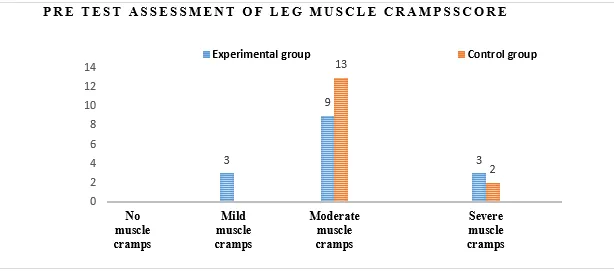
Fig. No. 1 Pretest Assessment of leg muscle cramps among hemodialysis patients
Among the participants in the experimental group, 3 (20%) had mild muscle cramps, 9 (60%) had moderate muscle cramps, and 3 (20%) had severe muscle cramps during the pre-test . In the control group, the majority of the participants, 13 (86.7%), had moderate muscle cramps, while 2 (13.3%) had severe muscle cramps. None of the participants in the control group experienced mild muscle cramps.
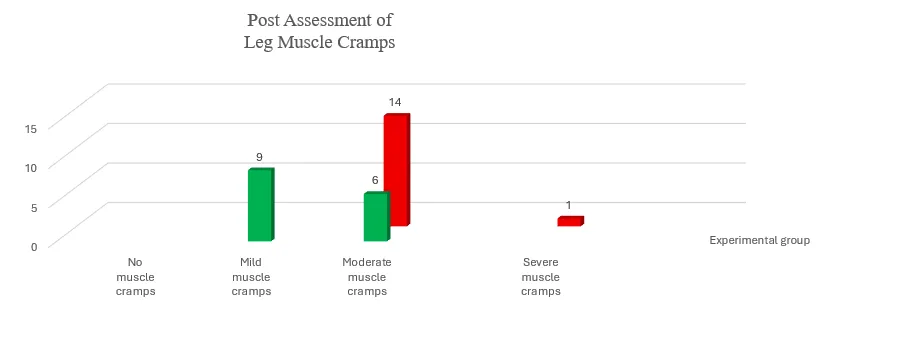
Fig. No.2 Posttest Assessment of leg muscle cramps among hemodialysis patients
During the post test in experimental group 9(60%) had mild pain 6 (40%) had moderate pain and none had severe pain and in control group14 (93%) and one (7%) had severe pain
The control group showed a negligible reduction in muscle cramp scores from 9.87 ± 1.30 to 9.80 ± 1.08. The paired t-test value of 0.32 was not statistically significant (p > 0.05), indicating that no meaningful reduction in muscle cramps occurred without the intervention.
In contrast, the experimental group demonstrated a marked reduction in muscle cramp scores from 9.07 ± 1.98 to 6.47 ± 1.64. The paired t-test value of 7.76 was highly statistically significant (p < 0.001), indicating that the leg exercise effectively reduced muscle cramps among the participants.
Effectiveness of Leg Exercise on Muscle Cramps among Hemodialysis Patients
|
Muscle Cramp |
PreTest Mean± SD |
Post Test Mean ± SD |
Mean difference |
Paired t |
p value |
|
Control Group |
9.87±1.30 |
9.80±1.08 |
0.07 |
0.32 |
>0.05 (NS) |
|
Experimental Group |
9.07±1.98 |
6.47 ± 1.64 |
2.60 |
7.76 |
<0.001** |
** Highly significant NS: Not significant
Association between muscle cramps and selected demographic variables
The findings revealed a statistically significant association between the severity of muscle cramps and gender (χ² = 6.66, critical value = 5.99) and duration of kidney disease (χ² = 13.82, critical value = 12.59). Since the calculated chi-square values exceeded the corresponding critical values, the null hypothesis was rejected for these variables, indicating a significant association with the severity of muscle cramps among the study participants.
However, no statistically significant association was found between the severity of muscle cramps and age (χ² = 3.81, critical value = 7.815), duration of dialysis (χ² = 4.34, critical value = 12.59), frequency of dialysis (χ² = 2.66, critical value = 12.59), or lifestyle diseases (χ² = 7.70, critical value = 12.59), as the calculated chi-square values were lower than the corresponding critical values. Therefore, the null hypothesis was accepted for these variables, suggesting that they were not significantly associated with the severity of muscle cramps in the present study population.
DISCUSSION
Muscle cramps are among the most common and distressing complications experienced during hemodialysis, often leading to discomfort, interruption of dialysis sessions, and reduced quality of life. The present study evaluated the effectiveness of structured intradialytic leg exercises in reducing the severity of muscle cramps among patients undergoing maintenance hemodialysis.
The majority of individuals in both groups had mild muscle cramps at baseline. Patients with both diabetes mellitus and hypertension, as well as those receiving dialysis for one to three years, had a higher incidence of cramps. This suggests that multiple comorbidities and chronic dialysis exposure may enhance vulnerability to muscular cramps.
The study's main conclusion was the significant reduction in muscle cramp severity following five consecutive days of structured leg exercises. While the control group showed no discernible improvement, the experimental group showed a substantial drop in mean muscular cramp ratings (9.07 ± 1.98 to 6.47 ± 1.64; t = 7.76, p < 0.001). These results suggest that systematic intradialytic leg exercises are a successful non-pharmacological treatment for hemodialysis patients' muscle cramps.
The present findings are consistent with a study which found that when compared to standard care, intradialytic stretching exercises considerably decreased the frequency and intensity of leg muscular cramps. Shraida et al. (2021), Similarly, in a recent randomized controlled trial , a nurse-led intradialytic stretching program successfully decreased the burden of muscle cramps and enhanced patient comfort.( El-Said et al. 2025). This finding supports the integration of structured exercise into regular dialysis therapy.
A meta-analysis examined randomized controlled trials assessing non-pharmacological treatments for muscle cramps in hemodialysis patients, provides additional support for the findings. The effectiveness of planned leg exercises, as shown in this trial, was reinforced by the authors' conclusion that exercise-based therapies dramatically reduced muscular cramping and improved patient outcomes. ( Kesik and Altinok Ersoy 2023),
The result of this study is supported by a study that discovered a correlation between muscle cramps and parameters related to dialysis, longer sedentary behavior, lower physical functioning, and greater body mass index. The study highlighted the value of physical activity in reducing muscle-related symptoms, which is consistent with the positive benefits seen in the current study, even though it concentrated on predictors rather than therapies. (Kot et al. 2024)
Overall, the results point to planned intradialytic leg exercises as a straightforward, safe, affordable, and scientifically supported nursing intervention for hemodialysis patients' muscle cramps. Including these exercises in regular dialysis sessions may increase treatment tolerance, improve patient comfort, and improve overall quality of life.
CONCLUSION
The findings of the study provide significant insights into the effectiveness of leg exercises in reducing the level of leg muscle cramps among hemodialysis patients.In comparison to the control group, patients in the experimental group demonstrated a statistically significant improvement in post-test muscular cramp scores, indicating the efficacy of the intervention. The majority of the chosen demographic factors did not significantly correlate with the degree of leg muscle cramping. The results lay the groundwork for future nursing research on non-pharmacological treatment of muscular cramping and support the integration of basic leg exercise regimens into standard nursing care during hemodialysis.
REFERENCES




Rani Catherine K. V.*, Geethu BL, Anupama Vincent, Ancita Joseph, Relieving Muscle Cramps Through Leg Exercises: A Quasi-Experimental Study Among Hemodialysis Patients, Int. J. Sci. R. Tech., 2026, 3 (7), 716-721. https://doi.org/10.5281/zenodo.21471620
 10.5281/zenodo.21471620