

We use cookies to ensure our website works properly and to personalise your experience. Cookies policy
1Shri Gurudatta Shikshan Prasarak Sanstha Institute Of Pharmacy Kaulkhed, Akola
2PRMMS Anuradha College of Pharmacy Chikhli
Gastrointestinal tract (GIT) disorders are among the most common health problems worldwide, affecting millions of people and significantly impacting quality of life. Common disorders include indigestion, gastritis, peptic ulcer disease, constipation, diarrhea, inflammatory bowel disease, and irritable bowel syndrome. Conventional therapies provide symptomatic relief but are often associated with adverse effects during long-term use. Ayurveda, the traditional system of medicine practiced in India for thousands of years, offers a holistic approach to the prevention and treatment of GIT disorders through the use of medicinal herbs, dietary modifications, and lifestyle management. Numerous Ayurvedic herbs possess gastroprotective, anti-inflammatory, antioxidant, antimicrobial, carminative, laxative, and digestive properties that contribute to maintaining gastrointestinal health. Herbs such as Zingiber officinale (Ginger), Curcuma longa (Turmeric), Emblica officinalis (Amla), Terminalia chebula (Haritaki), Glycyrrhiza glabra (Licorice), Aegle marmelos (Bael), and Mentha piperita (Peppermint) have demonstrated significant therapeutic potential in various experimental and clinical studies. This review summarizes the traditional uses, pharmacological activities, and scientific evidence supporting the efficacy of Ayurvedic herbs in managing GIT disorders. The article also highlights their mechanisms of action and future prospects in integrative healthcare.
The gastrointestinal tract (GIT) is responsible for digestion, absorption of nutrients, metabolism, and elimination of waste products. Disorders affecting the GIT are increasingly prevalent due to unhealthy dietary habits, stress, sedentary lifestyles, infections, and excessive use of medications. Conditions such as gastritis, gastroesophageal reflux disease (GERD), peptic ulcers, constipation, diarrhea, inflammatory bowel disease (IBD), and irritable bowel syndrome (IBS) represent major healthcare challenges.Ayurveda describes digestive health through the concept of Agni (digestive fire), which governs digestion and metabolism. Impaired Agni leads to the formation of Ama (toxins), resulting in various gastrointestinal disorders. Ayurvedic treatment focuses on restoring digestive balance through herbal remedies, dietary interventions, detoxification therapies, and lifestyle modifications.[1]
Many Ayurvedic medicinal plants contain bioactive constituents such as flavonoids, alkaloids, tannins, terpenoids, glycosides, and polyphenols that exert protective effects on the digestive system. These herbs are increasingly being investigated scientifically for their therapeutic potential and safety.[2]
|
Disorder |
Modern Description |
Ayurvedic Correlation |
|
Gastritis |
Inflammation of gastric mucosa |
Amlapitta |
|
Peptic Ulcer |
Ulceration of stomach/duodenal lining |
Parinama Shoola |
|
Constipation |
Difficult bowel evacuation |
Vibandha |
|
Diarrhea |
Frequent loose stools |
Atisara |
|
IBS |
Functional bowel disorder |
Grahani |
|
GERD |
Acid reflux disease |
Urdhwaga Amlapitta |
|
IBD |
Chronic intestinal inflammation |
Pravahika/Grahani |
Table : Gastrointestinal Disorders and Their Ayurvedic Perspective[3,4]
Ayurvedic Concept of Gastrointestinal Tract (GIT)
In Ayurveda, the gastrointestinal tract is considered the foundation of health and disease. Proper digestion and metabolism are governed by Agni (digestive fire), which is responsible for the transformation of food into nutrients and energy. According to Ayurvedic principles, a balanced digestive system maintains physical, mental, and emotional well-being, whereas impaired digestion leads to the accumulation of Ama (toxic metabolic waste), which is regarded as the root cause of many diseases.[5]
|
Ayurvedic Concept |
Function in GIT |
Disorders Due to Imbalance |
|
Agni (Digestive Fire) |
Digestion, absorption, and metabolism of food |
Indigestion, gastritis, constipation |
|
Ama (Toxins) |
Byproduct of impaired digestion |
Bloating, diarrhea, inflammation |
|
Vata Dosha |
Controls intestinal movement and peristalsis |
Constipation, flatulence, IBS |
|
Pitta Dosha |
Regulates digestion and enzyme activity |
Hyperacidity, gastritis, ulcers |
|
Kapha Dosha |
Protects and lubricates GIT mucosa |
Sluggish digestion, heaviness |
|
Grahani |
Responsible for digestion and nutrient absorption |
Malabsorption, chronic diarrhea, IBS |
|
Annavaha Srotas |
Food transport and digestion |
Dyspepsia, loss of appetite |
|
Purishavaha Srotas |
Formation and elimination of feces |
Constipation, diarrhea |
Table: Ayurvedic Concept of Gastrointestinal Tract (GIT)[6,7,8]
Ayurvedic Pathogenesis of GIT Disorders
According to Ayurveda, the primary cause of gastrointestinal (GIT) disorders is the impairment of Agni (digestive fire). Healthy digestion depends on the proper functioning of Agni, which is responsible for the digestion, absorption, and assimilation of nutrients. When Agni becomes weak (Mandagni) due to improper diet, unhealthy lifestyle, stress, or irregular eating habits, food is not completely digested. This results in the formation of Ama, a toxic metabolic byproduct that accumulates within the body.The accumulated Ama obstructs the digestive channels (Annavaha and Purishavaha Srotas) and disturbs the balance of the three Doshas—Vata, Pitta, and Kapha. This imbalance impairs the function of Grahani (the digestive and absorptive organ), leading to defective digestion, absorption, and elimination. Consequently, various gastrointestinal disorders such as Ajirna (indigestion), Amlapitta (hyperacidity/gastritis), Atisara (diarrhea), Vibandha (constipation), and Grahani Roga (IBS-like disorders) develop.Thus, Ayurvedic management focuses on strengthening Agni, eliminating Ama, restoring Dosha balance, and improving the function of Grahani to maintain gastrointestinal health and prevent disease progression.[9,10]
|
Ayurvedic Factor |
Pathogenesis |
|
Weak Digestion (Mandagni) |
Impaired digestive fire leads to incomplete digestion of food. |
|
Formation of Ama |
Undigested food is converted into Ama (toxins), which accumulates in the body. |
|
Dosha Imbalance |
Ama aggravates Vata, Pitta, and Kapha doshas, disturbing normal gastrointestinal function. |
|
Srotas Obstruction |
Ama blocks the digestive channels (Annavaha and Purishavaha Srotas), impairing nutrient absorption and waste elimination. |
|
Grahani Dysfunction |
The digestive organ (Grahani) loses its ability to properly digest and absorb food. |
|
Disease Manifestation |
Results in disorders such as Ajirna (indigestion), Amlapitta (gastritis/hyperacidity), Atisara (diarrhea), Vibandha (constipation), and Grahani (IBS-like disorders). |
Table: Ayurvedic Pathogenesis of GIT Disorders[11,12]
Single Herbs Used Against GIT Disorders
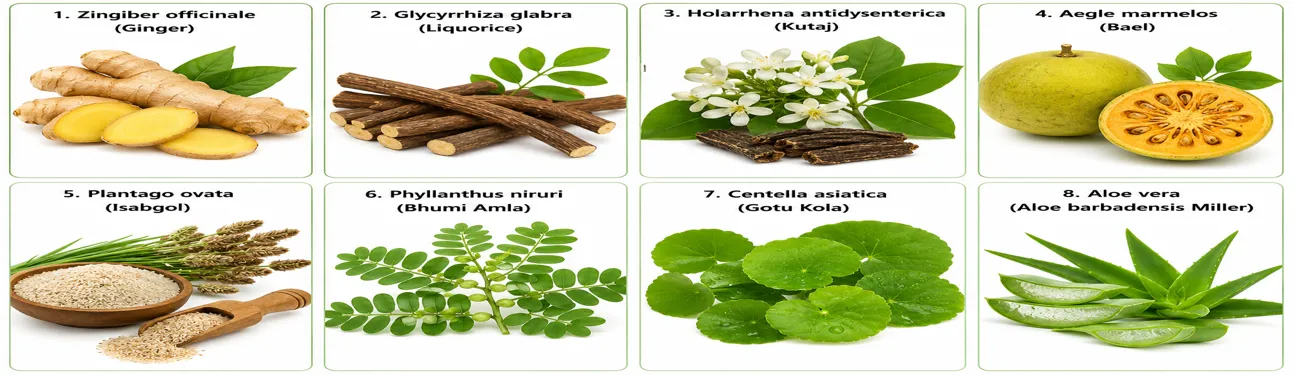
A. Zingiber officinale (Ginger):
Zingiber officinale (Shunthi/Ardraka) is widely used in Ayurveda for the management of digestive disorders. It helps reduce gas, improves appetite, prevents vomiting, relieves bloating, and supports healthy digestion while balancing Vata and Kapha doshas. Ginger contains bioactive compounds such as gingerols, shogaols, and essential oils, which possess anti-inflammatory, antioxidant, and gastroprotective properties. It acts by inhibiting inflammatory enzymes, enhancing digestive enzyme activity, and protecting the gastric mucosa from oxidative damage. Clinical studies have demonstrated its effectiveness in reducing nausea, vomiting, and symptoms of indigestion.[13]
B. Glycyrrhiza glabra (Liquorice/Yashtimadhu):
Glycyrrhiza glabra is an important Ayurvedic herb used to pacify aggravated Pitta and promote healing of gastric and duodenal ulcers. It contains glycyrrhizin, flavonoids, and polysaccharides that exhibit anti-ulcer, anti-inflammatory, and antimicrobial activities. Liquorice enhances mucus secretion, inhibits the adhesion of Helicobacter pylori to the gastric lining, and protects tissues from oxidative damage through its antioxidant action. Clinical evidence supports its use in relieving symptoms associated with peptic ulcers and gastritis.[14]
C. Holarrhena antidysenterica (Kutaj):
Holarrhena antidysenterica, commonly known as Kutaj, has traditionally been used in Ayurveda for the treatment of diarrhoea and dysentery. It helps maintain the balance of Pitta and Kapha doshas and contains alkaloids such as conessine, which possess potent antibacterial and antiprotozoal activities. Kutaj reduces excessive intestinal motility, inhibits pathogenic microorganisms, and strengthens the intestinal mucosal barrier. Clinical studies have reported its effectiveness in both acute and chronic diarrhoea, including dysentery caused by bacterial infections.[15]
D. Aegle marmelos (Bael):
Bael is a well-known Ayurvedic remedy for gastrointestinal disorders such as diarrhoea, dysentery, and constipation. It is rich in alkaloids, coumarins, and flavonoids that provide antidiarrheal, antimicrobial, and antioxidant benefits. Bael works by reducing intestinal secretions, preventing microbial adhesion to the gut wall, and regulating digestive functions. Clinical studies have demonstrated its efficacy in managing acute diarrhoeal conditions in both children and adults.[16]
E. Plantago ovata (Isabgol):
Plantago ovata, commonly known as Isabgol, is extensively used in Ayurveda for the treatment of constipation and bowel irregularities. It is rich in soluble dietary fiber, which absorbs water and forms a gel-like mass in the intestine. This action softens stools, increases fecal bulk, and promotes normal bowel movements. Clinical studies have confirmed its usefulness in managing chronic constipation, irritable bowel syndrome (IBS), and improving overall gastrointestinal function.[17]
F. Phyllanthus niruri (Bhumi Amla):
Bhumi Amla is traditionally used to support liver health and digestive function. It helps balance Pitta dosha and is particularly beneficial in liver-related gastrointestinal disorders. The plant contains lignans, flavonoids, and alkaloids with hepatoprotective, antioxidant, and anti-inflammatory properties. Its mechanism involves protecting liver cells from oxidative stress, enhancing bile secretion, and improving liver function. Clinical studies indicate its effectiveness in conditions such as viral hepatitis and non-alcoholic fatty liver disease.[18]
G. Centella asiatica (Gotu Kola/Mandukaparni):
Centella asiatica is valued in Ayurveda for balancing Vata and Pitta doshas and promoting the healing of gastric and intestinal ulcers. The herb contains triterpenoids, asiaticoside, and flavonoids that exhibit antioxidant, anti-inflammatory, and wound-healing activities. It promotes the regeneration of gastrointestinal mucosal tissues, reduces oxidative stress, and controls inflammatory responses. Experimental studies have shown significant protection against gastric ulcer formation and enhancement of mucosal healing.[19]
H. Aloe vera (Aloe barbadensis Miller):
Aloe vera, known as Kumari in Ayurveda, is commonly used for gastritis, peptic ulcers, and constipation. It helps pacify aggravated Pitta and supports gastrointestinal health. Aloe vera contains anthraquinones, polysaccharides, and glycoproteins that provide anti-inflammatory, laxative, and gastroprotective effects. It promotes mucus secretion, reduces gastric acid production, and improves intestinal motility. Clinical studies suggest that Aloe vera gel can accelerate ulcer healing and provide symptomatic relief in constipation and gastroesophageal reflux disease (GERD). [20]
Top of Form
Polyherbal Formulations for GIT Disorders
1. Triphala
Triphala is one of the most widely used Ayurvedic polyherbal formulations, consisting of Emblica officinalis (Amla), Terminalia chebula (Haritaki), and Terminalia bellirica (Bibhitaki). In Ayurveda, it is considered a Tridosha-balancingformulation that promotes digestive health, improves bowel function, and acts as a mild laxative. Triphala is rich in tannins, flavonoids, and vitamin C, which contribute to its antioxidant, antimicrobial, and gastroprotective activities. Clinical studies have demonstrated its effectiveness in managing constipation, functional dyspepsia, and as an adjunct therapy in peptic ulcer disease.[21]
2. Avipattikar Churna
Avipattikar Churna is a classical Ayurvedic formulation composed of Triphala, Trikatu (Zingiber officinale, Piper nigrum, and Piper longum), along with several other medicinal herbs. It is traditionally used to pacify aggravated Pitta dosha and is beneficial in hyperacidity, gastritis, acid reflux, and indigestion. Pharmacological studies have shown that it possesses anti-ulcer, carminative, and digestive stimulant properties. Clinical evidence suggests that Avipattikar Churna effectively reduces gastric acidity, improves digestion, and helps prevent ulcer recurrence.[22]
3. Kutajarishta
Kutajarishta is a fermented herbal preparation primarily containing Holarrhena antidysenterica (Kutaj) along with supportive herbs. It is extensively used in Ayurveda for the treatment of chronic diarrhoea, dysentery, and gastrointestinal infections. Pharmacological studies indicate that Kutajarishta exhibits antidiarrheal, antimicrobial, and immunomodulatory activities. Clinical investigations have reported significant reductions in stool frequency, severity, and duration in both acute and chronic diarrhoeal conditions.[23]
4. Other Ayurvedic Formulations
Several other Ayurvedic formulations are used for gastrointestinal disorders. Dhatri Lauha is beneficial in digestive disturbances associated with iron deficiency and anemia. Panchakarma therapies, particularly Basti (medicated enema), are recommended for Vata-related constipation and bowel dysfunction. These therapies help restore digestive balance, improve gut motility, and promote overall gastrointestinal health.[24]
Mechanisms of Action of Ayurvedic Herbs in GIT Disorders
Ayurvedic herbs exert their therapeutic effects through multiple mechanisms. Many medicinal plants possess anti-inflammatory activity by inhibiting cyclooxygenase (COX) and lipoxygenase (LOX) pathways, thereby reducing gastrointestinal inflammation and mucosal damage. Their antioxidant properties, attributed to flavonoids, tannins, and phenolic compounds, help neutralize free radicals and protect the gastric and intestinal mucosa from oxidative stress. Several herbs exhibit antimicrobial activity, where alkaloids, essential oils, and other phytoconstituents inhibit the growth of pathogenic bacteria, fungi, and protozoa responsible for gastrointestinal infections. Additionally, these herbs demonstrate gastroprotective effects by enhancing mucus secretion, strengthening the mucosal barrier, and reducing excessive gastric acid secretion. Some herbs, such as Plantago ovata (Isabgol) and Zingiber officinale (Ginger), also help regulate intestinal motility, thereby improving bowel function and relieving constipation or diarrhoea. Together, these mechanisms contribute to the prevention and management of various gastrointestinal disorders.[25]
|
Herb/Formulation |
Clinical Evidence |
|
Triphala |
Improves digestion, promotes regular bowel movements, acts as a mild laxative, and supports overall gut health. Effective in constipation and functional dyspepsia. |
|
Aegle marmelos (Bael) |
Demonstrates antidiarrheal and gastroprotective effects. Helps reduce oxidative stress and protects against ulcer formation. |
|
Glycyrrhiza glabra (Liquorice) |
Promotes healing of gastric ulcers and gastritis through mucosal protection and anti-inflammatory activity. |
|
Avipattikar Churna |
Effective in reducing hyperacidity, gastritis, acid reflux, and indigestion. Exhibits significant gastroprotective effects. |
|
Kutajarishta |
Reduces stool frequency and severity in acute and chronic diarrhoea and dysentery. |
Table: Clinical Evidence and Trials of Ayurvedic Herbs/Formulations for GIT Disorders[26,27]
|
Herb/Formulation |
Potential Adverse Effects |
Precautions |
|
Glycyrrhiza glabra (Liquorice) |
Hypertension, fluid retention, hypokalemia, cardiovascular complications. |
Avoid prolonged high-dose use; use cautiously during pregnancy. |
|
Aloe vera |
Diarrhoea, abdominal cramps, electrolyte imbalance, kidney dysfunction, allergic reactions. |
Avoid excessive or long-term consumption. |
|
Polyherbal Formulations |
Potential toxicity, herb-drug interactions, contamination, and adulteration. |
Use standardized products under professional supervision. |
|
Most Ayurvedic Herbs |
Generally safe when used appropriately. |
Proper dosing and quality control are essential. |
Table: Safety and Toxicity of Ayurvedic Herbs/Formulations[28]
Future Perspectives
Ayurvedic herbs and polyherbal formulations have demonstrated significant therapeutic potential in the management of gastrointestinal (GIT) disorders through their diverse pharmacological activities, including anti-inflammatory, antioxidant, antimicrobial, gastroprotective, and bowel-regulating effects. Widely studied herbal remedies such as Triphala, Glycyrrhiza glabra (Liquorice), Aegle marmelos (Bael), Kutajarishta, Avipattikar Churna, and Aloe vera have shown beneficial outcomes in the treatment of common digestive disorders including constipation, diarrhoea, gastritis, peptic ulcers, irritable bowel syndrome (IBS), gastroesophageal reflux disease (GERD), and dyspepsia. Although these traditional medicines are generally considered safe, their therapeutic use requires appropriate dosing, standardization of formulations, quality control, and clinical monitoring to minimize potential adverse effects. Despite encouraging preclinical and clinical evidence, further large-scale multicentric randomized controlled trials are needed to validate their efficacy, establish safety profiles, and standardize herbal preparations. Future research should focus on integrating Ayurvedic therapies with modern medical approaches, which may provide a more comprehensive, holistic, and patient-centered strategy for the prevention and management of gastrointestinal disorders.[29]
CONCLUSION
Ayurvedic herbs and polyherbal formulations offer a promising and holistic approach for the management of gastrointestinal (GIT) disorders. Traditional remedies such as Ginger (Zingiber officinale), Liquorice (Glycyrrhiza glabra), Bael (Aegle marmelos), Isabgol (Plantago ovata), Aloe vera, and formulations like Triphala, Avipattikar Churna, and Kutajarishta have demonstrated significant therapeutic benefits in conditions such as constipation, diarrhoea, gastritis, peptic ulcers, irritable bowel syndrome (IBS), and gastroesophageal reflux disease (GERD). Their beneficial effects are attributed to anti-inflammatory, antioxidant, antimicrobial, gastroprotective, and bowel-regulating activities. Scientific studies increasingly support the traditional Ayurvedic claims regarding their efficacy and mechanisms of action. However, challenges related to standardization, quality control, dosage optimization, and long-term safety remain. Therefore, further well-designed multicentric clinical trials and rigorous scientific investigations are necessary to establish their therapeutic potential and facilitate their integration into modern healthcare. Overall, Ayurveda provides a valuable complementary and preventive strategy for maintaining digestive health and improving the management of gastrointestinal disorders.
REFERENCES

Mrunali Prashant Wankhade¹*, Aditi Dahapute¹, Anjali Anil Pawsale¹, Pranjali Uddhav Thombal¹, Pranali Devidas Asolkar¹, Gayatri Santosh Jawanjal¹, Anisha Ashish Lohiya¹, Jogeshwari Shivaji Burungale2, A Comprehensive Review On Ayurvedic Herbs In The Management Of Gastrointestinal Tract (GIT) Disorders, Int. J. Sci. R. Tech., 2026, 3 (6), 198-205. https://doi.org/10.5281/zenodo.20525296
 10.5281/zenodo.20525296