

We use cookies to ensure our website works properly and to personalise your experience. Cookies policy
Department of Pharmaceutics, Dr. Bapuji Salunkhe Institute of Pharmacy, Miraj, Maharashtra, India.
This study provides a systematic comparative evaluation of wet granulation and direct compression manufacturing methods using Metronidazole, a vital 5-nitroimidazole antibiotic widely prescribed for treating complex anaerobic bacterial and protozoan infections. While wet granulation is traditionally chosen to improve the compressibility and flow properties of poor flowing raw active pharmaceutical ingredients (APIs), direct compression offers an efficient, moisture-free alternative that significantly reduces operational time and energetic costs. Pre-formulation studies confirmed that the Metronidazole sample was a crystalline white powder with a melting point of 160°C and optimal solubility in 0.1 N HCl. Standard calibration curves established a linear relationship against concentration-absorbance profiles at a maximum absorption wavelength of 277 nm (R2 = 0.9971). Core experimental batches were successfully formulated using an optimized blend of microcrystalline cellulose (diluent), acacia (binder), sodium starch glycolate (superdisintegrant), magnesium stearate (lubricant), and talc (glidant). Both intermediate powder mixtures and finalized core matrices were rigorously tested against official pharmacopoeial guidelines. Pre-compression evaluation quantified powder micromeritics via bulk density, tapped density, Carr's compressibility index, Hausner's ratio, and angle of repose to establish definitive flow profiles. Post-compression quality metrics systematically assessed finished tablet batches for weight variation uniformity, thickness, mechanical hardness, friability percentages, and official disintegration rates. Ultimately, spectrophotometric in-vitro dissolution profiles analyzed cumulative drug release kinetics. This comparative diagnostic map serves as a practical industrial guide for selecting manufacturing workflows to scale solid oral formulations.
A compacted solid dosage form that contains medications, either with or without excipients, is called a tablet. The Indian Pharmacopoeia defines pharmaceutical tablets as solid, flat, or biconvex dishes that are used as a unit dose form. They are made by compressing a medication or a combination of medications, either with or without diluents. Depending on the quantity of therapeutic chemicals and the intended manner of administration, they fluctuate significantly in size, weight, and shape.1 Oral administration of solid medications can take the form of powders, pills, cachets, capsules, or tablets Even in the case of prolonged action preparations, which technically include the equivalent of multiple conventional doses of medicine, these dosage forms are referred to as solid unit dosage forms because they contain an amount of drug that is administered as a single unit. The prescription of powders and pills has been steadily declining due to the strict formulation requirements of current medications, the many benefits of tablet and capsule medication, the expansion of health services, and the commitment required for large-scale economic manufacture. On the other hand, tablets and capsules presently make up well over two thirds of all medications produced worldwide, both in terms of quantity and cost.2
Among all the dosage forms that are accessible, tablets are the most commonly utilized since they are elegant, easy to administer, and less expensive to produce. Tablets are a solid dose form made by compressing medications, either with or without excipients. Some of the most well-liked and thoroughly studied parts of oral solid dosage form development are tablet formulations that offer a unit dose that is either immediate drug release, modulated release, or taste disguised. The process of combining an active pharmaceutical ingredient (API) with inert excipients—fillers, binders, disintegrations, and lubricants—to produce a solid dosage form that is stable, efficient, and manufactural is known as tablet formulation. It entails adjusting the mixture for compression using techniques like dry granules and direct compression. 3 Metronidazole an antibiotic is utilized to manage various infection by halting the proliferation of specific bacteria and parasites. This antibiotic is efficient solely against particular bacterial and parasitic infections and is ineffective against viral infections like the common cold or influenza. Inappropriate use of antibiotics when unnecessary can result in decreased efficacy in upcoming infections. Metronidazole can also be paired with other drugs to address specific stomach or intestinal ulcers triggered by H. pylori bacteria.4 Wet granulation is frequently employed to enhance the compressibility and flow characteristics of powders, particularly for medications that flow poorly. However, it takes longer, needs more steps, and might not be appropriate for medications that are sensitive to heat or moisture.5 Direct compression is an easy, economical, and time-saving technique, but it necessitates powders with superior flow and compressibility properties. In order to comprehend how these two approaches, affect tablet characteristics like hardness, disintegration time, dissolve rate, and uniformity, it is necessary to investigate and contrast them.6
MATERIAL AND METHODS:
Materials:
Metronidazole obtained as Gift Sample from Arti Labs Mumbai and All Excipients used were of analytical grade.
Methods
1 Pre-formulation study
1.1 Organoleptic properties
The specimens were analyzed for colour, odour and texture.
1.2 Melting point determination: A small quantity of the drug was placed in a capillary tube, which was then secured alongside a thermometer and immersed in liquid paraffin within the Thiele’s tube. Controlled heating was applied using a burner, and the temperature of fusion was recorded. To ensure accuracy and reduce potential mistakes, the procedure was repeated three times.7
1.3 Solubility
Testing solubility in various solvents with the sample drug in a sodium fusion tube.
1.4 Absorption maxima of metronidazole in 0.1N HCL
10 mg of metronidazole was dissolved in 100 ml of 0.1 N HCL, resulting in a final stock solution concentration of 100 µg/ml. Take 2.5 ml from the above stock solution and dilute it to 25 ml with 0.1 N HCL to achieve a concentration of 10 µg/ml. This solution was scanned at range 200-400 nm.8
1.5 Calibration curve metronidazole in 0.1N HCL
A solution containing metronidazole at a concentration of 100ug/ml was prepared by dissolving 10 mg of metronidazole in 100 mL of 0.1 N hydrochloric acid. Different volumes (0.5 ml, 1 ml, 1.5 ml, 2 ml, and 2.5 ml) were then taken from this solution and diluted to 25 ml with 0.1 N HCl, resulting in dilutions ranging from 2 µg/mL to 10 µg/mL. The absorbance values for metronidazole were measured at 277 nm. A calibration curve was created by plotting absorbance against concentration.9
1.6 Drug excipient compatibility
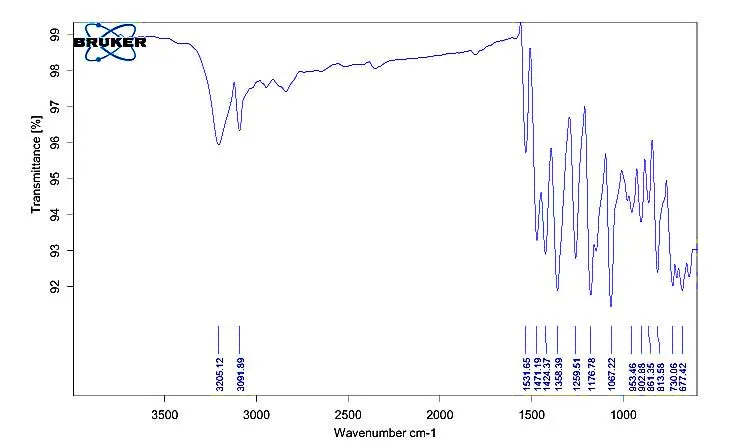
The FT-IR spectrophotometer (BRUKER ALPHA II) was utilized to capture the infrared spectrum of Metronidazole. A small amount of the powder was placed on the sample holder for the FTIR assessment, and the device was set to scan within the range of 4000 to 400 cm⻹. Following the scan, the obtained spectrum was compared with reference information to confirm the sample's identity and purity.10
2. Tablet preparation
The tablets were prepared using the wet granulation technique. Initially, Metronidazole Powder was mixed with other excipient in a specific order by grinding them together in a mortar and pestle. Each binder was then combined with a portion of water to create a Mucilage. This Mucilage was added to the powder mixture to form a moist mass. Afterward, the moist mass was sieved and dried in a hot oven. The resulting dried granules were sieved again to separate the fine granules from the coarse ones. Magnesium stearate was blended with both types of granules and thoroughly mixed. The granule mixture was then compressed into tablets using a single punch machine. 11
Weight all the ingredient accurately. All the ingredient was passed separately through sieve or mesh #40 then mix all the ingredient. Prepared the tablet by direct compression method 12
|
Ingredients |
Quantity |
Role |
|
Metronidazole |
100mg |
API |
|
Microcrystalline cellulose |
127.5 mg |
Diluent |
|
Acacia |
7.5 mg |
Binder |
|
Sodium starch glycolate |
10 mg |
Disintegrate |
|
Magnesium stearate |
5 mg |
Lubricant |
|
Talc |
5 mg |
Glidant |
Composition of Tablet Formulation
3. Evaluation of granules:
3.1. Measurement of angle of Repose:
The angle of repose, labelled as a, was determined by employing the fixed funnel and free-standing cone technique. A funnel was fixed with its pointed end placed 2cm above a sheet of graph paper on a flat surface. The powders were poured through the funnel cautiously until the peak of the cone touched the funnel's tip. The average base widths (r) of the powder cones were gauged, and the tangent of the angle of repose (Tan Ó¨) was computed using the specified formula:
Angle of repose Ó¨ = tan -1 h/ r
Here, h represents the height from the base to the apex of the powder cone.13
3.2 Bulk Density:
Bulk density is the measurement of the density of a collection of granules. To calculate the bulk density, a specific quantity of granules is poured into a measuring cylinder, and the volume taken up by the granules from different batches with different binders is gauged. The bulk density is subsequently computed using a specific formula.14
Bulk density = Total mass of granules / Total volume of granules
3.3 Tap Density:
Tap density refers to the density of granules once they have undergone 100 taps from a specific height, and the resulting volume is measured. The tap densities of four different concentrations are determined using the following equation15
Tap density = Mass of tapped granules / Volume of tapped granules
3.4 Compressibility Index (Carr's Index %): Compressibility is a simple method to measure the powder's free-flowing property, indicating how easily a material can flow. The percentage compressibility, known as Carr's index (%), is calculated as follows16
Carr's index (%) = Tap density - Bulk density / Tap density * 100.
3.5 Hausner's ratio:
Hausner's ratio is a measure of how easily powder flows, determined by the formula17
Hausner's ratio = Tapped density / Bulk density.
4. Evaluation of Tablets
4.1 Weight variation test
Weigh individually 20 units selected and calculate the average weight. Not more than two of the individual weights deviate from the average weight by more than the percentage given in the pharmacopoeia and none deviates by more than twice that percentage. IP/BP & USP limits for tablet weight variation. 18
4.2 Friability Test
Select the 20 tablet and collectively weighed. Subsequently, they were placed in a Roche friabilator and run for 4 minutes at a speed of 25 revolutions per minute. After dusting, the tablets were reweighed, and the percentage of friability was computed using the formula19

4.3 Hardness Test
Select the three tablets, and their average hardness was measured employing a Monsanto Hardness tester.
4.4 Disintegration Time
A 900ml volume of 0.1 N HCL was used as the disintegration medium. This medium contained in the disintegration apparatus was allowed to reach a temperature of 37°C.20 Three tablets from a batch were dropped into each of the tablet cylinders and apparatus was started. The time taken for the last tablet or its fragment to pass through the mesh into the disintegration medium was recorded.21
For this test USP dissolution apparatus was used. To test for dissolution, one tablet was placed into container , which held 900 ml of 0.1 M hydrochloric acid (HCl) as a dissolution medium maintained at 37 ± 0.5 °C.22 The device rotated continuously at a speed of 100 rpm. Every 10 mint, 1 ml sample was withdrawn and this was immediately replaced with the same volume of fresh test media. The sample was filtered and 1 ml of filtrate was taken and diluted to 10 ml with 0.1 N HCL. Absorbance was determined spectrophotometrically at the wavelength.23
5. RESULT AND DISCUSSION
5.1 pre-formulation study
5.1.1 Organoleptic properties
|
Properties |
Observation |
|
BCS class |
Class I |
|
Colour |
White powder |
|
Odour |
Odourless |
|
Texture |
Crystalline powder |
5.1.2 Melting point Determination
The melting point of metronidazole was found to be 1600C.
5.1.3 Solubility
|
Sample |
Solubility |
|
Water |
Slightly soluble |
|
Acetone |
Sparingly soluble |
|
Methanol |
Soluble |
|
0.1N HCL |
Soluble |
|
Ethanol |
Sparingly soluble |
5.1.4. Absorption maxima of metronidazole in 0.1N HCL
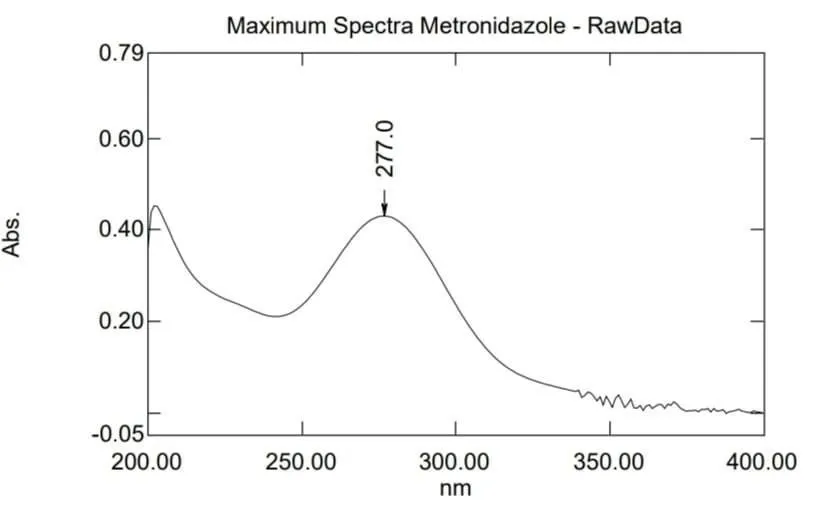
The absorption maxima of metronidazole was found to be at 277 nm.
5.1.5 Calibration curve metronidazole in 0.1N HCL
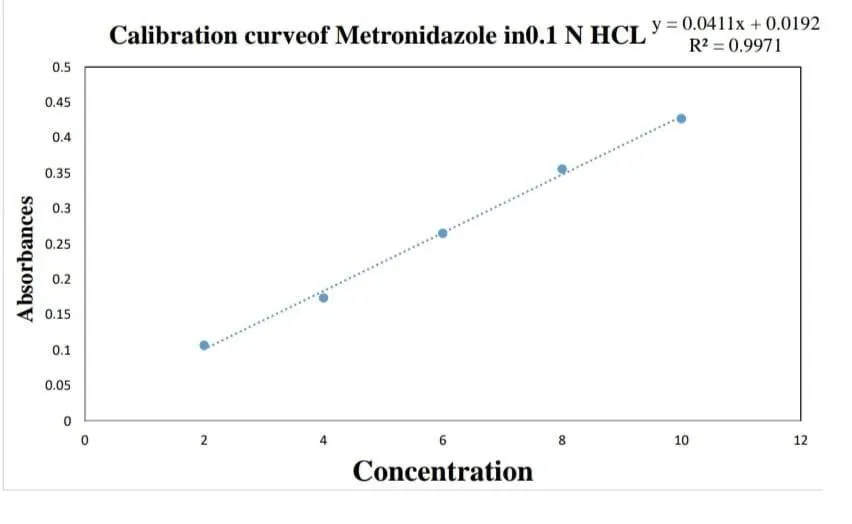
The calibration curve of metronidazole in 0.1 N HCL was found to be linear against the concentration vs absorbances ranging from 2 -10 ug /ml with ð‘…2=0.9971.
The FTIR spectroscopy study of Metronidazole was performed to verify its identity, identify its functional groups, by detecting characteristic absorption peaks. The characteristic peaks that were obtained, are depicted in figure and explained in table below these findings confirmed the authenticity of sample.
5.1.7 Drug Excipient Compatibility Study
FTIR analysis was used to investigate potential drug-excipient interaction. When Metronidazole was coupled with excipients, the results showed no noticeable alteration in its infrared peaks when compared to the medication in its pure form. The drug was therefore compatible with the specified excipients, according to the FTIR spectroscopy findings.
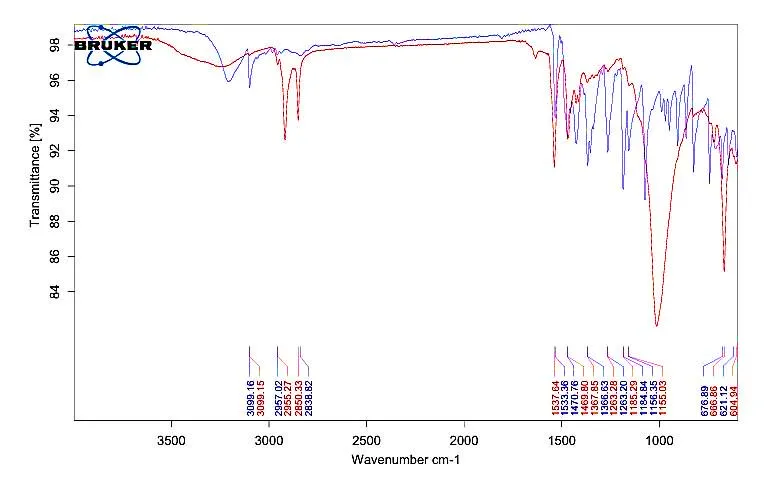
Blue Peak-Physical mixture; Red Peak-API
5.2.1 Precompression Parameters
A. GRANULES
|
Bulk density |
Tapped density |
Carr ’s index |
Hausner’s ratio |
Angle of repose |
|
0.34 g/ml |
0.38 g/ml |
10.0 |
1.11 |
29.6 |
The flow properties of the granules were found to be excellent as per standard range.
B. POWDER
|
Bulk density |
Tapped density |
Carr ’s index |
Hausner’s ratio |
Angle of repose |
|
0.40 g/ml |
0.46 g/ml |
13.0 |
1.15 |
33.1 |
The flow properties of the powder were found to be good as per standard range.
5.3 Evaluation of tablet
Post compression parameters
5.3.1 Weight variation Test
All the tablets show percentage deviation Less than 5 % as specified range in IP for 250mg tablet and complies weight variation test.
All the tablets show percentage deviation Less than 5 % as specified range in IP for 250mg tablet and complies weight variation test
5.3.2 Friability Test
The friability of tablet prepared by direct compression was found to be 0.94 %
Wet Granulation Method
The friability of tablet prepared by wet granulation method was found to be 0.84 %.
5.3.3. Hardness Test
The average hardness of tablet prepared by direct compression method was found to be 4.2 kg/cm2.
The average hardness of tablet prepared by wet granulation method was found to be 6.1 kg/cm2
The disintegration time of the tablet prepared by using the direct compression method was found to be 11 min.13sec meet the IP limit of NMT 15 min.
The disintegration time of the tablet prepared by using the wet granulation method was found to be 13 min.50sec meet the IP limit of NMT 15 min.
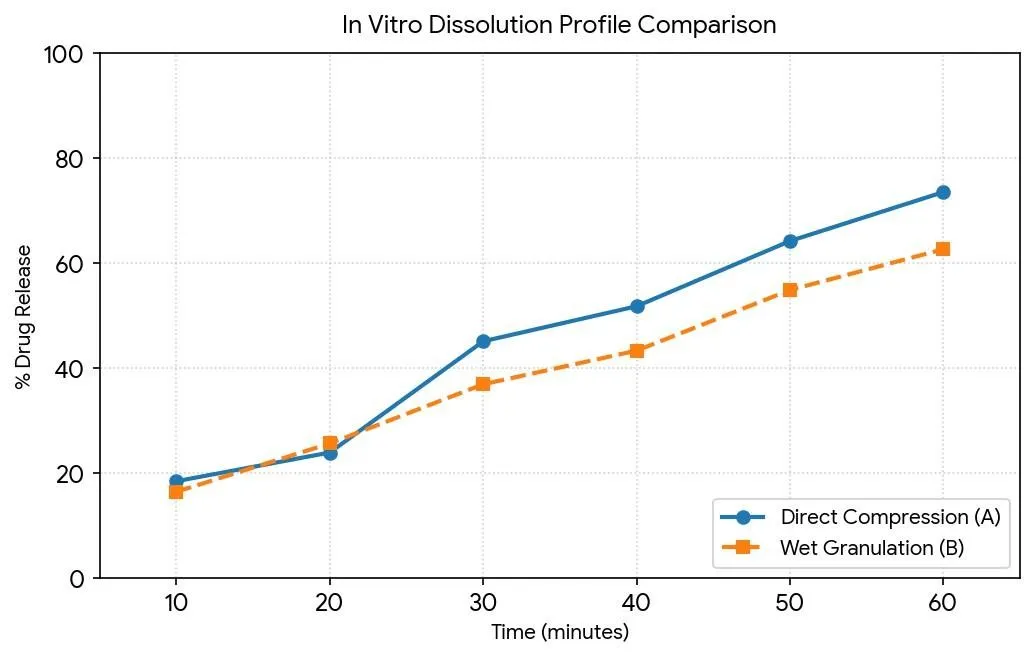
|
TYPE |
TIME |
% DRUG RELEASE |
|
1.Direct Compression Method |
10 min |
18.46 |
|
20 min |
23.93 |
|
|
30 min |
45.12 |
|
|
40 min |
51.80 |
|
|
50 min |
64.23 |
|
|
60 min |
73.56 |
The Metronidazole tablet show 73 % drug release after 1 hour.
|
TYPE |
TIME |
%DRUG RELEASE |
|
2.Wet Granulation Method |
10 min |
16.45 |
|
20 min |
25.65 |
|
|
30min |
36.93 |
|
|
40 min |
43.34 |
|
|
50min |
54.89 |
|
|
60 min |
62.67 |
The Metronidazole tablet show 62 % drug release after 1 hour
CONCLUSION
The wet granulation method is the superior manufacturing pathway for formulating immediate-release Metronidazole tablets compared to the direct compression technique. While pre-formulation testing validated the active pharmaceutical ingredient as a stable, crystalline BCS Class I compound with a melting point of 160°C and a adsorption maxima of 277 nm, the processing choice heavily dictated final product quality. The wet granulation method fundamentally alters intermediate powder dynamics by introducing a binder solution, yielding granules with an "excellent" flow profile, a lower angle of repose 29.6°, and a reduced Carr's index (10.0). In contrast, the direct compression powder matrix exhibits a lesser "good" flow profile. Post-compression results show that while both methods strictly pass the Indian Pharmacopoeia weight variation limits, wet granulation yields tablets with far greater structural integrity. The granulated batch achieves a robust average hardness of 6.1 kg/cm and a lower friability of 0.84%, whereas direct compression results in weaker tablets averaging just 4.2 kg/cm in hardness and 0.94% in friability the disintegration time of direct compression shows minimized disintegration time than wet granulation method. The dissolution time of direct compression shows minimized dissolution time than wet granulation method.
REFERENCES
Cantor SL, Kothari S, Koo OM. Evaluation of the physical and mechanical properties of high drug load formulations: Wet granulation vs. novel foam granulation. Powder Technology. 2009 Oct 10;195(1):15-24
Cantor SL, Kothari S, Koo OM. Evaluation of the physical and mechanical properties of high drug load formulations: Wet granulation vs. novel foam granulation. Powder Technology. 2009 Oct 10;195(1):15-24

Ashwini Aldar*, Dineshbabu Naidu, Misba Mujawar, Ujma Belif, To Formulate Tablet By Using Wet Granulation Method And Direct Compression Method And Compare Their Pre-Compression And Post Compression Parameters, Int. J. Sci. R. Tech., 2026, 3 (6), 1536-1544. https://doi.org/10.5281/zenodo.20924156
 10.5281/zenodo.20924156