

We use cookies to ensure our website works properly and to personalise your experience. Cookies policy
Shatabdi Institute of Pharmacy, Bamdod, Nandurbar, Maharashtra, India 425412
Hand hygiene is a fundamental practice for preventing the transmission of infectious diseases and maintaining public health. The widespread use of conventional alcohol-based hand sanitizers has significantly reduced microbial contamination; however, frequent use may cause skin dryness, irritation, and allergic reactions. These limitations have led to increasing interest in herbal hand sanitizers as safer and more skin-friendly alternatives. Herbal formulations utilize plant-derived bioactive compounds possessing antimicrobial, antioxidant, anti-inflammatory, and moisturizing properties. This review focuses on the phytochemistry, antimicrobial activity, and formulation approaches of herbal hand sanitizers, with particular emphasis on Neem (Azadirachta indica), Tulsi (Ocimum sanctum), and Aloe Vera (Aloe vera). Neem contains biologically active constituents such as nimbin, nimbidin, and azadirachtin, which exhibit potent antibacterial and antifungal activities. Tulsi is rich in eugenol, ursolic acid, and other phenolic compounds that contribute to broad-spectrum antimicrobial and antioxidant effects. Aloe Vera contains polysaccharides, anthraquinones, and saponins that provide moisturizing, wound-healing, and mild antimicrobial properties, enhancing skin compatibility in sanitizer formulations. The review summarizes various formulation strategies including gels, sprays, and polyherbal preparations, along with their physicochemical evaluation, stability studies, and antimicrobial assessment methods. Published studies indicate that herbal hand sanitizers demonstrate significant activity against common pathogenic microorganisms such as Staphylococcus aureus, Escherichia coli, and Candida albicans. Furthermore, polyherbal formulations often exhibit synergistic effects, improving antimicrobial efficacy while maintaining skin health. Despite their promising potential, challenges such as standardization of plant extracts, variability in phytochemical composition, regulatory requirements, and limited clinical evidence remain important considerations. Future research should focus on advanced delivery systems, standardized formulations, and clinical validation to enhance the effectiveness and acceptance of herbal hand sanitizers. Overall, herbal hand sanitizers represent a promising, eco-friendly, and sustainable approach to hand hygiene and infection prevention.
Hand hygiene is recognized as one of the most effective and economical methods for preventing the transmission of infectious microorganisms and reducing the incidence of communicable diseases. Human hands serve as major carriers of pathogenic bacteria, viruses, and fungi, facilitating the spread of infections through direct contact and contaminated surfaces. Consequently, proper hand hygiene practices, including hand washing and the use of hand sanitizers, have become essential components of public health and infection control programs worldwide. [1]
Conventional hand sanitizers, particularly alcohol-based formulations containing ethanol or isopropyl alcohol, are widely used due to their rapid and broad-spectrum antimicrobial activity. These products effectively reduce microbial load and help prevent the spread of infectious diseases. However, frequent and prolonged use of alcohol-based sanitizers may lead to adverse effects such as skin dryness, irritation, allergic reactions, and disruption of the natural skin barrier. In addition, concerns regarding chemical exposure, flammability, and environmental impact have encouraged researchers to explore safer and more sustainable alternatives.[2]
In recent years, herbal hand sanitizers have gained considerable attention as natural substitutes for conventional formulations. Herbal sanitizers utilize extracts obtained from medicinal plants that possess antimicrobial, antioxidant, anti-inflammatory, and skin-protective properties. The presence of bioactive phytochemicals such as flavonoids, alkaloids, tannins, terpenoids, phenolic compounds, and essential oils contributes to their therapeutic potential. Unlike synthetic antimicrobial agents, herbal ingredients often provide additional benefits including skin moisturization, wound healing, and reduced risk of adverse reactions.[3]
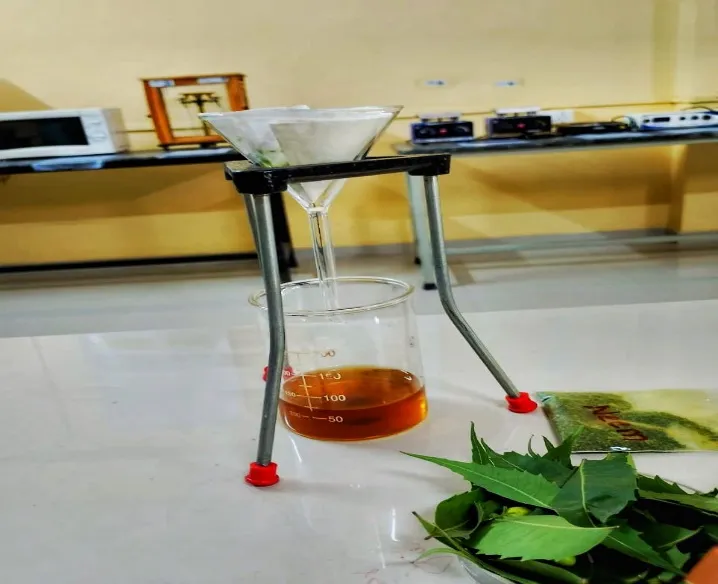
Fig. Neem Handwash
Among the various medicinal plants investigated for hand sanitizer formulations, Neem (Azadirachta indica), Tulsi (Ocimum sanctum), and Aloe Vera (Aloe vera) have emerged as promising candidates due to their well-documented pharmacological activities. Neem is widely recognized for its potent antibacterial, antifungal, antiviral, and anti-inflammatory properties, primarily attributed to compounds such as nimbin, nimbidin, and azadirachtin. Tulsi contains bioactive constituents including eugenol, ursolic acid, and rosmarinic acid, which exhibit broad-spectrum antimicrobial and antioxidant activities. Aloe Vera is valued for its moisturizing, wound-healing, and soothing effects, making it an ideal component for enhancing skin compatibility and user acceptability in sanitizer formulations.[4]
The effectiveness of herbal hand sanitizers depends not only on the antimicrobial activity of plant extracts but also on formulation parameters such as extract concentration, excipient selection, stability, viscosity, pH, and overall product quality. Various formulation approaches, including gels, sprays, foams, and polyherbal preparations, have been developed to optimize efficacy and consumer acceptance. Furthermore, scientific studies have demonstrated that combinations of medicinal plant extracts may produce synergistic antimicrobial effects, enhancing their ability to inhibit pathogenic microorganisms.
Despite the growing popularity of herbal hand sanitizers, challenges remain regarding standardization of plant materials, consistency of phytochemical composition, quality control, regulatory approval, and clinical validation. Comprehensive evaluation of existing literature is therefore necessary to understand the current status of herbal sanitizer research and identify future opportunities for development.[5]
This review aims to provide a comprehensive overview of herbal hand sanitizers with special emphasis on their phytochemical constituents, antimicrobial mechanisms, formulation approaches, evaluation parameters, advantages, limitations, and future prospects. Particular attention is given to Neem (Azadirachta indica), Tulsi (Ocimum sanctum), and Aloe Vera (Aloe vera) due to their widespread use and significant potential in the development of safe, effective, and sustainable hand hygiene products.[6]
Overview of Hand Sanitizers
Types of Hand Sanitizers [7]
Phytochemistry of Herbal Ingredients
A. Neem (Azadirachta indica)
Major Phytochemicals
Pharmacological Activities
Mechanism of Antimicrobial Action
Neem phytochemicals disrupt microbial cell walls, inhibit enzyme systems, and interfere with microbial metabolism. Several studies report activity against Staphylococcus aureus, Escherichia coli, and other pathogens.[8]
B. Tulsi (Ocimum sanctum)
Major Phytochemicals
Pharmacological Activities
Antimicrobial Mechanism
Essential oils and phenolic compounds in Tulsi damage microbial membranes, causing leakage of cellular contents and inhibition of growth.
C. Aloe Vera (Aloe vera)
Major Phytochemicals
Pharmacological Activities
Role in Sanitizers
Aloe vera improves skin hydration, reduces alcohol-induced dryness, and enhances user acceptability.
Antimicrobial Activity of Herbal Hand Sanitizers [9]
Studies have demonstrated that herbal formulations containing Neem, Tulsi, and Aloe Vera exhibit significant antimicrobial activity against:
|
Microorganism |
Activity Reported |
|
Staphylococcus aureus |
Strong |
|
Escherichia coli |
Strong |
|
Pseudomonas aeruginosa |
Moderate |
|
Candida albicans |
Moderate |
|
Various skin flora |
Significant reduction |
The antimicrobial effect is attributed to flavonoids, alkaloids, tannins, phenolics, terpenoids, and essential oils present in medicinal plants. Polyherbal formulations often show synergistic activity compared with single-plant formulations.[10]
Evaluation Parameters
Review the following parameters reported in literature:
Physicochemical Evaluation
Stability Studies
Microbiological Evaluation
Safety Evaluation
Typical herbal sanitizer formulations show pH values between 6.0 and 7.2, suitable for skin application.
Advantages of Herbal Hand Sanitizers
Limitations
Future Perspectives [11]
Future research should focus on:
Green and sustainable pharmaceutical formulations [12]
CONCLUSION
REFERENCES

Madhuri K. Patil*, Vasant Y. Chavan, Pankaj M. Chaudhari, A Review On Herbal Hand Sanitizers: Phytochemistry, Antimicrobial Activity, And Formulation Approaches, Int. J. Sci. R. Tech., 2026, 3 (6), 1136-1141. https://doi.org/10.5281/zenodo.20771991
 10.5281/zenodo.20771991