

We use cookies to ensure our website works properly and to personalise your experience. Cookies policy
Rohilkhand College of Nursing, Bareilly, (U.P.)
Background: In response to Intense National as well as Global to improve the quality of knowledge of postnatal mothers regarding immunization schedule. Immunization protects people from disease by introducing vaccine into the body. Objective: To assess the existing knowledge among the postnatal mothers regarding immunization schedule. To evaluate the effectiveness of structured teaching programme on knowledge regarding immunization schedule among the postnatal mothers. To associate the post-test level of knowledge regarding immunization schedule among the postnatal mother with their demographic variables. Method: In view of the nature of problem and to accomplish the objectives of the study, structured questionnaire to assess the knowledge regarding immunization schedule among the postnatal mothers admitted in obstetrical and Gynaecological ward. Validity of the tool was ensured by consulting the guides & experts in the field of Statistics, Medicines & Nursing & reliability (0.81) of the tool was tested. Result: The present study included 50 postnatal mothers admitted in obstetrical and Gynaecological ward of Rohilkhand Medical College & Hospital, Bareilly. The postnatal mothers were asked to complete Questionnaire. Structured questionnaire was used to collect the base line data for knowledge regarding immunization schedule. Analysis: Data was analysed by using descriptive and inferential statistics. Interpretation: Major finding of the study revealed that the knowledge score of the study in pre-test 0% of respondent had excellent score (25-30), 14% of respondent had good score (19-24), 28% of respondent had average score (13-18), 32% of respondent had poor score (7-12), 26% of respondent had very poor score (0-6). In post -test 4% of respondent h d excellent score (25-30), 52% of respondent h d good score (19-24), 30% of respondent had average score (13-18), 14% of respondent had poor score (7-12), 0% of respondent had very poor score (0-6). The study proved that there was significant association between demographic variables such as age, gravidae, qualification and no significant association residential area, family income, source of information, family type. Conclusion: It can be concluded that in our study score was good regarding immunization schedule after implementation of structured teaching programme the knowledge of postnatal mother was improved. Hence, the structured teaching programme was effective.
In Indian society, much like in many East and South Asian countries, patriarchy is so deeply rooted that families often try to avoid the birth of a girl child altogether. In the past, new born girls were frequently killed shortly after birth through various methods.[1]
Female foeticide refers to the termination of a female fetus through illegal methods. Legally, this can involve either deliberate or accidental actions that result in the death of a fetus due to criminal acts, such as physically harming pregnant women. From a medical perspective, foeticide refers to the termination of a fetus, which often the first step in a legally sanctioned abortion.[2]
The sex ratio is a way to show how many females there are for every 1000 males. In India, the number of girls between 0-6 years old has fallen to the lowest it's ever been since India became independent, with only 914 girls for every 1000 boys.[3]
The Hon’ble High Court has upheld the installation of the silent observe (SIOB) device in ultrasound machines. This initiative was introduced by the collector of Kolhapur as part of the “SAVE THE BABY GIRL CHILD”. The (SIOB) is an external device designed to facilitate the online submission of the F-Form while also recording all ultrasound images, whether related to obstetrics or non- obstetric examinations. The INDIAN RADIOLOGISTAND IMAGING ASSOCIATION (IRIA) has challenged this move by filing a petition and a review petition. Both of which were dismissed by the Hon’ble high court.[4]
In India, gender inequality is often seen as an injustice or discrimination against women. This inequality restricts women’s participation in various areas and negatively impacts future generations as well. One of the most extreme forms of discrimination against female foeticide, where a girl is denied her most basic and fundamental right- “THE RIGHT TO LIFE”.[5]
The issue of the female child has always been a matter of debate. There is a strong preference, often referred to the ‘SON SYNDROME’, where a male child is seen as a liability. Sons are considered crucial for continuing the female and pay ‘O GOD’, bless us with a son here, and let daughters be born elsewhere.[6]
Over time, a women’s physical vulnerability was exploited to weaken her psychologically as well. Gradually, girls were conditioned to feel-inferior not only physically but also mentally, intellectually and emotionally. They were systematically deprived of property rights, either from the outset or through laws that eventually stripped them of their inheritance entirely.[7]
The causes of female foeticide include the deeply ingrained belief that a male child is superior to a female child, an obsession with having sons, the perception that daughters are an additional financial burden, and the belief that sons will take care of parents in their old age. Sons are also seen as the ones who carry forward the family name and occupation and perform important religious rituals. The harmful effects of female foeticide include disruptions in the family system, a shortage of brides, and an increase in instances of sexual harassment.[8]
NEED FOR STUDY
India makes up about 32.1% of the world’s 142.6 million missing females, making it the second largest contributor to the global total. China rank first, 72.3million missing females, which accounts for 50.7% of all missing females worldwide. According to the UNFPA report, between 2015 and 2020, India lost around 3.6 lakhs female each year due to excess female deaths. Additionally, about 5.9 lakh female children were lost annually to pre-natal sex selection, resulting in missing females at birth.[9]
In India, the number of females per 1,000 males has shown some fluctuations over the decades. In 1991, there were 945 females for every 1,000 males. This ratio declined in 2001, dropping to 927 females per 1,000 males. However, by 2011, the ratio had improved slightly to 940 females for every 1,000 males. Most cases recorded in state of Haryana (834), Punjab (846), Jammu&Kashmir (862), Rajasthan (888), and Gujarat (890).[10]
The female foeticide is a cruel crime against women, denying them the very right to be born. The deliberate killing of female foetuses has led to a significant decline in the sex ratio. It is ironic that in Indian society, girls are worshipped as goddesses in rituals like ‘Kanya Poojan’ yet, at the same time, they are mercilessly killed before or immediately after birth. This has resulted in a loss of nearly 40-50 million girls from India’s population. Various social, cultural, and religious factors contribute to the continued devaluation of women in society.[11]
The "Save Girls" campaign in India, while a good idea, has faced challenges in implementation and public understanding. Sex-selective abortion, a practice happening in India since the early 1900s, has led to gender imbalances. The campaign uses media like rallies, posters, videos, and ads to raise awareness about this issue. These efforts are largely supported by the government and other groups, and many well-known Indians have also voiced their support.[12]
Female foeticide can be prevented by changing people's mind-set and making them understand that girls are just as important and capable as boys. Today, women are excelling in every field, standing shoulder to shoulder with men. Educating society about the value of girls and their vital role in families and society can help put an end to this practice. In this study an effort has been made to assess the knowledge and attitude regarding female foeticide among under the age of Reproductive women at selected village, Bareilly, U.P. [13]
At this point, community health nursing professionals play a vital role in raising awareness within the community about preventing female feticide and discouraging gender bias.
The researcher has taken this study because some people’s thinks that female child is a burden on a family due to dowry system in marriages and high preferences for male child in a family and risk of sexual abuse to girl child. [14]
OBJECTIVE OF THE STUDY
To assess the level of knowledge and level of attitude regarding female foeticide among reproductive women.
To determine the relationship between the level of knowledge and level of attitude regarding female foeticide among reproductive women.
To determine the association between the level of knowledge and level of attitude regarding female foeticide among reproductive women with their selected demographic variables.
HYPOTHESIS
H1: There will be a significant difference between level of knowledge and level of Attitude.
H2: There will be significant association between level of knowledge of reproductive women and their selected demographic variables
H3: There will be significant association between level of attitude of reproductive women and their selected demographic variables.
MATERIALS&METHODS:
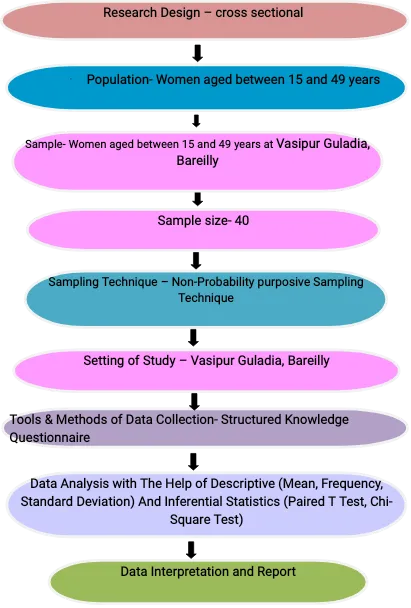
ANALYSIS AND INTERPRETATION:
Table 1: Demographic Characteristics of Respondents (N = 40)
| Variable | Category | n | % |
|---|---|---|---|
| Age Group | 15–25 | 9 | 22.5 |
| 26–35 | 16 | 40.0 | |
| 36–45 | 10 | 25.0 | |
| 46+ | 5 | 12.5 | |
| Religion | Hindu | 29 | 72.5 |
| Muslim | 11 | 27.5 | |
| Education | High school | 24 | 60.0 |
| Intermediate | 12 | 30.0 | |
| Graduate | 3 | 7.5 | |
| Illiterate | 1 | 2.5 | |
| Marital Status | Married | 33 | 82.5 |
| Unmarried | 7 | 17.5 | |
| Socio-economic Status | Lower class | 3 | 7.5 |
| Middle class | 15 | 37.5 | |
| Upper middle class | 21 | 52.5 | |
| Upper class | 1 | 2.5 | |
| Total Respondents | 40 | 100 |
Interpretation: Demographic characteristics of respondents (N = 40). Distribution by age, religion, education, marital status, and socio-economic status.
Knowledge Level of Respondents
Table 2: Knowledge Level Distribution (N = 40)
| Knowledge Level | n | % |
|---|---|---|
| Inadequate (0–10) | 17 | 42.5 |
| Moderate (11–15) | 18 | 45.0 |
| Adequate (16–20) | 5 | 12.5 |
| Total | 40 | 100 |
Association with Demographic Variables
Chi-square analysis revealed that education was significantly associated with knowledge levels (χ² = 17.103, p = 0.009). No significant association was observed between knowledge and age, religion, marital status, or socio-economic status. Similarly, attitude levels—despite being predominantly negative—were not significantly associated with any demographic variables.
This indicates that negative attitudes toward preventing female foeticide are pervasive across all social categories, suggesting that resistance to change is not confined to a specific group. However, since education strongly influences knowledge, it emerges as the most critical lever to transform awareness into positive attitudes. Thus, educational and awareness campaigns must be prioritized to counter the entrenched negative perceptions and promote attitudinal change.
REFERENCES




Anush Joshua Abhilashi, Arohi Sharma, Ayushi Saxena, Anand Prakash, “A Study to Assess the Knowledge and Attitude Regarding Female Foeticide Among the Women of Reproductive Age Group in Selected Village, Bareilly, U.P”, Int. J. Sci. R. Tech., 2026, 3 (10), 1496-1500. https://doi.org/10.5281/zenodo.23834935
 10.5281/zenodo.23834935