

We use cookies to ensure our website works properly and to personalise your experience. Cookies policy
Rohilkhand College of Nursing, Bareilly, (U.P.)
Background: Technology addiction has become an important concern among late adolescents due to the increasing use of smartphones, laptops, tablets, and other digital devices. Excessive use of technology may affect adolescents' physical, psychological, social, and academic well-being. Adequate knowledge regarding Technology Addiction is therefore essential for promoting healthy technology-use practices among late adolescents. Objectives: The objectives of the study were to assess the knowledge of late adolescents regarding Technology Addiction, to evaluate the effectiveness of the Structured Teaching Programme on their knowledge regarding Technology Addiction, and to determine the association between pre-test knowledge scores and selected socio-demographic variables. Methods A pre-experimental one-group pre-test–post-test research design was adopted for the study. The study was conducted at Rohilkhand College of Nursing, Bareilly, Uttar Pradesh. A total of 30 late adolescents were selected using a non-probability sampling technique. Data was collected using a structured knowledge questionnaire regarding Technology Addiction. The data collected was analyzed using descriptive and inferential statistics. Results The findings revealed that 48% of participants were 18 years of age, 28% were 20 years, 14% were 19 years, and 10% were 21 years. Regarding gender, 56% were female and 44% were male. With respect to semester of study, 48% were studying in the I and II semesters, 32% in the III and IV semesters, and 20% in the V and VI semesters. Regarding family type, 48% belonged to nuclear families, 36% to extended families, and 16% to joint families. Most participants were Hindu (56%), followed by Christian (24%), Muslim (16%), and Sikh (4%). Fifty-six percent were from rural areas and 44% were from urban areas. Regarding daily technology use, 34% reported very high use of more than 6 hours, 24% reported high use of 4–6 hours, 22% reported moderate use of 2–4 hours, and 20% reported low use of less than 2 hours per day. Smartphones were the most frequently used devices (80%), followed by laptops (10%), tablets (6%), and multiple devices (4%). The mean post-test knowledge score (22.23 ± 2.12) was higher than the mean pre-test knowledge score (14.53 ± 2.28), with a mean difference of 7.70. The calculated ‘t’ value was 13.81, which was greater than the table value of *t*(29) = 2.05 at the 0.05 level of significance. This indicated a statistically significant improvement in knowledge following the administration of the Structured Teaching Programme. Conclusion: The findings of the study revealed that the Structured Teaching Programme was effective in improving the knowledge of late adolescents regarding Technology Addiction. Therefore, structured educational interventions may be incorporated into nursing education to enhance awareness and promote healthy and responsible technology-use practices among late adolescents.
The rapid advancement of digital technology has transformed communication, education, healthcare, entertainment, and social interaction. Smartphones, computers, tablets, and internet services have become an integral part of daily life, particularly among adolescents. However, excessive and uncontrolled use of digital technology may lead to technology addiction, characterized by loss of control, excessive use, dependence, and interference with daily activities. Adolescence is a critical developmental period during which individuals are particularly vulnerable to behavioural and environmental influences. Excessive technology use among adolescents has been associated with psychological problems, sleep disturbances, reduced physical activity, poor concentration, academic difficulties, and impaired social relationships. In India, the widespread availability of affordable smartphones and internet services has further increased the use of digital devices among young people, making technology addiction an emerging public health concern. Early identification, awareness, and preventive education are therefore essential to promote responsible technology use and prevent its adverse effects. Nurses play an important role in adolescent health promotion through health education, counselling, and preventive interventions.
AIM
To evaluate the effectiveness of a Structured Teaching Programme on the knowledge regarding technology addiction among late adolescents studying at Rohilkhand College of Nursing, Bareilly,
Objective:
Hypotheses:
H1: There will be a significant difference between pre-test test and post-test which means knowledge score of Late adolescence regarding Technology Addiction.
H2: There will be a significant association between the pre-test mean level of Knowledge scores
of late adolescences regarding technology addiction and selected socio-demographic variables.
MATERIALS & METHODS:
A quantitative research approach with a pre-experimental one-group pre-test–post-test design was adopted to assess the effectiveness of a Structured Teaching Programme on knowledge regarding Technology Addiction among late adolescents at Rohilkhand College of Nursing, Bareilly, Uttar Pradesh. The target and accessible population comprised late adolescents studying at the institution. A sample of 50 students aged 18–21 years was selected using a non-probability convenience sampling technique. Students who were available during the data collection period and willing to participate were included, while those who had previously attended a structured teaching programme on Technology Addiction were excluded. Data were collected using a structured tool consisting of two sections: a demographic questionnaire and a 30-item self-structured knowledge questionnaire regarding Technology Addiction. Each correct response was awarded one mark, with a maximum score of 30. Knowledge scores were categorized as inadequate (0–10), moderate (11–20), and adequate (21–30). The tool was validated by seven experts in Mental Health Nursing, and its reliability was established using the test-retest method (r = 0.80), indicating good reliability. Pre-testing was conducted among seven participants to assess the clarity, comprehensibility, and feasibility of the tool. Ethical clearance and institutional permission were obtained, and written informed consent was obtained from all participants. Confidentiality and anonymity were maintained throughout the study, and the collected data were used solely for research purposes.
Data Collection Procedure:
Data Collection Procedure: Data collection was conducted over a period of five weeks after obtaining approval from the Institutional Ethics Committee and administrative permission from the Principal of Rohilkhand College of Nursing, Bareilly. Nursing students who fulfilled the inclusion criteria were recruited using a non-probability purposive sampling technique. The purpose of the study was to explain to all participants, and written informed consent was obtained prior to data collection. Baseline knowledge regarding intellectual disability was assessed using a validated self-administered structured questionnaire. Immediately after the pre-test, a 45-minute Structured Teaching Programme was delivered in English using lectures, interactive discussions, and audiovisual teaching aids. The educational session covered the definition, causes, classification, clinical features, diagnosis, management, rehabilitation, and nursing care of individuals with intellectual disability. A post-test was administered seven days after the intervention using the same questionnaire to evaluate the effectiveness of the programme. All complete questionnaires were checked for completeness, coded, and entered the database for statistical analysis while maintaining the confidentiality and anonymity of all participants
Analysis and Interpretation:
|
S.no |
Demographic variables |
Experimental group |
|
|
|
|
f |
% |
|
1 |
Age in years |
||
|
18 years |
24 |
48 |
|
|
19 years |
7 |
14 |
|
|
20 years |
14 |
28 |
|
|
21 years |
5 |
10 |
|
|
2 |
Gender |
||
|
Male |
22 |
44 |
|
|
Female |
28 |
56 |
|
|
3 |
Year of studying |
||
|
I& II Semester |
24 |
48 |
|
|
III & IV Semester |
16 |
32 |
|
|
V & VII Semester |
10 |
20 |
|
|
4 |
Type of family |
||
|
Nuclear |
24 |
48 |
|
|
Joint |
8 |
16 |
|
|
Extended |
18 |
36 |
|
|
5 |
Religion |
||
|
Hindu |
28 |
56 |
|
|
Muslim |
8 |
16 |
|
|
Sikh |
2 |
4 |
|
|
Christian |
12 |
24 |
|
|
6. |
Area of Residence |
||
|
|
Urban |
22 |
44 |
|
Rural |
28 |
56 |
|
|
7. |
Technology addiction |
|
|
|
|
low use – less than 2 hours daily |
10 |
20 |
|
Moderate use 2-4 hours/day |
11 |
22 |
|
|
High use 4-6 hours/day |
12 |
24 |
|
|
Very high use- more than 6 hours/day |
17 |
34 |
|
|
8. |
Type of Gadget Used |
|
|
|
Smart phone |
40 |
80 |
|
|
Tablet |
3 |
6 |
|
|
Laptop |
5 |
10 |
|
|
Multiple devices |
2 |
4 |
|
Table 1: Distribution of sample characteristics in terms of frequency & Percentage
|
S.no |
Demographic variables |
Experimental group |
|
|
|
|
f |
% |
|
1 |
Age in years |
||
|
18 years |
24 |
48 |
|
|
19 years |
7 |
14 |
|
|
20 years |
14 |
28 |
|
|
21 years |
5 |
10 |
|
|
2 |
Gender |
||
|
Male |
22 |
44 |
|
|
Female |
28 |
56 |
|
|
3 |
Year of studying |
||
|
I& II Semester |
24 |
48 |
|
|
III & IV Semester |
16 |
32 |
|
|
V & VII Semester |
10 |
20 |
|
|
4 |
Type of family |
||
|
Nuclear |
24 |
48 |
|
|
Joint |
8 |
16 |
|
|
Extended |
18 |
36 |
|
|
5 |
Religion |
||
|
Hindu |
28 |
56 |
|
|
Muslim |
8 |
16 |
|
|
Sikh |
2 |
4 |
|
|
Christian |
12 |
24 |
|
|
6. |
Area of Residence |
||
|
|
Urban |
22 |
44 |
|
Rural |
28 |
56 |
|
|
7. |
Technology addiction |
|
|
|
|
low use – less than 2 hours daily |
10 |
20 |
|
Moderate use 2-4 hours/day |
11 |
22 |
|
|
High use 4-6 hours/day |
12 |
24 |
|
|
Very high use- more than 6 hours/day |
17 |
34 |
|
|
8. |
Type of Gadget Used |
|
|
|
Smart phone |
40 |
80 |
|
|
Tablet |
3 |
6 |
|
|
Laptop |
5 |
10 |
|
|
Multiple devices |
2 |
4 |
|
Table 2: Distribution of sample characteristics in terms of frequency & Percentage
Table 1 depicts that majority of the participants in experimental groups i.e. 48% belong to 18 years of age, 28 % of the participants belong to 20 years age group, 14% of the participants belong to 19years and above and 10% of participants belong to 21 years of age group
Table 1revealed that majority of the participants i.e. 56% participants were female and 44% were male in the experimental group
Table 1 showed that majority of the participants i.e. 48% of partcipants in the experimental group were studying in I & II semester, 32% were studying in III & IV semester and 20% were studying in V & VIII semester.
Table 1 depicts that majority of participants in experimental groups, i.e. % ofof the participants were from nuclear families. 36% were from extended family and 16% were from joint family.
Table 1 showed that majority of participants in experimental group i.e. 56% were Hindu and 24% were Christian and 16% were Muslim and 4% were Sikh.
Table 1 depicts that majority of participants in experimental groups were i.e. 44% were from urban areas and 56% were from rural areas.
Table 1 showed that most participants in experimental groups, i.e. 3, hadad very high use of more than 6 hours, 24% had high use 4-6 house of 22% had moderate use 2-4 hours/day and only 20% had low use less than 2 hours daily.
Table 1 depicts that most participants in experimental groups, i.e. 80% use smart phones more often, 10% uses laptop, 6% uses tablet and remaining 4% uses multiple devices.
|
Test |
Range |
Mean± SD |
Mean Difference |
t- value (p value) |
|
Experimental group pre-test |
19-10 = 9 |
4.53±2.27 |
7.7 |
13.81* (0.000) |
|
Experimental group post-test |
26-15 =11 |
22.23±2.12 |
t(29)= 2.05 , p<0.05* Significant NS – Non-Significant
Table 2: Comparison of mean pre-test and mean post test knowledge score of the experimental group (N=50)
Table 2 depicts that the mean Experimental group post-test knowledge score (22.23 ± 2.12) was greater than the mean Experimental group pre-test knowledge score (14.53 ± 2.28) with the mean difference of 7.7 The calculated t value was (t=13.81) which is more than the tabled value (t (29) = 2.05). Hence there is significance difference in the mean pre- test and mean post- test knowledge score.
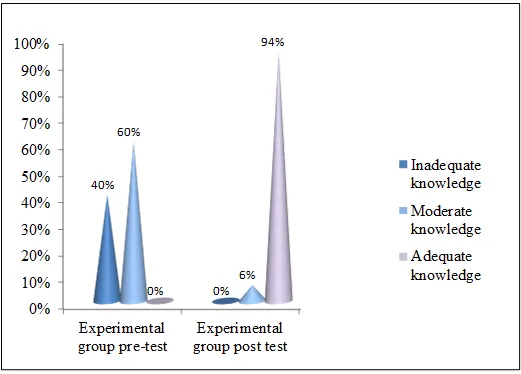
Figure 1: Conical diagram showing comparison of level of knowledge pre- test and post test of experimental group
Figure 1 The findings revealed a substantial improvement in the knowledge level of participants following the administration of the Structured Teaching Programme. In the pre-test, 40% of participants had inadequate knowledge, while 60% had moderate knowledge, and none had adequate knowledge. In contrast, the post-test results showed that 94% of participants attained adequate knowledge and 6% had moderate knowledge, with none remaining in the inadequate knowledge category. The marked shift from inadequate and moderate knowledge in the pre-test to predominantly adequate knowledge in the post-test indicates that the Structured Teaching Programme was effective in improving knowledge regarding Technology Addiction among the participants.
DISCUSSION:
The present study demonstrated that the Structured Teaching Programme was effective in improving knowledge regarding Technology Addiction among late adolescents. The mean knowledge score increased from 14.53 ± 2.28 in the pre-test to 22.23 ± 2.12 in the post-test, with a mean difference of 7.70 and a statistically significant t value of 13.81 (p < 0.05). The categorical findings further showed a marked improvement, with 94% of participants achieving adequate knowledge in the post-test compared with none in the pre-test, while inadequate knowledge decreased from 40% to 0%. The findings suggest that a structured and systematically delivered educational intervention can effectively address knowledge gaps related to Technology Addiction. Considering the high use of smartphones and prolonged technology exposure among adolescents, such educational programmes may help promote responsible technology use and awareness of its potential adverse effects. The findings support the incorporation of focused health-education interventions on Technology Addiction into nursing education and adolescent health-promotion programmes.
CONCLUSION
The present study concluded that the Structured Teaching Programme was effective in improving knowledge regarding Technology Addiction among late adolescents studying at Rohilkhand College of Nursing, Bareilly, Uttar Pradesh. The findings demonstrate that structured health education can effectively address knowledge gaps and enhance awareness regarding the causes, consequences, prevention, and responsible use of technology. The study highlights the importance of incorporating targeted educational interventions into adolescent health promotion and nursing education to encourage healthy and responsible technology-use practices.
REFERENCES






Velladurai Narayanan, Anand Prakash, Ashish Gangwar*, Bhanu Prakash, Brajesh Pal, Brajesh Yadav, A Study To Assess The Effectiveness Of Structured Teaching Program On Knowledge Regarding Technology Addiction Among Late Adolscence In Selected College, Bareilly, Int. J. Sci. R. Tech., 2026, 3 (10), 400-407. https://doi.org/10.5281/zenodo.23163824
 10.5281/zenodo.23163824