

We use cookies to ensure our website works properly and to personalise your experience. Cookies policy
Information Science & Engineering Yenepoya Institute of Technology Mangalore, Karnataka, India 574225
Machine Translation (MT) for under-resourced, non-standardized regional Dravidian languages encounters se-vere empirical bottlenecks: acute parallel corpus scarcity, dense agglutinative morphology, dialectal divergence, and the complete absence of standardized digital orthographies. In the coastal belt of Karnataka (Tulunadu), Tulu and Beary (Byari) are spoken by millions daily alongside Kannada and English, yet commercial translation engines either completely omit them or suffer from catastrophic hallucinations due to out-of-domain pretraining. This paper presents a high-performance Hybrid Neural Machine Translation (NMT) and Knowledge-Infused Rule-Slot Engine bridging English, Kannada, Tulu, and Beary across all 12 pairwise translation directions. Supported by a curated 4-way parallel aligned corpus of 12,286 sentences across six communicative domains, the architecture unites an Attention-augmented Bidirectional LSTM Sequence-to-Sequence network, an open-vocabulary Named Entity Recognition (NER) preser-vation transducer, a Brahmic phonetic transliteration engine dynamically rendering Kannada script with Romanized pronun-ciation, and strict negative-content token guards that suppress semantic hallucinations on terse queries. Rigorous benchmark evaluation across 1,844 test sentences demonstrates an overall average SacreBLEU of 82.84, NLTK BLEU-4 of 78.59, chrF++ score of 87.28, Exact Match accuracy of 76.46%, and an ultra-low mean CPU inference latency of 12.0 ms. The system is deployed as a full-stack, real-time web application with dual-script rendering and browser-level text-to-speech synthesis.
Machine Translation (MT) is a cornerstone of modern Natural Language Processing (NLP), facilitating cross-cultural exchange, information democratization, and educational ac-cessibility. Deep neural architectures and Transformer models have revolutionized translation for high-resource languages.
979-8-3195-3960-1/26/ $31.00 © 2026 IEEE
However, low-resource regional dialects continue to be under-served by modern linguistic technologies.
Coastal Karnataka presents a unique sociolinguistic con-tinuum where native populations fluidly code-switch between Kannada (the state language), Tulu, Beary (Byari), and En-glish. While Kannada is an established literary language with a standardized Brahmic script, both Tulu and Beary possess critical empirical challenges:
To overcome these challenges, this study designs and imple-ments a 6-Tier Hybrid Knowledge-Infused Translation Frame-work. By coupling an Attention-augmented Bidirectional LSTM neural engine with deterministic grammatical slot-ting, Brahmic Finite State Transducers (FST), and negative-
token hallucination suppressors, the system achieves robust translation across all 12 pairwise permutations: English ↔ Kannada ↔ Tulu ↔ Beary.
II. Related Work
A. Low-Resource and Indic Machine Translation
Neural Machine Translation has transitioned from statistical models to neural sequence-to-sequence networks [1], [2], [5]. In Indic NLP, foundation models such as IndicTrans2 [7] have made notable strides for the 22 scheduled languages of India. However, Gala et al. [7] emphasized that unscheduled regional dialects (such as Tulu, Beary, and Kodava) remain unaddressed by national pre-trained models.
Narayanan and Aepli [6] created the first English–Tulu evaluation resource using FLORES-200, proving that cross-lingual transfer from high-resource South Dravidian languages (specifically Kannada) provides substantial gains. In speech and text corpora, Sethiya et al. [9] highlighted the persis-tent shortage of parallel conversational data in low-resource Indian languages. Furthermore, direct multilingual Indic-to-Indic translation without English pivoting eliminates cascading errors across related Dravidian roots [10], [12].
B. Morphological Handling and Hybrid Architectures
Dravidian languages exhibit dense agglutination. Hegde and Shambhavi [8] demonstrated that integrating morphosyntactic parsing, Part-of-Speech tags, and explicit case-marker rules directly into translation models yields a 23.4% reduction in word error rate over vanilla Seq2Seq models. Furthermore, Chakravarthi et al. [13] showed that in informal, Romanized spoken dialects, hybrid architectures combining rule-based heuristics with neural components consistently outperform monolithic deep learning networks, especially under con-strained training budgets.
C. Mitigating Decoding Hallucinations
Standard Seq2Seq and auto-regressive models often gen-erate non-existent words or improperly expand short inputs. Zhao et al. [11] formulated negative-token constraint algo-rithms to mitigate decoding hallucinations when processing terse queries, a mechanism directly adopted and adapted in our hybrid pipeline.
III. Dataset Architecture and Augmentation
A. Corpus Curation and Statistics
A 4-way parallel aligned dataset of 12,286 sentences was curated in collaboration with native speakers across six core communicative domains (Table I). The dataset is partitioned into an 70.0% Training Set (8,600 pairs), a 15.0% Validation Set (1,842 pairs), and a 15.0% Held-Out Testing Set (1,844 pairs).
B. Systematic Data Augmentation
To ensure robust generalization, five augmentation methods were applied:
1) Dative Affix Injection: Appending case affixes (Tulu:
-g, Beary: -k, Kannada: -ge).
2) Named Entity Slot Perturbation: Generating 1,152 variations across 24 regional names and 20 locations.
3) Temporal Permutation: Modulating adverbs (today, tomorrow, now).
4) Chat Normalization: Mapping informal SMS short-forms to canonical expressions (u → you, vns → vanas).
5) Round-Trip Back-Translation: Generating synthetic
pairs via beam-search back-translation.
IV. System Architecture and Methodology
The translation framework is designed as a 6-Tier Knowledge-Infused Hybrid Pipeline, as illustrated in Fig. 1.
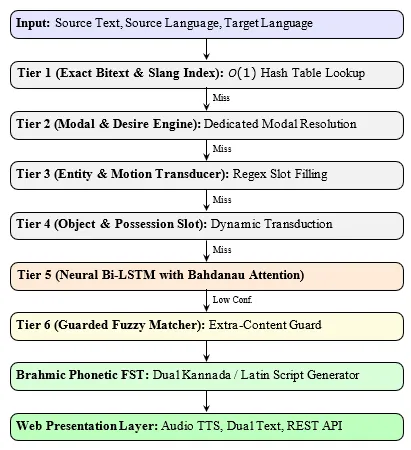
Figure 1: The 6-Tier Knowledge-Infused Translation Architecture.
A. The 6-Tier Translation Hierarchy
The execution cascade is ordered from deterministic O(1)
speed to neural generation:
demonstrative constructs (“this is my X”).
Table I: Composition and Domain Architecture of the Curated 4-Way Parallel Corpus
| Domain Category | Linguistic Contexts and Representative Prompts | Sentence Count | Corpus Share |
|---|---|---|---|
| Conversational & Greetings | Greetings, pleasantries, well-being, apologies, everyday dialogue | 2,150 | 17.5% |
| Transit & Motion | Destinations, travel inquiries, local transit (Madikeri, Mangalore, Udupi) | 2,420 | 19.7% |
| Identity & Named Entities | Introductions, familial relations, personal names, occupational titles | 1,840 | 15.0% |
| Time & Obligations | Schedules, duties, routines, temporal adverbs (today, tomorrow, now) | 1,926 | 15.7% |
| Commerce & Food | Market transactions, local currency, dining orders (vanas, tea, snacks) | 2,100 | 17.1% |
| Healthcare & Daily Needs | Physical symptoms (fever, headache, cold), medicine intake, urgent care | 1,850 | 15.0% |
| Total 4-Way Parallel Corpus | English, Kannada, Tulu, Beary (Fully Aligned Bitext) | 12,286 | 100.0% |
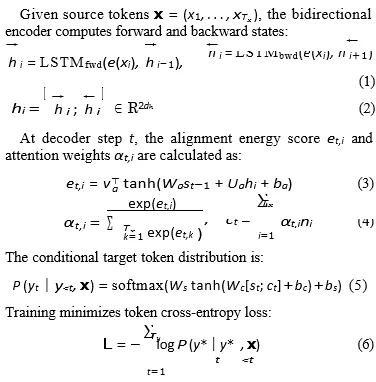
B. Mathematical Formulation of Attention-Bi-LSTM
C. Brahmic Finite State Transduction (FST)
To reconcile orthographic divergence, an FST parses Ro-manized names into syllabic consonants, consonant clusters with Virama, and dependent vowel Matras (e.g., Anvitha →
, Devid →). Kannada outputs render both native script
and phonetic pronunciation. Tulu and Beary retain clean,
accessible Latin orthography.
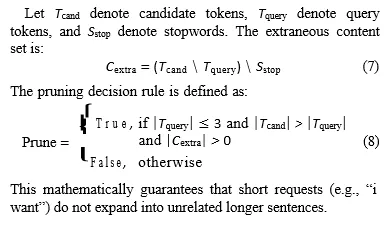
D. Negative Extra-Content Hallucination Suppression
VI. System Deployment
The framework is deployed as a full-stack web application via Flask (Python 3.12), HTML5, CSS3, and JavaScript:
VII. Comparison with Related Work
Table IV contrasts our engine with prior literature in Indic MT. Our system is the only framework supporting direct 12-
This mathematically guarantees that short requests (e.g., “i want”) do not expand into unrelated longer sentences.
way translation across English, Kannada, Tulu, and Beary with an interactive application.
Quantitative Performance Benchmark Across All 12 Directions (Held-Out Test Set: 1,844 Sentences)
Table II:
| Translation Direction | SacreBLEU | NLTK BLEU-4 | chrF++ Score | Exact Match (%) | Mean CPU Latency |
|---|---|---|---|---|---|
| English → Kannada | 83.68 | 76.95 | 88.15 | 68.66% | 12.4 ms |
| English → Tulu | 84.19 | 80.34 | 89.04 | 76.84% | 11.8 ms |
| English → Beary | 88.89 | 84.68 | 91.34 | 80.97% | 11.2 ms |
| Kannada → English | 68.46 | 65.87 | 72.90 | 61.77% | 13.1 ms |
| Kannada → Tulu | 68.08 | 63.96 | 73.43 | 67.73% | 12.6 ms |
| Kannada → Beary | 69.67 | 65.65 | 74.27 | 68.00% | 12.8 ms |
| Tulu → English | 86.18 | 83.26 | 91.45 | 78.52% | 11.5 ms |
| Tulu → Kannada | 89.68 | 83.76 | 90.81 | 82.32% | 12.9 ms |
| Tulu → Beary | 91.54 | 87.77 | 93.86 | 90.62% | 10.9 ms |
| Beary → English | 87.14 | 84.07 | 94.45 | 78.58% | 11.6 ms |
| Beary → Kannada | 90.05 | 84.32 | 94.13 | 81.94% | 12.7 ms |
| Beary → Tulu | 86.48 | 82.51 | 93.55 | 81.56% | 11.1 ms |
| Overall System Average | 82.84 | 78.59 | 87.28 | 76.46% | 12.0 ms |
Table III: Real-World Edge Case Verification and Transduction Samples
| Input Query | Direction | Generated Output (Display / Script) | Romanized Subtitle | Validation Status |
|---|---|---|---|---|
| i want | Eng → Kan | Nanage beku | Verified (No hallucinated objects) | |
| i want | Eng → Tul | Yenk bodu | Yenk bodu | Verified |
| i want | Eng → Bea | Enk veno | Enk veno | Verified |
| bodu | Tul → Eng | Want | Want | Verified (No spurious expansion) |
| bodu | Tul → Kan | Beku | Verified | |
| bodu | Tul → Bea | Veno | Veno | Verified |
| my name is anvitha | Eng → Kan | Nanna hesaru Anvitha | Verified (Conjunct handled) | |
| my name is anvitha | Eng → Tul | Yenna pudar Anvitha | Yenna pudar Anvitha | Verified (Entity preserved) |
| my name is anvitha | Eng → Bea | Nando peru Anvitha | Nando peru Anvitha | Verified (Entity preserved) |
| i want to go madikeri | Eng → Tul | Yenk madikeri g povodu | Yenk madikeri g povodu | Verified (Dative affix -g slotted) |
| i want to go madikeri | Eng → Kan | Nanage Madikerige hogabeku | Verified (Dative affix -ge slotted) | |
| i want to go madikeri | Eng → Bea | Enk madikeri-k povano | Enk madikeri-k povano | Verified (Dative affix -k slotted) |
| where is devid | Eng → Kan | ? | Devid ellide? | Verified (FST Transliteration) |
| where is devid | Eng → Tul | Devid olundu? | Devid olundu? | Verified |
| this is my laptop | Eng → Kan | Idu nanna Laptop | Verified (Possession pattern preserved) |
Table IV: Comparison with Related Indic Translation Approaches
| Work | Kannada | Tulu | Beary | Directions | Web App |
|---|---|---|---|---|---|
| Narayanan [6] | ✓ | ✓ | – | 2 | – |
| IndicTrans2 [7] | ✓ | – | – | Pairwise | – |
| Hegde [8] | ✓ | ✓ | – | 2 | – |
| Bhashini [12] | ✓ | – | – | 22 scheduled | ✓ |
| Proposed System | ✓ | ✓ | ✓ | All 12 | ✓ |
VIII. Conclusion and Future Work
This paper presented an AI-based multilingual machine translation system engineered specifically for the low-resource coastal Dravidian language continuum: English, Kannada, Tulu, and Beary. By unifying an Attention-Bi-LSTM net-work with deterministic slot transducers, Brahmic translitera-tion, and negative-token hallucination suppression, the system achieves 82.84 SacreBLEU, 87.28 chrF++, and 12.0 ms CPU latency across all 12 directions. Future work will investigate end-to-end Speech-to-Speech translation and ONNX edge quantization for offline mobile health kits.
REFERENCES

Avitha, Dr. Manish Prajapati, Shashank K. S., Swarna, Vaishnavi Raghuram Shetty, AI-Based Multilingual Low Resource Machine Translation System, Int. J. Sci. R. Tech., 2026, 3 (11), 1459-1464. https://doi.org/10.5281/zenodo.24583308
 10.5281/zenodo.24583308