

We use cookies to ensure our website works properly and to personalise your experience. Cookies policy
SSS Indira College of Pharmacy, Vishnupuri, Nanded.
Artificial Intelligence (AI) is progressively reshaping regulatory affairs in the pharmaceutical sector by enhancing efficiency, precision, and adherence in electronic Common Technical Document (eCTD) submissions. Even though eCTD has established itself as a worldwide benchmark for regulatory submissions, the processes involved in its preparation and lifecycle management continue to be complicated, lengthy, and susceptible to human mistakes because of the vast documentation and manual operations. This assessment examines the impact of AI-powered automation in enhancing eCTD submissions, concentrating on the Indian pharmaceutical sector. Literature from 2020 to 2025 was reviewed to explore the use of AI technologies, such as Machine Learning (ML), Natural Language Processing (NLP), Robotic Process Automation (RPA), and Explainable AI (XAI), in regulatory processes. These technologies facilitate automated document creation, metadata extraction, validation, and compliance oversight, thus improving submission efficiency. Research shows that incorporating AI can cut document processing time by about 35% and lower submission errors by 26–40%, whereas eCTD implementation by itself brings down preparation time by nearly 25%. The shift to eCTD 4.0 enhances structured data management and boosts interoperability, making AI integration easier. Despite these advantages, issues like data privacy worries, absence of regulatory uniformity, and elevated implementation expenses remain, especially in India. In general, automation powered by AI has considerable potential to improve regulatory efficiency and speed up digital transformation in pharmaceutical submissions.
The pharmaceutical industry is one of the most regulated sectors globally, requiring extensive documentation to ensure the safety, quality, and effectiveness of medicines. Regulatory submissions are crucial for obtaining marketing authorization, clinical trial approval, and maintaining compliance throughout a product's lifecycle. 1To standardize submissions across different regions, the International Council for Harmonization (ICH) developed the Common Technical Document (CTD), which was later updated to the Electronic Common Technical Document (eCTD) for digital submissions.2
CTD and eCTD dossiers contain detailed information on product quality, manufacturing, non-clinical studies, clinical data, safety, and effectiveness. Traditionally, preparing a dossier involves a lot of manual work, including compiling documents, formatting, validating, cross-referencing, and managing the lifecycle. Growing regulatory demands have made submission management more complicated, resulting in higher workloads, longer timelines, and an increased risk of documentation errors.2
Recent advances in digital technologies have changed how pharmaceutical regulatory operations work. Artificial Intelligence (AI), Machine Learning (ML), Natural Language Processing (NLP), and Robotic Process Automation (RPA) are increasingly used to automate tasks like document classification, metadata generation, validation, compliance monitoring, and regulatory intelligence. These technologies improve efficiency, lessen manual work, and enhance the quality of submissions.3
The launch of eCTD 4.0 has opened up more opportunities for automation within a structured, metadata-driven, and user-friendly submission framework. Its stronger lifecycle management and data handling capabilities make it a good fit for AI-enabled regulatory systems. This review focuses on how AI-driven automation can assist with eCTD submissions, highlighting applications, benefits, challenges, and future prospects, especially in the Indian pharmaceutical industry.1,3
1.1 Evolution of CTD and eCTD Systems
The creation of the Common Technical Document (CTD) and its electronic version, eCTD, has greatly improved pharmaceutical regulatory submissions. It has increased global standardization, submission efficiency, and communication between pharmaceutical companies and regulatory bodies. Advances in digital technologies have further sped up the adoption of modern electronic submission standards.3
2. COMMON TECHNICAL DOCUMENT (CTD)
The Common Technical Document (CTD) was developed by ICH to establish a standardized format for regulatory submissions across various regions.4
2.1 Objectives of CTD
Before the CTD was implemented, companies created different dossier formats for various regulatory agencies. This approach led to increased workloads, higher costs, and slower approvals. The CTD addressed these challenges by providing a globally accepted standardized structure.4,5
2.2 Structure of CTD
The CTD consists of five modules:
2.3 Transition from CTD to eCTD
As pharmaceutical development grew more complex, paper-based CTD submissions posed challenges in document management, version control, and global submissions.9
2.3.1 Limitations of Paper-Based CTD
To overcome these limitations, the pharmaceutical industry embraced the Electronic Common Technical Document (eCTD), converting traditional paper dossiers into a structured electronic format.6,7
3. ELECTRONIC COMMON TECHNICAL DOCUMENT (eCTD):
The Electronic Common Technical Document (eCTD) is an electronic version of the CTD format that uses an XML-based standardized structure for regulatory submissions.5,9
3.1 Major Features of eCTD6
3.2 Benefits of eCTD
3.3 Evolution of eCTD Versions
The evolution of eCTD from a basic electronic submission format to an advanced digital framework has enhanced submission quality, lifecycle management, traceability, and regulatory efficiency. Modern eCTD systems also support AI-driven automation technologies.5
|
Year |
Version |
Key Features |
|
2000 |
CTD |
Introduction of harmonized paper-based submission format with 5 standardized modules |
|
2003 |
eCTD v2.0 |
Initial transition from paper-based to electronic submissions |
|
2005 |
eCTD v3.0 |
Introduction of electronic dossier structure with basic lifecycle management |
|
2008 |
eCTD v3.2.2 |
XML backbone, hyperlinking, improved validation, and global adoption |
|
2021 |
eCTD v4.0 |
HL7 RPS-based architecture, advanced metadata, interoperability, and enhanced lifecycle management |
|
Present |
eCTD 4.0 Adoption |
Support for AI integration, automation, structured data exchange, and digital regulatory transformation |
Table No. 01: Evolution of CTD and eCTD Systems 5
3.4 Technical Components of eCTD
3.4.1 XML Backbone
3.4.2 Lifecycle Management
• Tracks document updates throughout the product lifecycle
• Supports replace, append, and delete operations
• Maintains submission history
• Simplifies post-approval changes
3.4.3 Hyperlinks and Bookmarks
• Improve navigation within dossiers
• Provide quick access to related information
• Reduce review time
3.4.4 Validation Mechanisms
• Verify compliance with regulatory requirements
• Identify submission errors
• Improve submission quality and approval rates
The structured architecture of eCTD, especially eCTD 4.0, provides a solid foundation for AI-driven automation by supporting intelligent document processing, compliance monitoring, and workflow automation.10
3.5 Limitations of eCTD 3.2.2
|
Feature |
CTD |
eCTD 3.2.2 |
eCTD 4.0 |
|
Submission Type |
Paper-based |
Electronic |
Structured Digital |
|
Lifecycle Management |
Manual |
Basic |
Advanced |
|
Metadata Handling |
Minimal |
Limited |
Extensive |
|
Automation Support |
Low |
Moderate |
High |
|
AI Compatibility |
Very Low |
Moderate |
High |
|
Communication |
Manual |
One-way |
Two-way |
|
Validation |
Manual |
Automated |
Intelligent/Advanced |
|
Interoperability |
Low |
Moderate |
High |
|
Content Reuse |
Not Supported |
Partial |
Strong |
|
Regulatory Efficiency |
Low |
Improved |
Highly Efficient |
Table No. 02: Comparative Analysis of CTD, eCTD 3.2.2, and eCTD 4.010
3.6 Need for eCTD 4.0
eCTD 4.0 is the version of the Electronic Common Technical Document. It was developed by the International Council for Harmonization (ICH) to modernize regulatory submissions. ECTD 4.0 is based on the Health Level Seven (HL7) Regulated Product Submission (RPS) standard.12 This standard enables data exchange, interoperability and communication between pharmaceutical companies and regulatory authorities.13
eCTD 4.0 was introduced to address the limitations of eCTD versions. It supports the increasing demand for digital and globally harmonized regulatory processes.14
4.1 Objectives of eCTD 4.0
4.2 Key Features of eCTD 4.0 19
4.2.1 Harmonized Submission Structure
4.2.2 Forward Compatibility
4.2.3 Two-Way Communication
4.2.4 Context of Use (CoU)
4.2.5 Keywords
4.2.6 Controlled Vocabularies
4.3 Components of eCTD 4.014-19
4.3.1 XML Schema
4.3.2 Object Identifiers (OIDs)
4.3.2 Unique Identifiers (UUIDs)
4.3.3 Code Systems
4.3.4 Regional Specifications
4.3.5. Folder Structure
The advanced features and structured architecture of eCTD 4.0 provide a foundation for digital regulatory transformation. Its standardized data model, lifecycle management capabilities and interoperability support the integration of Artificial Intelligence (AI) automation technologies and intelligent regulatory workflows in regulatory affairs. 19
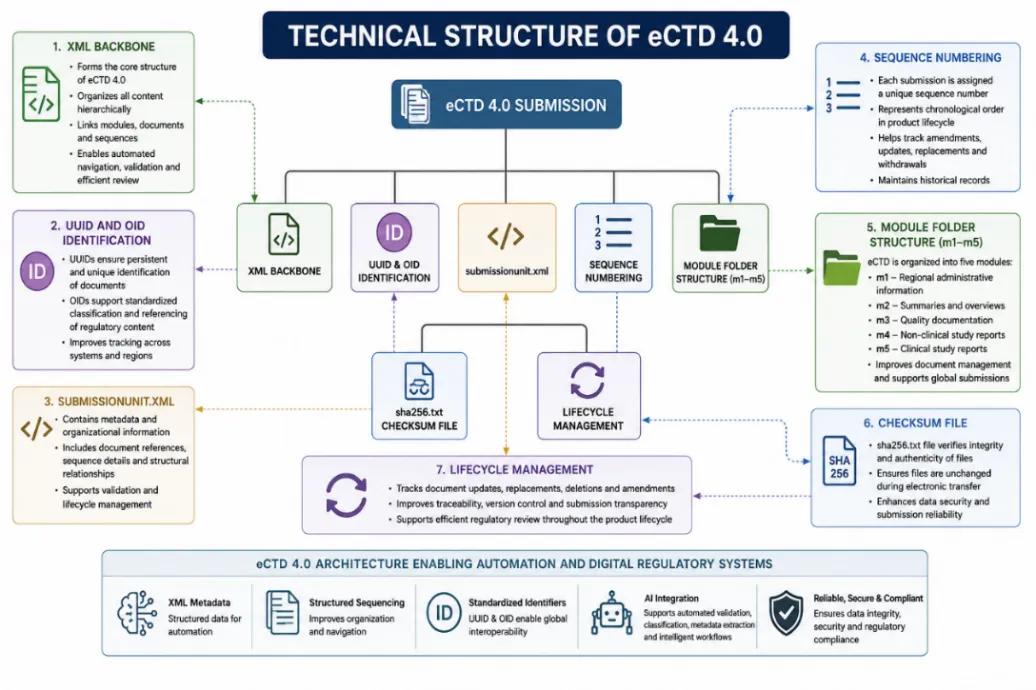
Figure No.05: Technical structure of eCTD 4.0
4.4 Relevance to AI-Driven Regulatory Affairs
The structured and metadata-rich architecture of eCTD 4.0 provides a foundation for implementing Artificial Intelligence (AI) Machine Learning (ML) Natural Language Processing (NLP) and Robotic Process Automation (RPA).20 These technologies can automate document classification, validation, compliance monitoring and regulatory intelligence activities thereby improving efficiency and reducing effort.21
Recent advancements in AI technologies including machine learning (ML) natural language processing (NLP) and robotic process automation (RPA) have created opportunities, for automating regulatory submission workflows.22 AI-driven systems enable automated document classification, content extraction, validation checks, metadata generation and regulatory intelligence analysis. They have demonstrated that AI-based automation significantly improves compliance, audit readiness and documentation accuracy while reducing manual workload.24
|
AI Technology |
Application in eCTD |
Benefit |
|
Machine Learning (ML) |
Predictive analysis, risk detection |
Improved decision making |
|
NLP |
Document processing, data extraction |
Increased accuracy |
|
RPA |
Workflow automation |
Faster submission |
|
XAI |
Transparent decisions |
Regulatory trust |
Table No 03: AI Technologies in Regulatory Submissions
Natural Language Processing (NLP) helps manage large volumes of unstructured regulatory text through automated document analysis, content comparison, and information extraction, improving efficiency and consistency in submissions. However, challenges related to data quality and model validation remain.25
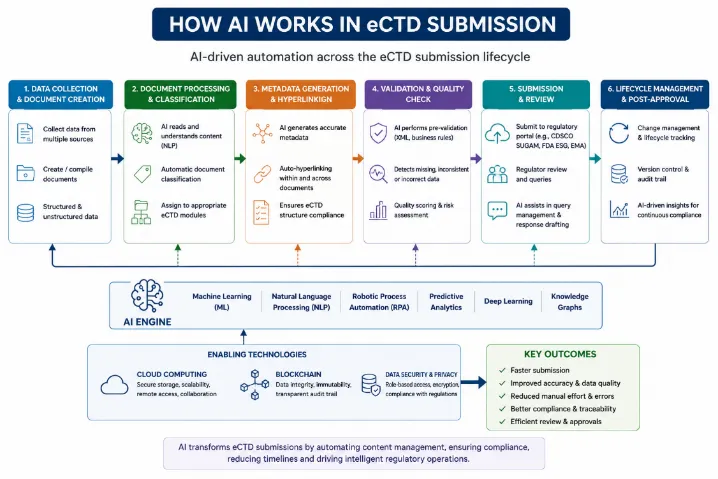
Fig. No. 03: AI driven automation across the eCTD submission lifecycle
eCTD 4.0 is a major advancement in regulatory submissions, using structured content and metadata-driven systems to improve interoperability, lifecycle management, traceability, and automation. It also supports integration with advanced digital technologies.26
AI-driven automation improves regulatory workflows but requires transparency, explainability, and ethical implementation. Explainable Artificial Intelligence (XAI) enhances trust, accountability, and regulatory acceptance.27 AI also supports risk assessment, benefit–risk evaluation, and review processes, improving consistency and efficiency.28
Technologies such as Machine Learning (ML), NLP, and Robotic Process Automation (RPA) automate document classification, metadata generation, validation, and lifecycle management in eCTD submissions. Cloud computing and blockchain further improve data security and workflow efficiency.29
4.4 Benefits of eCTD 4.0
eCTD 4.0 improves regulatory submissions through better data structure, automation, and communication, enabling faster reviews, reduced redundancy, and improved global interoperability.28
4.4.1 Enhanced Lifecycle Management
4.4.2 Improved Review Efficiency
4.4.3 Reduced Redundancy
4.4.4 Real-Time Two-Way Communication
4.4.5 Content Modularity and Reuse
4.4.6 Improved Metadata Handling
4.4.7 Global Harmonization
Despite these advantages, the implementation of AI-driven eCTD systems in India is associated with several infrastructural, regulatory, and operational challenges. Addressing these limitations is essential for the effective integration of AI technologies into pharmaceutical regulatory affairs. ²
Although AI-based technologies enhance efficiency, accuracy, and workflow management in regulatory submissions, human expertise and regulatory oversight remain crucial to ensure reliability, ethical implementation, and compliance with regulatory standards. â
4.5 Global Implementation of eCTD 4.0
Pharmaceutical regulation bodies in various key markets are moving towards adopting eCTD 4.0. A number of regulators will mandate the use of eCTD 4.0 for drug submissions in the coming years.27
|
Regulatory Agency |
Adoption Status |
Expected Timeline |
Key Considerations |
|
FDA (USA) |
Voluntary eCTD 4.0 submissions initiated |
Mandatory adoption expected by 2029 |
Gradual transition supported by pilot programs |
|
EMA (Europe) |
Currently using eCTD 3.2.2 |
Transition planned by 2027–2028 |
Focus on harmonization and interoperability |
|
PMDA (Japan) |
Active transition and pilot testing |
Mandatory adoption targeted by 2026 |
Strong regulatory preparedness |
|
Health Canada |
Expanding pilot implementation |
Full implementation planned by 2026 |
Alignment with ICH guidelines and digital modernization |
|
CDSCO (India) |
Pilot implementation through SUGAM portal |
Official timeline not finalized |
Requires infrastructure development, technical training, and regulatory alignment |
Table No. 04: Global eCTD 4.0 Adoption Status
As a result, there is a gradual shift being seen in the adoption of upgraded technology by pharmaceutical companies.28
Though considerable progress has been made worldwide in adopting AI-driven regulatory systems, implementation in India's pharmaceutical regulatory system is at an early stage.
|
Criteria |
Traditional CTD/eCTD |
AI-based eCTD |
|
Document Creation |
Documents created manually |
Automatic processing of documents |
|
Verification |
Manual validation |
Automatic metadata creation |
|
Metadata Generation |
Manual metadata creation |
Automatic metadata creation |
|
Lifecycle Management |
Manual lifecycle tracking |
Automated lifecycle monitoring |
|
|Error Probability |
Higher chance of error |
Lower due to automation |
|
Submission Timeline |
Takes more time to process |
Quick submission process |
|
Compliance Review |
Manual compliance checking |
AI-supported compliance monitoring |
|
Operational Efficiency |
Moderate efficiency |
Improved efficiency and productivity |
Table No. 05: Comparative Analysis of Conventional and AI-Enabled eCTD Systems
4.6 Current Status of Digital Adoption in India
India currently uses the CTD format under the New Drugs and Clinical Trials Rules (NDCTR), 2019. The country is slowly moving toward mandatory eCTD implementation through efforts by CDSCO.27 Many large Indian pharmaceutical companies already use eCTD 3.2.2 when submitting to agencies like the USFDA and EMA. However, the adoption of eCTD 4.0 is still in the early stages.34 Only a few companies are evaluating or testing the new system. This shows that the digital maturity of regulatory operations in the Indian pharmaceutical industry is still developing.35
5. INDIAN PHARMACEUTICAL INDUSTRY PERSPECTIVE
India is one of the largest producers of pharmaceuticals globally. It plays a crucial role in supplying generic medicines, vaccines, and active pharmaceutical ingredients (APIs). 36 The Indian pharmaceutical industry exports its products to highly regulated markets such as the United States, Europe, and Canada, as well as to emerging international regions. As global regulatory requirements shift toward digital submissions, Indian pharmaceutical companies are increasingly using electronic submission methods to stay competitive and meet compliance standards.37
5.1 India’s Position and Strategic Opportunities
The adoption of artificial intelligence in India’s regulatory affairs remains in its early stages, primarily constrained by infrastructure limitations and a lack of standardized data formats.38 Despite these challenges, initiatives such as the CDSCO SUGAM 2.0 platform indicate a transition in the direction of digital regulatory processes. 39These developments establish a foundation for AI applications in dossier validation, document classification, and regulatory intelligence.40
|
Entity |
Platform / System |
Application |
Implementation Status |
Key Outcome |
|
FDA (USA) |
ELSA & KASA |
AI-assisted dossier review |
Operational |
Faster reviews and improved data integrity |
|
EMA (Europe) |
IRIS Platform |
Validation and document routing |
Operational |
Improved efficiency and transparency |
|
CDSCO (India) |
SUGAM 2.0 |
Digital submissions and planned AI integration |
Pilot Stage |
Initial step toward automation |
|
Pfizer |
Veeva Vault RIM + AI |
Automated dossier compilation |
Active Use |
Improved CTD consistency |
|
Sun Pharma |
AI-based RIM System |
Document management and validation |
Pilot Stage |
Improved internal efficiency |
|
Dr. Reddy’s Laboratories |
AI-based document QC |
Metadata correction and validation |
Pilot Stage |
Reduced manual verification time |
Table No 04: Global and Indian Adoption Landscape of AI-Driven Regulatory Platforms41
The integration of Natural Language Processing, Machine Learning, and Robotic Process Automation into regulatory workflows will likely depend on coordination between regulatory bodies, pharmaceutical manufacturers, and technology providers. Aligning domestic practices with the frameworks established by the FDA and EMA may facilitate the development of a more standardized digital regulatory environment in India.40
Table 4 outlines the current implementation status of AI-driven regulatory platforms within global and domestic contexts.
This comparison shows that while regulatory agencies in developed markets have transitioned to operational AI-supported systems, the Indian regulatory landscape is currently characterized by pilot programs and developmental initiatives. Even so, the development of technological transformation inside the pharma sector indicates a definite course toward greater artificial intelligence-powered automation within Indian regulatory compliance.41
|
Barrier |
Description |
Impact |
|
High Cost |
Expensive AI software and infrastructure |
Limits adoption |
|
Skilled Workforce Shortage |
Lack of AI and eCTD experts |
Reduces efficiency |
|
Poor Digital Infrastructure |
Dependence on traditional systems |
Slows automation |
|
Data Security Concerns |
Sensitive regulatory data risks |
Compliance issues |
|
Limited Regulatory Guidelines |
Few CDSCO AI regulations |
Implementation uncertainty |
|
Interoperability Issues |
Difficulty integrating systems |
Workflow inefficiency |
|
Resistance to Change |
Hesitation in adopting new technology |
Delays automation |
|
Validation Challenges |
Need for continuous AI validation |
Affects regulatory acceptance |
|
Limited eCTD 4.0 Awareness |
Slow transition from older systems |
Delays modernization |
|
Manual Documentation Dependence |
Continued use of manual processes |
Increases errors and delays |
Table No.05: Barriers to AI-Driven eCTD Implementation in India
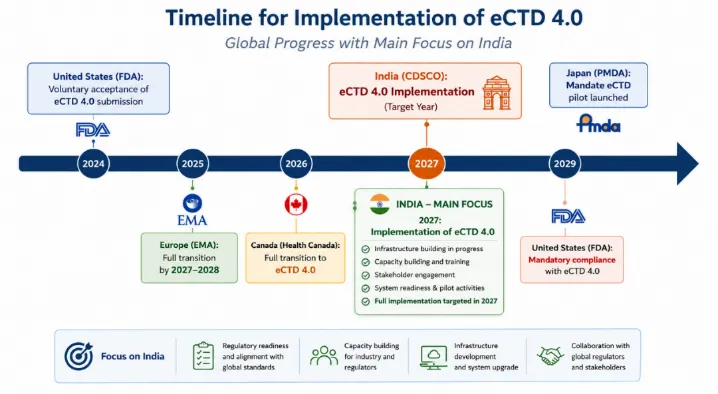
Figure No. 06: Timeline for implantation of eCTD 4.0[11]
5.2 Future Prospects of Artificial Intelligence in Regulatory Affairs
The function of Artificial Intelligence (AI) in pharmaceutical regulatory matters is anticipated to grow considerably with the continuous progress of digital technologies. New systems like AI-driven dossier management platforms, predictive regulatory analytics, cloud-based regulatory solutions, and smart document processing tools could modernize conventional regulatory operations and enhance overall workflow efficiency.42
Prospective AI applications might enable automatic document categorization, metadata creation, compliance evaluation, lifecycle monitoring, and regulatory insights. Technologies such as Machine Learning (ML) and Natural Language Processing (NLP) can aid in examining extensive amounts of regulatory data, spotting possible compliance concerns, and facilitating quicker and more uniform decision-making procedures.43
The adoption of eCTD 4.0 alongside AI technologies is expected to boost submission quality, improve traceability, shorten review timelines, and reinforce global regulatory alignment. Moreover, sophisticated digital technologies like cloud computing, blockchain systems, and organized content management solutions could enhance transparency, interoperability, and secure data sharing in regulatory frameworks.44
With the ongoing evolution of pharmaceutical regulatory systems towards digital transformation, AI-supported regulatory operations are anticipated to assume a more significant role in contemporary submission management. Additionally, implementing explainable AI and organized digital workflows could enhance regulatory confidence, uniformity, and acceptance of AI-driven procedures in pharmaceutical regulatory affairs.45
6. KEY FINDINGS
6.1 Research Gap
Existing literature has widely explored the role of Artificial Intelligence (AI) in pharmaceutical regulatory operations; however, comparatively fewer studies have examined its practical application in automating electronic Common Technical Document (eCTD) submissions, particularly in the context of the Indian pharmaceutical sector. Areas such as implementation readiness, regulatory alignment, infrastructure limitations, explainable AI practices, and availability of trained professionals still require deeper investigation. In view of these gaps, the present review focuses on understanding the emerging role of AI in eCTD submissions, along with its applications, benefits, limitations, and future potential in pharmaceutical regulatory affairs.
7. AIM AND OBJECTIVES:
7.1 Aim: AI-Driven Automation in eCTD Submissions: Opportunities and Implementation for Indian Pharmaceutical Industry
7.2 Objective:
8. MATERIALS AND METHODS
8.1 Research Design and Study Type
This study employs a systematic review framework to examine the integration of artificial intelligence within the electronic Common Technical Document submission process in the pharmaceutical industry. The research is non-experimental and descriptive, prioritizing the synthesis of secondary data to assess current practices and technological trends. An analytical approach is used to evaluate findings across multiple studies, while a comparative component contrasts traditional manual workflows with automated systems.
8.2 Sources of Data
Data were collected from established academic databases and regulatory repositories, including PubMed, Google Scholar, ScienceDirect, and the official portals of the United States Food and Drug Administration, the European Medicines Agency, and the Central Drugs Standard Control Organization.
8.3 Data Collection and Selection Criteria
The literature search targeted publications released between 2020 and 2025. Identification of relevant material was conducted using specific keywords such as artificial intelligence in regulatory affairs, eCTD automation, and pharmaceutical submissions. Articles were selected based on their technical relevance, source credibility, and the availability of comprehensive data. Selection was limited to expert-reviewed, English-written publications and sector reports centered on regulation processes. Conversely, the study excluded materials published prior to 2020, non-peer-reviewed sources, and research unrelated to pharmaceutical regulatory processes.
8.4 Data Analysis Method
The collected information was analyzed through qualitative and comparative methods. Findings were categorized into thematic areas, including specific AI technologies, implementation tools, operational benefits, and existing challenges. This categorization allowed for the identification of broader industry trends and the assessment of automation efficiency.
8.5 Comparative Regulatory Analysis
A focused comparison of regulatory frameworks from international agencies and the Indian regulatory authority was performed. This analysis evaluated regional differences in submission requirements, the maturity of digital adoption, and the formal acceptance of AI-driven methodologies.
8.6 Ethical Considerations and Limitations
As the research is based entirely on publicly available secondary data, it did not involve human or animal subjects. Standard academic practices for citation and attribution were followed to ensure research integrity. Study limitations include a reliance on existing literature and restricted access to proprietary industry data. Additionally, the rapid evolution of AI technologies and varying levels of regulatory acceptance across different jurisdictions may affect the long-term applicability of the findings.
8.7 Expected Outcomes and Case Study Analysis
The study intends to identify the primary AI technologies currently utilized in regulatory submissions and to evaluate their specific impact on the Indian pharmaceutical sector. To contextualize these findings, the research incorporates an analysis of selected case studies from published literature. These cases serve to illustrate practical implementation, performance improvements, and the technical hurdles encountered during the adoption of automated systems.
CONCLUSION
The transition from conventional Common Technical Document (CTD) systems to electronic Common Technical Document (eCTD) platforms has significantly improved the efficiency and standardization of pharmaceutical regulatory submissions. The emergence of eCTD 4.0 has further strengthened digital regulatory operations through structured content management, advanced metadata handling, interoperability, and improved lifecycle management. These advancements have created a strong foundation for the integration of Artificial Intelligence (AI) and automation technologies in regulatory affairs.
This review highlights the growing role of AI technologies such as Machine Learning (ML), Natural Language Processing (NLP), and Robotic Process Automation (RPA) in transforming eCTD submission processes. AI-driven systems support automated document classification, metadata generation, validation, compliance monitoring, regulatory intelligence, and workflow management, thereby reducing manual effort, minimizing errors, and improving submission quality and review efficiency. In addition, digital tools including Electronic Document Management Systems (EDMS), Regulatory Information Management (RIM) systems, cloud-based platforms, and blockchain technologies further enhance data management, traceability, and operational efficiency.
Despite these advantages, several challenges continue to limit the widespread implementation of AI-driven regulatory automation, particularly in the Indian pharmaceutical industry. Major barriers include inadequate digital infrastructure, high implementation costs, limited regulatory harmonization, data privacy concerns, lack of skilled professionals, and the need for transparent and explainable AI systems. Regulatory acceptance, ethical governance, and robust validation frameworks remain essential for sustainable adoption.
Overall, AI-driven automation has the potential to reshape pharmaceutical regulatory submissions into more efficient, accurate, and data-driven processes. Continued advancements in digital technologies, stronger regulatory frameworks, global harmonization initiatives, and increased industry preparedness are expected to accelerate the adoption of AI-enabled eCTD systems in the future. India, through initiatives such as the CDSCO SUGAM platform and ongoing digital transformation efforts, has significant opportunities to strengthen its regulatory ecosystem and align with evolving global regulatory standards.
The gradual adoption of AI-enabled eCTD systems reflects a broader transition from traditional document-centred regulatory practices toward more data-oriented and digitally integrated regulatory management.
CONFLICTS OF INTEREST:
The authors declare no conflict of interest. This review is based on publicly available regulatory and scientific literature, and no financial or personal relationships have influenced its preparation or conclusions
REFERENCES




Suryakant B. Jadhav, Shraddha R. Ratanwar*, Vijay V. Navghare, Harshada H. Gore, AI-Driven Automation In eCTD Submissions: Opportunities And Implementation For Indian Pharmaceutical Industry, Int. J. Sci. R. Tech., 2026, 3 (7), 1861-1876. https://doi.org/10.5281/zenodo.21104142
 10.5281/zenodo.21104142