

We use cookies to ensure our website works properly and to personalise your experience. Cookies policy
1Department of Pharmaceutics, Dattakala College of Pharmacy Swami Chincholi, Maharashtra, India.
2Department of Pharmaceutical Chemistry, Dattakala College of Pharmacy, Swami-Chincholi, Maharashtra, India.
Artificial intelligence has emerged as one of the most transformative technologies in pharmaceutical sciences, fundamentally changing the paradigm of drug discovery, formulation development, manufacturing, and quality assurance. Conventional pharmaceutical formulation development primarily relies on empirical experimentation and trial based optimization, which are often time consuming, labor intensive, and resource demanding. The increasing complexity of modern drug molecules, particularly poorly water soluble compounds, biologics, and personalized medicines, has highlighted the limitations of traditional formulation strategies and created a need for more intelligent and predictive development approaches. The integration of artificial intelligence with pharmaceutical sciences has enabled the development of data driven models capable of predicting critical formulation attributes, optimizing manufacturing processes, improving product quality, and accelerating regulatory decision making. Recent advances in machine learning, deep learning, generative artificial intelligence, digital twins, autonomous laboratories, and explainable artificial intelligence have significantly expanded the scope of pharmaceutical formulation development beyond the principles of conventional Quality by Design. Artificial intelligence assisted Quality by Design enables predictive risk assessment, intelligent experimental design, real time process optimization, and continuous quality monitoring throughout the product life cycle. Moreover, emerging technologies such as robotic experimentation, self driving laboratories, and autonomous drug design platforms have the potential to revolutionize pharmaceutical research by reducing development timelines and improving formulation success rates. This review comprehensively discusses the evolution of artificial intelligence in pharmaceutical formulation development, beginning with the principles of Quality by Design and extending toward autonomous drug design. The review also highlights current applications, regulatory perspectives, technological challenges, future opportunities, and research gaps associated with artificial intelligence implementation in pharmaceutical sciences. Collectively, artificial intelligence is expected to become a central component of future pharmaceutical research, enabling more efficient, robust, and personalized formulation development.
Pharmaceutical formulation development has evolved from empirical trial and error approaches toward systematic, science based and increasingly computational methodologies. The primary objective is to develop safe, effective, stable and patient acceptable dosage forms while maintaining consistent quality throughout the product lifecycle. Conventional formulation development depends heavily on laboratory experimentation and repeated optimization, which can require considerable time, cost and expertise, particularly for poorly soluble drugs, highly potent compounds, peptides, proteins and nucleic acid based therapeutics [1,2].
The rapid expansion of pharmaceutical data from high throughput screening, advanced analytical technologies, electronic laboratory systems and manufacturing processes has created opportunities for Artificial Intelligence (AI) based analysis. Machine Learning (ML) can identify complex and nonlinear relationships among formulation variables, material properties, process parameters and product performance that may be difficult to evaluate using conventional statistical approaches [3,4]. Design of Experiments has improved formulation optimization, but complex delivery systems such as nanoparticles, lipid based formulations, biologics and personalized medicines require more advanced predictive approaches [5,6].
Quality by Design (QbD) has established a systematic framework based on predefined product objectives, critical quality attributes, critical material attributes, critical process parameters, risk assessment and design space. Integration of AI with QbD can further support predictive modelling, intelligent optimization and data driven decision making [7,8]. The emergence of Pharma 4.0 has further connected AI with automation, Process Analytical Technology (PAT), digital twins, predictive maintenance and intelligent manufacturing [9,10].
Recent developments in ML, Deep Learning, Generative AI and autonomous laboratories enable prediction of formulation properties, generation of formulation strategies, automated experimentation and real time process optimization [11,12]. However, challenges including limited datasets, model interpretability, cybersecurity, data privacy, validation, regulatory uncertainty and generalizability remain important barriers [17,18]. Overall, AI offers significant potential to transform pharmaceutical formulation development toward predictive, efficient and increasingly autonomous systems.
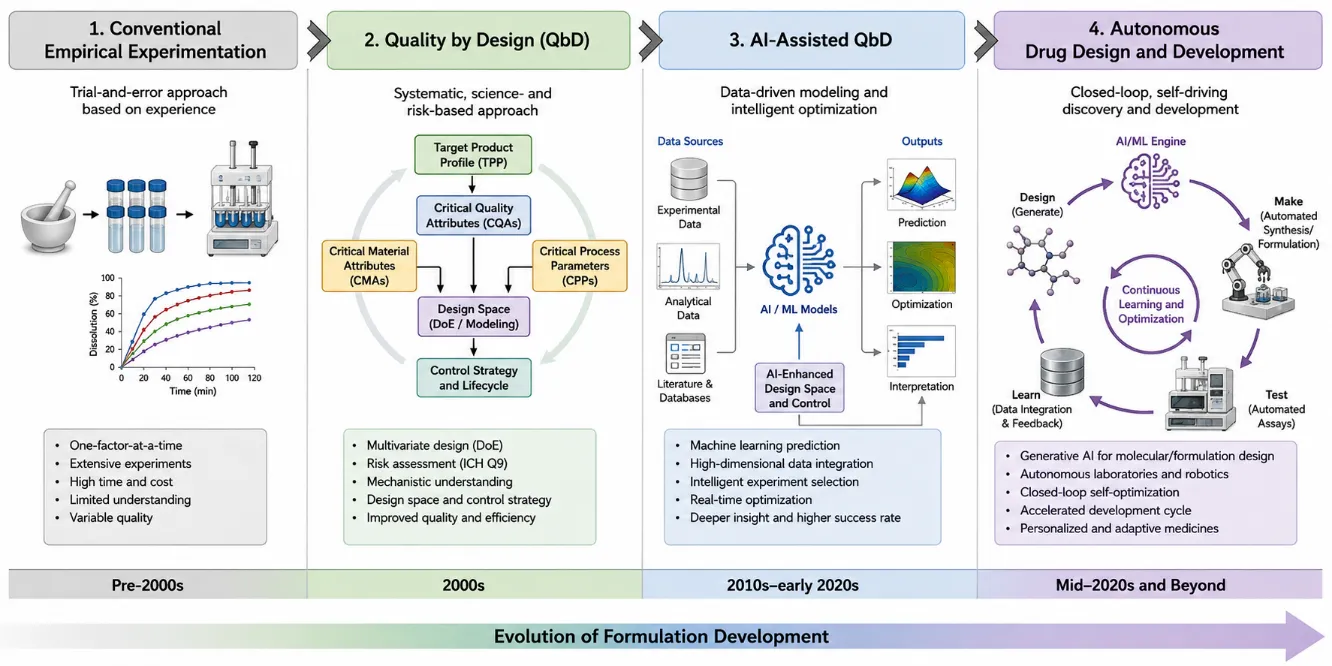
Figure 1. Evolution of pharmaceutical formulation development from conventional empirical experimentation to Quality by Design, Artificial Intelligence assisted Quality by Design, and autonomous drug design.
2. FUNDAMENTALS OF ARTIFICIAL INTELLIGENCE
Artificial Intelligence (AI) refers to computational systems capable of performing tasks associated with human intelligence, including learning, reasoning, pattern recognition, decision making and problem solving. In pharmaceutical sciences, AI has become an important tool for drug discovery, formulation development, manufacturing optimization and quality control because it can identify complex relationships within large datasets and support predictive, data driven development [19,20]. Current pharmaceutical applications mainly involve narrow AI designed for specific tasks, while Machine Learning (ML), Deep Learning (DL), Reinforcement Learning, Natural Language Processing, Computer Vision, Generative AI and Explainable AI provide complementary computational capabilities [20,21].
Machine Learning enables systems to learn relationships from experimental data and predict pharmaceutical properties such as solubility, dissolution, stability, particle characteristics and drug excipient compatibility. Supervised, unsupervised and reinforcement learning approaches support prediction, data classification, pattern identification and optimization of pharmaceutical processes [22,23]. Deep Learning uses multilayer neural networks to analyse highly complex and nonlinear datasets. Architectures including convolutional neural networks, recurrent neural networks and transformers have applications in pharmaceutical imaging, sequential process analysis, molecular modelling and scientific information extraction [24,25].
Generative AI can create novel molecular structures, formulation strategies and scientific content using technologies such as large language models, diffusion models and generative networks [26,27]. Explainable AI improves transparency by identifying variables responsible for model predictions through approaches such as SHAP, LIME and feature importance analysis. This improves scientific interpretation, model trust and potential regulatory acceptance [28]. Overall, these AI technologies provide an integrated computational foundation for predictive and increasingly intelligent pharmaceutical development.
3. TRADITIONAL PHARMACEUTICAL FORMULATION DEVELOPMENT
Traditional pharmaceutical formulation development is a systematic and largely experimental process involving preformulation characterization, excipient selection, formulation screening, optimization, scale up, and final product evaluation. Preformulation studies establish the physicochemical and biopharmaceutical properties of the active pharmaceutical ingredient, including solubility, pKa, partition coefficient, particle size, crystallinity, polymorphism, melting point, stability, and drug excipient compatibility. These investigations provide the basis for selecting suitable dosage forms and manufacturing strategies, particularly for poorly soluble drugs where dissolution may influence bioavailability [29,30].
Excipient selection is performed according to the desired formulation characteristics, previous scientific knowledge, regulatory acceptability, literature evidence, and experimental compatibility. Excipients may function as diluents, binders, disintegrants, polymers, surfactants, lubricants, stabilizers, or release modifiers. Formulation screening subsequently involves preparation of multiple batches with different compositions and process conditions, followed by evaluation of critical quality attributes such as assay, dissolution, hardness, particle size, drug release, and stability [31,32].
During scale up, variations in equipment, mixing, shear, temperature, drying, and material properties can affect product performance and may require repeated experimental adjustments. Conventional development is therefore often time consuming, resource intensive, and limited in its ability to efficiently evaluate nonlinear interactions among numerous variables [33,34]. These limitations provide a rationale for integrating machine learning and data driven approaches with conventional formulation science to improve prediction, optimization, experiment prioritization, and overall development efficiency [35].
4. QUALITY BY DESIGN (QBD): THE FOUNDATION OF AI INTEGRATION
Quality by Design (QbD) is a systematic, science-based and risk-based approach to pharmaceutical development that aims to build quality into a product and its manufacturing process from the beginning rather than relying primarily on end-product testing [36]. The approach is supported by ICH Q8, ICH Q9 and ICH Q10 and involves defining the Quality Target Product Profile (QTPP), identifying Critical Quality Attributes (CQAs), Critical Material Attributes (CMAs) and Critical Process Parameters (CPPs), followed by risk assessment, Design of Experiments (DoE), establishment of a design space and development of an appropriate control strategy [37].
The QTPP defines the intended characteristics of a pharmaceutical product according to therapeutic, quality and regulatory requirements, while CQAs represent attributes that must remain within predefined limits to ensure product performance. CMAs describe material properties that can influence CQAs, whereas CPPs are process variables requiring appropriate control. Risk assessment helps prioritize variables according to their potential impact on quality. DoE systematically evaluates formulation and process variables, including their interactions, and supports identification of optimized conditions [38].
Integration of artificial intelligence with QbD provides an advanced predictive and optimization layer. Machine learning can analyse complex datasets, identify nonlinear relationships between CMAs, CPPs and CQAs, predict formulation performance and prioritize experiments. Therefore, AI-enabled QbD can enhance formulation development by improving prediction, optimization, risk management and efficient utilization of experimental data [39].
5. AI DRIVEN QUALITY BY DESIGN (AI QBD)
The integration of Artificial Intelligence (AI) and Machine Learning (ML) with Quality by Design (QbD) represents an advanced approach to pharmaceutical formulation development by combining scientific understanding with predictive and data driven modelling. Conventional QbD establishes relationships among the Quality Target Product Profile (QTPP), Critical Quality Attributes (CQAs), Critical Material Attributes (CMAs), Critical Process Parameters (CPPs), risk assessment, Design of Experiments (DoE), design space and control strategy. AI enhances this framework by analysing experimental, historical and process datasets to identify complex relationships, predict formulation performance and optimize multiple responses simultaneously [40].
AI assisted risk assessment can identify and rank formulation and process variables that significantly influence CQAs, complementing conventional tools such as FMEA and expert judgement. AI based experimental design, particularly Bayesian optimization, can prioritize informative experiments and reduce unnecessary experimental runs through sequential learning [48]. Machine learning models can also support smart design space generation by predicting acceptable multidimensional regions and enabling multi objective optimization of CQAs such as particle size, encapsulation efficiency, dissolution and stability [41].
Predictive quality modelling using algorithms such as artificial neural networks, random forests and support vector machines can estimate product performance from formulation and process variables. AI can further optimize manufacturing parameters and integrate with Process Analytical Technology (PAT) for real time monitoring and early detection of process deviations [42]. However, successful AI QbD implementation requires high quality data, appropriate validation, model interpretability, data integrity and human oversight. Overall, AI QbD provides a transition from conventional risk based development toward predictive, adaptive and potentially autonomous pharmaceutical formulation development [43].
6. MACHINE LEARNING APPLICATIONS IN PHARMACEUTICAL FORMULATION
Machine learning (ML) has emerged as a valuable computational approach in pharmaceutical formulation development because formulation performance is influenced by complex interactions among drug properties, excipients, formulation composition and manufacturing conditions. ML can identify patterns within experimental and historical datasets and predict formulation performance, thereby reducing extensive trial-and-error experimentation [44]. It has been applied to solubility prediction, dissolution modelling, stability and shelf-life assessment, drug-excipient compatibility, tablet compression, granulation, coating and controlled drug release. Solubility prediction models can use molecular descriptors, physicochemical properties, solvent characteristics and excipient information to identify suitable formulation strategies for poorly water-soluble drugs, with ensemble approaches showing high predictive performance [45]. ML-based dissolution models can incorporate particle size, formulation composition, compression force and process variables to predict dissolution profiles and support formulation optimization. Stability models can analyse temperature, humidity, packaging and degradation data to estimate stability behaviour and prioritize promising formulations, although regulatory stability studies remain necessary [46]. ML can also predict potential drug-excipient interactions using molecular fingerprints and chemical descriptors, reducing experimental compatibility screening [47]. In manufacturing, ML can optimize compression, granulation and coating processes by relating process parameters to critical quality attributes. For controlled-release formulations, ML can predict drug-release profiles from polymer and formulation characteristics. Overall, ML supports prediction, optimization and prioritization of pharmaceutical formulation development while reducing experimental workload. However, reliable application requires high-quality datasets, appropriate validation, model interpretability and experimental confirmation [48].
7. AI IN ADVANCED DRUG DELIVERY SYSTEMS
Artificial Intelligence (AI) and Machine Learning (ML) are increasingly being applied to advanced drug delivery systems to overcome the complexity associated with formulation development and optimization. Nanoparticles, liposomes, solid lipid nanoparticles, nanostructured lipid carriers, polymeric nanoparticles, hydrogels, nanogels, microneedles and 3D printed dosage forms involve multiple interacting formulation and process variables. AI models can analyse these variables and predict critical quality attributes such as particle size, polydispersity, zeta potential, encapsulation efficiency, drug loading, stability and drug release, thereby reducing dependence on conventional trial and error approaches [49].
In nanoparticle and lipid based systems, ML can identify relationships between lipid or polymer composition, surfactant concentration and processing conditions, supporting multi objective optimization and QbD based formulation development [50]. For hydrogels and nanogels, AI can predict swelling, mechanical properties, drug loading and release by analysing polymer composition and crosslinking parameters. Microneedle development can benefit from AI based prediction of mechanical strength, insertion performance and drug delivery efficiency, while deep learning can support automated detection of manufacturing defects. In 3D printed dosage forms, AI can correlate printing parameters with tablet geometry, mechanical properties and dissolution behaviour. AI can also contribute to personalized medicines by integrating patient characteristics with formulation and pharmacokinetic data to support individualized dose, release profile and dosage form selection. Overall, AI provides a predictive and data driven approach for accelerating advanced drug delivery development, optimization and personalization [51].
8. AI IN PROCESS ANALYTICAL TECHNOLOGY (PAT)
Process Analytical Technology (PAT) enables real time monitoring and control of pharmaceutical manufacturing by measuring critical material attributes, critical process parameters and critical quality attributes. The integration of Artificial Intelligence (AI) and Machine Learning (ML) with PAT allows complex process data to be analysed for quality prediction, process optimization and fault detection [52]. Unlike conventional monitoring, AI based PAT can identify nonlinear relationships between process variables and product quality and provide early warnings of process deviations [53].
PAT commonly uses Near Infrared (NIR), Raman and FTIR spectroscopy along with sensors measuring temperature, pressure, moisture, particle size and other process variables. AI models can integrate these multiple data streams to predict blend uniformity, granulation endpoints, moisture content, tablet quality and dissolution. ML based models using NIR spectra, compression force and particle size have demonstrated potential for predicting dissolution and supporting real time release testing [54].
AI is also valuable in continuous manufacturing, where large volumes of time dependent data are generated. ML models can predict the effect of upstream process changes on downstream product quality and support rapid process intervention. AI based optimization can further identify suitable combinations of process parameters to maintain product quality and improve manufacturing efficiency.
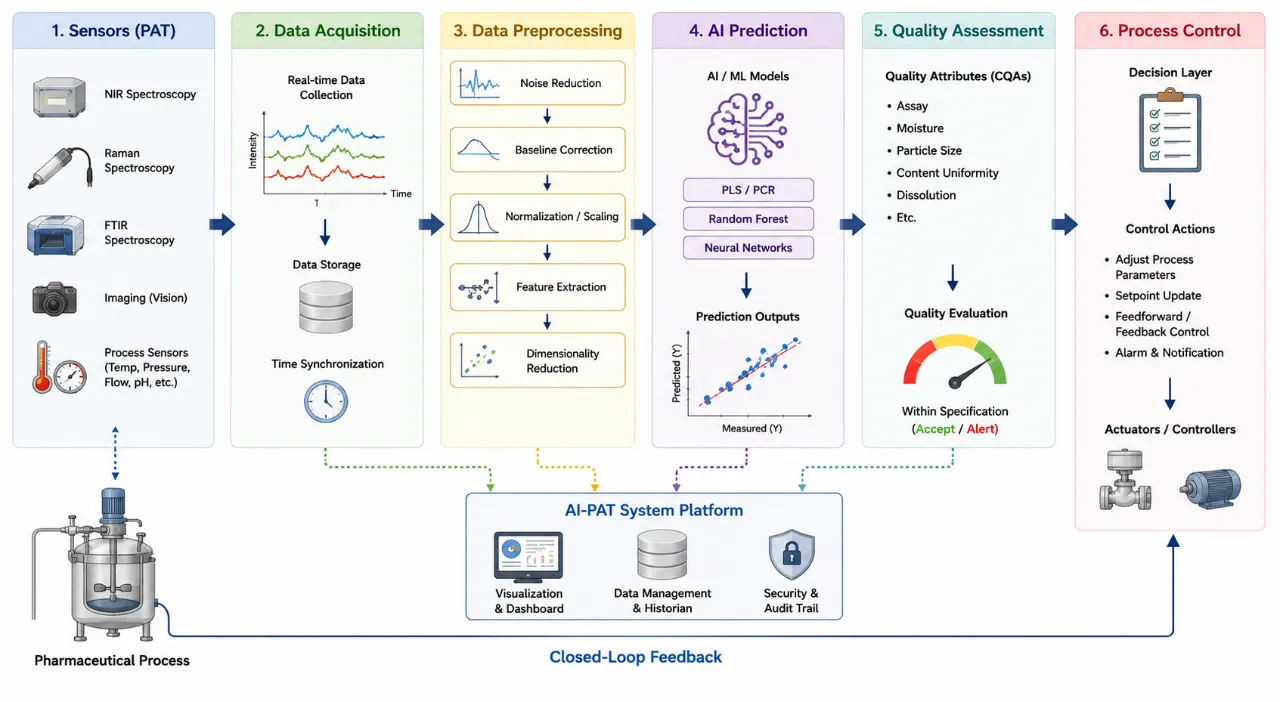
Figure 10. Conceptual architecture of an AI enabled PAT system showing sensors, data acquisition, preprocessing, AI prediction, quality assessment and process control.
|
PAT application |
AI application |
Predicted output |
|
Blend monitoring |
Regression/classification |
Blend uniformity |
|
Granulation |
Process prediction |
Granulation endpoint |
|
Drying |
Regression |
Moisture content |
|
Compression |
Predictive modelling |
Tablet quality |
|
Dissolution |
ML regression |
Dissolution profile |
|
Fault detection |
Anomaly detection |
Process deviation |
|
Continuous manufacturing |
Predictive control |
Process quality |
Table 6. Applications of AI in pharmaceutical PAT
9. AI IN PHARMACEUTICAL MANUFACTURING
Artificial Intelligence (AI) is transforming pharmaceutical manufacturing into intelligent, connected and data driven systems by analysing information generated from equipment, Process Analytical Technology (PAT), laboratory instruments, quality systems and supply chains. Machine Learning (ML), Deep Learning (DL) and computer vision can support process optimization, quality prediction, equipment maintenance and operational decision making [55]. Pharma 4.0 extends Industry 4.0 principles to pharmaceutical manufacturing by integrating automation, connectivity, advanced analytics and intelligent decision support, enabling prediction of process behaviour and early detection of deviations [56].
AI based smart manufacturing can integrate sensors, manufacturing execution systems and quality platforms to predict product attributes such as tablet hardness, dissolution and content uniformity. Computer vision can support automated inspection of tablets, capsules and vials for physical defects. In continuous manufacturing, AI can analyse high frequency process data, account for residence time and predict downstream quality, thereby supporting real time diversion and process control [57].
10. CHALLENGES AND LIMITATIONS
Despite the potential of Artificial Intelligence (AI) and Machine Learning (ML) in pharmaceutical formulation, development and manufacturing, several challenges limit their widespread implementation. Reliable and representative pharmaceutical datasets are essential, but formulation studies often generate small datasets because experiments are costly and time consuming. Data may also be distributed across organizations because of confidentiality and intellectual property restrictions [58]. Data quality is another concern because missing values, inconsistent analytical methods, experimental variability and differences in data reporting can affect model performance.
Small datasets may lead to overfitting, particularly with complex deep learning models. Transfer learning, Bayesian modelling and active learning can help improve model performance while reducing experimental requirements [59]. Another important limitation is the black box nature of advanced AI models, which can reduce scientific confidence and regulatory acceptance. Explainable AI methods such as SHAP, LIME and feature importance analysis can improve interpretation. Cybersecurity is also essential because connected AI systems may expose laboratory and manufacturing data to unauthorized access or manipulation. Ethical concerns include data privacy, algorithmic bias, intellectual property and research integrity. Regulatory uncertainty remains a major barrier because AI models require appropriate validation, change control and lifecycle management [60]. Finally, computational costs, specialized infrastructure and energy requirements may limit adoption, although model compression, transfer learning and edge computing can reduce these demands.
11. FUTURE PERSPECTIVES
The future of Artificial Intelligence (AI) in pharmaceutical development is expected to progress from individual predictive applications toward interconnected, adaptive and increasingly autonomous systems. Emerging technologies such as Explainable AI (XAI), Federated Learning, Edge AI, Quantum Machine Learning, Digital Twins, autonomous laboratories and Generative AI may contribute to improved formulation development, manufacturing and drug discovery [61]. Explainable AI can improve transparency by identifying the formulation and process variables responsible for model predictions, thereby supporting scientific interpretation and regulatory acceptance [62].
Federated Learning may enable pharmaceutical organizations to develop shared AI models without directly exchanging proprietary datasets, improving model generalizability while maintaining data privacy. Edge AI can provide rapid, low latency analysis of PAT and sensor data directly at the manufacturing site, supporting real time process monitoring [64]. Quantum Machine Learning represents a longer term opportunity for molecular simulation, drug discovery and complex optimization, although current hardware limitations restrict practical applications [65].
Digital Twins can create virtual representations of formulations, processes and manufacturing systems, allowing process changes and potential failures to be evaluated before physical implementation. Autonomous laboratories may combine AI, robotics and automated experimentation to accelerate formulation and drug development. AI driven personalized medicine could further support individualized dosage forms and drug delivery according to patient specific characteristics [66]. Overall, future pharmaceutical AI will depend on reliable data, model validation, regulatory oversight, cybersecurity and appropriate human supervision.
CONCLUSION
Artificial Intelligence (AI) is transforming pharmaceutical formulation development by enabling predictive modelling, intelligent optimization and data driven decision making. Machine Learning, Deep Learning, Generative AI and Explainable AI can support formulation optimization, quality prediction, process monitoring and manufacturing control. Integration of AI with Quality by Design, Process Analytical Technology, digital twins and autonomous laboratories can reduce experimental requirements, development time and manufacturing failures while improving product quality. However, successful implementation requires reliable datasets, model validation, explainability, data integrity, cybersecurity and regulatory oversight. Overall, AI provides a strong foundation for faster, efficient and increasingly intelligent pharmaceutical formulation development.
REFERENCES

Shweta K. Gaikwad1*, Vedantika U. Nikam1, Vishal B. Babar2, Sudarshan N. Nagrale2, Artificial Intelligence In Pharmaceutical Formulation Development: From Quality By Design (Qbd) To Autonomous Drug Design, Int. J. Sci. R. Tech., 2026, 3 (8), 282-291. https://doi.org/10.5281/zenodo.21860127
 10.5281/zenodo.21860127