

We use cookies to ensure our website works properly and to personalise your experience. Cookies policy
PG and Research Department of Mathematics, St. Joseph’s College of Arts & Science (Autonomous), Cuddalore-01
Objectives: This paper presents an algorithmic investigation into the identification and analysis of dominating sets and independent dominating sets in simple graphs. Methods: A dominating set and an independent dominating set are found in the following definitions (i) A set S ? V is a dominating set of a graph G if every vertex v ? V is either an element of S or is adjacent to an element of S. (ii) An independent dominating set of G is a set that satisfies both dominating and independent in G. Findings: The possibilities of a dominating set and an independent dominating set are found in Python programming language. Novelty: The Python programming language to implement algorithms that precisely identify dominating sets and independent dominating sets in simple graphs.
The development of algorithms provides systematic and efficient solutions to a wide range of problems across different domains. Algorithms are a fundamental concept in computer science and critical for advancing technology and solving complex challenges. Through the paper, the graph G = (V, E) means a simple, finite, undirected, and connected graph. A set S ⊆
V is a dominating set of a graph G if every vertex v ∈S either n element of S or is adjacent to an element of S [4]. In 1958[1], Berge defined the concept of the domination number of a graph, calling this as “coefficient of External Stability”. In 1962[3], Ore used the name “dominating set” and “domination number‟ for the same concept. In 1977[2] Cockayne and Hedetniemi made an interesting and extensive survey of the results known at that time about dominating sets in graphs. They have used the notation γ (G) for the domination number of a graph. The domination number of G, denoted by γ (G), is the minimum size of a dominating set. A set is independent (or stable) if no two vertices are adjacent. An independent dominating set of G is a set that is both dominating and independent in G. The independent domination number and the notation i(G) were introduced by Cockayne and Hedetniemi in [5,6] is the minimum size of an independent dominating set. The independence number of G, denoted α(G), is the maximum size of an independent set in G. It follows immediately that γ (G) ≤ i(G) ≤ α(G). A dominating set of G of size γ (G)is called a γ -set, while an independent dominating set of G of size i(G)is called an i-set [7].
class MyGraph:
def __init__(self, num_vertices):
self.V = num_vertices
self.adj = []
for i in range(num_vertices):
self. adj.append([])
def add_my_edge(self, v1, v2):
self.adj[v1].append(v2)
self.adj[v2].append(v1)
def is_my_dominating(self, dom_set):
for i in range(self.V):
if i not in dom_set:
flag = False
for j in self.adj[i]:
if j in dom_set:
flag = True
break
if not flag:
return False
for i in dom_set:
for j in dom_set:
if i != j and j in self.adj[i]:
return False
return True
def find_my_dominating_sets(self):
all_sets = []
for i in range(1 << self.V):
dom_set = []
for j in range(self.V):
if i & (1 << j):
dom_set.append(j)
if self.is_my_dominating(dom_set):
all_sets.append(dom_set)
return all_sets
g = MyGraph(8)
g.add_my_edge(0, 1)
g.add_my_edge(0, 7)
g.add_my_edge(1, 2)
g.add_my_edge(2, 7)
g.add_my_edge(2, 3)
g.add_my_edge(3, 4)
g.add_my_edge(4, 5)
g.add_my_edge(4, 6)
dom_sets = g.find_my_dominating_sets()
print(dom_sets)
Output:
[[0,2,4], [0,2,5,6], [0,3,5,6], [1,4,7], [1,3,5,6,7]]
Manual output:
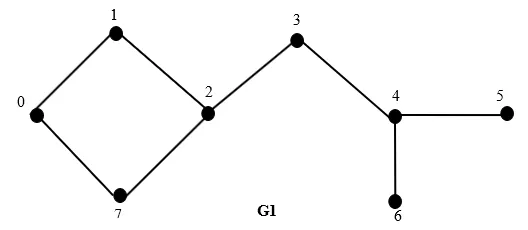
The possible dominating sets of G1 are: {[0,2,4], [0,2,5,6], [0,3,5,6], [1,4,7], [1,3,5,6,7]}
2.2 An algorithm on Independent Dominating set using Python language
class MyGraph:
def __init__(self, num_nodes):
self.num_nodes = num_nodes
self.adj_list = []
for node in range(num_nodes):
self.adj_list.append([])
def add_my_edge(self, node1, node2):
self.adj_list[node1].append(node2)
self.adj_list[node2].append(node1)
def is_my_independent_set(self, my_set):
for node1 in my_set:
for node2 in my_set:
if node1 != node2 and node2 in self.adj_list[node1]:
return False
return True
def is_my_dominating_set(self, my_set):
covered = my_set.copy()
for node1 in my_set:
for node2 in self.adj_list[node1]:
covered.append(node2)
covered_set = set(covered)
return len(covered_set) == self.num_nodes
def find_my_independent_dominating_sets(self):
all_sets = []
for i in range(1 << self.num_nodes):
my_set = []
for j in range(self.num_nodes):
if i & (1 << j):
my_set.append(j)
if self.is_my_independent_set(my_set) and self.is_my_dominating_set(my_set):
all_sets.append(my_set)
return all_sets
g = MyGraph(6)
g.add_my_edge(0, 3)
g.add_my_edge(0, 4)
g.add_my_edge(0, 5)
g.add_my_edge(1, 3)
g.add_my_edge(1, 4)
g.add_my_edge(1, 5)
g.add_my_edge(2, 3)
g.add_my_edge(2, 4)
g.add_my_edge(2, 5)
ids = g.find_my_independent_dominating_sets()
print(ids)
Output:
[[0,1,2], [3,4,5]]
Manual output:
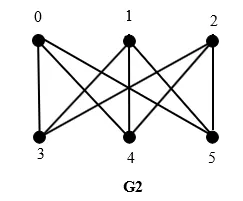
The possible independent dominating sets of G2 are: {[0,1,2], [3,4,5]}
CONCLUSION
This paper presents an algorithm developed to determine the possibilities of dominating and independent dominating sets for simple graphs, implemented using Python programming.
REFERENCES

A. Venkatesan*, An Algorithmic Exploration Of Dominating Set And Independent Dominating Set, Int. J. Sci. R. Tech., 2026, 3 (8), 690-693. https://doi.org/10.5281/zenodo.21990050
 10.5281/zenodo.21990050