

We use cookies to ensure our website works properly and to personalise your experience. Cookies policy
Department of Commerce, Late Nitin College, Pathri. Tq. Pathri Dist-Parbhani (MS) 431506
Modern banking has transitioned from a localized, branch-centric model into a hyper-connected, algorithmic ecosystem. This paper provides a critical analysis of this structural shift, evaluating how the fusion of financial technology (Fintech) and banking-as-a-service (BaaS) has altered systemic risk. While digitalization has democratized access to financial tools and maximized operational efficiency, it has simultaneously introduced unprecedented structural vulnerabilities. This study examines four critical dimensions of contemporary banking: the mechanics of digital bank runs accelerated by mobile applications, algorithmic biases in artificial intelligence (AI)-driven credit scoring, the concentration risk posed by systemic reliance on cloud infrastructure, and the regulatory oversight gaps inherent in shadow banking and decentralized networks. The paper concludes that current macroprudential regulatory frameworks, such as the Basel accords, are fundamentally analog designs attempting to govern a digital-velocity environment, necessitating a shift toward dynamic, real-time programmatic regulation.
For centuries, commercial banking operated on physical custody, localized relationship lending, and structural friction. The friction of distance and time acted as a natural shock absorber during periods of market stress. However, the decade following the 2008 financial crisis accelerated a paradigm shift, compressing traditional infrastructure into digital applications.
Today, modern banking is defined by open banking APIs, cloud architecture, and automated algorithmic decision-making. While these innovations have drastically lowered transaction costs and expanded financial inclusion globally, they have also fundamentally altered the velocity and nature of systemic risk. This paper critically deconstructs the modern banking apparatus, analyzing how its technological strengths directly generate its most severe structural vulnerabilities.
2. The Velocity of Modern Contagion: Digital Bank Runs
Historically, a bank run required depositors to physically queue outside an institution, limiting the speed of capital flight to the operating hours and physical throughput of the branch. In the modern era, fractional-reserve banking intersects with instant mobile payment systems, creating a hyper-accelerated panic loop.
Digital-first depositors can initiate maximum-limit wire transfers or withdraw uninsured deposits within seconds via mobile software. This friction-free environment removes the temporal and geographic delays that previously allowed banks or central authorities to intervene, structure liquidity assistance, or restore public confidence. When social media platforms amplify panic, the velocity of capital flight can trigger insolvency before regulators can legally execute a weekend intervention or weekend receivership.
3. Algorithmic Discrimination and the Black-Box Credit Problem
The integration of Artificial Intelligence (AI) and Machine Learning (ML) models has streamlined credit scoring, reducing loan approval times from weeks to seconds. However, this efficiency introduces profound ethical and systemic risks regarding algorithmic bias.
Modern credit scoring models frequently utilize alternative data points, including:
Because these machine learning models train on historical financial data, they routinely internalize and perpetuate systemic societal inequalities. If historical lending practices biased credit against specific socioeconomic demographics, the algorithm identifies these traits as risk factors. Furthermore, the "black-box" nature of deep learning neural networks makes it difficult to audit the exact criteria used for credit denial, creating severe compliance challenges regarding fair lending laws.
4. Concentration Risk in Financial Infrastructure
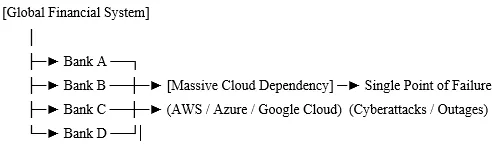
One of the most overlooked vulnerabilities in modern banking is its intense reliance on third-party technology conglomerates. To achieve scalability and reduce overhead costs, traditional banks and neobanks alike have migrated core computing architectures to commercial cloud service providers.
This migration has concentrated a vast majority of global financial data processing within three major cloud firms: Amazon Web Services (AWS), Microsoft Azure, and Google Cloud Platform. This creates a critical single point of failure. A severe cyberattack, physical infrastructure failure, or extended outage at any of these cloud service centers would not just disrupt a single bank; it could simultaneously freeze payment processing, liquidity settlements, and operational functions across dozens of major international financial institutions.
5. Regulatory Lag and Shadow Banking Ecosystems
Financial regulations have historically been reactive, formulated in the aftermath of major systemic collapses. In the modern landscape, the speed of financial innovation far outpaces the legislative and rule-making processes.
This disconnect is most visible in the expansion of shadow banking and decentralized finance (DeFi). Non-bank financial intermediaries—such as algorithmic market makers, peer-to-peer digital lenders, and asset managers using synthetic leverage—operate outside the traditional reserve requirements and capital adequacy oversight mandated by the Basel framework. Because these entities are deeply interconnected with traditional banks through credit lines and derivative exposure, distress in the unregulated shadow banking sector quickly transmits into the regulated core banking system.
CONCLUSION
Modern banking is caught in a paradox: it has achieved unparalleled convenience and operational capability at the expense of structural resilience. The removal of friction from global finance has left the system highly sensitive to rapid capital flight and systemic infrastructure failures.
To mitigate these risks, international regulatory bodies must transition from static, balance-sheet-focused oversight to real-time, dynamic algorithmic auditing. Macroprudential policies must be updated to account for the digital velocity of capital, requiring adjusted liquidity coverage ratios that assume near-instantaneous deposit outflows. Finally, financial authorities must treat cloud provider reliance as a core systemic risk, mandating multi-cloud redundancy strategies to protect global financial stability from single-point infrastructure failures.
REFERENCES

Bharat Trimbakrao Nirwal*, The Fragile Digital Architecture: A Critical Analysis Of Vulnerabilities, Biases, And Regulatory Gaps In Modern Banking, Int. J. Sci. R. Tech., 2026, 3 (7), 1049-1051. https://doi.org/10.5281/zenodo.21698083
 10.5281/zenodo.21698083