

We use cookies to ensure our website works properly and to personalise your experience. Cookies policy
1Anesthesia & Operation Theatre Technology, Emversity, Bangalore, India
2School of Allied Healthcare Sciences, Sri Balaji Vidyapeeth University, Puducherry, India
3Era Institute of Allied Health Sciences and Research, Era University Lucknow, India.
4B. Sc Nursing, Sky Lark institute of Nursing and Allied health science Jammu & Kashmir
Background: Difficult-airway events remain a leading cause of preventable perioperative morbidity and mortality, and the readiness of the entire operation theatre (OT) team — not only the anaesthesiologist — determines how effectively a crisis is managed. Operation theatre technicians, anaesthesia technicians, and OT nurses are frequently the first responders who locate equipment and assist during a difficult-airway emergency, yet their knowledge of the difficult-airway cart and institutional emergency airway algorithms is rarely assessed. Objective: To assess the level of knowledge and self-reported preparedness regarding difficult-airway equipment and emergency airway algorithms among operation theatre professionals, and to identify factors associated with knowledge scores. Methods: A cross-sectional study was conducted among 150 operation theatre professionals across two tertiary-care assessment centres (Mumbai and Hyderabad) using a pre-validated, structured knowledge questionnaire covering equipment identification, difficult-airway cart contents, algorithm awareness, and crisis-response role clarity. Data were analysed using descriptive statistics; associations were tested using one-way ANOVA and the chi-square test, with p < 0.05 considered significant. Results: The overall composite knowledge score was 54.1% (SD 6.7), corresponding to a moderate level of preparedness. Emergency airway algorithm awareness was the weakest domain (46.5%, SD 15.6), while crisis response and role clarity scored highest (60.7%, SD 12.5). Overall score rose significantly with experience — 47.8% (< 5 years) to 56.6% (5–10 years) to 64.5% (> 10 years), F = 33.96, p < 0.001. Knowledge adequacy (? 50%) also varied by designation (58.6% of OT Technicians vs. 37.1% of OT Nurses adequate), though this association fell short of statistical significance (?² = 7.58, df = 3, p = 0.055). Conclusion: Operation theatre professionals demonstrated only moderate knowledge of difficult-airway equipment and emergency airway algorithms, with experience — but not designation alone — significantly associated with better performance. Structured, recurrent simulation-based training and standardised difficult-airway cart labelling are recommended to strengthen team-based emergency airway preparedness, particularly for less-experienced staff.
Airway management crises are among the most time-critical emergencies encountered in the perioperative environment. International guidelines, including those of the American Society of Anesthesiologists [1] and the Difficult Airway Society [2], emphasise that a predictable, rehearsed team response — not only the technical skill of the anaesthesiologist — determines patient outcome during a "cannot intubate, cannot oxygenate" event.
The 4th National Audit Project of the Royal College of Anaesthetists and the Difficult Airway Society (NAP4) identified that deficient equipment availability, inadequate contingency planning, and insufficiently rehearsed staff roles were recurring contributors to major airway complications in UK hospitals [3]. Building on these findings, subsequent guidelines for tracheal intubation in critically ill patients have placed particular emphasis on human factors, a shared mental model, and team-based preparation — rather than the technical skill of any single operator — as the determinants of safe emergency airway management [4].
In most operation theatres, it is the operation theatre (OT) technician, anaesthesia technician, or OT nurse who is expected to immediately retrieve the difficult-airway trolley, assemble video-laryngoscopy or supraglottic devices, and support the surgical or emergency front-of-neck-access pathway when required. Despite this pivotal role, formal training curricula for OT support staff often focus on general instrument handling and sterilisation practices, with comparatively limited structured exposure to difficult-airway equipment and institutional emergency airway algorithms.
A gap in this specific knowledge base can translate directly into delayed equipment availability during a crisis, even when the primary clinical team is otherwise well prepared. Assessing the current knowledge and preparedness of this frontline workforce is therefore an important step toward designing targeted, competency-based training interventions.
2. NEED OF THE STUDY
Knowledge and practice-pattern surveys of anaesthesiologists in difficult-airway management are well documented in the Indian literature. Rajesh et al. found that a substantial proportion of anaesthesiologists lacked ready access to key difficult-airway devices and had not received recent hands-on training on them [5], and a more recent nationwide survey by Govardhane et al. similarly reported inconsistent availability of advanced airway devices and variable practice patterns for unanticipated difficult intubation across Indian hospitals [6]. In contrast, comparable data on operation theatre technicians, anaesthesia technicians, and OT nursing staff — the personnel who physically locate and hand over this equipment — remain scarce, particularly in the Indian tertiary-care setting. Given that these professionals form the first line of equipment support during an airway emergency, understanding their existing knowledge base, identifying specific domains of deficiency, and correlating preparedness with experience and designation can guide institutions in designing focused induction and refresher training programmes, standardising difficult-airway cart content and labelling, and integrating OT support staff into simulation-based mock-drill schedules. This study was undertaken to address this gap.
3. RESEARCH METHODOLOGY
3.1 Study Design
A descriptive, cross-sectional study design was adopted.
3.2 Study Setting and Duration
The study was conducted across two affiliated tertiary-care hospital assessment centres — one in Mumbai and one in Hyderabad — over a period of four months, from February 2026 to May 2026.
3.3 Study Population and Sampling
Operation theatre technicians, anaesthesia technicians, and OT nursing staff with a minimum of one year of clinical experience and currently posted in a functional operation theatre were included. Professionals on leave during the data-collection period and those who did not consent to participate were excluded. Participants were selected using a convenience sampling technique from eligible staff across both centres.
3.4 Sample Size
Based on an anticipated proportion of adequate knowledge of 50% (to maximise sample size), a 95% confidence level (Z = 1.96), and an absolute precision (d) of 8%, the minimum required sample size was calculated using the formula n = Z²p(1–p)/d² = (1.96)² × 0.5 × 0.5 / (0.08)² ≈ 150. A total sample size of 150 was therefore targeted and achieved in full, with 75 participants recruited from each of the two assessment centres.
3.5 Data Collection Tool
Data were collected using a pre-validated, structured, self-administered questionnaire comprising two sections: (a) sociodemographic and professional profile, and (b) a 30-item knowledge assessment covering four domains — identification of difficult-airway equipment, difficult-airway cart contents, emergency airway algorithm awareness, and crisis response/role clarity. Items on algorithm awareness and stepwise escalation were adapted to reflect the stepwise approach recommended in the All India Difficult Airway Association 2016 guidelines, to ensure the tool was contextually relevant to Indian practice [7]. Content validity of the tool was established through expert review, and internal consistency was assessed using Cronbach's alpha (α = 0.81) prior to data collection. A composite knowledge score for each participant was derived as the mean of the four domain scores, and scores were categorised as poor (< 50%), moderate (50–69%), or good (≥ 70%).
3.6 Statistical Analysis
Data were entered and analysed using SPSS version 26.0 (SPSS Inc., Chicago, IL). Categorical variables were summarised as frequencies and percentages; continuous variables were expressed as mean ± standard deviation. One-way ANOVA was used to compare mean composite knowledge scores across experience groups and across knowledge domains, and the chi-square test was used to test the association between designation and dichotomised knowledge adequacy (≥ 50% vs. < 50%). A p-value < 0.05 was considered statistically significant.
3.7 Ethical Considerations
Institutional ethics committee approval was obtained prior to data collection, and written informed consent was taken from all participants. Confidentiality and anonymity of responses were maintained throughout the study.
4. RESULTS AND DISCUSSION
A total of 150 operation theatre professionals participated in the study (response rate 100%), with the majority (47.3%) in the 25–35 year age group and a near-equal distribution across OT technicians, anaesthesia technicians, and OT nurses (Table 1, Figure 1).
|
Variable |
Category |
n |
% |
|
Age (years) |
< 25 |
42 |
28.0 |
|
|
25 – 35 |
71 |
47.3 |
|
|
> 35 |
37 |
24.7 |
|
Gender |
Male |
64 |
42.7 |
|
|
Female |
86 |
57.3 |
|
Designation |
OT Technician |
58 |
38.7 |
|
|
Anaesthesia Technician |
41 |
27.3 |
|
|
OT Nurse |
35 |
23.3 |
|
|
Others |
16 |
10.7 |
|
Clinical experience |
< 5 years |
55 |
36.7 |
|
|
5 – 10 years |
59 |
39.3 |
|
|
> 10 years |
36 |
24.0 |
values are expressed as number (n) and percentage (%)
Table 1. sociodemographic and professional profile of participants (n = 150)
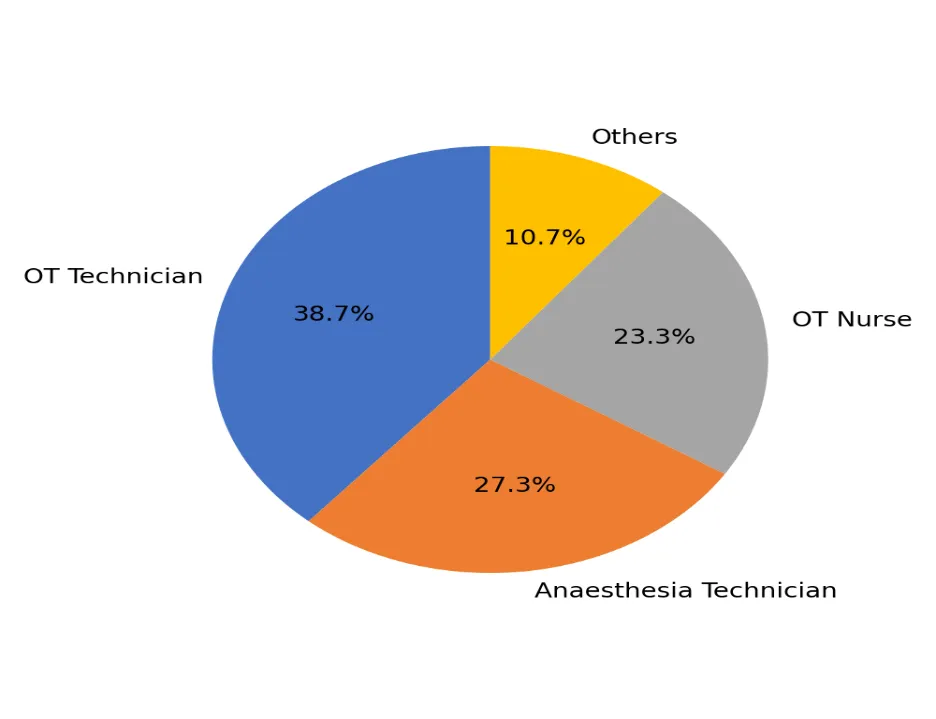
Figure 1. distribution of participants by professional designation (n = 150)
The overall composite knowledge score was 54.1% (SD 6.7), indicating a moderate level of preparedness. Domain-wise analysis showed that knowledge of emergency airway algorithms was weakest (46.5%, SD 15.6), followed closely by knowledge of difficult-airway cart contents (48.6%, SD 14.5), while identification of equipment (60.5%, SD 13.1) and crisis response/role clarity (60.7%, SD 12.5) scored comparatively higher (Table 2, Figure 2). A one-way ANOVA comparing the four domain scores confirmed that this variation was statistically significant (F = 44.03, p < 0.001), indicating genuine, non-random differences in preparedness across domains rather than uniform knowledge. This pattern suggests that while participants have a reasonable functional understanding of their role during a crisis and can identify equipment, structured, algorithm-specific knowledge — such as the stepwise escalation pathway recommended in national and international difficult-airway guidelines — is not being adequately reinforced at the OT-support-staff level.
|
Knowledge domain |
Mean score (%) |
SD |
Category |
|
Identification of difficult-airway equipment |
60.5 |
13.1 |
Moderate |
|
Difficult-airway cart contents |
48.6 |
14.5 |
Poor |
|
Emergency airway algorithm awareness |
46.5 |
15.6 |
Poor |
|
Crisis response and role clarity |
60.7 |
12.5 |
Moderate |
|
Overall composite score |
54.1 |
6.7 |
Moderate |
sd: standard deviation; poor < 50%, moderate 50–69%, good ≥ 70%
Table 2. domain-wise knowledge scores (n = 150)
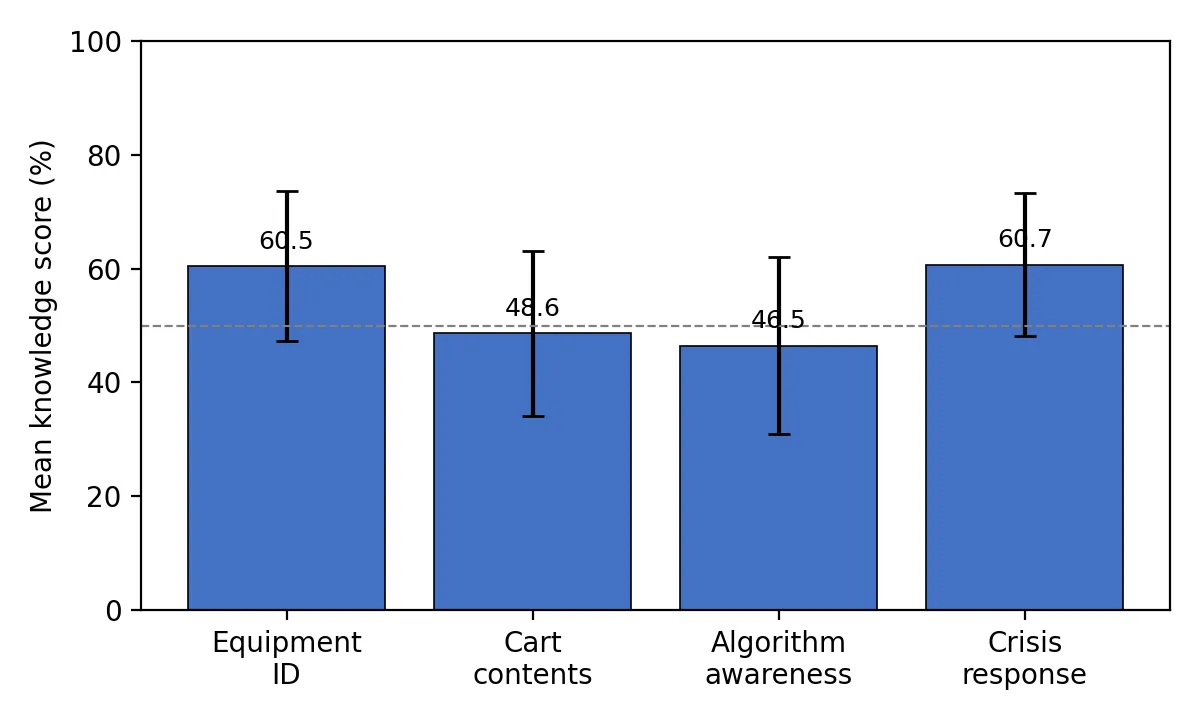
Figure 2. domain-wise mean knowledge scores with standard deviation (dashed line = 50% threshold)
Experience was significantly associated with overall knowledge score. Mean composite scores rose steadily from 47.8% (SD 10.5) among participants with less than five years of experience, to 56.6% (SD 8.6) among those with 5–10 years, to 64.5% (SD 9.6) among those with more than ten years of experience. A one-way ANOVA confirmed this trend was highly significant (F = 33.96, p < 0.001) (Table 3, Figure 3). This finding is consistent with the general expectation that repeated exposure to real or simulated airway emergencies over time reinforces both equipment familiarity and algorithm recall, and reinforces the case for structured induction training rather than reliance on incidental, on-the-job learning alone.
|
Experience group |
n |
Mean overall score (%) |
SD |
p-value |
|
< 5 years |
55 |
47.8 |
10.5 |
|
|
5 – 10 years |
59 |
56.6 |
8.6 |
< 0.001* |
|
> 10 years |
36 |
64.5 |
9.6 |
(F = 33.96) |
*statistically significant, p < 0.05
Table 3. mean overall knowledge score by clinical experience (one-way anova)
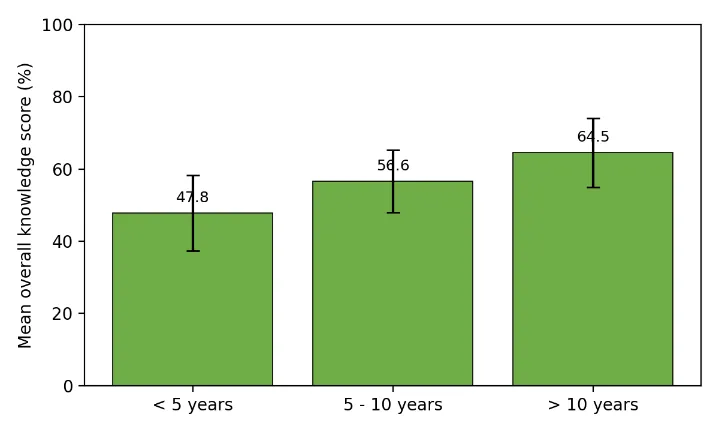
Figure 3. mean overall knowledge score by clinical experience group, with standard deviation
When knowledge was dichotomised as adequate (≥ 50%) or inadequate (< 50%), 79 of 150 participants (52.7%) had adequate overall knowledge. Adequacy was highest among anaesthesia technicians (63.4%) and OT technicians (58.6%), and lowest among OT nurses (37.1%) and other cadres (37.5%) (Table 4). A chi-square test of association between designation and knowledge adequacy approached but did not reach conventional statistical significance (χ² = 7.58, df = 3, p = 0.055), suggesting a possible trend toward designation-based differences that a larger, multi-centric sample may be better powered to confirm.
|
Designation |
Adequate (≥ 50%), n |
Inadequate (< 50%), n |
Total, n |
% Adequate |
|
OT Technician |
34 |
24 |
58 |
58.6 |
|
Anaesthesia Technician |
26 |
15 |
41 |
63.4 |
|
OT Nurse |
13 |
22 |
35 |
37.1 |
|
Others |
6 |
10 |
16 |
37.5 |
|
Total |
79 |
71 |
150 |
52.7 |
adequate: composite score ≥ 50%; χ² = 7.58, df = 3, p = 0.055 (not significant at α = 0.05)
Table 4. association between designation and knowledge adequacy (chi-square test)
These findings broadly align with previously reported gaps in equipment availability and staff preparedness identified by the NAP4 audit [3], and with Indian survey data showing that even anaesthesiologists themselves do not always have consistent access to, or recent training on, key difficult-airway devices [5,6]. They reinforce international guideline recommendations that team-based, simulation-based training — rather than anaesthesiologist-focused training alone — is necessary to improve real-world crisis readiness [2,4]. Institutions may consider standardising difficult-airway cart layout and labelling, conducting periodic algorithm-based refresher sessions aligned with the AIDAA stepwise approach for OT support staff (particularly newer recruits and nursing cadres) [7], and incorporating this cadre into scheduled mock difficult-airway drills.
Limitations of this study include its cross-sectional design, which precludes causal inference; its reliance on a convenience sample from two centres, which may limit generalisability; and its use of a knowledge-based questionnaire, which may not fully reflect actual performance under real crisis conditions. The near-significant association between designation and knowledge adequacy also warrants confirmation in a larger, adequately powered sample. Future multi-centric studies incorporating simulation-based performance assessment are recommended.
ACKNOWLEDGMENT
The authors thank the administration and operation theatre staff of the participating assessment centres in Mumbai and Hyderabad for their cooperation during data collection. Z.H.P. thanks the departmental colleagues who assisted with questionnaire validation and data entry.
REFERENCES


Zakir Hussain Parray1*, Aadesh R. Desai2, Seerat Jan3, Kaneez Zehra3, Rabia Farooq4, Assessment Of Knowledge And Preparedness Regarding Difficult-Airway Equipment And Emergency Airway Algorithms Among Operation Theatre Professionals: A Cross-Sectional Study, Int. J. Sci. R. Tech., 2026, 3 (9), 227-233. https://doi.org/10.5281/zenodo.22670658
 10.5281/zenodo.22670658