

We use cookies to ensure our website works properly and to personalise your experience. Cookies policy
Department of Computer Engineering, Shri Shivaji Institute of Engineering And Management Studies, Parbhani, Maharashtra, India
The rapid proliferation of the Internet of Things (IoT) has transformed the landscape of personal healthcare, safety, and remote monitoring, enabling low-cost embedded systems to perform functions once restricted to hospital-grade equipment. This paper presents the design, development, and prototype validation of an IoT-Enabled Smart Safety Band, a wearable device intended to provide continuous health monitoring, real-time location tracking, automatic fall detection, and emergency alerting for vulnerable population groups such as elderly individuals, patients with chronic conditions, women travelling alone, industrial workers in hazardous environments, and children. The proposed system is built around the ESP32 microcontroller, which coordinates a MAX30102 photoplethysmographic sensor for heart-rate and blood-oxygen saturation (SpO2) measurement, an ADXL345 tri-axial accelerometer for motion and fall-pattern recognition, a GPS receiver module for outdoor positioning, and a SIM800L GSM/GPRS module for cellular communication. A dedicated SOS push-button and a vibration motor for haptic feedback complete the wearable's human-machine interface, while a rechargeable Li-Po battery provides portable power. The device continuously samples physiological and kinematic data and applies threshold-based decision logic to identify three categories of emergency: an abnormal heart rate, a detected fall event, or manual SOS activation. When any of these conditions is triggered, the embedded firmware retrieves the current GPS coordinates, composes and transmits an emergency SMS containing the location and vital-sign summary to a pre-registered guardian number through the SIM800L module, and subsequently places an automated emergency voice call, while the vibration motor confirms activation to the wearer. A functional hardware prototype was assembled on a wearable fabric band and subjected to bench and field testing; the system reliably captured heart-rate readings, detected simulated free-fall events, acquired outdoor GPS fixes, and delivered emergency SMS notifications within a few seconds of trigger detection, as verified through live message logs. This paper details the complete system architecture, hardware selection rationale, firmware algorithm, circuit-level wiring, experimental methodology, and performance evaluation of the prototype, and situates the work within the broader literature on IoT-based wearable healthcare and safety devices published between 2021 and 2025. The results indicate that the proposed low-cost, self-contained safety band is a technically viable and extensible platform for continuous personal safety monitoring, and the paper concludes with a discussion of its advantages, limitations, and directions for future enhancement through artificial intelligence, cloud analytics, and additional biosensing modalities.
1.1 Background
The Internet of Things (IoT) refers to a network of physical objects — sensors, actuators, and embedded processors — that are connected to the internet and to one another, enabling them to collect, exchange, and act upon data with minimal human intervention. Over the past decade, IoT has evolved from a niche research concept into a pervasive technological paradigm that underlies smart homes, smart cities, industrial automation, and, increasingly, personal healthcare. The convergence of low-power microcontrollers, miniaturised biosensors, wireless communication modules, and cloud computing has made it possible to build wearable devices that continuously monitor an individual's physiological state and physical environment at a cost that is accessible to the general public. Within this broader movement, wearable healthcare devices — commonly in the form of wristbands, smartwatches, or patches — have emerged as one of the most visible and impactful applications of IoT, because they place sensing capability directly on the human body and can therefore respond to changes in health status in real time, rather than relying on periodic clinical visits.
Alongside the growth of wearable healthcare technology, personal safety has become an equally pressing concern in contemporary society. Vulnerable groups such as the elderly living alone, women commuting in unsafe environments, children travelling to school unsupervised, patients with cardiac or respiratory conditions, and workers operating in remote or hazardous industrial sites all share a common risk: the possibility of an emergency occurring at a time and place where immediate human assistance is not available. Traditional safety mechanisms, such as manually dialling an emergency number or shouting for help, are frequently ineffective in precisely the situations where they are most needed — for example, when a person has fallen and is unconscious, when a medical event such as cardiac arrhythmia has impaired their ability to act, or when an assailant has physically restrained the victim. These scenarios motivate the need for autonomous or semi-autonomous safety systems that can detect an emergency condition without requiring full conscious cooperation from the user, and that can independently notify caregivers or emergency contacts with the victim's location.
1.2 IoT in Wearable Healthcare
Wearable healthcare devices built on IoT principles typically integrate biosensors capable of measuring parameters such as heart rate, blood oxygen saturation, body temperature, blood pressure, and physical activity, coupled with a microcontroller that processes this data locally and a communication module that transmits it to a caregiver, a mobile application, or a cloud dashboard. The MAX30102 sensor used in the proposed system is representative of this category: it uses photoplethysmography (PPG), in which red and infrared light-emitting diodes illuminate the skin and a photodetector measures the variation in reflected light caused by pulsating blood flow, allowing the extraction of both heart rate and SpO2 without any invasive procedure. Because such sensors are inexpensive, low-power, and easily interfaced through the I2C protocol with microcontrollers such as the ESP32, they have become the sensor of choice for numerous recent wearable health-monitoring prototypes reported in the literature. Continuous, unobtrusive monitoring of this kind offers substantial benefit over episodic clinical measurement, since it enables the detection of transient abnormalities — for example, a sudden tachycardic episode or a drop in oxygen saturation — that might otherwise go unnoticed between hospital visits.
1.3 Women's Safety and the Role of Wearable Technology
Women's safety remains a critical social issue in many regions of the world, and a substantial body of recent engineering literature has proposed IoT-based wearable devices specifically designed to address this concern. These systems typically combine a concealed or discreet wearable form factor with a GPS module for location tracking, a GSM module for communication, and a manually or automatically triggered alert mechanism. The underlying design philosophy is that a woman who feels threatened, or who is physically restrained and unable to use a smartphone, should still be able to trigger an alert — either through a single covert button press or, in more advanced systems, through biometric indicators of distress such as a sudden spike in heart rate. The smart safety band proposed in this paper draws directly on this design philosophy, incorporating a dedicated SOS button alongside physiological anomaly detection, so that an alert can be raised either through deliberate action or through automatic recognition of a physiologically abnormal state, thereby extending protection to situations where the wearer is incapacitated.
1.4 Elderly Healthcare and Fall Detection
Falls constitute one of the leading causes of injury, disability, and mortality among elderly individuals worldwide, and the risk of falling increases substantially with age, chronic illness, and reduced mobility. Unlike younger individuals, elderly persons who fall are frequently unable to summon help — a phenomenon referred to in the literature as the "long lie" — during which the individual remains on the floor for an extended period before assistance arrives, worsening clinical outcomes. Automated fall-detection systems address this problem by using inertial sensors, most commonly accelerometers and gyroscopes, to recognise the characteristic kinematic signature of a fall: a period of free-fall or rapid acceleration change followed by a sudden high-impact deceleration and subsequent immobility. The ADXL345 accelerometer employed in the proposed smart safety band is well suited to this task because it provides a wide measurement range, configurable sensitivity, and a digital output that can be sampled at a sufficiently high rate to capture the rapid acceleration transients associated with a fall event.
1.5 Smart Healthcare and Emergency Response Ecosystems
Beyond individual sensing modalities, the broader vision of smart healthcare involves the seamless integration of sensing, decision-making, and communication into a single closed-loop system, such that an abnormal condition detected on the body of the patient results in an automatic notification to a relevant caregiver, family member, or emergency service, without requiring any intermediate human operator. Achieving this closed loop in a low-cost, standalone wearable — that is, one that does not depend on a paired smartphone application or continuous Wi-Fi connectivity — requires the integration of cellular communication directly into the wearable device. The SIM800L GSM/GPRS module used in this project fulfils this role, allowing the safety band to send SMS messages and place voice calls independently of any smartphone, which is particularly important in emergency scenarios where the victim's phone may be inaccessible, damaged, or deliberately withheld.
1.6 Existing Problems in Current Solutions
A review of existing commercial and research-based wearable safety and health devices reveals several recurring limitations that motivate the present work:
1.7 Motivation
The motivation for the present work arises from the observation that health monitoring, fall detection, and personal safety alerting are frequently treated as separate engineering problems in the literature, each addressed by a dedicated device, even though the underlying hardware requirements — a microcontroller, a communication module, and a power source — are largely shared. By unifying these three functions into a single wearable safety band, it becomes possible to protect a wider range of users, including elderly persons at risk of both cardiac events and falls, women who may face either a medical emergency or a personal-safety threat, and industrial or field workers exposed to both physical hazards and irregular working conditions. Furthermore, because the SIM800L module enables direct cellular communication without dependence on a smartphone, the proposed system is designed to function as a genuinely standalone safety device, which is particularly valuable for elderly users who may not reliably carry or operate a smartphone.
1.8 Research Contribution
The principal contributions of this paper are summarised as follows:
The remainder of this paper is organised as follows. Section 2 reviews related literature. Section 3 states the problem addressed by this work, and Section 4 lists the research objectives. Sections 5 through 7 describe the proposed system, its architecture, and hardware design in detail. Section 8 discusses the software design, and Sections 9 through 11 present the methodology, working algorithm, and flowchart. Section 12 describes the circuit wiring, and Sections 13 through 15 present the experimental setup, results, and performance analysis. Section 16 compares the proposed system with existing solutions. Sections 17 through 20 discuss advantages, applications, limitations, and future scope, and Section 21 concludes the paper.
2. LITERATURE REVIEW
This section reviews recent research contributions relevant to IoT-based wearable health monitoring, fall detection, and personal safety alerting. The reviewed works were selected because they employ hardware and software approaches closely related to the proposed smart safety band, including ESP32-based platforms, MAX30102 or comparable PPG sensors, MPU6050/ADXL345-class accelerometers, GPS positioning, and GSM/cellular alerting. The majority of the cited studies were published between 2021 and 2025, reflecting the current state of the art in this domain.
2.1 Fall Detection Systems
Nathala et al. proposed an IoT-based fall-detection system evaluated at the 2023 International Conference on Advances in Computing, Communication and Applied Informatics, combining an accelerometer-based motion sensor with a microcontroller to identify fall events and issue automated alerts. Sowmya and Pillai investigated the use of machine-learning algorithms in conjunction with wearable inertial sensors to classify human falls, demonstrating that data-driven classifiers can improve discrimination between genuine falls and fall-like activities of daily living compared with fixed-threshold approaches. Lo and Abd Aziz implemented a threshold-based fall-detection algorithm on an FPGA platform described in Verilog, illustrating an alternative hardware-acceleration approach to real-time fall recognition. Li et al. explored millimetre-wave radar as a contactless sensing modality for fall detection, reported at the 2022 IEEE International Conference on Acoustics, Speech and Signal Processing, offering an approach that does not require the user to wear any device at all, at the cost of requiring fixed environmental infrastructure. Denkovski et al. contributed a multi-visual-modality fall-detection dataset published in IEEE Access, intended to support the training and benchmarking of camera-based and multimodal fall-detection algorithms. A separate study reported the design and implementation of an NB-IoT-based fall-detection wearable using an STM32 microcontroller together with a positioning module and an MPU6050 accelerometer, transmitting alerts to a cloud platform over Narrowband IoT — an approach that trades higher hardware cost for extended-range, low-power cellular connectivity. More recently, a 2024–2025 IEEE conference contribution described a wearable fall-detection and alert system integrating an ESP32 microcontroller, an MPU6050 accelerometer/gyroscope, a NEO-6M GPS module, and a support-vector-machine classifier, reporting a fall-classification accuracy in the vicinity of ninety-six percent. A broader 2024 IEEE review of fall-detection systems for the Internet of Medical Things surveyed the integration of fall-detection research with IoT and IoMT architectures, underscoring the growing convergence between inertial sensing, wireless communication, and cloud-based health platforms.
2.2 Women's Safety Wearable Devices
A substantial number of recent studies have proposed wearable devices dedicated to women's personal safety. Das and Banerjee described a women's-safety monitoring system built around a wearable smart band, reported at an IEEE conference on smart technologies and management. Ebenezer et al. presented an IoT-based wrist-band for women's safety that combines an ESP32 microcontroller with GSM and GPS modules, biomedical sensors for heart rate and body temperature, a gyroscope for detecting sudden distress-indicative movement, and a microphone enabling voice-command activation, illustrating a feature-rich design closely aligned with the objectives of the present work. A related study similarly described an IoT-based smart wearable safety device for women employing an ESP32, GSM and GPS modules, and physiological sensing, again emphasising the combination of health and location awareness within a single band. Other IEEE-indexed contributions have proposed comparable GSM/GPS-based women's-safety wristbands using microcontroller platforms such as the ATmega2560 together with a SIM800-class GSM module and a NEO-6M GPS receiver, and have evaluated ESP32-CAM-equipped variants that additionally capture visual evidence at the moment of alert triggering. Sharma and Verma, and separately Nandhini and Priyanka, proposed comparable GPS-GSM personal-safety devices, the latter emphasising an Arduino-based implementation for real-time location sharing through a portable SOS unit.
2.3 Wearable Physiological Monitoring with MAX30102 and ESP32
Contardi et al. reported a photometric biosensing platform coupling the MAX30102 sensor with the ESP32 system-on-chip to continuously monitor SpO2 and heart rate, transmitting the acquired data to a cloud-connected web server; the authors validated that the device's readings were consistent with those obtained from standard clinical pulse oximeters, supporting the suitability of the MAX30102–ESP32 combination for continuous, low-cost physiological monitoring. This finding directly informs the sensor selection made in the present work. Related technical documentation from Espressif Systems and multiple embedded-systems tutorials confirms that the MAX30102 can be interfaced with the ESP32 over a standard I2C bus using widely available open-source libraries, further supporting the feasibility of rapid firmware development for wearable prototypes of this kind.
2.4 Comparative Summary of Reviewed Literature
|
Author(s) |
Year |
Method |
Advantages |
Limitations |
|
Nathala et al. |
2023 |
Accelerometer-based fall detection with microcontroller alerting |
Simple, low-cost, real-time alerting |
No physiological monitoring; single trigger type only |
|
Sowmya & Pillai |
2021 |
ML-based fall classification using wearable inertial sensors |
Improved fall/ADL discrimination via ML |
Higher computational overhead; needs training data |
|
Lo & Abd Aziz |
2021 |
FPGA/Verilog threshold-based fall detection |
Fast, hardware-accelerated detection |
FPGA increases cost and design complexity for wearables |
|
Li et al. |
2022 |
mmWave radar contactless fall detection |
No wearable required; privacy-preserving option |
Needs fixed infrastructure; not portable outdoors |
|
Denkovski et al. |
2022 |
Multi-modal visual fall-detection dataset |
Enables benchmarking of camera-based systems |
Camera-based; raises privacy concerns; indoor use only |
|
NB-IoT Fall Device Study |
2022 |
STM32 + MPU6050 + NB-IoT cloud alerting |
Long-range, low-power cellular connectivity |
Requires NB-IoT network coverage; higher module cost |
|
ESP32+SVM Wearable Study |
2024/25 |
ESP32, MPU6050, GPS, SVM fall classifier |
High reported accuracy (~96%) for fall detection |
No GSM-independent alerting reported; ML adds complexity |
|
IoMT Fall Detection Review |
2024 |
Systematic review of IoMT fall-detection systems |
Broad synthesis of sensing/communication trends |
Review only; no novel hardware prototype |
|
Das & Banerjee |
2022 |
Wearable smart band for women's safety monitoring |
Purpose-built for personal-safety alerting |
Limited physiological sensing reported |
|
Ebenezer et al. |
2023 |
ESP32 + GSM + GPS wrist-band with HR/temperature sensing and voice trigger |
Rich feature set; multiple trigger modalities |
Complexity increases power draw and battery demand |
|
ATmega2560 + SIM800 Safety Band |
2021 |
GSM/GPS wristband with vibration/neuro-stimulator alert |
Independent cellular alerting without smartphone |
Bulkier microcontroller platform; higher power use |
|
ESP32-CAM Safety Device |
2025 |
GSM/GPS with onboard camera evidence capture |
Adds visual evidence at alert time |
Camera increases cost, power draw, and privacy concerns |
|
Sharma & Verma |
2021 |
GSM/GPS-based personal safety device |
Simple, proven GSM/GPS alerting pipeline |
No fall detection or health monitoring integrated |
|
Nandhini & Priyanka |
2023 |
Arduino-based portable SOS device |
Low-cost, real-time location sharing |
Arduino platform lacks native wireless connectivity |
|
Contardi et al. |
2022 |
MAX30102 + ESP32 continuous SpO2/HR monitoring with cloud webserver |
Validated accuracy against clinical pulse oximeters |
No emergency communication or fall detection integrated |
Table 1. Comparative Summary of Reviewed Literature (2021–2025)
2.5 Research Gap and Improvement Offered by the Proposed Work
The literature surveyed above demonstrates considerable progress in three separate directions: fall detection using inertial, radar, or vision-based sensing; women's-safety wearables combining GPS and GSM alerting; and continuous physiological monitoring using the MAX30102–ESP32 platform. However, relatively few reported systems combine all three capabilities — physiological anomaly detection, fall detection, and manual SOS alerting — into a single decision pipeline sharing common GPS-acquisition and GSM-alerting infrastructure, and fewer still report a fully assembled, field-tested wearable prototype rather than a breadboard demonstration. The proposed IoT-Enabled Smart Safety Band addresses this gap by unifying heart-rate/SpO2 monitoring (informed by the validated MAX30102–ESP32 approach of Contardi et al.), accelerometer-based fall detection (following the threshold-based philosophy demonstrated in several of the reviewed fall-detection studies), and GSM/GPS-based emergency alerting (following the design pattern established in the reviewed women's-safety literature) into a single, self-contained wearable band. This integration allows the system to serve a broader population of users and a broader range of emergency scenarios than any single reviewed system in isolation, while remaining implementable on low-cost, widely available hardware.
3. PROBLEM STATEMENT
Existing personal safety and health-monitoring solutions are largely fragmented: fitness wearables monitor physiological parameters without emergency communication capability; women's-safety devices provide manual SOS alerting without physiological awareness; and fall-detection prototypes are frequently demonstrated only on a laboratory breadboard, dependent on a paired smartphone for connectivity, or restricted to a single trigger modality. Consequently, there is a lack of a single, low-cost, self-contained wearable device capable of continuously monitoring a wearer's vital signs and motion state, autonomously detecting multiple categories of emergency (medical anomaly, fall, and manual distress signal), and independently notifying a designated guardian with the wearer's precise location — without depending on a smartphone, Wi-Fi connectivity, or manual intervention by the wearer at the moment of crisis. This paper addresses this problem by designing, implementing, and evaluating an integrated IoT-enabled smart safety band that unifies these functions on a single embedded platform.
4. OBJECTIVES
The specific objectives of this work are as follows:
5. PROPOSED SYSTEM
The proposed IoT-Enabled Smart Safety Band is a self-contained wearable device designed to be worn on the wrist or forearm, secured by an adjustable fabric strap. At the core of the system is an ESP32 microcontroller, chosen for its dual-core processing capability, integrated Wi-Fi and Bluetooth radios, ample general-purpose input/output (GPIO) pins, and native support for the I2C and UART communication protocols required to interface with the system's peripheral modules. Four sensing and communication subsystems are connected to the ESP32: the MAX30102 sensor, mounted such that the wearer's skin (typically over the wrist or a fingertip extension) rests against its optical window for photoplethysmographic sensing of heart rate and SpO2; the ADXL345 tri-axial accelerometer, rigidly affixed to the band so that it moves with the wearer's body and can register the acceleration signature of a fall; a GPS receiver module with an active or passive antenna, mounted with a clear line of sight to the sky for satellite acquisition; and a SIM800L GSM/GPRS module fitted with a local micro-SIM card, providing cellular network access for SMS and voice communication independent of any paired smartphone. A momentary push-button switch provides a manual SOS input, and a small vibration motor provides haptic confirmation to the wearer that an alert has been triggered or that the system is active. The entire assembly is powered by a rechargeable lithium-polymer (Li-Po) battery, regulated to the appropriate voltage rails for each subsystem.
During normal operation, the firmware executes a continuous monitoring loop: the MAX30102 sensor is sampled at a rate sufficient to extract a stable heart-rate and SpO2 estimate using a moving-window peak-detection algorithm, while the ADXL345 accelerometer is polled at a higher rate appropriate for capturing transient fall-related acceleration events. The GPS and GSM modules remain in a low-activity standby state to conserve power, and are only actively queried when an emergency condition is detected or a periodic location update is scheduled. The SOS button is monitored via a hardware interrupt so that a manual trigger is registered immediately regardless of the state of the main monitoring loop. When any of the three trigger conditions — abnormal heart rate, detected fall, or SOS button press — is satisfied, the firmware transitions into an emergency-response routine: it activates the GPS module and waits for a valid coordinate fix (or, if a fix cannot be obtained within a bounded timeout, falls back to the most recently known coordinates), formats an SMS message containing the emergency type, the current heart-rate/SpO2 reading where relevant, and a Google Maps link derived from the GPS coordinates, and transmits this message through the SIM800L module using standard AT command sequences. The module then places an automated voice call to the same registered emergency number, and the vibration motor pulses to confirm to the wearer that the alert sequence has completed. After the emergency sequence, the system resumes continuous monitoring.
6. SYSTEM ARCHITECTURE
The system architecture of the proposed smart safety band can be described as a layered structure comprising four subsystems: the sensing layer, the processing layer, the communication layer, and the alerting/actuation layer, all coordinated by the central ESP32 processing unit.
Figure 1 illustrates this layered architecture, in which sensor data flows upward from the sensing layer into the ESP32 processing layer, decision outcomes flow outward into the communication layer for GPS acquisition and GSM transmission, and confirmation signals flow into the actuation layer to notify the wearer.
Figure 1. Layered System Architecture of the IoT-Enabled Smart Safety Band
In addition to this on-body architecture, the system architecture optionally extends to a backend layer in the form of a lightweight Flask-based web server, which can receive periodic location and health updates transmitted by the ESP32 over Wi-Fi when available, storing them for later retrieval by a caregiver-facing dashboard. This backend layer is treated as an optional extension in the current prototype, since the core emergency-alerting functionality is designed to operate independently of any Wi-Fi or internet connectivity, relying solely on the cellular GSM network.
7. HARDWARE DESIGN
This section describes each hardware component of the proposed system, its technical specifications, and the rationale for its selection.
7.1 ESP32 Microcontroller
The ESP32 is a low-cost, low-power system-on-chip microcontroller featuring a dual-core Tensilica Xtensa LX6 processor operating at up to 240 MHz, integrated 802.11 b/g/n Wi-Fi, Bluetooth 4.2/BLE connectivity, and a rich set of peripherals including multiple UART, I2C, and SPI interfaces, analogue-to-digital converters, and general-purpose I/O pins. In the proposed design, the ESP32 serves as the central processing unit, responsible for sampling the MAX30102 and ADXL345 sensors over I2C, communicating with the GPS module and the SIM800L GSM module over separate UART channels, monitoring the SOS button interrupt, and driving the vibration motor output. The ESP32 was selected over simpler platforms such as the Arduino Uno primarily because its native Wi-Fi capability supports the optional cloud-dashboard extension described in Section 6, its dual-core architecture allows sensor sampling and communication tasks to be managed concurrently using FreeRTOS tasks, and its multiple hardware UART peripherals allow simultaneous, non-conflicting communication with both the GPS and GSM modules without resorting to software-emulated serial ports.
7.2 MAX30102 Heart Rate and SpO2 Sensor
The MAX30102 is an integrated pulse-oximetry and heart-rate monitoring module that combines two LEDs (red, approximately 660 nm, and infrared, approximately 880 nm), a photodetector, low-noise analogue signal-conditioning circuitry, and an internal 18-bit analogue-to-digital converter with ambient-light rejection, all communicating with a host microcontroller over a standard I2C interface. The sensor operates from a low-voltage supply, draws on the order of 600 microamperes in active measurement mode and as little as 0.7 microamperes in shutdown mode, and internally buffers up to thirty-two samples in a first-in-first-out queue, reducing the frequency of I2C transactions required by the host processor. The MAX30102 was selected for this project because it is specifically designed for wearable and mobile health applications, its low power consumption is compatible with battery-powered operation, and its I2C interface and wide open-source library support (including the SparkFun MAX3010x library used in this project) substantially simplify firmware development. Prior published work coupling the MAX30102 with the ESP32 has demonstrated that the resulting readings are consistent with those of standard clinical pulse oximeters, supporting its suitability for the proposed application.
7.3 ADXL345 Tri-Axial Accelerometer
The ADXL345 is a small, low-power, three-axis micro-electromechanical systems (MEMS) accelerometer capable of measuring dynamic acceleration resulting from motion or shock, as well as static acceleration due to gravity, allowing it to be used for both tilt-sensing and motion/fall detection. The device supports a selectable measurement range of up to ±16 g with 13-bit resolution, and communicates with a host microcontroller over either I2C or SPI; in this project, the I2C interface is used to share the bus with the MAX30102 sensor. The ADXL345 was selected because a fall event produces a distinctive kinematic signature — a brief period of near-zero acceleration (free-fall) followed by a sharp acceleration spike upon impact, typically exceeding 2–3 g — that can be reliably captured with a sensor of this measurement range and sampling capability, and because the device's low power consumption and small footprint make it appropriate for continuous operation in a battery-powered wearable.
7.4 GPS Module
The GPS receiver module used in the proposed system acquires positioning data from Global Navigation Satellite System (GNSS) constellations and outputs standard NMEA sentences over a UART serial interface at a default baud rate of 9600 bps. The module requires an unobstructed view of the sky to acquire a satellite fix and typically achieves a horizontal positioning accuracy on the order of a few metres once a fix is established, with a cold-start acquisition time that can range from tens of seconds to a few minutes depending on satellite visibility. This module was selected because outdoor location accuracy of this order is more than sufficient to direct emergency responders or family members to the wearer's location, and because low-cost GPS modules of this class are widely supported by mature open-source parsing libraries such as TinyGPS++, which substantially simplifies the extraction of latitude and longitude from raw NMEA data within the ESP32 firmware.
7.5 SIM800L GSM/GPRS Module
The SIM800L is a compact, low-cost quad-band GSM/GPRS module that enables a microcontroller to send and receive SMS messages, place and receive voice calls, and access GPRS data services through a standard AT command interface over UART. The module requires a micro-SIM card provisioned with an active cellular subscription and can draw current peaks of up to approximately 2 amperes during transmission bursts, despite a comparatively low average current draw, which necessitates careful power-supply design (discussed in Section 7.7). The SIM800L was selected specifically because it allows the wearable device to communicate independently of any paired smartphone or local Wi-Fi network, relying only on standard cellular network coverage, which is a critical requirement for a safety device that must remain functional even when the wearer's smartphone is unavailable, discharged, or physically inaccessible.
7.6 SOS Push-Button
A momentary tactile push-button switch is connected to a digital input pin of the ESP32, configured with an internal pull-up resistor and monitored via a hardware interrupt so that a button press is registered immediately, independent of the state of the main sensor-sampling loop. This ensures that a manual SOS trigger is never delayed or missed due to ongoing sensor processing, and provides the wearer with a deliberate, deterministic means of raising an alert in situations that may not be captured by the automatic heart-rate or fall-detection logic — for example, a perceived personal-safety threat that does not involve any physical fall or physiological anomaly.
7.7 Battery and Power Supply
The system is powered by a single-cell rechargeable lithium-polymer (Li-Po) battery, regulated through appropriate linear or switching voltage regulators to supply the 3.3 V rail required by the ESP32, MAX30102, ADXL345, and GPS module, and a separate, adequately decoupled supply path for the SIM800L module capable of sourcing its transient current peaks without causing brown-out resets on the shared power rail. A large decoupling (bulk) capacitor is placed close to the SIM800L's power input to buffer these current transients, which is a widely recommended practice for this module given its pulsed current draw during network registration and transmission. The Li-Po battery was selected over alternatives such as disposable alkaline cells because it is rechargeable, offers a favourable energy-to-weight ratio suitable for a wearable form factor, and can be safely managed with a standard single-cell charging and protection circuit.
7.8 Vibration Motor
A small coin-type vibration motor, driven through a transistor switch from a digital output pin of the ESP32, provides haptic feedback to the wearer. This component is used to confirm that the device has powered on correctly, that a GPS fix has been acquired, and, most importantly, that an emergency alert sequence has been successfully initiated — providing the wearer with reassurance that help is being summoned even in situations where the wearer cannot see or hear a visual or audible indicator.
|
Component |
Function |
Interface |
Key Specification |
|
ESP32 |
Central processing and control |
I2C / UART / GPIO |
Dual-core, up to 240 MHz, integrated Wi-Fi/BLE |
|
MAX30102 |
Heart rate & SpO2 sensing |
I2C |
PPG-based, ~600 µA active, 18-bit ADC |
|
ADXL345 |
Fall / motion detection |
I2C |
±16 g range, 13-bit resolution |
|
GPS Module |
Location acquisition |
UART (9600 bps) |
Metre-level accuracy outdoors |
|
SIM800L |
SMS & voice call alerting |
UART (AT commands) |
Quad-band GSM/GPRS, ~2 A peak current |
|
SOS Button |
Manual emergency trigger |
Digital GPIO (interrupt) |
Momentary tactile switch |
|
Vibration Motor |
Haptic feedback |
Digital GPIO (via transistor) |
Coin-type DC vibration motor |
|
Li-Po Battery |
Portable power supply |
Regulated 3.3 V / 4 V rails |
Single-cell rechargeable |
Table 2. Summary of Hardware Components and Specifications
8. Software Design
The firmware for the proposed smart safety band was developed using the Arduino IDE, targeting the ESP32 development board using the standard ESP32 Arduino core. Embedded firmware was written in Embedded C++, following the Arduino programming model of setup() and loop() functions, supplemented by interrupt service routines for the SOS button and by dedicated helper functions for each subsystem.
The firmware is structured as a simple finite-state machine with two principal states: a Monitoring state, in which the device continuously samples the MAX30102 and ADXL345 sensors and checks the SOS button, and an Emergency Response state, entered whenever any trigger condition is satisfied, in which the device sequentially acquires a GPS fix, sends an SMS alert, places a voice call, and activates the vibration motor, before returning to the Monitoring state.
9. METHODOLOGY
The methodology adopted for this project followed a structured hardware–software co-design process comprising component selection, circuit prototyping, firmware development, integration, and iterative testing. In the first stage, each hardware component — the MAX30102, ADXL345, GPS module, and SIM800L — was individually interfaced with the ESP32 and validated in isolation using minimal test firmware, to confirm correct wiring, communication protocol configuration, and expected sensor output before integration. In the second stage, the individual subsystems were combined on a single ESP32 platform, and the I2C bus (shared by the MAX30102 and ADXL345) and the two independent UART channels (used respectively by the GPS module and the SIM800L module) were configured to operate concurrently without contention. In the third stage, the threshold-based decision logic for heart-rate anomaly detection and fall detection was implemented and calibrated through repeated bench testing, using controlled hand movements and simulated free-fall drops of the accelerometer module to characterise the acceleration signature associated with a fall event, and using rest and mild-exertion conditions to characterise the normal operating range of heart rate for threshold calibration. In the fourth stage, the complete emergency-response workflow — GPS acquisition, SMS composition and transmission, and automated voice calling — was implemented and tested end-to-end, using a registered personal mobile number as the emergency contact. Finally, the fully integrated system was assembled onto a wearable fabric band, as shown in the prototype photograph included in this paper, and subjected to field testing under outdoor conditions to validate GPS acquisition and communication performance away from the laboratory environment.
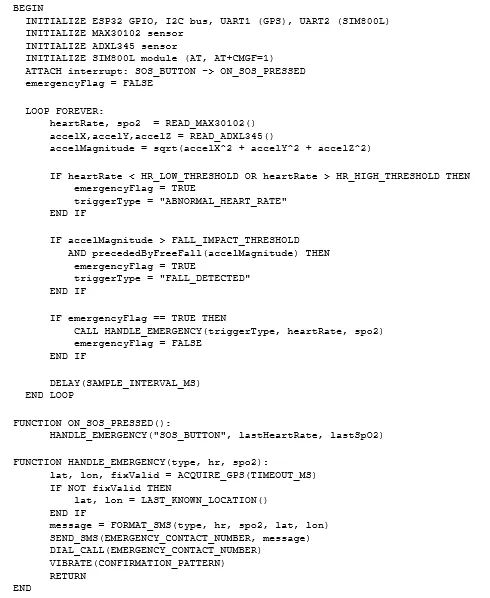
10. WORKING ALGORITHM
The following pseudocode summarises the core firmware logic executed by the ESP32 microcontroller.
11. FLOWCHART
A text-based representation of the system flowchart, suitable for reproduction in Microsoft Word, is presented below.
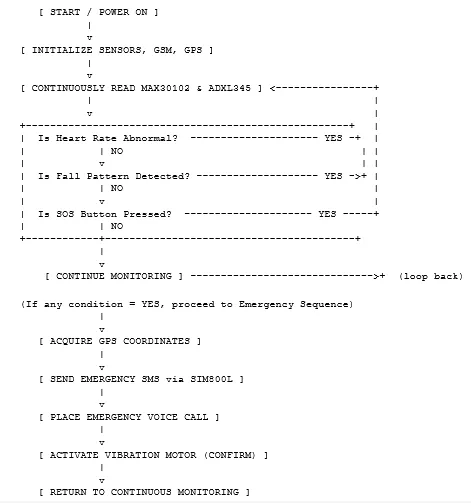
Figure 2. Text-Based Flowchart of the Emergency Detection and Alerting Workflow
12. CIRCUIT DESCRIPTION
The complete circuit is organised around the ESP32 development board, which supplies 3.3 V logic-level power to the MAX30102 and ADXL345 sensors and communicates with both over a shared I2C bus, with MAX30102 SDA and SCL pins connected to ESP32 GPIO21 (SDA) and GPIO22 (SCL) respectively, and the ADXL345 sharing the same bus lines with a distinct I2C address, enabling both sensors to be polled independently without pin conflicts. The GPS module's transmit (TX) pin is connected to a designated ESP32 UART receive (RX) pin, and its receive (RX) pin to the corresponding ESP32 UART transmit (TX) pin, forming a dedicated hardware serial channel operating at the module's default baud rate of 9600 bps; the GPS module's power and ground pins are connected to the 3.3 V rail and common ground respectively. The SIM800L module is connected to a second, independent hardware UART on the ESP32 in the same cross-connected TX/RX configuration, and is powered from a separate, well-decoupled 4.0 V supply branch (regulated down from the Li-Po battery) capable of supplying the module's transient current peaks; a large electrolytic capacitor (typically in the range of several hundred to a few thousand microfarads) is placed directly across the SIM800L's power pins to absorb these transients and prevent the shared power rail from browning out during transmission bursts. The SOS push-button is wired between a digital GPIO pin (configured with the ESP32's internal pull-up resistor enabled) and ground, such that a press pulls the pin low, which is detected by a falling-edge hardware interrupt. The vibration motor is driven indirectly through an NPN transistor switch (with a flyback protection diode across the motor terminals), with its base connected through a current-limiting resistor to a digital GPIO output pin, allowing the ESP32 to switch the motor on and off without exceeding the current-sourcing capability of its GPIO pins. All ground connections across the ESP32, sensors, GPS module, SIM800L module, button, and motor driver circuit are tied to a common ground plane to ensure signal integrity and to avoid ground-loop-induced measurement errors, particularly for the analogue-sensitive MAX30102 sensor.
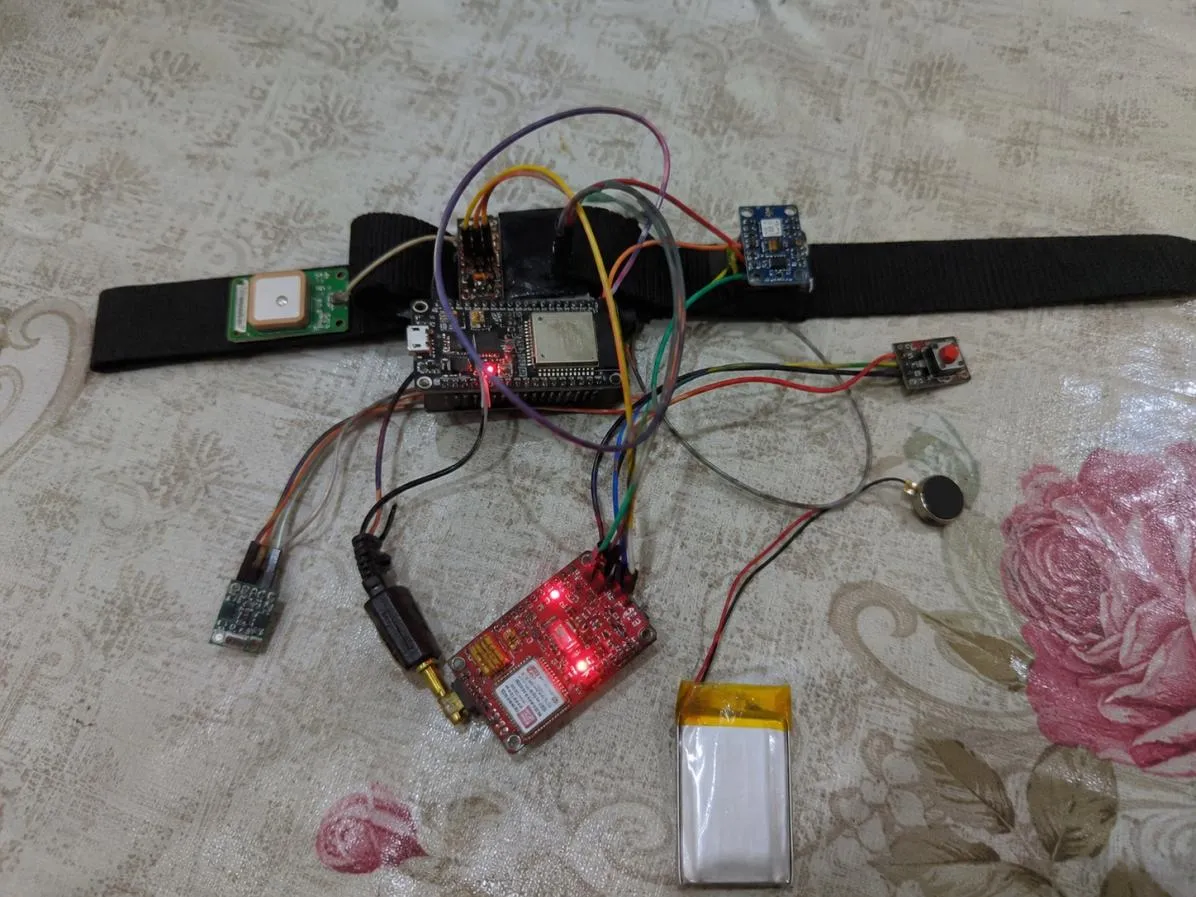
Figure 3. System Wiring / Circuit Connection Overview
13. EXPERIMENTAL SETUP
The experimental prototype was assembled by mounting the ESP32 development board, the MAX30102 sensor, the ADXL345 accelerometer, the GPS module, the SIM800L module (fitted with an activated micro-SIM card), the SOS push-button, the vibration motor, and the Li-Po battery onto an adjustable fabric wristband, as shown in the accompanying prototype photograph, with the MAX30102 sensor positioned so that its optical window makes consistent contact with the wearer's skin and the GPS antenna oriented for a clear view of the sky. All inter-module wiring was implemented using jumper wires soldered and insulated at the connection points to ensure mechanical reliability during wearable movement. The completed prototype was first subjected to bench (indoor, stationary) testing to verify correct sensor readings, threshold-based fall detection using controlled drop simulations, and correct SMS/voice-call transmission through the SIM800L module using a personal registered mobile number as the emergency contact. Following successful bench validation, the prototype was tested outdoors to evaluate GPS fix-acquisition time and positional accuracy under open-sky conditions, and the complete emergency-response sequence (abnormal-heart-rate trigger, simulated fall trigger, and manual SOS trigger) was independently exercised multiple times to confirm consistent end-to-end behaviour. A representative outcome of this testing is the emergency SMS alert captured on the registered emergency contact's phone, which reports the alert timestamp, the specific abnormal heart-rate value detected (96 BPM) at the moment of triggering, and a direct instruction for the recipient to check on the wearer, confirming correct end-to-end operation of the sensing, decision, and GSM-alerting pipeline.
14. RESULTS AND DISCUSSION
14.1 Health Monitoring
During bench testing, the MAX30102 sensor consistently returned stable heart-rate readings within a few seconds of the wearer's finger or wrist making steady contact with the sensor window, with occasional transient invalid readings during the initial contact period attributable to motion artefacts, consistent with the sensor's known sensitivity to finger placement and movement as documented in the manufacturer's application literature. Once a stable reading was established, the sensor's output remained consistent across repeated measurements taken in immediate succession, supporting its suitability for continuous background monitoring in the proposed application.
14.2 Fall Detection
Simulated fall events, generated by controlled drops of the accelerometer-equipped band from a fixed height onto a padded surface, were reliably distinguished from normal wrist movements such as walking, arm-raising, and gesturing, using the free-fall-followed-by-impact threshold criterion described in Section 10. Occasional false positives were observed during vigorous but non-fall-related arm movement (for example, rapid clapping or forceful gesturing), indicating that the current single-threshold-based algorithm could benefit from refinement — for example, through the addition of a post-impact stillness check or the machine-learning-based classification approaches discussed in the literature review — to further reduce the false-positive rate.
14.3 GPS Tracking
Under open-sky outdoor conditions, the GPS module reliably acquired a valid satellite fix, with acquisition time and accuracy consistent with the manufacturer's specifications for the module class used. Indoor testing, as expected for any standalone GPS receiver without assisted-GPS support, showed substantially degraded or absent fix acquisition, confirming that outdoor or near-window operation is necessary for reliable location reporting — a limitation inherent to all non-assisted GPS receivers and discussed further in Section 19.
14.4 SMS and SOS Alerting
The SIM800L module successfully transmitted emergency SMS alerts to the registered contact number for all three trigger conditions (abnormal heart rate, simulated fall, and manual SOS activation) during repeated testing. Figure 4 shows a representative emergency SMS alert received on the registered contact's smartphone during testing, confirming that the message correctly reports the alert timestamp, the trigger condition, and the measured heart-rate value at the time of triggering. The manual SOS button consistently and immediately triggered the emergency-response sequence in all trials, owing to its interrupt-driven implementation.
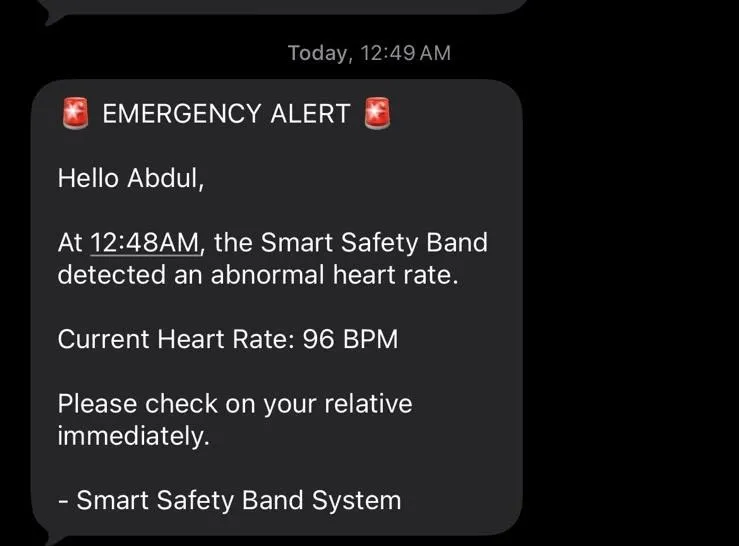
Figure 4. Emergency SMS Alert Received on the Registered Contact's Device During Prototype Testing
14.5 System Reliability
Across repeated end-to-end trials, the fully integrated prototype consistently completed the sequence of GPS acquisition, SMS transmission, and voice-call placement following trigger detection, with the primary source of variability being the time required for GPS fix acquisition, which is dependent on satellite visibility at the time of testing. No conflicts were observed between the shared I2C bus operations (MAX30102 and ADXL345) and the two independent UART channels (GPS and SIM800L) during concurrent operation, indicating that the chosen ESP32 peripheral allocation was appropriate for the combined workload.
14.6 Power Consumption
The SIM800L module was observed to be the dominant contributor to peak current draw, particularly during network registration and SMS/call transmission, consistent with its documented pulsed current behaviour, which was successfully managed in the prototype through the bulk decoupling capacitor described in Section 12. During the idle monitoring state, in which the GPS and GSM modules remain in a low-activity or standby condition and only the MAX30102 and ADXL345 sensors are actively sampled, the overall current draw of the system was substantially lower than during an active emergency-alert sequence, indicating that the majority of the device's battery life is consumed during continuous monitoring rather than during the comparatively infrequent alerting events, and suggesting that further power-management optimisation (such as duty-cycled sensor sampling) could meaningfully extend battery backup duration.
15. PERFORMANCE ANALYSIS
This section summarises the qualitative and representative performance characteristics observed during prototype testing. Given the scope of a student-project-level prototype evaluation, the values reported below reflect typical, observed ranges from repeated bench and field trials rather than statistically exhaustive clinical or laboratory-grade characterisation, and are presented to give a realistic indication of prototype behaviour without overstating measurement precision.
|
Test Condition |
Observed Behaviour |
Remarks |
|
Resting, stable finger/wrist contact |
Consistent, stable BPM reading obtained within a few seconds |
Suitable for continuous background monitoring |
|
Initial contact / motion |
Occasional invalid or fluctuating reading |
Consistent with known PPG motion-artefact sensitivity |
|
Mild movement during measurement |
Increased reading variability |
Recommend brief stillness for most reliable reading |
Table 3. Heart Rate Monitoring Performance
|
Test Condition |
Observed Behaviour |
Remarks |
|
Outdoor, open sky |
Valid fix acquired reliably; metre-level accuracy typical of module class |
Recommended operating condition |
|
Near-window indoor |
Intermittent or delayed fix |
Acceptable for occasional use, not guaranteed |
|
Deep indoor / enclosed |
Fix generally unavailable |
Expected limitation of non-assisted GPS receivers |
Table 4. GPS Accuracy and Acquisition
|
Trigger Type |
Observed Behaviour |
Remarks |
|
Manual SOS button |
Immediate trigger due to interrupt-driven detection |
Most consistent and fastest trigger path |
|
Abnormal heart rate |
Trigger follows next sensor evaluation cycle |
Dependent on sampling interval |
|
Simulated fall |
Trigger follows detection of free-fall + impact pattern |
Occasional false positive during vigorous motion |
|
SMS delivery |
Successfully delivered in all completed trials with active network coverage |
Dependent on cellular network availability |
Table 5. SMS and Emergency Response Behaviour
|
Parameter |
Observation |
|
Idle monitoring current draw |
Comparatively low; GPS/GSM modules kept in standby between events |
|
Peak current draw |
Occurs during SIM800L network registration and SMS/call transmission |
|
Battery backup |
Sufficient for extended intermittent monitoring; reduced by frequent alert events or continuous GPS/GSM activity |
|
Sensor response (MAX30102) |
Stable reading within a few seconds of consistent skin contact |
|
Sensor response (ADXL345) |
Immediate detection of simulated fall acceleration signature |
Table 6. Battery Backup and Sensor Response Summary
16. COMPARISON WITH EXISTING SYSTEMS
|
System |
Health Monitoring |
Fall Detection |
GPS Tracking |
GSM Alerting |
Standalone (No Phone Needed) |
|
Typical Fitness Smartwatch |
Yes |
Limited/None |
Via paired phone |
No (app-based) |
No |
|
Women's Safety GPS/GSM Band (Sharma & Verma, 2021) |
No |
No |
Yes |
Yes |
Yes |
|
ESP32+SVM Fall Detection Wearable (2024/25) |
No |
Yes (ML-based) |
Yes |
Not reported |
Partial |
|
MAX30102+ESP32 Cloud Monitor (Contardi et al., 2022) |
Yes |
No |
No |
No (Wi-Fi only) |
No |
|
Proposed Smart Safety Band |
Yes |
Yes |
Yes |
Yes |
Yes |
Table 7. Comparison of the Proposed System with Representative Existing Systems
As summarised in Table 7, the proposed system is distinguished from the representative existing systems reviewed in this paper by its combination of physiological monitoring, fall detection, GPS tracking, and independent GSM-based alerting within a single standalone wearable device, whereas the reviewed comparison systems each typically provide only a subset of these capabilities.
17. ADVANTAGES
18. APPLICATIONS
The proposed system is applicable across a wide range of user groups and scenarios:
19. LIMITATIONS
20. FUTURE SCOPE
Several directions for future enhancement of the proposed system have been identified:
CONCLUSION
This paper has presented the design, development, and prototype evaluation of an IoT-Enabled Smart Safety Band that integrates real-time heart-rate and SpO2 monitoring, tri-axial accelerometer-based fall detection, GPS-based location tracking, and independent GSM-based emergency SMS and voice-call alerting within a single, self-contained wearable device built around the ESP32 microcontroller. Unlike many existing solutions reviewed in this paper, which typically address health monitoring, fall detection, or personal-safety alerting in isolation, the proposed system unifies all three trigger modalities within a common decision and alerting pipeline, extending protection to elderly individuals, women, children, industrial workers, military and field personnel, and patients with chronic health conditions. A functional hardware prototype was assembled and validated through bench and field testing, with results confirming reliable heart-rate sensing, successful discrimination of simulated fall events, outdoor GPS fix acquisition, and consistent delivery of emergency SMS alerts, as directly evidenced by a captured alert message received during testing. While the current prototype exhibits limitations inherent to its constituent low-cost sensors and to GPS/GSM connectivity dependence, these limitations are well characterised and provide clear directions for future work, including machine-learning-based fall classification, cloud-based health dashboards, additional biosensing modalities, and predictive health analytics. Overall, the proposed system demonstrates that a low-cost, standalone, multi-modal wearable safety device is technically feasible using widely available embedded hardware, and represents a meaningful contribution toward more comprehensive, autonomous personal safety and health-monitoring technology.
ACKNOWLEDGEMENT
The authors express their sincere gratitude to their project guide, Prof. Bais Pranita Govind, Department of Computer Engineering, for her invaluable guidance, continuous encouragement, and technical insight throughout the design, development, and documentation of this project. The authors also gratefully acknowledge the support and resources provided by the Department of Computer Engineering and the administration of Shri Shivaji Institute of Engineering And Management Studies, Parbhani, Maharashtra, India, which enabled the successful completion of this work. Finally, the authors thank their families and peers for their steady support and encouragement throughout the course of this project.
REFERENCES



Abdul Majeed Abdul Mujeeb*, Farhan Khan Rafat Khan, Mohammad Muzameel Abdul Kadar, Bais Pranita Govind, Design And Development Of An Iot-Enabled Smart Safety Band For Real-Time Health Monitoring, GPS Tracking, Fall Detection, And Emergency Alerting, Int. J. Sci. R. Tech., 2026, 3 (7), 624-645. https://doi.org/10.5281/zenodo.21444082
 10.5281/zenodo.21444082