

We use cookies to ensure our website works properly and to personalise your experience. Cookies policy
1Institute for Social Transformation, School of Arts and Social Sciences, Tangaza University, Langata South Road, Karen, Nairobi, Kenya
2Environment & Climate Change Dept. of Community Dev. & Environmental Mngt. (DCEM) Co-operative University of Kenya
Peri-urban settlement growth in Kenya is increasing pressure on solid-waste management services. This study examined waste-management practices and their relationship with perceived community sustainability in Isinya Sub-County, Kajiado County, Kenya. A mixed-methods, cross-sectional design was used. Questionnaire data were obtained from 346 respondents, representing 86.72% of the target sample of 399, while three focus group discussions involved 18 waste collectors, recyclers, and county-government or municipal representatives. Quantitative data were analysed using descriptive statistics, reliability analysis, Pearson correlation, linear and logistic regression, and analysis of variance. Qualitative data were analysed thematically. Waste-management practices recorded the lowest composite mean (M = 2.63), compared with ecological knowledge (M = 3.53) and perceived community-sustainability outcomes (M = 3.57). Ecological knowledge was the strongest predictor of perceived sustainability outcomes in the linear regression model (? = .368, p < .001) and the only significant predictor in the logistic regression model (OR = 3.44, 95% CI [2.06, 5.76], p < .001). Government and institutional support was positively associated with perceived environmental cleanliness (B = 0.497, p < .001). Focus group discussions identified irregular collection, informal disposal, inadequate protective equipment, licensing costs, and stigma affecting waste workers. The findings suggest that environmental education should be complemented by reliable collection services, accessible recovery infrastructure, institutional coordination, and support for waste-management workers. Because the study was cross-sectional, the findings indicate associations rather than causal relationships.
Rapid urbanisation has made solid waste a major environmental-management challenge. Global waste generation was estimated at 2.01 billion tonnes in 2016 and is projected to reach 3.40 billion tonnes by 2050¹. The Global Waste Management Outlook 2024 projects that municipal solid-waste generation will reach 3.80 billion tonnes by 2050². The effects of poor waste management extend beyond visual pollution. Solid waste can provide breeding sites and food sources for disease vectors and urban zoonotic reservoirs, and its accumulation is associated with vector-borne disease³. Waste management is therefore an environmental, public-health, and community-sustainability concern.
In Kenya, a central challenge is the implementation of existing policy rather than the absence of policy. A qualitative study of urban Kenya identified weak implementation and enforcement of waste-management policies and regulations as major challenges, alongside corruption, limited political will, political interference, and low citizen participationâ´. Weak institutional capacity, inadequate enforcement, and the influence of criminal cartels have also been documented in Nairobi and Mombasaâµ. Although much of this evidence comes from Kenya’s largest cities, peri-urban settlements—where access to services may be limited—have received less systematic research attentionâµË’â¶.
Isinya Sub-County lies approximately 50 km southeast of Nairobi along the Nairobi–Namanga Road in Kajiado County. The area has historically supported pastoralist and agro-pastoralist livelihoods, but it has experienced rapid settlement growth, expanding trade, and increasing household density. The 2019 census recorded a population of 210,473 in the sub-countyâ·. Evidence on interactions among households, community groups, and public institutions in peri-urban waste management remains limited, constraining the development of locally appropriate interventions.
Research suggests that knowledge of environmental risks does not necessarily translate into sound waste-handling practices. In Techimantia, Ghana, residents demonstrated knowledge of waste-related issues, but this knowledge did not necessarily translate into appropriate waste-management behaviourâ¸. A study in Eastleigh, Nairobi, similarly emphasised that public education should be accompanied by sufficient resources for effective waste managementâ¶. In peri-urban settings, awareness campaigns may therefore have limited effects when practical barriers to action remain unaddressed.
The study was guided by two complementary frameworks. The Theory of Planned Behavior proposes that behaviour is shaped by beliefs about likely outcomes, perceived social expectations, and perceived factors that facilitate or hinder actionâ¹. Perceived behavioural control is particularly relevant where services are unavailable: positive attitudes may not translate into action without bins, reliable collection routes, or recovery points. This individual-level perspective is complemented by social-ecological systems frameworks, which support interdisciplinary analysis of complex interactions between social and ecological systems¹â°. Together, these frameworks help situate household decisions within their wider community and institutional contexts.
The study examined waste-management practices and perceived community sustainability in Isinya Sub-County through four objectives: (a) to identify household and community-based waste-management practices; (b) to examine the relationship of ecological knowledge with waste-management practices and perceived sustainability outcomes; (c) to explore community-based systems underpinning waste management; and (d) to examine the role of government and institutional support in relation to waste-management practices and perceived community-sustainability outcomes. Community sustainability was operationalised through perceived environmental cleanliness, public health, community unity, livelihoods and employment, and community resilience. The study provides local evidence from an under-researched peri-urban context and examines whether knowledge, community organisation, or institutional support is associated with perceived sustainability in this setting.
MATERIALS AND METHODS
Study Design
This descriptive, cross-sectional study used a mixed-methods design. A structured questionnaire generated quantitative data on waste-management practices, ecological knowledge, community-based systems, government and institutional support, and perceived community-sustainability outcomes. Qualitative data were collected through three focus group discussions (FGDs). An observation checklist was used to compare reported practices with observable conditions in households, markets, public spaces, and collection points. The quantitative and qualitative strands were triangulated, and areas of convergence and divergence were considered for each study objective.
Participants and Sampling
The target population comprised adults aged 18 years or older who had lived or operated in Isinya Sub-County for at least six months. Four groups were represented: household members; members of community-based groups, including youth groups, women’s cooperatives, and community-based organisations; waste-management actors, including formal and informal collectors, recyclers, and small-business operators; and government or institutional stakeholders, including county environmental and public-health officers, National Environment Management Authority (NEMA) representatives, and sub-county administration officials. Minors were excluded.
The target sample comprised 399 participants: 339 household respondents, 34 community-based group members, 20 waste-management actors, and six government or institutional stakeholders. The sample-size calculation was reported using the formula n = N/(1 + Ne²), with a 5% margin of error. Households were selected through stratified random sampling from village registers. Participants in the other groups were recruited purposively, and snowball sampling was used to reach informal waste actors. Of the 399 targeted questionnaires, 346 were complete and usable, yielding a response rate of 86.72%. The sample-size calculation used the 2019 sub-county population figure reported in the study.
Three focus group discussions (FGDs) were conducted, each with six participants: waste collectors (n = 6), waste recyclers (n = 6), and county-government or municipal representatives (n = 6). Discussions took place face-to-face in private locations, lasted approximately 60–90 minutes, and followed a semi-structured guide aligned with the study objectives. Data were documented in notes.
Instruments and Pretesting
The questionnaire collected respondents’ background characteristics and measured five constructs. Waste-management practices were assessed using 12 items: five agreement items covering household waste separation, collection reliability, the practicality of recycling, the prevalence of composting, and the prevalence of improper waste disposal (reverse-coded); and seven frequency items covering recycling, proper waste disposal, water and energy conservation, tree planting, community clean-ups, composting, and participation in environmental meetings. Five agreement items were developed for each of the other constructs: ecological knowledge, community-based systems, government and institutional support, and perceived community-sustainability outcomes. Agreement items were rated on a five-point scale from strongly disagree (1) to strongly agree (5), while frequency items were rated from never (1) to always (5). Higher scores represented greater agreement or frequency. The sustainability scale covered environmental cleanliness, public health, community unity, livelihoods and employment, and resilience.
The questionnaire was pretested in Rongai town with 10 participants—six household members and four county environmental officers—in a setting outside Isinya with broadly similar sociodemographic characteristics. The wording was revised in response to their feedback. Research supervisors and specialists in environmental education and research methods reviewed the instrument for content validity. Bilingual research assistants provided oral Kiswahili translations when requested. Standard Kiswahili equivalents for key technical terms were agreed upon before fieldwork and tested during the pilot.
Data Collection and Researcher Positionality
Trained bilingual research assistants collected data in June 2026 after ethical approval had been obtained. The first author’s role as founder of ECOTAKA Solutions Africa created potential risks of participant coercion, socially desirable responses, and conflicts of interest. Safeguards included not recruiting participants known to the author through the organisation’s activities; explaining that the research was academically independent and that participation or withdrawal would not affect access to organisational services; and maintaining a reflexive journal during analysis and interpretation.
Data Analysis
Quantitative data were analysed using IBM SPSS Statistics. Internal consistency was assessed using Cronbach’s alpha, with .70 treated as the minimum acceptable value. Analyses included descriptive statistics, Pearson correlations among study constructs, multiple linear regression predicting community-sustainability outcomes, separate regression models for each of the five sustainability indicators, logistic regression, and analyses of variance by gender and education level. For logistic regression, sustainability scores were dichotomised at the median (3.60), creating low (n = 170) and high (n = 172) groups. Qualitative data were analysed using the six-phase thematic-analysis framework described by Braun and Clarke¹². The practice-scale findings require cautious interpretation because the scale includes a reverse-coded item and its reported associations were negative; the item coding and composite-score calculation should be verified against the original dataset.
Ethical Considerations
Ethical clearance was obtained from the Tangaza University Research Ethics Committee, and a research permit was obtained from the National Commission for Science, Technology and Innovation (NACOSTI). Approval and authorization were also sought from the Kajiado County Environmental Department, Isinya Sub-County administration, community leaders, and participating institutions. Participation was voluntary, and informed consent was obtained privately from each participant. Local administrators and group leaders who helped identify potential participants were not present during consent and could not determine whether individuals withdrew or skipped questions.
RESULTS AND DISCUSSION
3.1 Respondent Characteristics
The characteristics of the 346 respondents are presented in Table 1. Females represented 53.2% of respondents, and the largest age group was 36–45 years (45.9%). Diploma holders accounted for 41.8%, while 27.7% had completed secondary education. Most respondents described their settlement as urban (61.4%); 18.1% described it as peri-urban and 20.2% as rural. The most frequently reported monthly household income category was KSh 45,001–60,000 (27.4%). The largest groups had lived in Isinya for four to six years (41.8%) or seven to ten years (33.1%).
CHARACTERISTICS OF SURVEY RESPONDENTS (N = 346)
Table 1:
| Characteristic | n | % |
|---|---|---|
| Gender | ||
| Female | 184 | 53.2 |
| Male | 153 | 44.1 |
| Prefer not to say | 9 | 2.6 |
| Age (years) | ||
| 18–25 | 23 | 6.6 |
| 26–35 | 90 | 26.0 |
| 36–45 | 159 | 45.9 |
| 46–55 | 59 | 17.0 |
| 56 and above | 15 | 4.3 |
| Education | ||
| No formal education | 5 | 1.4 |
| Primary | 15 | 4.3 |
| Secondary | 96 | 27.7 |
| Diploma | 145 | 41.8 |
| Bachelor’s degree | 69 | 19.9 |
| Master’s or PhD | 16 | 4.6 |
| Settlement area | ||
| Urban | 213 | 61.4 |
| Peri-urban | 63 | 18.1 |
| Rural | 70 | 20.2 |
Note. Percentages are of the 346 usable questionnaires and may not sum to exactly 100 because of rounding.
3.2 Reliability and Descriptive Statistics
All five scales had Cronbach’s alpha values above .70, ranging from .758 for community sustainability outcomes to .821 for government and institutional support (Table 2). Waste-management practices had the lowest composite mean (M = 2.63, SD = 0.59). Ecological knowledge had a mean of 3.53, community-based systems 3.43, government and institutional support 3.39, and perceived community sustainability outcomes 3.57. Thus, respondents reported comparatively higher ecological knowledge and sustainability perceptions than the frequency or quality of waste-management practices.
RELIABILITY AND DESCRIPTIVE STATISTICS FOR THE STUDY CONSTRUCTS
Table 2:
| Construct | Items | α | N | M | SD |
|---|---|---|---|---|---|
| Waste management practices | 12 | .812 | 340 | 2.63 | 0.59 |
| Ecological knowledge systems | 5 | .765 | 342 | 3.53 | 0.65 |
| Community-based systems | 5 | .784 | 340 | 3.43 | 0.60 |
| Government and institutional support | 5 | .821 | 340 | 3.39 | 0.65 |
| Community sustainability outcomes | 5 | .758 | 340 | 3.57 | 0.60 |
Note. α = Cronbach’s alpha. Scores range from 1 to 5; higher scores indicate greater agreement or frequency.
Composite Mean Scores of the Study Constructs
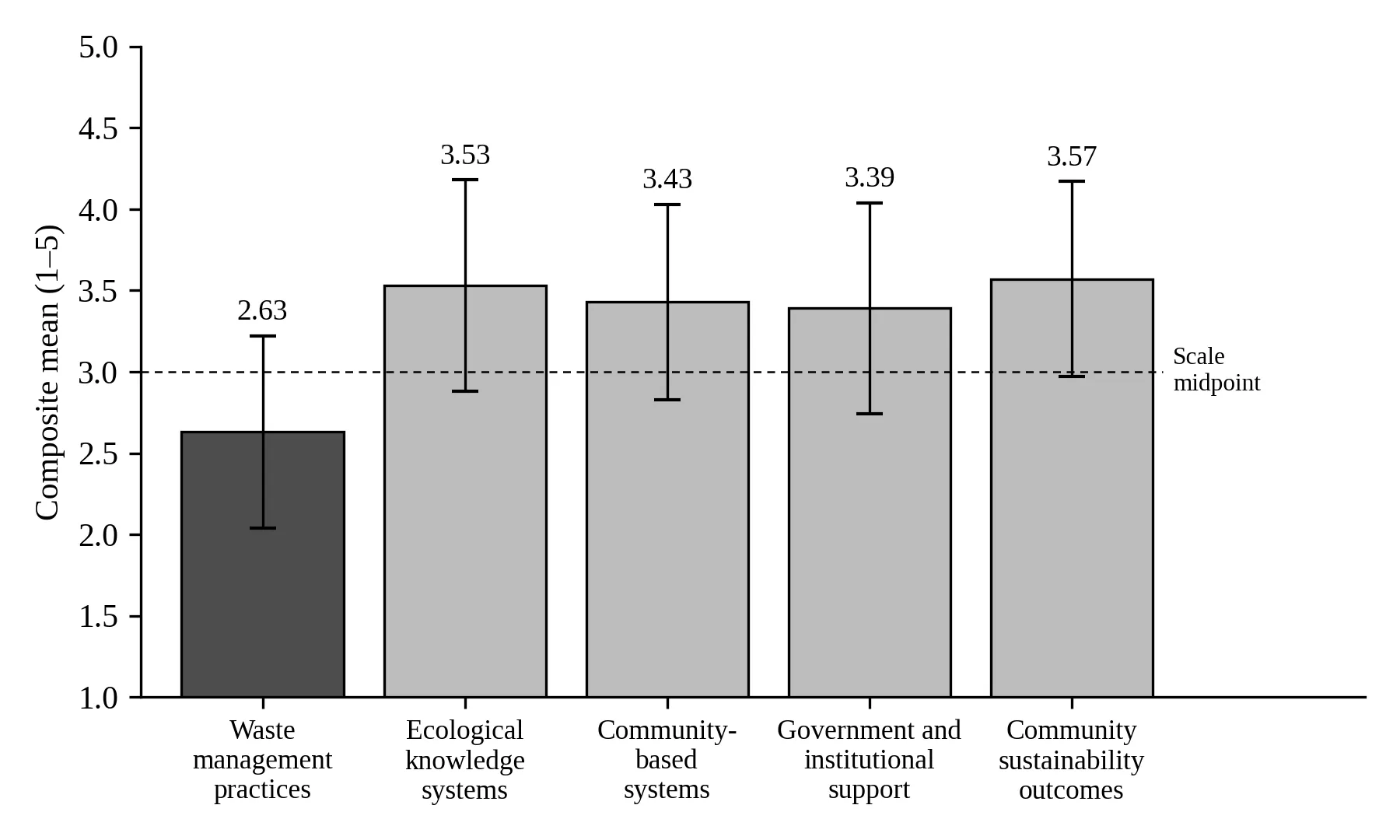
Figure 1:
Note. Error bars show ±1 standard deviation. The dashed line marks the scale midpoint (3.00).
3.3 Waste Management Practices
Table 3 presents item-level results for the 12 waste-management practice items. Household waste separation had a mean of 2.52. Reported participation was lowest for attending environmental meetings (M = 2.37), recycling (M = 2.39), community clean-ups (M = 2.40), and composting organic waste (M = 2.46). Respondents also rated collection reliability (M = 2.96) and the practicality of recycling (M = 2.80) below the scale midpoint. Only the item assessing whether composting was common in Isinya had a mean slightly above the midpoint (M = 3.04). Overall, the results indicate that source separation, recycling, and composting were not well established and that confidence in collection services and recycling opportunities was limited.
ITEM-LEVEL DESCRIPTIVE STATISTICS FOR WASTE MANAGEMENT PRACTICES
Table 3:
| Item | M | SD |
|---|---|---|
| My household separates waste into different categories | 2.52 | 1.02 |
| Waste collection services are reliable in my area | 2.96 | 0.93 |
| Recycling activities are practical in my community | 2.80 | 0.94 |
| Composting is common in Isinya | 3.04 | 0.90 |
| Improper waste disposal is common in my area (reverse-coded) | 2.71 | 0.87 |
| Recycling waste (frequency) | 2.39 | 1.05 |
| Proper waste disposal (frequency) | 2.63 | 1.13 |
| Conserving water and energy (frequency) | 2.66 | 1.16 |
| Participating in tree planting (frequency) | 2.63 | 1.08 |
| Participating in community clean-ups (frequency) | 2.40 | 1.01 |
| Composting organic waste (frequency) | 2.46 | 1.07 |
| Attending environmental meetings (frequency) | 2.37 | 1.01 |
Note. N = 341–346 per item. Scores range from 1 to 5.
Focus group accounts indicated that waste-management practices varied by location and residential tenure. In rented urban dwellings, residents commonly placed waste in polythene bags at designated collection points. Collection schedules, negotiated with landlords, ranged from three times a week to once a month. Collectors reportedly separated organic waste from recyclable materials and directed recyclable materials to recyclers. Burning and burying were described as more common than composting in rural and some peri-urban areas. Some plant waste, including cabbage, kale, and maize stalks, was left in open areas or along roads for livestock. Participants also described limited public bins in centres such as Kitengela and Isinya town, low use of some existing bins, and market collection points that relied on large bins.
Participants identified rapid population growth, inadequate collection transport, limited knowledge of segregation, and the perception that waste management is primarily a government responsibility as barriers. Collectors and recyclers also reported inadequate masks and other protective equipment, risks of cuts from glass, tensions when crossing grazing land, low recovery value for some materials, licensing costs, and stigma associated with the term “chokora.”
3.4 Ecological Knowledge Systems
The mean ecological knowledge score was 3.53. Respondents most strongly agreed that poor waste management creates health hazards (M = 3.71), environmental degradation affects future generations (M = 3.66), and poor waste handling has negative impacts (M = 3.63). Agreement was lowest for the statement concerning the presence of environmental education programmes in Isinya (M = 3.27). Ecological knowledge was not significantly correlated with waste-management practices (r = −.062). Men had a higher mean knowledge score than women (3.60 versus 3.48; F = 4.74, p = .030), and knowledge scores increased with education level (F = 8.76, p < .001). Practice scores also differed by education level (F = 2.67, p = .022). Other construct differences by gender or education were not statistically significant (all p ≥ .162).
Focus group participants described seminars, workshops, and environmental days, but also reported continuing awareness gaps. They discussed women’s substantial responsibility for household waste handling and differences between traditional practices and newer waste-recovery approaches. Participants described changes associated with urban growth, including emerging recovery processes for plastics and other materials, as well as environmental degradation associated with quarrying. They also referred to the Kajiado County Environmental Act of 2020, the “Taka ni Mali” campaign, and the delegation of waste responsibilities to the municipality.
3.5 Community-Based Systems
Respondents rated community-based systems moderately positively (M = 3.43). They most strongly endorsed the contribution of community collaboration to sustainability (M = 3.59) and community participation in clean-up activities (M = 3.47). Public meetings addressing waste-management issues received the lowest mean (M = 3.32).
Participants described clean-up groups, youth and women’s groups, placards, social-media campaigns in markets, public barazas, and neighbour-to-neighbour mobilization. Some activities received support from local businesses. Contributions included protective equipment, refreshments, and labour. Reported motivations included environmental cleanliness, property improvement, incentives, business promotion, and protecting water sources for livestock. Barriers included limited recognition or incentives, the time and effort required, negative attitudes, and the belief that waste management is the government’s responsibility.
3.6 Government and Institutional Support
The mean rating for government and institutional support was 3.39. Respondents most strongly endorsed institutional support for community initiatives (M = 3.56) and government collaboration with community groups (M = 3.43). The adequacy of waste-collection facilities had the lowest mean (M = 3.28).
Focus group participants described county support as moderate and funding for waste-management activities as limited. Collectors and recyclers called for more collection personnel and logistics, enterprise-development support, suitable disposal sites, training, and collaboration on technology. They also proposed protective support for waste workers, formal recognition of collectors, reduced or waived site-access fees, safer recycling sites, and public-awareness partnerships with local operators.
3.7 Relationships Among the Constructs
Ecological knowledge, community-based systems, and government and institutional support were positively correlated with one another and with sustainability outcomes. The strongest correlation was between community-based systems and government and institutional support (r = .500, p < .001). Correlations between these three constructs and sustainability outcomes ranged from .347 to .422. Waste-management practices had weak negative correlations with the other constructs, including sustainability outcomes (r = −.126, p < .05). Given the scale’s reverse-coded item and the unexpected direction of these associations, this pattern should be interpreted cautiously pending verification of coding and scoring.
PEARSON CORRELATIONS AMONG THE STUDY CONSTRUCTS
Table 4:
| Construct | 1 | 2 | 3 | 4 | 5 |
|---|---|---|---|---|---|
| 1. Waste management practices | — | ||||
| 2. Ecological knowledge systems | −.062 | — | |||
| 3. Community-based systems | −.126* | .422*** | — | ||
| 4. Government and institutional support | −.152** | .287*** | .500*** | — | |
| 5. Community sustainability outcomes | −.126* | .375*** | .422*** | .347*** | — |
Note. N = 335–340. *p < .05. **p < .01. ***p < .001.
3.8 Predictors of Community Sustainability Outcomes
The four predictors jointly explained 19.9% of the variance in perceived community sustainability outcomes (R² = .199; Table 5). Ecological knowledge was the strongest predictor (B = 0.342, β = .368, p < .001). Community-based systems showed a positive but non-significant association (β = .115, p = .085), while government and institutional support was not a statistically significant predictor in this model (β = .043, p = .454). Waste-management practices had a small negative coefficient (β = −.104, p = .034); this result should be interpreted cautiously because of the potential scale-composition or coding issue described above.
MULTIPLE REGRESSION PREDICTING COMMUNITY SUSTAINABILITY OUTCOMES
Table 5:
| Predictor | B | SE | β | t | p |
|---|---|---|---|---|---|
| Constant | 2.108 | 0.253 | — | 8.33 | < .001 |
| Waste management practices | −0.105 | 0.049 | −.104 | −2.13 | .034 |
| Ecological knowledge systems | 0.342 | 0.053 | .368 | 6.47 | < .001 |
| Community-based systems | 0.115 | 0.066 | .115 | 1.73 | .085 |
| Government and institutional support | 0.040 | 0.053 | .043 | 0.75 | .454 |
Note. R = .446, R² = .199, adjusted R² = .189, F(4, 337) = 20.91, p < .001.
In separate models for the five sustainability indicators, government and institutional support was the strongest predictor of perceived environmental cleanliness (B = 0.497, p < .001). Ecological knowledge was the strongest predictor of perceived public health (B = 0.522, p < .001), livelihoods and employment (B = 0.502, p < .001), and community resilience (B = 0.444, p < .001). It was also the only significant predictor of community unity (B = 0.297, p = .001), although that model explained 6.1% of the variance. Waste-management practices had significant negative coefficients in the public-health and resilience models; government and institutional support had a significant negative coefficient in the public-health model. These unexpected negative coefficients warrant cautious interpretation.
In the logistic regression model, ecological knowledge was the only statistically significant predictor of membership in the high-sustainability group (OR = 3.44, 95% CI [2.06, 5.76], p < .001; Table 6). The model was statistically significant (χ²(4) = 32.96, p < .001), had a pseudo-R² of .070, and correctly classified approximately 60% of cases. These results indicate a significant association but only modest predictive performance.
LOGISTIC REGRESSION PREDICTING HIGH VERSUS LOW COMMUNITY SUSTAINABILITY OUTCOMES
Table 6:
| Predictor | B | SE | Wald z | p | OR | 95% CI |
|---|---|---|---|---|---|---|
| Constant | −4.120 | 1.244 | −3.31 | .001 | 0.02 | — |
| Waste management practices | −0.181 | 0.228 | −0.79 | .429 | 0.84 | [0.53, 1.31] |
| Ecological knowledge systems | 1.237 | 0.263 | 4.70 | < .001 | 3.44 | [2.06, 5.76] |
| Community-based systems | 0.131 | 0.309 | 0.42 | .671 | 1.14 | [0.62, 2.09] |
| Government and institutional support | −0.062 | 0.247 | −0.25 | .801 | 0.94 | [0.58, 1.53] |
Note. High (n = 172) and low (n = 170) groups were formed by a median split of community sustainability outcomes at 3.60. OR = odds ratio; CI = confidence interval. Pseudo-R² = .070; χ²(4) = 32.96, p < .001.
3.9 Convergence Between the Quantitative and Qualitative Strands
The qualitative findings broadly converged with the survey results. Low practice scores were consistent with reports of burning, burying, roadside disposal, and limited collection in busy centres. The association between ecological knowledge and sustainability perceptions coexisted with reports of uneven awareness, persistent habits, and practical barriers to acting on knowledge. Community initiatives were active but inconsistently sustained, while participants emphasized the need for infrastructure, funding, coordination, and institutional recognition for waste workers.
3.10 Discussion of findings
The principal finding is a gap between ecological knowledge and reported waste-management practices. Practices had the lowest composite mean (M = 2.63), and ecological knowledge was not significantly correlated with practices (r = −.062). Focus group participants described irregular collection, burning and burying of waste, roadside disposal, and limited public bins. This pattern is consistent with prior research reporting that awareness of waste-related risks does not necessarily translate into effective waste-management behaviour and that public education needs to be accompanied by practical resources.
The Theory of Planned Behavior offers one possible interpretation: perceived behavioural control is shaped by factors that facilitate or constrain action. In Isinya, reported constraints included limited collection transport, few bins, a lack of nearby recovery points, and collection schedules negotiated with landlords. From this perspective, some unsafe disposal practices may reflect constrained options as well as individual decisions. This is an interpretation of the qualitative accounts rather than a relationship directly measured by the survey.
Ecological knowledge was the strongest predictor of perceived sustainability outcomes in the linear model (β = .368) and the only significant predictor in the logistic model (OR = 3.44). However, the cross-sectional design does not establish causation, and the model explained 19.9% of the variance. Knowledge was measured through awareness of environmental impacts and risks, conservation beliefs, and perceptions of education programmes; it should not be equated with practical skills in segregation or composting. The findings therefore suggest an association between ecological orientation and more positive sustainability perceptions, even where reported practices remain limited.
Men had slightly higher ecological knowledge scores than women (a difference of 0.12 points), whereas focus group accounts emphasized women’s responsibility for household waste handling. These findings may reflect differences between the survey’s measure of general ecological awareness and participants’ accounts of task-specific experience. The study cannot resolve this discrepancy. The observed education differences in knowledge and practices nevertheless support tailoring environmental education to groups with different levels of formal education and practical access to waste-management information.
Community-based systems received moderately positive ratings (M = 3.43), but their association with overall sustainability outcomes was not statistically significant after adjustment for the other constructs (β = .115, p = .085). Participants described clean-up groups, youth and women’s initiatives, and business-supported campaigns, but also identified barriers to sustained participation. The correlation between community-based systems and institutional support (r = .500) suggests that community action and institutional arrangements may be connected. The qualitative evidence supports strengthening community initiatives through infrastructure, incentives, and recognition rather than treating them as substitutes for public services.
Government and institutional support was most strongly associated with perceived environmental cleanliness (B = 0.497, p < .001), but was not a significant predictor of overall sustainability outcomes in the multivariable model. This distinction may reflect the closer relationship between visible services, such as collection and enforcement, and perceptions of cleanliness than with broader outcomes such as health, livelihoods, unity, and resilience. Participants’ requests for greater collection capacity, suitable disposal sites, lower access costs, and recognition of collectors point to practical institutional priorities. The negative coefficient for institutional support in the public-health model is unexpected and cannot be explained conclusively by these data. Although the fourth objective referred to institutional support as a potential mediator, the analysis treated it as a simultaneous predictor; therefore, no mediation effect can be claimed.
Focus group accounts also highlighted the occupational risks and social disadvantages experienced by collectors and recyclers, including inadequate protective equipment, unstable returns from recovered materials, licensing costs, and stigma. These findings indicate that worker safety, dignity, and livelihoods should be integrated into waste-management planning. Environmental education may be more effective when residents, collectors, recyclers, and institutions jointly identify barriers and connect reflection with practical collective action. Existing door-to-door collection, the “Taka ni Mali” campaign, clean-up events, and public barazas may offer locally familiar platforms for such engagement, with progress assessed through indicators such as household separation and worker safety incidents.
3.11 Limitations
Several limitations should be considered. The cross-sectional design means that observed associations are not causal. Predictor and outcome measures were reported by the same respondents, creating a risk of common-method bias. The linear model explained 19.9% of the variance, and the logistic model correctly classified approximately 60% of cases. The negative correlations involving the practices scale may reflect its composition or coding and should be checked against the original data. Results were not reported separately for each sampling stratum, and the sample was dominated by household respondents. The FGDs involved collectors, recyclers, and county officials rather than household residents; consequently, accounts of household roles and gendered responsibilities reflect informants’ descriptions. Observation checklist data were used for triangulation but were not analysed separately. Purposive sampling in three of the four strata and data collection in one sub-county limit generalizability. Finally, no formal mediation analysis was conducted.
CONCLUSION
The study identified a clear difference between respondents’ ecological knowledge and their reported waste-management practices in peri-urban Isinya. Ecological knowledge was associated with more positive perceived sustainability outcomes, while government and institutional support was most strongly associated with perceived environmental cleanliness. Community-based initiatives were present but faced constraints relating to resources, incentives, infrastructure, and recognition. These findings support a coordinated approach that combines practical environmental education with reliable collection and recovery services, institutional collaboration, and safer, more dignified conditions for formal and informal waste workers. Because the study was cross-sectional, these conclusions concern associations and reported experiences rather than causal effects.
1. Recommendation 1: Establish opportunities for source separation. Kajiado County Government and community partners should consider establishing material-recovery centres and sorting bays in Isinya, providing clearly differentiated household bins, and publishing reliable collection schedules. These measures could make segregation, composting, and safe disposal more practicable.
2. Recommendation 2: Deliver practical, dialogic environmental education. County environmental officers, community elders, and local organizations should develop action-oriented education on safe handling of household hazardous waste, plastic reduction, and locally relevant resource-recovery practices. Activities should document traditional and local knowledge, including livestock-feeding and manuring practices, and be accessible to women and people with lower levels of formal education.
3. Recommendation 3: Support community and informal waste actors. County and non-governmental partners should consider skills training and micro-grants for community, women’s, and youth groups working on composting, briquetting, and plastic recovery. Protective equipment and appropriate health coverage for collectors and recyclers, together with public recognition, could improve occupational safety and reduce stigma.
4. Recommendation 4: Strengthen institutional delivery and coordination. Kajiado County Government should assess opportunities to expand peri-urban collection infrastructure, improve the safety and management of disposal sites, implement relevant by-laws consistently, and establish a multi-stakeholder coordination mechanism involving municipal officials, NEMA, local administration, community organizations, and informal waste actors.
5. Recommendation 5: Strengthen the evidence base. Future research should verify and refine the measurement of practices, ecological knowledge, and sustainability outcomes; use confirmatory factor analysis or structural equation modelling where appropriate; formally test mediation hypotheses; and employ longitudinal or intervention designs to assess whether environmental education is followed by changes in practice. Studies in other peri-urban sub-counties would help assess transferability.
ACKNOWLEDGMENT
The author sincerely acknowledges the study participants for their valuable contributions. Appreciation is extended to C. Ouko and Z. Muiruri for their supervision and academic guidance during the research process.
FUNDING
The study received no external funding.
CONFLICT OF INTEREST
No financial or non-financial conflict of interest related to this study.
ETHICAL STATEMENTS
Ethical approval for this study was obtained from the Tangaza University Research Ethics Committee Approval No.: TU/ISERC2026/01/00170 dated 14th May 2026 A research permit was subsequently obtained from the National Commission for Science, Technology and Innovation (NACOSTI), Kenya Permit No. NACOSTI/P/26/4191259], issued on 18TH June 2026. The study was conducted in accordance with the conditions specified in the ethical approval and research permit.
STATEMENT OF INFORMED CONSENT
Participation in the study was voluntary, and informed consent was obtained privately from each participant before data collection. Consent was sought on a one-to-one basis, without local administrators or group leaders present. Participants could decline to answer questions, and safeguards were used to ensure that participation or withdrawal did not affect access to the services of ECOTAKA Solutions Africa. The consent process emphasized the academic and independent nature of the study and the confidentiality of participants’ responses.
DATA AVAILABILITY
The qualitative data contain participant accounts collected from selected study sites in Isinya Sub-County, Kajiado County, Kenya, and are not publicly available with this article. Access to de-identified data may be considered upon reasonable request, subject to ethical approval, institutional research governance requirements, and measures to protect participant confidentiality and the identities of the study sites.
REFERENCES


R. K. Omariba, C. Ouko, Z. Muiruri, Bridging the Knowledge–Practice Gap: Waste Management Practices and Community Sustainability in Peri-Urban Isinya Sub-County, Kajiado County, Kenya, Int. J. Sci. R. Tech., 2026, 3 (10), 1047-1057. https://doi.org/10.5281/zenodo.23473498
 10.5281/zenodo.23473498