

We use cookies to ensure our website works properly and to personalise your experience. Cookies policy
1Department of Sociology, H.N.B Garhwal University Srinagar Garhwal.
2Department of Geography, School of Earth Science H.N.B Garhwal University BGR Campus Pauri Garhwal.
This paper aims to study of the interrelationship between women's literacy and the sex ratio of Mewat district. In the Mewat district, there are Blocks such as Nuh, Firozpur Jhirka, Punhana, Taoru, and Nagina. Literacy is considered alone of the most important social aspect of any society's development, especially in rural areas. Literacy and education are universally recognized as major components of human development. This paper is an attempt to analyze the correlation between women's literacy and the sex ratio in district Mewat. Literacy affected on migration and sex ratio. In the Mewat district in Haryana and study basis of this analysis with a secondary data survey with the district census data handbook 2011. The knowledge of literacy and sex ratio is essential for understanding the coordination of women in society. In the literacy rate in 2011 is 54.1 percent whereas it was 43.3 percent during the 2001 Census and sex-ratio is of the district which was 899 in 2001 has increased to 907 in 2011. In the district, the literacy rate amongst the Male population which was 61 percent in 2001 has increased to 69.9 percent and in an urban area it is 80.1 percent, and literacy rate has also shown an increase amongst the female population, during 2001 it was 23.7 percent and it reached 36.6 percent during 2011. The literacy rate in rural areas of Mewat district is 51.99 % as per census data in 2011. In 2011, the female literacy rate of Mewat district was the lowest in Haryana state indicating the female illiteracy of the district. Great variations in literacy rates at village levels in the districts have been reported irrespective of gender. In the Mewat district highest literacy rate is 80.96% in and the lowest literacy rate is 7.14% in the district. This study finds out that in this district due to a lack of awareness, education, and transport facilities many of girls leave their schools and colleges. The government should be taken many steps to improve the education and social status of women in the region. The correlation between women's literacy and sex-Ratio is strong negative correlation® = -0.8 is the low volume of relation with literacy and sex ratio.
There are large disparities in the economic, social, and schooling opportunities available to men and women in India. Female literacy and sex ratio are two important demographic characteristics of the population. Female literacy plays an important role in the upliftment of the sex ratio. Literacy is the main indicator for socio – the economic development of societies. The census of India defines the literacy rate as a proportion of literates to total population in age group 7 years and above (Census of India, 1991). This was a 9.81% increase since the last census 2001(GOS, 2014). The Population Commission of the United Nations considers the ability to both read and write with understanding in any language. A person who can merely read but cannot write is not classified as literate. According to census 2011, the literacy rate of overall Indian population is 74.04% with 82.14% males and 65.46% female literates. The gap between male and female literacy is a sensitive indicator of social discrimination. The gender gap in education occurs when there are systematic differences in schooling levels between men and women. Indicators frequently used to measure gender equality include life expectancy, education, and earnings. The present sex composition of the population determines the future vital events such as marriage rate, labor force, age structure, birth and death, migration, etc. Literacy is the only one major mediator for the progress of the socio-economic condition and which could help human development in any country (Singh, 2016). It is also influenced marital status, manpower, the gross national product, planning regarding educational and medical services; housing, etc., as well as socio-cultural factors together, influences the overall demographic composition of the population. Literacy is a major indicator for which improves the status of women in the field of health, income, and standard of living. Many of women faced nutritional diseases because of a lack of knowledge about health issues. Literacy considered as a most important factor of social aspects of any society’s development, especially of rural area and it denotes essential criterion of human development. There as three types of sex ratio describe such as; primary sex ratio at the time of conception, secondary sex ratio is the ratio at the time of birth, and tertiary phase of sex ratio is mature stage. Education is not only an important need of life and the key factor in the process of development. The pattern of literacy various from one to another states. It affected the structure of occupation, government policies, socio- economic status and facilities for lifestyles. Literacy rate is also called ‘effective literacy rate’ is the total percentage of the population of an area at a particular time aged seven years or above who can read and write with understanding. Correlation is a stastiscal method which shows the relation between two variables, one variable is decrease and another variable is increase. Which define the positive and negative relation between two variables. In the papers shows the correlation between sex ratio and female literacy in district Mewat (Haryana). Literacy is a major important aspect of demography and is more often as a reliable index of social – cultural and advancement (Chandna 2015). Literacy and sex ratio are both indicators, which effect the development of any region or country, because its help to improve the conservation of resources and protection of social problems. If the literacy high in any region it effects the sex ratio in the region. Due the effect of education and awareness many regions faced the problem of backwardness, lack of accessibility, health’s issues, and modern technology advancement in the region. In the modern, times both indicators help to improve social and economic status of society or communities.
STUDY AREA
Mewat is a historical region of Haryana and Rajasthan states in northwestern India. The Mewat district is surrounded by Gurgaon district in north, Rewari district in west and Palwal & Faridabad districts in east. There are sub-divisions in this district: Nuh, Ferozepur Jhirka, Punhana, Taoru, and Nagina. It has an area of 1,860 square kilometers (720 sq mi) and had a population of 1.09 million in 2011.
REVIEW OF THE LITERATURE
In the paper analysis with the help of some review papers and articles, which implies the relations between the sex ratio and female literacy rate India and such states.
In the paper analysis the highly relationship between the literacy rate and sex ratio in the coastal areas due to highly urbanization, modernization, and effective population characteristics of climatic conditions (Gosal (1979).
In the paper analysis the correlation between the sex ratio and female literacy rate in india based on secondary data analysis the critical condition in observed in Jammu & Kashmir, Chandigarh, Punjab, Delhi, Sikim and Andman and Nicobar Islands. Its correlation defines the positive correlation 0.08 in between the sex ratio and literacy rate in india (Pakhare, R. P. (2015).
In the paper analysis the Influence of female literacy on the sex ratio in Indian states from the three decades 1981- 2011 on the based of secondary data. It found the result female literacy rate increase the 29.85 5 % in 1981 and 65.45 % in 2011, due to the increasing the literacy rate and its positive relation between the sex ratio and female literacy rate (Shetty, A., & Shetty, S. (2014).
The paper study the changing pattern and relation between the literacy and female sex ratio a micro level study of district Darjeeling between 2001- 2011, it was calculated on the based Spearmen Rank correlation method between the literacy rate and sex ration it applied 2001 propulsion is positive strong correlation 0.01 among the significance relationship and data 2011 applied on positive but become weak and significance + 0.38 on the relation between sex ratio and female literacy rate, Roy, S., & Singha, N.(2020).
This paper study then influences conducting the relation between the districts wise sex ratio and literacy rate in Haryana, it based on secondary data based 2011. The data presented in the paper with the significance of percentage, graphical and spearmen rank correlation method it found the normal negative correlation between the two variables in the state. Due to lack of female education, their health-related decision and income. This study suggests the government should be takes many steps in the state for the improvement the status of literacy rate and sex ratio, Malhan, D., & Singh, N. (2019).
OBJECTIVES OF THE STUDY
RESEARCH METHODOLOGY
In the paper analysis, the data collected with the Secondary data sources such as District census handbook, 2011, related review papers and books etc., the analysis the correlation between the sex ratio and female literacy rate of Mewat district with the help of Spearmen Rank correlation method, which show the decrease and increase the correlation value effect the sex ration and female literacy rate. The value of correlation lies between -1 to 1. It shows the positive, negative and no correlation relationship between the values and variables.
RESULT AND DISCUSSION
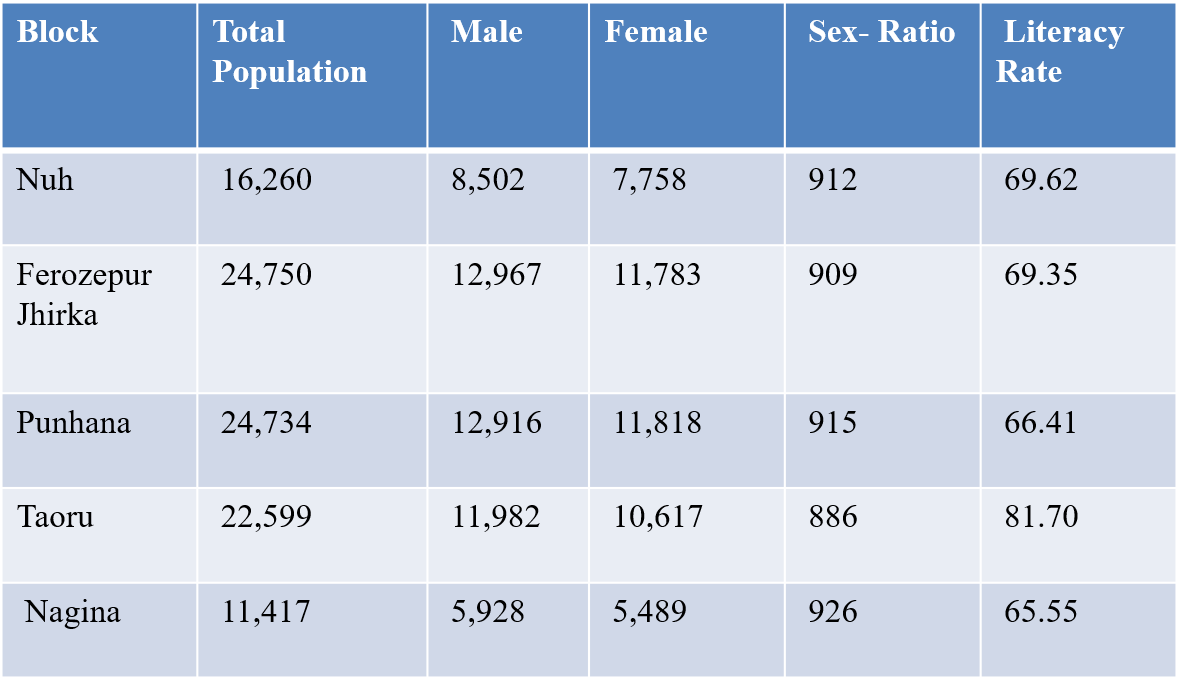
Source: District Census Handbook 2011
Table No.1 - Block –Wise Sex-Ratio and Female Literacy Rate in District Mewat
This table explain the Block -wise sex ratio and female literacy rate in the Mewat district according to 2011, highest population found in the Ferozepur Jhirka block is 24,750 and lowest population in Nagina block is 11,417, the highest literacy rate found in Taoru is 81.70 % and lowest in Nagina block is 65.55 %. In the district highest sex ratio found Nagina block is 926 and lowest sex ratio in Ferozepur Jhirka is 909. It found due to variation between the whole block in the district farthest from main city facilities.
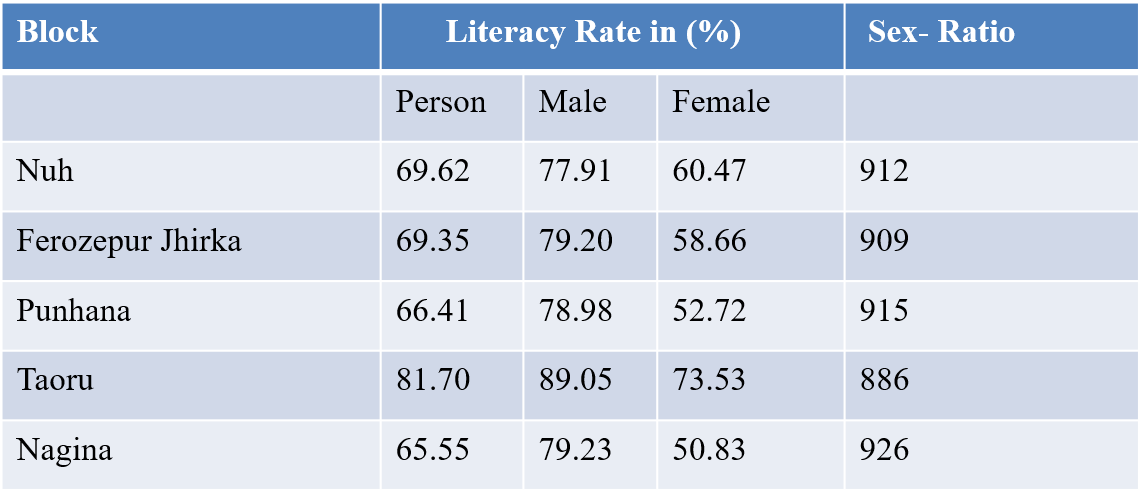
Source: District Census Handbook 2011
Table No. 2- Literacy Rate and Sex Ratio of Mewat District 2011
This table explain the district sex ratio and female literacy rate on the bases of person found in the district, highest sex ratio found in Nagina block is 926 due to high education facilities and awareness of people, and the lowest sex ratio found in Ferozepur Jhirka is 909 due to lowest awareness of education and modern thinking. The female literacy rate highest in Taoru is 73.53% and lowest in Nagina block.
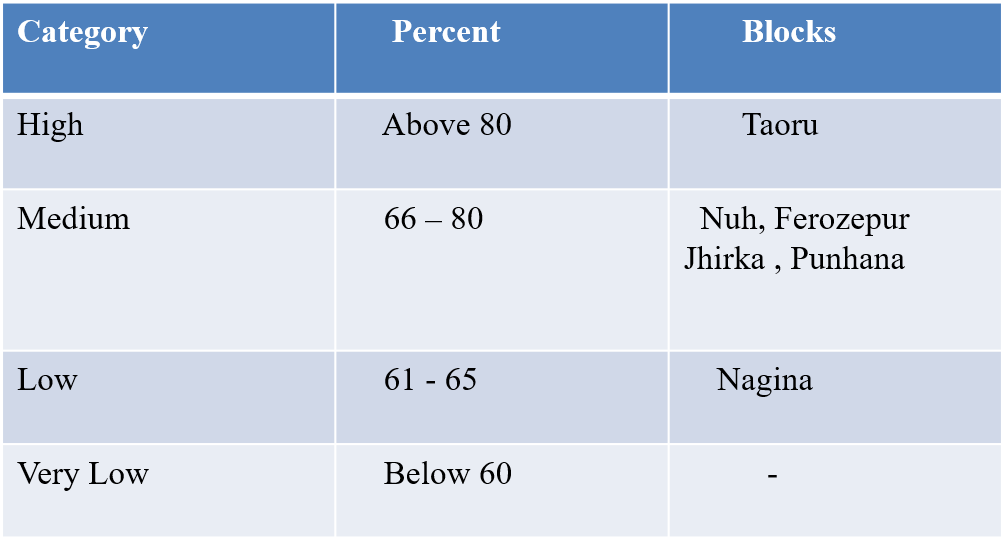
Table No.3- Blocks Wise Classification of Literacy Rate
This table explain the block wise literacy rate classification on the based of high, medium, low, and very low stage in the district, the block Taoru is above 80 % literacy rate in high level category and Nuh, Ferozepur Jhirka, Punhana literacy rate between 66-80 % in medium level, Nagina block literacy rate found between 61 – 65 in low level in the district. Its result based on the correlation between the sex ratio and female literacy rate in the district.
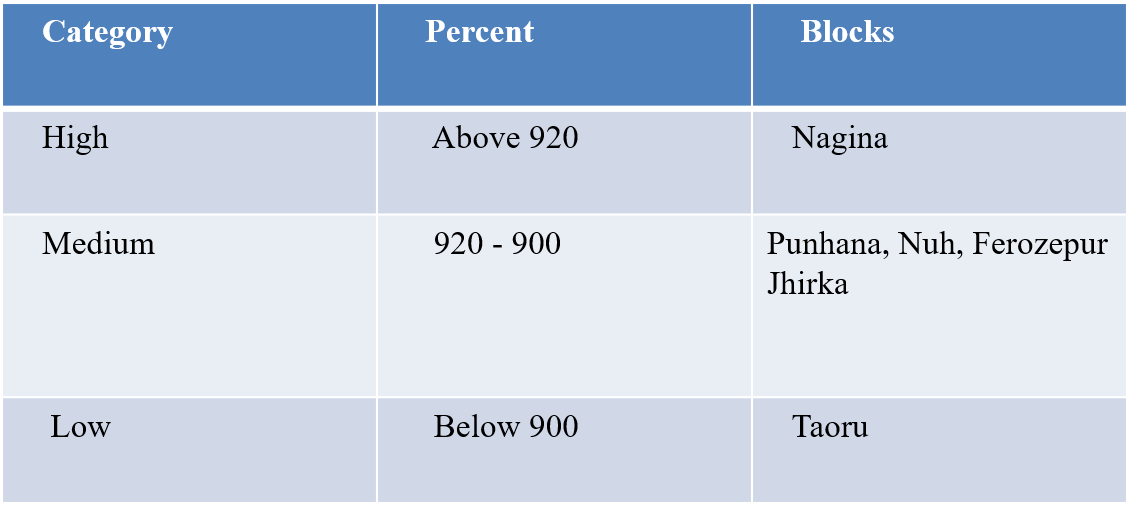
Table No.4- Block Wise Classification Sex- Ratio in District Mewat 2011
This table explain the block wise sex ratio in the district categorized on high, medium, and low category block, Nagina block is the highest sex ratio above 920 in the district, Punhana, Nuh, Ferozepur Jhirka between in 920-900 and lowest sex ratio below 900 found in Taoru block due to low literacy level and awareness, and modern social thinking in the district.
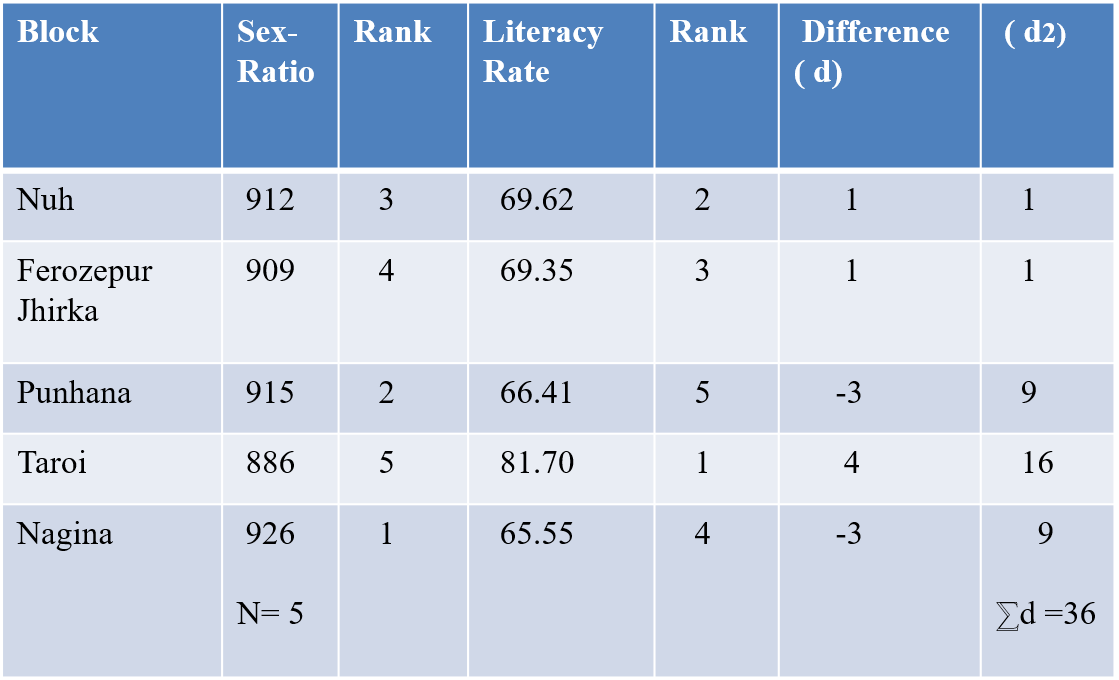
Table No.5 Correlation Between Sex- Ratio and Literacy Rate in District Mewat
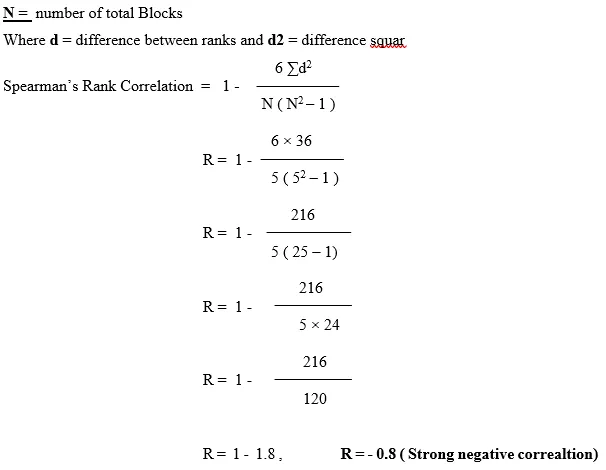
The method used for the correlation between literacy and sex ratio in Mewat district is spearman's rank rule, the correlation is r = - 0.8 between literacy and sex ratio in Mewat district. Which show the strong negative relations between two variables. This means low literacy rate and high sex ratio in the district. The low female literacy rates have a direct and indirect effect on family planning initiatives. The negative attitude of Indian society towards female literacy and the behaviors of society are patriarchal which lead to low literacy rate and high sex ratio. The lack of easy availability of schools is another reason for low female literacy rate. Even the schools available do not have a good standard of facilities and good education.
CONCLUSION
This study finds out that in this district due to a lack of awareness, education, and transport facilities many of girls leave their schools and colleges. The government should be taken many steps to improve the education level of female in the region, and people should change their mindset towards girl. The correlation of women's literacy and sex-Ratio is strong negative correlation r = - 0.8 is the negative inverse relation with literacy and sex ratio
SUGGESTION
Some of the suggestions which emerge out of the present study are as follows:
1. The Government should organize a series of activities including seminars and workshops to make the citizens aware of women development Programmes. Moreover, the government should try to make best possible use of the media for awareness generation.
2. Education is the most important instrument of social change. So, sincere consideration should be given to the promotion of women’s education. More educational institutions should be established for women, with special incentives like scholarships, hostel facilities and educational loan facilities for girl students belonging to poor families.
3. For security, protection and development of women, Women Police Stations need to be established in all the district headquarters of the state. Emphasis should be given on more income generating activities among the women SHGs. This will improve the livelihood opportunities of women so that they can receive better and stable income.
4. The involvement of NGOs, Civil Society Groups and Women Organizations along with institutions dealing with education, training and research must be involved in the formulation, implementation, monitoring and evaluation of the policies and Programmes with appropriate support related to resources and capacity building in the process of uplifting women.
REFERENCES


Sandeep Kumar1*, Mandeep Singh2, Kiran Bala1, Correlation Between Sex-Ratio And Female Literacy Rate In District Mewat (Haryana), Int. J. Sci. R. Tech., 2026, 3 (7), 1211-1216. https://doi.org/10.5281/zenodo.21721197
 10.5281/zenodo.21721197